Considering aluminum skids?

I guess I will have to disagree that RCI skids (and other Alu.) are some how not up to "rocks"

Only the OP knows what he hit and how fast they were going etc and I certainly can not argue with the photos of the bent skids but I don’t see how a skid plate that bent and yet protected your expensive drivetrain and allowed you get “get out of the woods” is anything but a product that did exactly what it was designed to do.

I don’t mean to attack the OP only to voice my opinion about a product that seems to be at odds with his/hers.

I have used mine (Alu. RCI) on a handful of rock gardens and while they do have gouges and a minor bend they have always done the job of protecting the undercarriage.

No skid (Steel or Alu.) is going to be un bendable off road if you are dropping the truck on a rock with small surface area.......but that’s why they are there. The one time you find yourself in a pickle from either unknown trail obstacles, bad line, etc. My opinion is that the RCI Alu. Skids are a great product for the price, a small weight savings over steel and a huge cosmetic benefit of not having to paint/maintain the suckers when they do actually see use.

I have not run any numbers or compared materials and thickness used to which would bend 1st under X conditions, nor am I saying the Alu. is stronger than the steel or that they are the "best skids on the planet" only that I would not classify them as anything outside of an exceptional skid at an exceptional price point. They have been plenty tough to get the job done for what my truck has seen and likely for what 95% of the needs of others are.

But to the OP, thank you for sharing your experience them (good or bad) just wanted to share mine which hasn't been the same.
 
Last edited:
All I gotta say is, if you're in the group that thinks the 1/4" aluminum skids are weaker than their steel counter parts, you really shouldn't be sharing your opinion with the world.
 
To clarify, I am in no way bashing RCI or their skids. But there are some weak points in the design. I am not new to rock crawling. I wheeled a Rubicon for 9 years on much more difficult stuff than the trail we ran this weekend.

I ran steel skids that were very well designed. I only bent the engine skid one time when I slid off a rock and dropped a good two feet on to a pointed rock The skid bent about an inch. I belly flopped on the tranny skid 100s of times with nothing but scratches. And the Jeep weighed at least as much as the 4Runner and was fully armored. But they were really really heavy skids.

To be fair, this was the first time out in rocks with the 4runner. I am not comfortable driving it yet as it is very large compared to the TJ. I did choose a bad line and it took 5 attempts to get over. I couldn't get out as the seat belt was locked into place due to the angle I was at. The damage was completely the drivers fault.

What I am trying to say is that if you are going to be doing rock crawling where you are relying heavily on the skids, these MAY not be the right choice. I never intended to use them to this level, it wasn't a difficult trail. I just met a 3' rock that wanted to challenge me and won.

I chose the aluminum for the weight savings, and they did what they were supposed to. They protected the under carriage. They did their job well. But it came at a cost that might not have had to be incurred.

You can see the weak spot I am referring to. I know there are limitations due to the design of the 4Runner and creating a skid that is more resistant to bending may reduce clearance. But I believe there are ways to enhance the design of the skids to reduce the bending and I may choose to attempt that if I decide to continue to run these types of trails.

This is one of the areas where I sustained most of the damage. I wasn't getting close enough to the rock on the side so would drop off the large flat rock each time.
RKrZJBK.jpg

0yXiST5.jpg


These are the weak spots I am referring to
3orYyRM.jpg


It's a flat skid, it's going to bend
toLd5kL.jpg
 
Yeah, I think RCIs design is what the issue is - not the material. Steel would have done the same thing.

Looks like they need to bend the edges up with a brake to create more structure and weld in some 1/4" strips on the inside of the skid to make some belting.

A fabricated steel crossmember that would run from the transmission skid mount up to the front would be an ideal addition.

These skid plates should be designed support the entire weight of the vehicle without deflection. They level of engineering wouldn't be cheap though. Probably raise the price 20-25%
 
Same thing happened to my transmission skid. And to everyone saying you need to pick better lines, blah blah blah, my lines were fine, I made it with zero damage to anything except the skid plates. When you're running legitimately hard trails (Golden Spike in Moab) in a mildly built 4Runner, you're gonna hit the skid plates hard no matter what you do.

There's just too many rocks and ledges to avoid and you need some momentum to get through some spots unless you want to take two days to do the trail and get strapped over every hard spot.

I plan on seeing if I can beat it back into submission and then welding some angle iron on the inside of it for additional strength.
 
Last edited:
All I gotta say is, if you're in the group that thinks the 1/4" aluminum skids are weaker than their steel counter parts, you really shouldn't be sharing your opinion with the world.

I bent my steel transmission skid recently, of course I fully admit my driving skill is likely not on the level of most on here.

What is left out of this discussion is fatigue life, I feel confident I can use my BFH to pound my steel plate back many times. I don't have that confidence with aluminum without compromising integrity. Again probably a moot argument for those that rarely hit their skids.
 
Yeah, I think RCIs design is what the issue is - not the material. Steel would have done the same thing.

Looks like they need to bend the edges up with a brake to create more structure and weld in some 1/4" strips on the inside of the skid to make some belting.

A fabricated steel crossmember that would run from the transmission skid mount up to the front would be an ideal addition.

These skid plates should be designed support the entire weight of the vehicle without deflection. They level of engineering wouldn't be cheap though. Probably raise the price 20-25%

The retarded crossover pipe design makes a cookie cutter solution difficult. There are many simple solutions to support the skids better, but you really have to do custom work. I have not seen a pre-fabricated setup that addresses this. Once that pipe is out of the way, many options open up.
 
Last edited:
Also, looks like more than your skids took a hit. I can see the rear bumper is tweaked in one of the pics....

Damage is part of wheeling these pigs. They are not jeeps. It takes a lot of tweaking and compromises to make they ready for difficult trails and even then shit will continue to happen. People who think they can wheel in rocks with 0 damage are in for a surprise. You just try to keep it to a minimum.

Bent skids are more or less a good problem to have.
 
Last edited:
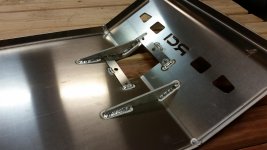
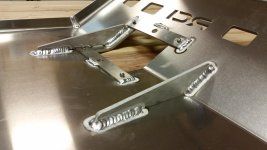
Yes, both aluminum and steel have the potential to deform. I'm not sure how long you have had your RCI plates, but all the newest versions are coming with a pair of 1/4" gussets to help resist warping.
 

Attachments

  • 20151117_103351.jpg
    20151117_103351.jpg
    129.2 KB · Views: 386
  • 20151117_103403.jpg
    20151117_103403.jpg
    130.2 KB · Views: 396
Also, the newest generation of RCI transfer case plates have a 1" joggle rise, which not only increases ground clearance, but stiffens up the plate dramatically. It requires a new crossmember, too, to acomidate the rise in the t-case plate.
 
Thanks for sharing the pics....i was thinking of aluminum RCI plates, but I might reconsider and go steel instead. Makes me wonder how my TRD pro front skid plate would fare....hmmm.
Why the worry about aluminum? Skid plates regardless of if they're aluminum or unobtainium aren't made to drop the dead weight of any vehicle onto. I have both steel and aluminum on my jeep and sure I had my dumbass moments where I landed wrong and bounced off my sliders or skids. Both aluminum and steel parts bend and dented up nearly the same.
 
If you haven't already, I personally think you should be sharing your experience with RCI to help them improve their system.

AFAIK, none of this stuff has been engineered. Fabricators see a market and design what they think will do the trick from their personal experience and material knowledge. They update their designs when need be.

~6000lb 4runner (bone stock 5500lbs) not many jeeps (wrangler type) weigh in at those numbers, if they do they are equipped with a hell of a lot more bomber armor than is available off the shelf for a 4runner. Just sayin' :)

Regardless of opinions (yours and others) it was nice of you to share your experience. We all f'k up it is just the way it is when you are traveling the road less traveled.
 
Last edited:
Weather it's 4700, or 6000, that's still a lot of weight. Gracefully sliding over rocks vs falling off a ledge and landing on rocks are going to put two different types of stress on any skid plate. In the end, drive train protection, and getting home are the main reason for skids. If they do move around a bit, I'd say you were having a good day in the rocks. Now, that being said, we will take this feedback into consideration when doing redesigns, or coming up with new products. Good feed back, guys.
 
I thought the 4Runner was 4700 lbs?

Where did you get your 6000 lbs number from?

I haven't hit up a scale yet, so now I'm curious!

Sure, understand that the weight you see on the sticker is Curb weight, it is 4,400 to 4,805 for a 5th gen, that means stock tires, port accessories, and full of fluids. Never ever will your truck weigh that unless you take all of your stuff out of it and it has no occupants. (When I said bone stock 5500lbs, I consider a driver, passenger, and some gear, and crap.)

Now add:
- a driver
- numX passengers
- modifications: including but not limited too, upgraded tires/wheels, skids, sliders, winch (cable or synth), front and/or rear bumpers, deep cycle or dual battery setups, compressor, lights, racks, ect.
- crap you should be carrying; recovery gear, water, first aid, tools, blankets, ect.
- crap you carry that isn't necessarily necessary like; cooler/fridges, beer, chairs, chainsaw, fire wood, crap, ect.

For example my recovery kit (straps, block and shackles) weighs 50lbs alone. You and a passenger 300-400 lbs. mods can easily go from 400 all the way to ~1200 lbs or more. Just the crap you carry around add another ~100 lbs. All this stuff adds up.
 
Last edited:
Why the worry about aluminum? Skid plates regardless of if they're aluminum or unobtainium aren't made to drop the dead weight of any vehicle onto. I have both steel and aluminum on my jeep and sure I had my dumbass moments where I landed wrong and bounced off my sliders or skids. Both aluminum and steel parts bend and dented up nearly the same.

I agree, its the metal gouging that I don't really like. I've never really seriously scrapped off road, so maybe it is an imaginary/academic issue, but I'd rather have scratched/dented steel than gouged/dented aluminum.

I know alu. is super stiff and strong, I've been mountain biking for years and all my bike frames have been alu. Despite plenty of bike crashes, no dents in the frames, and alu bike frames are plenty stiff (perhaps even harshly so).

Some of the steel plates have access panels for oil changes which I like. The alu. ones tend to be one solid piece, requiring total removal for an oil change.

Completely agree with your points, I just didn't really consider the gouging until I saw these pics. It's really just a personal preference thing; in the end one isn't better than the other, just slightly different.
 
Some of the steel plates have access panels for oil changes which I like. The alu. ones tend to be one solid piece, requiring total removal for an oil change.

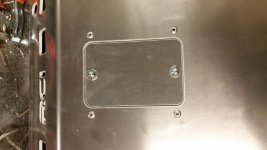
Not to derail the thread, but the RCI plates come with oil change access ports wherever applicable, steel or aluminum.
 

Attachments

  • 20151118_164732.jpg
    20151118_164732.jpg
    130.7 KB · Views: 322

Members online

No members online now.

Forum statistics

Threads
278,312
Messages
3,554,089
Members
248,016
Latest member
Advally Service

Trending content

Back
Top