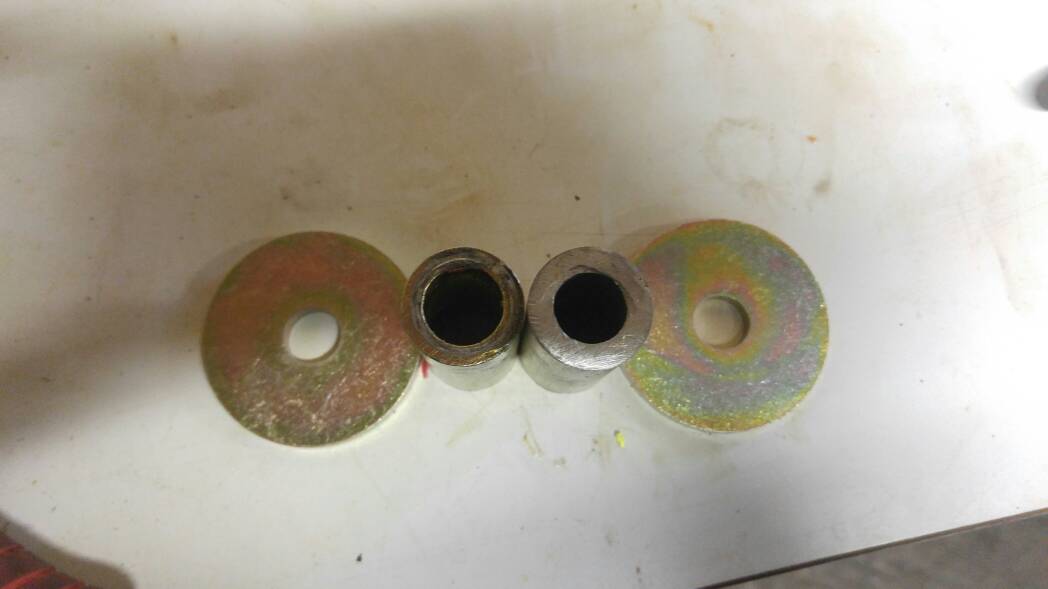
I wanted to follow up with my issue. The failure is the misalignment spacers. Not the uniball its self. The misalignment spacers are cast metal of some type. I cannot identify the material for certain. I initially thought maybe case aluminum, but it's a bit on the heavy side for that - yet feels too light for cast steel. I may run it up to a material science lab to have someone with better experience tell me exactly what it is.
If it's cast aluminum it would typically have a tensile strength of about 10ksi as compared to around 200ksi for 17-4 stainless. So we're talking only 5% of the tensile strength. You can see clearly from the failure in the pic I'll link that it fractured in tension from the tension of the through-bolt. I torqued it to 100ft/lbs.
The area (if it didn't have the obvious casting problems you can see in the pics) that is placed in tension is roughly 0.198 square inches being generous. That means it should be expected to fail at a tension of somewhere between 40,000lbs for 17-4 stainless and as low as 9,900 for cast stainless, or 1,980lbs for cast aluminum.
The clamping force of a 9/16 -12 bolt at 100ft/lbs is 10,700lbs. A lubricated grade 8 bolt with find threads could easily double or tipple that figure.
*** the basic hardware calculations indicate that the misalignment spacers that shipped with my arms should be expected to fail under normal installation instructions***
This is extremely dangerous. I suspect that it may have been a supplier who switched the hardware as we often see from China. If you don't have a person on the ground watching manufacturing you can expect product quality erosion. I am working on tracking down the seller Jennifer Fan of Baldwin Park, CA. That's who the Ebay seller account is registered to. As far as I can tell she has no business license in California that I can find. Someone is going to get killed if she continues to sell these spacers.
One more note - the tapered side of the spacer set is not sufficient to adequately seat in the spindle. The taper is too short and the result is that the spacer ends bottoming out on the flat shoulder before it tightens in the tapered hole. Over time it will almost certainly fail due to lateral motion.