Engine Trouble caused by driving without oil

What's "out of spec" mean? Does it just need ground and polished, or are you going to need a new crank? If the crank is shot it's a good bet so is everything else. It'll be quicker to replace it, probably cheaper to rebuild it yourself. I did a quick search, here's a new longblock for $2500: Toyota Engine 5VZE 5VZ 3.4L v6 Long Block 1995-2004. Here's a used JDM motor for $1700: JDM Engine - JDM Motors - JDM Parts - JDM Transmission - Honda Cars, Nissan, Subaru, Mazda, Toyota. A quick search on car-part.com shows junkyard motors in California starting at $800 and going up. If you hunt around I'm sure you could find cheaper examples of each. By comparison, master rebuild kits look like they're around $500 plus or minus, and you can plan on spending at least several hundred more at the machine shop getting everything ground and honed and decked and etc.

Do you have a copy of the FSM? You need one, and if you have one you need to read it.

Good advice but I'm afraid you're just wasting your time. The OP is a troll and is having a great time reeling in people who bite. Why he/she isn't banned is a mystery.
 
What's "out of spec" mean? Does it just need ground and polished, or are you going to need a new crank? If the crank is shot it's a good bet so is everything else. It'll be quicker to replace it, probably cheaper to rebuild it yourself. I did a quick search, here's a new longblock for $2500: Toyota Engine 5VZE 5VZ 3.4L v6 Long Block 1995-2004. Here's a used JDM motor for $1700: JDM Engine - JDM Motors - JDM Parts - JDM Transmission - Honda Cars, Nissan, Subaru, Mazda, Toyota. A quick search on car-part.com shows junkyard motors in California starting at $800 and going up. If you hunt around I'm sure you could find cheaper examples of each. By comparison, master rebuild kits look like they're around $500 plus or minus, and you can plan on spending at least several hundred more at the machine shop getting everything ground and honed and decked and etc.

Do you have a copy of the FSM? You need one, and if you have one you need to read it.

Thanks for the advice! I have a Chilton's guide I have been reading. Will that work or should I look into getting a different one? There seems to be some details about engine rebuilding in their manual but definitely not as detailed and "step-by-step" as their basic repairs areas are. They have some good pictures and descriptions of what tools to use and how to use them.

Are there any reasons as to the different prices of the engines? Any suggestions on what to look for when buying a used junkyard engine? I think this is the approach I am going to take as I know unexpected problems can arise when a noob like myself tries to rebuild a broken engine. That being said, I am going to actively search for a good engine to buy to replace the broken one I have now.
 
Thanks for the advice! I have a Chilton's guide I have been reading. Will that work or should I look into getting a different one? There seems to be some details about engine rebuilding in their manual but definitely not as detailed and "step-by-step" as their basic repairs areas are. They have some good pictures and descriptions of what tools to use and how to use them.

Are there any reasons as to the different prices of the engines? Any suggestions on what to look for when buying a used junkyard engine? I think this is the approach I am going to take as I know unexpected problems can arise when a noob like myself tries to rebuild a broken engine. That being said, I am going to actively search for a good engine to buy to replace the broken one I have now.

Chilton's is ok, but you really want a copy of the actual Factory Service Manual. The information in there is not as accessible, but far more comprehensive. See here: http://www.toyota-4runner.org/3rd-gen-t4rs/194651-its-time-year-again-fsm.html. Between the two and some internet searching and asking questions here, you should be able to get a good handle on everything you're going to need to do.

If you go for a used engine, being able to hear it run first is a huge bonus, so if you're buying from a guy parting out his truck or buying from a junkyard, if they haven't actually pulled the motor yet you wanna get down there and start it up and listen to it. If that's not possible, you at LEAST want to get it on a stand and hook up a starter and take compression readings on the cylinders. No funny noises and good compression numbers = probably a good motor. Some junkyards will give you a short warranty period that they'll let you return it if it turns out to be a bad motor, be sure to ask about that. Once you find one you like, make it easy on yourself and plan on replacing all the belts, water pump, oil pump, spark plugs/coils/etc, thermostat, valve cover gasket, service the fuel injectors, do pretty much all those little things before you put it in the truck.

If you can't find a good motor, get the best one you can and throw it in there, that gets your truck rolling again and buys you some time to rebuild your original motor or save up for a long block or whatever option you fancy.
 
Chilton's is ok, but you really want a copy of the actual Factory Service Manual. The information in there is not as accessible, but far more comprehensive. See here: http://www.toyota-4runner.org/3rd-gen-t4rs/194651-its-time-year-again-fsm.html. Between the two and some internet searching and asking questions here, you should be able to get a good handle on everything you're going to need to do.

If you go for a used engine, being able to hear it run first is a huge bonus, so if you're buying from a guy parting out his truck or buying from a junkyard, if they haven't actually pulled the motor yet you wanna get down there and start it up and listen to it. If that's not possible, you at LEAST want to get it on a stand and hook up a starter and take compression readings on the cylinders. No funny noises and good compression numbers = probably a good motor. Some junkyards will give you a short warranty period that they'll let you return it if it turns out to be a bad motor, be sure to ask about that. Once you find one you like, make it easy on yourself and plan on replacing all the belts, water pump, oil pump, spark plugs/coils/etc, thermostat, valve cover gasket, service the fuel injectors, do pretty much all those little things before you put it in the truck.

If you can't find a good motor, get the best one you can and throw it in there, that gets your truck rolling again and buys you some time to rebuild your original motor or save up for a long block or whatever option you fancy.

Excellent advice! Thank you very much for your help.
 
I am trying to make some progress towards successfully pulling the engine each day. I think progress is starting to slow a little.

So far I have successfully disconnected/ removed/ set aside the following items:

Radiator
power steering pump
ac compressor
detent cable
accelerator cable
throttle cable
alternator belt
A/C drive belt
power steering belt
engine undercovers
battery
some random tubes/hoses

Whats next seems more complicated but maybe I am wrong.

Things still needing to be removed (that I know of):

speedometer cable
stabilizer bar
remove driveshaft from transmission
front exhaust pipe
cross shaft
transmission rear mounting bracket
some A/C bot and wire?

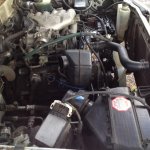
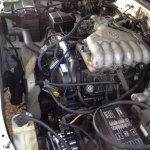
Pictures attached were taken today and are marking my slow progress towards a new engine (hopefully)
 

Attachments

  • image2.jpg
    image2.jpg
    63.5 KB · Views: 304
  • image1.jpg
    image1.jpg
    69.3 KB · Views: 305
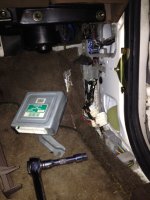
I have some specific questions on how to remove the engine harness. In the chilton guide it explains that you have to remove the cowl panel side trim, disconnect the ECU wiring, detach two connectors from the cowl wire.

Have I done that so far as shown in the attached picture?

It then says to disconnect the igniter (where is this and what does it look like?)
then detach the ground strap (Is this in the engine bay or still in the passenger side interior?)
then it says disconnect the six engine wire clamps. (again where?)
and finally pull the harness from the compartment.

Anyway, sorry for any questions that may seem obvious to the experienced but help is definitely appreciated.

Thanks all.
 

Attachments

  • image4.jpeg
    image4.jpeg
    123.2 KB · Views: 301
Aight, I gotta go there... WTF are you doing? It's the engine. Don't pull the tranny and transfer case with it. And there is NO need to pull the wire harness with it.
 
yeah, disconnect all the wiring that's attached and connected directly to the engine, don't disconnect anything from inside the vehicle.
 
If you wouldn't mind letting us know when your truck heads to the local PicknPull there may be something salvageable.
 
Aight, I gotta go there... WTF are you doing? It's the engine. Don't pull the tranny and transfer case with it. And there is NO need to pull the wire harness with it.

Okay, I wont. Thanks for the advice. Is separating the tranny from the engine pretty straight forward? I have been under my truck for a while looking at it trying to figure how I could do that but am mostly just puzzled.

I did a SAAB headgasket change a while back and it took 3 tries to get it right. I wonder how many this will take.

Thanks again for helping out.
 
Yup, no need to pull the trans. I haven't pulled a 5VZE, but you should be able to disconnect the engine wiring harness at the ECU and pull it through the firewall. Then disconnect the fuel lines, clutch line if it's a manual, remove the radiator completely so it's out of the way, unbolt at the motor mounts, six or eight bolts hold the bell housing to the engine, and she's ready to come out. Support the transmission with something, a floor jack or loop a ratchet strap around the frame or whatever. Might take a little rocking back and forth to slide the motor off the transmission input (which is why you pull the radiator :D), then lift a couple pumps at a time watching carefully to see you don't snag anything on your way up and didn't forget to disconnect anything.
 
Yup, no need to pull the trans. I haven't pulled a 5VZE, but you should be able to disconnect the engine wiring harness at the ECU and pull it through the firewall. Then disconnect the fuel lines, clutch line if it's a manual, remove the radiator completely so it's out of the way, unbolt at the motor mounts, six or eight bolts hold the bell housing to the engine, and she's ready to come out. Support the transmission with something, a floor jack or loop a ratchet strap around the frame or whatever. Might take a little rocking back and forth to slide the motor off the transmission input (which is why you pull the radiator :D), then lift a couple pumps at a time watching carefully to see you don't snag anything on your way up and didn't forget to disconnect anything.

So you suggest keeping the Engine wiring harness with the engine as opposed to with the chassis?

I've never done a re/re of an engine, so I'll admit I'm a little ignorant as to the general practice when it comes to the engine harness.

When you buy a replacement engine, does it typically come with its wiring harness?
 
It's not the only way, but it's how I do it. Sometimes those little clips can be a pain, they're easier to get to with the motor out.

You won't normally get a harness with a domestic long block. I don't know about JDM motors.
 

Members online

Forum statistics

Threads
278,312
Messages
3,554,089
Members
248,016
Latest member
Advally Service

Trending content

Back
Top