
You are using an out of date browser. It may not display this or other websites correctly.
You should upgrade or use an alternative browser.
You should upgrade or use an alternative browser.
Fire Extinguisher Information
- Thread starter T4Rfirefighter
- Start date


ToyotaBrah
Member
^ I like that. Originally, my 4runner was going to serve more as a recreational/multipurpose vehicle since I had a separate DD. But after this happened to my DD while driving on the highway on my way to work a few months ago...
Did you ever determine what was the cause of the fire?

acr_ted
New member
Thanks for the info! I had summer jobs at Ansul back in the late '60's unloading railroad box cars and also making parts for the 150 lb wheeled units. I also got to test some of the smaller units as they came off the line. Lots of fun 
I still have several Ansul units around here, but they have long since expired, although the gauges (on the units that have them) are still in the green.
I bet it would be cheaper just to buy a new one like that one from Amazon (even though it is not Ansul) than to have my older units re-qualified. I would rather have Ansul units of course, but Amazon doesn't carry them.
I still look at extinguishers in stores and restaurants and I see a lot of Ansul Sentry and R-101 units in use.
Ted
I still have several Ansul units around here, but they have long since expired, although the gauges (on the units that have them) are still in the green.
I bet it would be cheaper just to buy a new one like that one from Amazon (even though it is not Ansul) than to have my older units re-qualified. I would rather have Ansul units of course, but Amazon doesn't carry them.
I still look at extinguishers in stores and restaurants and I see a lot of Ansul Sentry and R-101 units in use.
Ted

fourfive
Senior Member
Did you ever determine what was the cause of the fire?
The fire investigator from my insurance thought it may have been due to a slow leak from my power steering fluid dripping onto my catalytic converter causing the fire bc apparently this was a recall issue on my model year accord. But my particular accord didnt have the recall when my insurance checked. So the cause was never confirmed bc everything was too badly burned.

BrianSD_42
New member
Just wanted to bump this thread as a PSA for keeping a fire extinguisher in your vehicle (4Runner or any othere). Wasn't able to stop this fire from consuming the vehicle, but I was able to keep it from becoming much more massive before the fire department arrived. Be safe out there kids!


If no one is in the vehicle is it even worth the risk for a citizen to try and put out a strangers car fire like that? (vs what gain)
It seems that the risk is:
1) the car will blow up (rare i know)
2) those fumes are f#@king cancerous.
Last edited:

Miguelon
New member
Correct on the 6 year maintenance, but every 12 years they are to be hydrostatically tested, unless otherwise stated by the manufacturer.
https://www.usfa.fema.gov/downloads/pdf/coffee-break/cb_fp_2010_9.pdf
I just bought 2 Max Out dry chemical fire extinguishers. One mini that I mounted under the hood and a larger one on the back. First of all, what do you think about the Max Outs ability to do the job?
Here is a link H3R Performance | MX250C . Chrome Dry Chemical Fire Extinguisher
And secondly, should I have any heat concerns about mounting the mini under the hood?

E92FF
New member
If no one is in the vehicle is it even worth the risk for a citizen to try and put out a strangers car fire like that? (vs what gain)
It seems that the risk is:
1) the car will blow up (rare i know)
2) those fumes are f#@king cancerous.
This is absolutely right! It's hard to tell what this car is but on most cars on the road today there are all kids of things that can blow up. Struts, air bags, side curtain airbags, seat belt pre tensioners, tires. When the struts blow they become projectiles that can travel a lot farther than you would think. The bumper can actually blow off the car and take you out at the knees if your too close.
There is a popular saying in the fire service. Risk a lot to save a lot, risk little to save little, risk nothing to save nothing. If you do find yourself in a situation where you decide to attack a car fire be conscious of the dangers, traffic included. And NEVER stand directly in front of or behind a burning car!
Also stay out of that smoke! Lots of firefighters fighting nasty cancers from breathing that $#!t.


psraff
New member
Took a trip to Anchorage today.... Passed an intersection and sure enough there as a fire truck and cop cars.....
RV totally gutted by fire sitting on the side of the road..... Not pretty. I was looking for some fire extinguishers but nothing but garbage in the Lowe's and Home Depots. Places I needed to go to were closed already.
RV totally gutted by fire sitting on the side of the road..... Not pretty. I was looking for some fire extinguishers but nothing but garbage in the Lowe's and Home Depots. Places I needed to go to were closed already.
T4Rfirefighter
New member
Just read all of this post. thanks to OP for all of the great info. I've never even thought about this subject, shame on me.
Thinking of getting some brackets like this Amerex: Heavy Duty Rubber Strap Brackets - OfficerStore
And mounting one or two Amerex B417 in passenger footwell, or preferably under the front of each seat
Thoughts OP?
Thanks again!
Good ideas all around, in my opinion. We run those very brackets on most of my department's fire trucks, so they will certainly work well for us on 4Runners.
T4Rfirefighter
New member
Thanks for the info! I had summer jobs at Ansul back in the late '60's unloading railroad box cars and also making parts for the 150 lb wheeled units. I also got to test some of the smaller units as they came off the line. Lots of fun
I still have several Ansul units around here, but they have long since expired, although the gauges (on the units that have them) are still in the green.
I bet it would be cheaper just to buy a new one like that one from Amazon (even though it is not Ansul) than to have my older units re-qualified. I would rather have Ansul units of course, but Amazon doesn't carry them.
I still look at extinguishers in stores and restaurants and I see a lot of Ansul Sentry and R-101 units in use.
Ted
If they are made before 1984, they cannot be serviced for use in commercial applications. However, they are still allowed to be kept for personal use.
If the gauge is still showing it to be in the green, I'd keep it around as a spare, or in your home. Once it is discharged or leaks you will have a hard time finding a place to recharge it because of the NFPA 10 rules about older extinguishers.
Ansul is top notch for sure.
T4Rfirefighter
New member
If no one is in the vehicle is it even worth the risk for a citizen to try and put out a strangers car fire like that? (vs what gain)
It seems that the risk is:
1) the car will blow up (rare i know)
2) those fumes are f#@king cancerous.
No.
The smoke is the bigger risk of the two. More likely that the bumpers will blow off than the gas tank exploding.
https://www.youtube.com/watch?v=Klr0xUif8UA
T4Rfirefighter
New member
I just bought 2 Max Out dry chemical fire extinguishers. One mini that I mounted under the hood and a larger one on the back. First of all, what do you think about the Max Outs ability to do the job?
Here is a link H3R Performance | MX250C . Chrome Dry Chemical Fire Extinguisher
And secondly, should I have any heat concerns about mounting the mini under the hood?
Those are rebranded Amerex extinguishers. Amerex is top notch.
They are rated for a wide range on temperatures, but I wouldn't mount it under the hood for several reasons:
1. That's the most likely place for a fire to start, so you'll be reaching into fire to grab an extinguisher, potentially.
2. Normal engine heat will likely make the extinguisher too hot to handle without leather gloves like we use for firefighting.
3. If the fire is under the hood, the release cable is often disabled, so you wouldn't be able to get to it anyway.
4. The mini, as you call it, is just a 1 lb. extinguisher, which is too small to do much of anything. a 2.5 lb. is the smallest I would consider, and even then I wouldn't recommend it. 5 lb. extinguishers are a good size for vehicles.
BrianSD_42
New member
Lots of good information in this thread.
I'm going to add this thread in the MISC section of the Tutorial & Docs Sticky v2.
On another note I really appreciate jobs of first responders and what you guys do for the rest of us.
I'd like to suggest anyone who hasn't seen it watch this HBO Documentary, either on HBO Go / Demmand or the lower res link below.
HBO Documentaries - A Good Job: Stories of the FDNY
https://youtu.be/YGqbKSr-46w
:bat:
I'm going to add this thread in the MISC section of the Tutorial & Docs Sticky v2.
On another note I really appreciate jobs of first responders and what you guys do for the rest of us.
I'd like to suggest anyone who hasn't seen it watch this HBO Documentary, either on HBO Go / Demmand or the lower res link below.
HBO Documentaries - A Good Job: Stories of the FDNY
https://youtu.be/YGqbKSr-46w
:bat:
Miguelon
New member
Every type of extinguisher has pros and cons. CO2 is cheap to refill and obviously produces less of a mess than dry chemical, but you get a larger and heavier extinguisher that is more expensive to purchase initially.
If you can afford it, a clean agent extinguisher like Halon or FE-36 is great. Small size, lightweight, very effective on BC fires and the big plus is no residue like you get with dry chems or the potential to damage electrical components with cold temperatures like you get with CO2.
Halon 1211 is still legal, it just hasn't been produced since 1994. That said, if you use one and have to get it refilled, it is around $30 a pound. Another misconception is that Halon is dangerous to inhale. This is true in confined areas with large systems like server rooms, but on an electrical fire on a vehicle, you'd be much more likely to injured by breathing super heated gas or toxic fumes from the fire than you would from the Halon.
All that to say, I'd recommend a 5lb. ABC in every vehicle that has the room for it. If for nothing other than being able to help other motorists who have a fire, you'll have a cheap and effective extinguisher at hand to help with. If you're concerned about damaging your own rig with ABC powder and can afford a Amerex Halon 1211, Ansul Cleanguard, etc. then by all means get one.
CO2 just takes up too much room and weighs a lot for a good sized extinguisher. Plus it will let you know in a hurry if it gets too hot.
So, my PowerTank is filled with CO2. I did not know it could put out fires.
Attachments
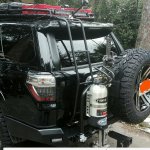
[MENTION=96877]T4Rfirefighter[/MENTION] I Knew Metal Had to better than Plastic for the controls, just about common sense in most cases, but I didn't know brand had so much to do with it. My current Fire extinguisher I've been carrying with me for a year is a "Strike First" ABC Dry Powder 5lb'er. It has metal controls and the weld on the bottom is smooth like dimes laid over, like a weld should be as far as I know. Any good or should I start looking for a Amerex like my work has?
Here it is and where I keep it. 5lb Extinguisher. I keep it behind the drivers door because it fits there well and isn't in the way and is VERY quick to get too. Only down side is you must open the back door to get at it.

Tucks up nice and tight to the door but doesn't touch, even did some pretty moderate wheeling and it never moved.

Here it is and where I keep it. 5lb Extinguisher. I keep it behind the drivers door because it fits there well and isn't in the way and is VERY quick to get too. Only down side is you must open the back door to get at it.
Tucks up nice and tight to the door but doesn't touch, even did some pretty moderate wheeling and it never moved.
T4Rfirefighter
New member
So, my PowerTank is filled with CO2. I did not know it could put out fires.
Not sure it will be able to put much out since it has to go through the regulator and has no horn. I wouldn't recommend trying to create your own CO2 extinguisher out of a PowerTank, either. Since it is a high pressure cylinder, things can get dangerous in a hurry if you discharge it in a way that it isn't meant to.
T4Rfirefighter
New member
[MENTION=96877]T4Rfirefighter[/MENTION] I Knew Metal Had to better than Plastic for the controls, just about common sense in most cases, but I didn't know brand had so much to do with it. My current Fire extinguisher I've been carrying with me for a year is a "Strike First" ABC Dry Powder 5lb'er. It has metal controls and the weld on the bottom is smooth like dimes laid over, like a weld should be as far as I know. Any good or should I start looking for a Amerex like my work has?
Here it is and where I keep it. 5lb Extinguisher. I keep it behind the drivers door because it fits there well and isn't in the way and is VERY quick to get too. Only down side is you must open the back door to get at it.
Tucks up nice and tight to the door but doesn't touch, even did some pretty moderate wheeling and it never moved.
Your Strike First is not one I would recommend. While you do have better handles than most Kiddes and better welds than Buckeyes, Strike First is kind of an oddball. They are Canadian, IIRC, and not nearly as common.
They may end up being fine, but their parts are not as common and may be to be ordered in when serviced.
If you can afford Amerex, you will be better served in the long run. If not, you're still in better shape than a Kidde or Buckeye.

weekendclimber
New member
If no one is in the vehicle is it even worth the risk for a citizen to try and put out a strangers car fire like that? (vs what gain)
It seems that the risk is:
1) the car will blow up (rare i know)
2) those fumes are f#@king cancerous.
No.
The smoke is the bigger risk of the two. More likely that the bumpers will blow off than the gas tank exploding.
https://www.youtube.com/watch?v=Klr0xUif8UA
This is absolutely right! It's hard to tell what this car is but on most cars on the road today there are all kids of things that can blow up. Struts, air bags, side curtain airbags, seat belt pre tensioners, tires. When the struts blow they become projectiles that can travel a lot farther than you would think. The bumper can actually blow off the car and take you out at the knees if your too close.
There is a popular saying in the fire service. Risk a lot to save a lot, risk little to save little, risk nothing to save nothing. If you do find yourself in a situation where you decide to attack a car fire be conscious of the dangers, traffic included. And NEVER stand directly in front of or behind a burning car!
Also stay out of that smoke! Lots of firefighters fighting nasty cancers from breathing that $#!t.
These are great tips. The picture I posted was just as the fire department was arriving and when I arrived the fire was not as involved. The paint on the hood was just beginning to bubble. Once I had emptied my extinguisher and determined that I was not going to be able to put it out I moved both my own rig and the owner of that car away from it and took the picture then.

T4Rfirefighter
New member
These are great tips. The picture I posted was just as the fire department was arriving and when I arrived the fire was not as involved. The paint on the hood was just beginning to bubble. Once I had emptied my extinguisher and determined that I was not going to be able to put it out I moved both my own rig and the owner of that car away from it and took the picture then.
People see fire and think that they always have to try to put it out, but honestly, very few vehicle fires are stopped quickly enough to prevent the vehicle from being totaled.
So get everybody out, and get away from it. The smoke is toxic, the explosive potential is there to harm/kill, and you're not going to make the vehicle any less damaged by fire if you couldn't get it out quickly.
Houses are a different story, but the risk a little to save a little/risk a lot to save a lot principle still applies.
Similar threads

- Replies
- 2
- Views
- 2K

- Replies
- 1
- Views
- 335

- Replies
- 2
- Views
- 1K


