...got bass?

Wow that escalated quickly. Great info. On a different note I blew yet another 12W3 [emoji35] so not happy. 12W6 time.


Sent from my iPhone using Tapatalk

Do you know what's causing these drivers to fail e.g. mechanical damage (over excursion), thermal damage (burned Voicecoil)...
 
Do you know what's causing these drivers to fail e.g. mechanical damage (over excursion), thermal damage (burned Voicecoil)...


I have no idea. No smoke and it seems to me a miss aligned coil. Having to send it to Florida from Canada every time is painstaking.


Sent from my iPhone using Tapatalk
 
I have no idea. No smoke and it seems to me a miss aligned coil. Having to send it to Florida from Canada every time is painstaking.


Sent from my iPhone using Tapatalk

Hi BowJanked,

I believe you said that you were using the 12" W3v3; now listed under "Discontinued"!

t313_5a0b8c5fc1faa49fe3c499a85219df8f.jpg


JL Audio 12W3v3-2 - W3v3

What kind of box (alignment) are you using e.g. bass reflex (BR) sealed (IB) band-pass? Something in that system is not right; I'm blaming the system, not necessarily you lol! Also are you using enough power to drive it? IIRC you've posted with this problem before about blowing drivers, yes? So before you spend your hard earned $$... you have to find out what's going on or we'll be right back here trying to figure out what happened to your new W6! That W3 has 13mm of x-max that's not inadequate by any standard. But it has a Qts of 0.5 which makes it a very good candidate for a sealed enclosure.

Here's the rule of thumb: A Qts of 0.4 or below indicates that the woofer is well suited for a vented enclosure. A Qts between 0.4 and 0.7 indicates that the driver is well suited for a sealed box environment. And a Qts of 0.7 and above is best suited to used in a "Free air" or a Infinite Baffle (IB) manifold environment. So I believe that, that driver would work best in a sealed box with a (JL recommended) 1.250 Cuft internal volume! All these numbers are a best case scenario rule, but as you know rule are for one thing... to be violated; even JL is recommending a 1.75 vented box environment to be used.

But if the box that you're using isn't properly sized, it may be contributing to your dilemma, so let us know what your using so we can help figure this out, okay...

Cheers!
 
Next question will be what amp and is it being run mono @ 2Ω. 150 watts is the bare minimum and if you jam your stereo a lot, I'm gonna guess that Rigtec says you need more powahhhh!
 
Blown one W3 so far with the amp at 1/2 gain. Think I might hit up a W6

Sent from my iPhone using Tapatalk

Hi BowJanked,

Did you say that this is your second or third W3v3-2 that has blown over the last few months? I just looked at your set-up a little more closely this time. This is not at all your fault. I also looked at it's T/S/parameters when I quoted you earlier and based on the Qts, that driver really should not be in that ported box. It's suspension system e.g. surround, spider, and cone are designed to yield a higher sensitivity (87.15; that's even higher than the W6 w/85.9 dB@ 1w/1m), but in order to accomplish this it needed to be built with a lighter moving system and a low resistance suspension system.

As a result the speaker would depend on the air pressure behind it to keep it's moving system from over excursion, slamming into it's magnetic back plate and from moving too far fwd and jumping out of the V.C. gap when reproducing high level dynamic programs. Why JL decided to take the risk and package that driver in a vented enclosure is beyond me, except for the fact that it would exhibit exceptional dB levels (output volume)... on second thought, JL has discontinued the entire W3 line so they may be just trying to get rid of them any way that they can. Never having seen it I 'suspect' that, that's what is happening!

Cheers
 
Last edited:
The amp I use at 1/4 gain
XD600/1v2 - Car Audio - Amplifiers - XD - JL Audio

Sent from my iPhone using Tapatalk

I realize that. That's why I feel that it's not your fault. A driver designed for a sealed box can be damaged (Mechanically) very easily in a low back pressure environment because unlike the subs designed to perform best in a vented box, these driver's suspension systems haven't got the rigidity to withstand high decibel dynamic peaks! PS: "Because I haven't ever seen your damaged drivers, this is only a theory!"

Cheers
 
I realize that. That's why I feel that it's not your fault. A driver designed for a sealed box can be damaged (Mechanically) very easily in a low back pressure environment because unlike the subs designed to perform best in a vented box, these driver's suspension systems haven't got the rigidity to withstand high decibel dynamic peaks! PS: "Because I haven't ever seen your damaged drivers, this is only a theory!"


Cheers


I'm sad that JL says this combo is perfect for each other and they are not. All the money I spent just to have it crap out every 2nd month is painful.


Sent from my iPhone using Tapatalk
 
I'm sad that JL says this combo is perfect for each other and they are not. All the money I spent just to have it crap out every 2nd month is painful.

Sent from my iPhone using Tapatalk

Did you set the amp settings by ear, volt meter or oscilloscope?
It's very possible you are clipping the signal and damaging the driver. If you really bump the bass, it's important to have the amp properly set.
For reference, I am using a 5 channel Alpine amp driving an Alpine 10" Type R and my gain is set to almost 0. And that sub will handle twice the power of yours.
 
I'm sad that JL says this combo is perfect for each other and they are not. All the money I spent just to have it crap out every 2nd month is painful.

Sent from my iPhone using Tapatalk

Listen,

Nobody is a bigger JL fan then me! But... I stopped using them because #1 they're far too expensive for what they do; everybody makes a sub that can match JL's ability to handle the stress of high impact wave-front reproduction. And #2, I needed four more of them ($350-$400 each) for an eight ten that I had planned to build, but because JL's are sooo expensive I ended up changing the plan and built four fifteen inch subs instead.

Do yourself a favor, there are plenty of subs that you can purchase (up in Canada) for 1/3 of what you're paying now. Your loyalty to JL Audio hasn't gotten you anything... but grief! I know they sell Alpine, Kicker and Sound Ordnance equipment up where you are, Best!
 
Called JL they say to set the amp using 40-50hrtz test tone with a 31.6v output and I should not have any issues using there sub enclosure setup. Thinking that it's not gonna make me happy.


Sent from my iPhone using Tapatalk
 
Called JL they say to set the amp using 40-50hrtz test tone with a 31.6v output and I should not have any issues using there sub enclosure setup. Thinking that it's not gonna make me happy. Sent from my iPhone using Tapatalk

Hi Corey,

Please take some sound advise and do business with a company that's near-bye you so you won't need to take a second mortgage just to cover the S&H. As far as setting up the gain levels, the reason for this is #1 to match the output of the bass with that of the other components. And #2 to prevent the amp's input signal from over/under-driving the opt-amp on the amps header, so it's very important to do that!

Here's a link to JL's Knowledge-base support department literature; and don't forget that the output voltage that's recommended by JL for the set-up is impedance dependent; meaning: an 8ohm driver's output voltage gain recommendation will be different from a 4ohm driver's output voltage gain target! Here's that link: JL Audio » header » Support » Tutorials » Tutorial: Input Sensitivity (Gain) Setting Let us know what you decide to replace that driver with, and how you make out with the voltage gain settings. If you need help with it I know that there a few guys here who know exactly how it's done, including myself!

Cheers
 
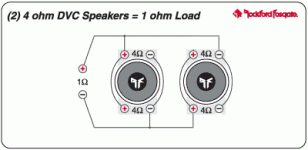
Rigtec, as I'm sure you already know, isobaric subs you are wiring one sub out of phase, so when the subs face each other one is pulling air and the other is pushing working in unison. A wiring example of subs facing each other is seen below from rockford.
If they were wired normally, they would cancel each other out. Do you have any examples of your configuration from any leading manufacturer?

You have 2 subs firing up, and 2 subs firing backward, 90 degrees out of phase, resulting in some cancellation both internally in the box and externally.
 

Attachments

  • 2_4ohmDVC_1ohm.gif
    2_4ohmDVC_1ohm.gif
    7.2 KB · Views: 744
Last edited:
Rigtec, as I'm sure you already know, isobaric subs you are wiring one sub out of phase, so when the subs face each other one is pulling air and the other is pushing working in unison. A wiring example of subs facing each other is seen below from rockford.
If they were wired normally, they would cancel each other out. Do you have any examples of your configuration from any leading manufacturer?

You have 2 subs firing up, and 2 subs firing backward, 90 degrees out of phase, resulting in some cancellation both internally in the box and externally.

The "Direction" of sub's does not matter in a car environment with regard to constructive interference. As Rigtec states - Subs radiate in an omnidirectional pattern. The wavelengths below 80Hz are so long that none of this comes into play. The subs are in the same enclosure - and naturally are still relatively close to each other (less than 1-2'). An 80Hz waveform is around 14' long at STP...

The above diagram you linked to MUST be referencing a situation where the woofers are mounted "cone-to-cone" (face-to-face) as an isobaric alignment (two woofers sharing a COMMON enclosure chamber - but mounted "face to face" to lower the required box volume for a given enclosure tuning).

This has nothing to do with the output delivered to the cabin due to constructive/destructive interference - but references the need to wire the 2 subs in opposite polarity because they are coupled internally (literally one facing the other in a sealed cavity). Isobaric enclosures can also have one woofer "behind" another - facing the same direction. In this case, the Isobaric subs would naturally need to be wired in a common polarity or you'd literally get ZERO output.

Polarity (and phase - which is NOT the same as polarity / phase takes into account frequency / polarity is absolute) needs to consider the frequencies the drivers' are playing in to have much meaning. Sub's are only reproducing 80Hz and below for most applications. You can have subs facing in many different directions - yet still have them "couple" to provide constructive interference between them (assuming they are all wired in correct polarity).. All subs exert "out" at the same time creating a positive pressure in the cabin, or all subs exert "in" to create a negative pressure in the cabin at these LONG sub-bass wavelengths.

In pro-sound, you can create a directional cardioid bass array by having woofers face in different directions - but then the rear facing woofer is also offset (delayed in time) to create the cardioid directionality of the array. This is similar to how a cardioid microphone works by rejecting sound entering the rear of the capsule by allowing a controlled amount of rear-waves to be combined with the "on-axis" front waves. Ever heard of "proximity effect" with a cardiod mic? That is the low-frequency's long wavelengths thwarting the front/rear pick-up pattern of the mic (because the low frequency wavelengths are SO LONG!).

In a confined vehicle listening environment below 100Hz, you will be hard-pressed to have any acoustic-summing issues by subs oriented in whatever direction you choose. You will get close to perfect summing of low-frequencies as long as all cones are cohesively providing positive and negative pressures in unison.

Once you get much higher than a few hundred hertz, the issues become much more complex due to the wavelengths and distances to the listener. But low-end is not directional by its nature (the wavelength is SO MUCH longer than any dimension of the driver or enclosure and even the listening space - you don't even need to worry about "baffle step-compensation" with subs!).

Now, speaking of getting smooth low-end response in a room or larger listening environment is a WHOLE different ball of wax - but that includes reflections and room modes that are not generally an issue in a mobile environment. In a room - you can place subs all around the room (literally separated by many yards, not a foot or so as in a mobile subwoofer array facing in whatever direction), and then process the "spaced subs" individually to help negate the room mode issues.

I know Rigtec would be happy to explain further - but rest assured, there is a lapse in comprehension in your reasoning. Not trying to be a dick, just trying to lead you to audio bliss :)

Phase takes frequency into account - and is an ever-changing relationship based off what specific frequency and relative distances you are referencing. Polarity is relatively absolute in the low-end-frequency-response of a confined listening environment like a vehicle due to the extremely long wavelenghts involved.

Now - trying to get rid of the front-door midbass issues in a 6' wide vehicle will have you pulling your hair out! 6' equates to around 140Hz waveform - and then you are grossly off-center from left to right in that equation. Those midbass wavelengths begin to fall into destructive interference territory @ 6' and will not generally couple cleanly without much manipulation and associated drawbacks (like "one seat" tuning, etc)...


:cool:
 
Last edited:
"Rigtec, as I'm sure you already know, isobaric subs you are wiring one sub out of phase, so when the subs face each other one is pulling air and the other is pushing working in unison..."

I never posted any theory on the subject of 'Isobaric Subs'! I did however refer to a Clam-Shell configuration as a recognized, legitimate, and well documented, non-destructive low-frequency driver configuration. If I feel that I need to introduce the subject of Isobaric subs and their benefits at some point I will, but for now I don't want anyone here to feel left out. The subwoofers that most of us are using here are pretty standard stuff; isobarics, horns and hybrids are for advanced audio techs and engineers who already understand basic theory!

You have 2 subs firing up, and 2 subs firing backward, 90 degrees out of phase, resulting in some cancellation both internally in the box and externally.

First of all, your example... and theory are totally bazaar! Any Phase anomalies experienced in my truck took place after leaving the box, resulting from the boundary effect factor; which happens as a result of the large soundwaves being trapped in a (relatively) small area, bouncing off of objects in the cabin and returning out of phase, relative to the source (the subs) now creating a destructive effect... not because I decided to use Two baffles on the box! Those waves combine and increase in linear fashion! I don't know why you keep coming back here posting these ridiculous ideas in your own head!

If you want to disprove my understanding and theory, start your own thread and teach whatever you want but don't keep posting this totally ludicrous, misguided bull-ship without one shred of professional audio docs to support it! I've already posted a link on the theory of low frequency wavefront reproduction, and how PC (phase cancellation) will not take place on the baffles just because an array of (identical) subs are converging on different sides; due to an additional factor referred to as 'Close proximity', Low frequency driver coupling phenomena! I'm posting the link and photos here once again in hopes that you'll get it (Everyone else here seems to) ...you obviously don't!:

Sonnie
HTS Hillbilly
HTS Administrator

There are numerous choices in how you might install your drivers in an IB system. Below is merely a few various examples of manifolds and line
arrays that are attached to floors, ceilings or walls. (This is an excerpt from the engineer's thread. To read his article, Please see the link provided below) *PS: All of the speakers pictured below are low-frequency drivers and subs and are arrayed at different angles for where space constraints are an issue!* ...and no destructive phase anomalies with any of these designs!

file.php
file.php
file.php
file.php

0000306_2.jpg~original

5448654d4cebd.png


"If what you say were true, these subs wouldn't be Thee' Industry Standard for Low-Frequency pro-Audio systems!"

Engineer's link>>Weiterleitungshinweis
 
Last edited:
"The "Direction" of sub's does not matter in a car environment with regard to constructive interference. As Rigtec states - Subs radiate in an omnidirectional pattern. The wavelengths below 80Hz are so long that none of this comes into play..."

Your entire post is as brilliant as it gets!!! If I had seen it before I started writing I wouldn't have needed to write anything at all. This gentleman is trying to apply High frequency driver wave pattern theory to a Low frequency driver application; he doesn't seem to understand that the rules change for different frequency pass-bands! My main concern is that there are some members here who are at the beginner level and I don't want them becoming confused or discouraged by the mis-information that he's peddling! Thanks for your comments,

Cheers!
 

Members online

Forum statistics

Threads
278,309
Messages
3,554,070
Members
248,016
Latest member
Advally Service

Trending content

Back
Top