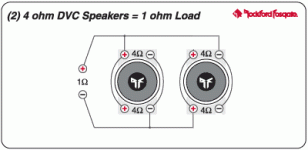
Rigtec, as I'm sure you already know, isobaric subs you are wiring one sub out of phase, so when the subs face each other one is pulling air and the other is pushing working in unison. A wiring example of subs facing each other is seen below from rockford.
If they were wired normally, they would cancel each other out. Do you have any examples of your configuration from any leading manufacturer?
You have 2 subs firing up, and 2 subs firing backward, 90 degrees out of phase, resulting in some cancellation both internally in the box and externally.
The "Direction" of sub's does not matter in a car environment with regard to constructive interference. As Rigtec states - Subs radiate in an omnidirectional pattern. The wavelengths below 80Hz are so long that none of this comes into play. The subs are in the same enclosure - and naturally are still relatively close to each other (less than 1-2'). An 80Hz waveform is around 14' long at STP...
The above diagram you linked to MUST be referencing a situation where the woofers are mounted "cone-to-cone" (face-to-face) as an isobaric alignment (two woofers sharing a COMMON enclosure chamber - but mounted "face to face" to lower the required box volume for a given enclosure tuning).
This has nothing to do with the output delivered to the cabin due to constructive/destructive interference - but references the need to wire the 2 subs in opposite polarity because they are coupled internally (literally one facing the other in a sealed cavity). Isobaric enclosures can also have one woofer "behind" another - facing the same direction. In this case, the Isobaric subs would naturally need to be wired in a common polarity or you'd literally get ZERO output.
Polarity (and phase - which is NOT the same as polarity / phase takes into account frequency / polarity is absolute) needs to consider the frequencies the drivers' are playing in to have much meaning. Sub's are only reproducing 80Hz and below for most applications. You can have subs facing in many different directions - yet still have them "couple" to provide constructive interference between them (assuming they are all wired in correct polarity).. All subs exert "out" at the same time creating a positive pressure in the cabin, or all subs exert "in" to create a negative pressure in the cabin at these LONG sub-bass wavelengths.
In pro-sound, you can create a directional cardioid bass array by having woofers face in different directions - but then the rear facing woofer is also offset (delayed in time) to create the cardioid directionality of the array. This is similar to how a cardioid microphone works by rejecting sound entering the rear of the capsule by allowing a controlled amount of rear-waves to be combined with the "on-axis" front waves. Ever heard of "proximity effect" with a cardiod mic? That is the low-frequency's long wavelengths thwarting the front/rear pick-up pattern of the mic (because the low frequency wavelengths are SO LONG!).
In a confined vehicle listening environment below 100Hz, you will be hard-pressed to have any acoustic-summing issues by subs oriented in whatever direction you choose. You will get close to perfect summing of low-frequencies as long as all cones are cohesively providing positive and negative pressures in unison.
Once you get much higher than a few hundred hertz, the issues become much more complex due to the wavelengths and distances to the listener. But low-end is not directional by its nature (the wavelength is SO MUCH longer than any dimension of the driver or enclosure and even the listening space - you don't even need to worry about "baffle step-compensation" with subs!).
Now, speaking of getting smooth low-end response in a room or larger listening environment is a WHOLE different ball of wax - but that includes reflections and room modes that are not generally an issue in a mobile environment. In a room - you can place subs all around the room (literally separated by many yards, not a foot or so as in a mobile subwoofer array facing in whatever direction), and then process the "spaced subs" individually to help negate the room mode issues.
I know Rigtec would be happy to explain further - but rest assured, there is a lapse in comprehension in your reasoning. Not trying to be a dick, just trying to lead you to audio bliss

Phase takes frequency into account - and is an ever-changing relationship based off what specific frequency and relative distances you are referencing. Polarity is relatively absolute in the low-end-frequency-response of a confined listening environment like a vehicle due to the extremely long wavelenghts involved.
Now - trying to get rid of the front-door midbass issues in a 6' wide vehicle will have you pulling your hair out! 6' equates to around 140Hz waveform - and then you are grossly off-center from left to right in that equation. Those midbass wavelengths begin to fall into destructive interference territory @ 6' and will not generally couple cleanly without much manipulation and associated drawbacks (like "one seat" tuning, etc)...






 op2:
op2:


