Greasing Driveshaft (4th Gen)

I have an 03 V8 AWD and have been using Valvoline Syn Power Full Synthetic Grease in all locations. I do not off road.

The tube reads:

Moly-fortified to increase strength and protection.
Extreme temp protection -40F to 400F
Drop point 500F minimum
NLGI #2 GC-LB complex Lithium EP Grease
Meets GM 1051344, Mack MG-C, ASTM D-4950

I contacted Valvoline.com and had a live chat with Matthew. I told him Toyota grease spec for spiders and for slide-yoke and asked if their Syn Power Full Synthetic grease was ok to use in both locations.
His answer was "yes, it's 1.2% moly and is lithium based. It will not have a negative impact on either."
 
I'm planning to grease the driveshaft (propeller shaft) of my 2004 4Runner. I read this thread but it's about 3rd-generation 4Runners and my 4th gen vehicle seems different.


I also downloaded the 4th gen service manual from this thread but as far as I can see it does not provide clear information about how to grease the drive shaft and which type of grease to use.


So, here are a couple of photos. My car seems to have only three grease fittings (Zerks), and I've numbered them in the photos.


View attachment 206763


View attachment 206764


It looks to me as if Zerks #1 and #3 are supplying grease to their respective u-joints (cardans), and therefore most likely require regular lithium grease. Whereas the grease that is applied via Zerk #2 is more likely for some type of metal-on-metal application and probably requires lithium grease that contains molybdenum disulphide.


Am I missing any Zerks? I can't see or feel any others. Are my guesses about which grease to use correct?


Finally, does anyone have any experience with renewing the grease? Can I just keep pumping grease in until the grease that is coming out is clean stuff? Or do I risk screwing up seals that way?


I’ve been reading about the dreaded “clunk” for months on this forum in various threads. Today I had my 4R in for brakes and asked the dealer if they knew about the clunk - nope. So I printed off one of the posts from here and showed it to them - they wanted $150 to grease it. I declined. Then I drove by another mechanic called “Toyota Specialist” and thought for sure they’d have heard about it - nope. So finally I decided to go buy a grease gun and some Lithium/Molly grease and some plain lithium grease and did it myself. I’m not mechanically inclined. I’ve never even changed my own oil. I was pretty concerned that I was gonna somehow screw it up. But I didn’t. In fact, I took it for a test drive and the clunk was gone! YOU people here on this forum inspired me and made me believe I could do it. Hopefully, it lasts. But even if it doesn’t, I know how to fix it again. Now, I’m gonna do my spark plugs cuz that looks easy. I may even try and tackle the “seized front brake caliper” that the dealer told me about today...they wanted $650 to replace both front calipers. I declined again because I know somewhere on this forum is an excellent guide for how to do it myself and save some cash. Thanks!


Sent from my iPhone using Tapatalk
 
Last edited:
I’ve been reading about the dreaded “clunk” for months on this forum in various threads. Today I had my 4R in for brakes and asked the dealer if they knew about the clunk - nope. So I printed off one of the posts from here and showed it to them - they wanted $150 to grease it. I declined. Then I drove by another mechanic called “Toyota Specialist” and thought for sure they’d have heard about it - nope. So finally I decided to go buy a grease gun and some Lithium/Molly grease and some plain lithium grease and did it myself. I’m not mechanically inclined. I’ve never even changed my own oil. I was pretty concerned that I was gonna somehow screw it up. But I didn’t. In fact, I took it for a test drive and the clunk was gone! YOU people here on this forum inspired me and made me believe I could do it. Hopefully, it lasts. But even if it doesn’t, I know how to fix it again. Now, I’m gonna do my spark plugs cuz that looks easy. I may even try and tackle the “seized front brake caliper” that the dealer told me about today...they wanted $650 to replace both front calipers. I declined again because I know somewhere on this forum is an excellent guide for how to do it myself and save some cash. Thanks!


Sent from my iPhone using Tapatalk

Nice work! There's a lot of value in doing simple routine maintenance and building up confidence to tackle bigger and bigger jobs. This is how many of us got our start, first it was changing a flat tire, then an oil change, and on and on!

I pumped some grease in my driveshafts a few weeks ago while doing an oil change and it helped temporarily but the clunk is back. I think I didn't put enough in at that time (3-6 pumps) so I'm gonna try sending it and pump em till they ooze a little bit. Worst case I'll do the trick to push some grease out backing up a curb should they be too full and cause issues.
 
I pumped some grease in my driveshafts a few weeks ago while doing an oil change and it helped temporarily but the clunk is back. I think I didn't put enough in at that time (3-6 pumps) so I'm gonna try sending it and pump em till they ooze a little bit. Worst case I'll do the trick to push some grease out backing up a curb should they be too full and cause issues.

My clunk was pretty bad. It would occur at almost every stop I came to. So, I assumed my slip yokes were dry as a bone. I counted at least 50 pumps in the slip yoke zerks. Basically, I pumped till I saw the drive shaft expand a little. I never saw any grease come through, just the shaft moving a little. Then I jumped on the back bumper a bunch to try to push the grease through a little. I also made sure to use the grease with lithium & molly in these 2 zerks. Seemed to do the trick!
 
My clunk was pretty bad. It would occur at almost every stop I came to. So, I assumed my slip yokes were dry as a bone. I counted at least 50 pumps in the slip yoke zerks. Basically, I pumped till I saw the drive shaft expand a little. I never saw any grease come through, just the shaft moving a little. Then I jumped on the back bumper a bunch to try to push the grease through a little. I also made sure to use the grease with lithium & molly in these 2 zerks. Seemed to do the trick!

Wow! I guess I really need to cram them full to make a difference! haha
 
Thread Update -

I loaded the U joints up just until they started to seep grease (4-7 pumps each) then on the slip yoke put in about 30 pumps. I didn't see grease come out on this one but I know that you don't want to over-do this one.

All clunk is gone, doesn't seem to bind/clunk like it used to at stop lights or when accelerating from a stop, driveline seems much happier and I'm hoping it will yield better driving characteristics and maybe even slightly better mileage (placebo effect?) since everything will be moving more efficiently!
 
I've put in over 200K miles between my '03 Tundra and '03 Tacoma using RedLine CV-2 grease on the driveshaft cardans and slip joints. And I'm over 50K on my used '07 4Runner following the same regimen. One grease gun for all 6 zerks, no failed cardan joints.

In terms of compatibility with the existing grease in the cardans, I pump it until fresh red grease is pushing from all 4 bearing caps during each oil change. Wipe away the mess and all done.

I sold the Tundra with 130K miles, the Tacoma with 220K miles (both bought used), still on the factory driveshafts and joints. RedLine CV-2 costs me ~$12 per tube, but it covers all zerks on all my vehicles including my wife's SUV which has fittings on the tie rod ends and front swaybar end links.
 
Okay just got my 2019 and was wondering if there was anything to lube. Found this thread and now I'm more confused than ever. My old 1992 little 4X4 had a ton of grease fittings and a map on the visor of where they were.

My 2019 manual states Lithium base chassis grease NLGI No.2 for the spider and the slide yoke states moly OR lithium base chassis grease No.2.

Doesn't this just mean I can use regular lithium base No.2 for both the spider and slide yoke?

Seems like I only need the one and hit em all? Something like Mystik JT-6 High-Temp No.2?

Sorry if this has been beat to death, this is only my second post.
Screen Shot 2019-08-25 at 1.44.06 PM by Michael Starmer, on Flickr
 
Last edited:
Okay just got my 2019 and was wondering if there was anything to lube. Found this thread and now I'm more confused than ever. My old 1992 little 4X4 had a ton of grease fittings and a map on the visor of where they were.

My 2019 manual states Lithium base chassis grease NLGI No.2 for the spider and the slide yoke states moly OR lithium base chassis grease No.2.

Doesn't this just mean I can use regular lithium base No.2 for both the spider and slide yoke?

Seems like I only need the one and hit em all? Something like Mystik JT-6 High-Temp No.2?

Sorry if this has been beat to death, this is only my second post.
Screen Shot 2019-08-25 at 1.44.06 PM by Michael Starmer, on Flickr

My 2019 manual says the same thing!
 
Overgreasing driveshaft - pay attention!!!

Just decided to grease u-joints and propeller shafts as I clicked over my first 10,000 kilometers, easy enough.. drive up on the ramps crack open a Belgium beer and slide under with flashlight and grease gun. U-joints were easy, front shaft spins freely but he to slide the hyd jack under rear wheel to get the fitting to 5oclock position. Stop as the grease comes out u-joint but shafts seem to take quite a bit and still don't see anything Aka chevy 4wd splines??? Who needs to read instructions for a friggin grease job....me!!! Alas the seal on closer inspection was not rubber but steel with a rubber beneath I am guessing.
Hmmmm... jumped onto the forum to read about over servicing propeller shafts.

Great!!! time for a fresh beer and cigarette now, the 15 min task just got way more complicated, how to undo the mess I just created. The laws of hydraulic pressure would transfer a shocking load path on the first bump to transfer case and differential like having cement inside that shaft. Hence can't be ignored.
I thought about just removing the grease fittings, and driving over a few whoop di doos to push the grease out for space as needed inside shaft....then rethought that idea as I would have no idea How much came out or was left inside with the centrifugal force...another cigarette and go look up torque values on those bolts
Of the prop shaft flanges. this would be ok on a lift but on a sliding mech bed and ramps changes the game to many sit ups, crap dripping from winter road salt in your face and the joy of tools above your face so long story short, remove zert split flange sections and compress shaft until it bottoms out and catch all the grease before it lands on your face then slide it back in the exact same orientation it came off for balancing purposes. Put a film of all. That grease on the virgin steel cup flange and nut while its open. It's also important to block wheels on ground, put on hand brake and slide it into neutral before removing and retorqued bolts not to put strain on txfr case and transmission as good measure. Sixty five ft pounds is what I read but sure seem way more than that when trying to remove them initially, btw the bolts are splined so don't try to spin them only the nut turns, a hammer and flathead screwdriver is needed to split the flange then its all easy street after that ,,,,,hahah seeing my front shaft doesn't spin until I move the lever To H or L i just removed to zert and will some heavy braking to dive the nose down and pump out that excessively grease statically ,,,,,,smart men learn from their mistakes, wise men learn from the mistakes of others,,,but the last lingering question, with this knowledge Are you really going to let your local mechanic or even newbie at the dealer grease your shafts in fear of getting shafted ? The repair cost must be huge on either side of that shaft, food for thought. Not to be a buzz kill either but how much grease is in that chamber right now,,,,,its only four bolts and one zert in the front for peace of mind ? thanks for your time and patience with the long winded msg hope it helps or saves some grief

 
One guy pulled his ZERKS out thinking it would reduce some form of precieved pressure incease.
One guy, a reverse over a large curb did the trick.

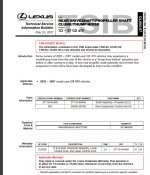
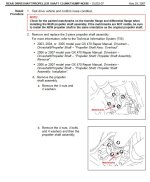
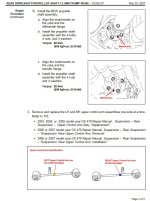
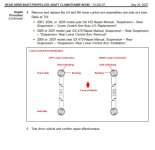
There was a TSB for Lexus.
T4R got no such love.
 

Attachments

  • DriveLineClunk.JPG
    DriveLineClunk.JPG
    118.5 KB · Views: 2,418
  • Pg2.JPG
    Pg2.JPG
    108 KB · Views: 2,455
  • Pg3.JPG
    Pg3.JPG
    112 KB · Views: 2,966
  • Pg4.JPG
    Pg4.JPG
    66.4 KB · Views: 2,451
Last edited:
Just decided to grease u-joints and propeller shafts as I clicked over my first 10,000 kilometers, easy enough.. drive up on the ramps crack open a Belgium beer and slide under with flashlight and grease gun. U-joints were easy, front shaft spins freely but he to slide the hyd jack under rear wheel to get the fitting to 5oclock position. Stop as the grease comes out u-joint but shafts seem to take quite a bit and still don't see anything Aka chevy 4wd splines??? Who needs to read instructions for a friggin grease job....me!!! Alas the seal on closer inspection was not rubber but steel with a rubber beneath I am guessing.
Hmmmm... jumped onto the forum to read about over servicing propeller shafts.

Great!!! time for a fresh beer and cigarette now, the 15 min task just got way more complicated, how to undo the mess I just created. The laws of hydraulic pressure would transfer a shocking load path on the first bump to transfer case and differential like having cement inside that shaft. Hence can't be ignored.
I thought about just removing the grease fittings, and driving over a few whoop di doos to push the grease out for space as needed inside shaft....then rethought that idea as I would have no idea How much came out or was left inside with the centrifugal force...another cigarette and go look up torque values on those bolts
Of the prop shaft flanges. this would be ok on a lift but on a sliding mech bed and ramps changes the game to many sit ups, crap dripping from winter road salt in your face and the joy of tools above your face so long story short, remove zert split flange sections and compress shaft until it bottoms out and catch all the grease before it lands on your face then slide it back in the exact same orientation it came off for balancing purposes. Put a film of all. That grease on the virgin steel cup flange and nut while its open. It's also important to block wheels on ground, put on hand brake and slide it into neutral before removing and retorqued bolts not to put strain on txfr case and transmission as good measure. Sixty five ft pounds is what I read but sure seem way more than that when trying to remove them initially, btw the bolts are splined so don't try to spin them only the nut turns, a hammer and flathead screwdriver is needed to split the flange then its all easy street after that ,,,,,hahah seeing my front shaft doesn't spin until I move the lever To H or L i just removed to zert and will some heavy braking to dive the nose down and pump out that excessively grease statically ,,,,,,smart men learn from their mistakes, wise men learn from the mistakes of others,,,but the last lingering question, with this knowledge Are you really going to let your local mechanic or even newbie at the dealer grease your shafts in fear of getting shafted ? The repair cost must be huge on either side of that shaft, food for thought. Not to be a buzz kill either but how much grease is in that chamber right now,,,,,its only four bolts and one zert in the front for peace of mind ? thanks for your time and patience with the long winded msg hope it helps or saves some grief

I think most people seemed to be more concerned about moly vs. no moly for that portion. I've read a lot here and on BITOG forums and just came to to conclusion a couple of pumps for the spines is plenty. Since most dealers or lube shops wont probably hit them at all anyway. I just put the rig in neutral and roll it until things line up. I'm planning on doing it each oil change just to keep it simple.
 
I think most people seemed to be more concerned about moly vs. no moly for that portion. I've read a lot here and on BITOG forums and just came to to conclusion a couple of pumps for the spines is plenty. Since most dealers or lube shops wont probably hit them at all anyway. I just put the rig in neutral and roll it until things line up. I'm planning on doing it each oil change just to keep it simple.

you mean to say you're planning to grease the slip joint on the driveshaft at every oil change? if so, keep in mind that the grease doesnt really go anywhere or evaporate away, so eventually after not too many oil changes you will have pumped in too much grease & have an overfill situation. the slip joint isnt like a ujoint where you can flush out the grease as much as you want.

doing about 4-6 pumps is all the slip joint should need for a long time until it starts to clunk again & if its not making any noise now then a few pumps of grease is all thats needed for preventative maint.
 
No grease fittings

Are all 4Runners supposed to have these grease fittings? I have a 2008 2WD and saw the grease fittings in the Chiltons Manual and picked up a grease gun, but when I went underneath it I couldn't find them. It's been a long time since I had a vehicle with grease fittings, but I don't see anything on the driveshaft.
 
Are all 4Runners supposed to have these grease fittings? I have a 2008 2WD and saw the grease fittings in the Chiltons Manual and picked up a grease gun, but when I went underneath it I couldn't find them. It's been a long time since I had a vehicle with grease fittings, but I don't see anything on the driveshaft.

you should have fittings on the ujoints but not sure of the 2wd have the slip joint like 4wd. all 2wd cars i have seen have a solid drive shaft & the slip yoke is at the front in the d/s going into the trans & not greased like a 4wd.
 
Are all 4Runners supposed to have these grease fittings? I have a 2008 2WD and saw the grease fittings in the Chiltons Manual and picked up a grease gun, but when I went underneath it I couldn't find them. It's been a long time since I had a vehicle with grease fittings, but I don't see anything on the driveshaft.

No zerks on the 2wd.
 
Bringing this back.. my buddy has a 3rd gen with 215k miles and said he uses "Valvoline Moly-Fortified Gray Full Synthetic Grease 14.1 OZ Cartridge" for both the spider and slip joints and has never had an issue.. My 4th gen has 178k miles and i've put on 60k miles and never greased them..

Thoughts on using this grease on all zerk fittings?
 
Bringing this back.. my buddy has a 3rd gen with 215k miles and said he uses "Valvoline Moly-Fortified Gray Full Synthetic Grease 14.1 OZ Cartridge" for both the spider and slip joints and has never had an issue.. My 4th gen has 178k miles and i've put on 60k miles and never greased them..

Thoughts on using this grease on all zerk fittings?

Should be fine from what I’ve read, the moly content is pretty low so you should be good to go. I just did all of mine this past weekend with the Mobil Synthetic grease and it was also fine.
 

Members online

Forum statistics

Threads
278,309
Messages
3,554,071
Members
248,016
Latest member
Advally Service

Trending content

Back
Top