Help with A/C please; dealer wants 160.

Some of the A/C lines are rubber (not all are metal) and the rubber can be a tiny bit porous, allowing small amounts of refrigerant to escape over the years. Also, connections between components and lines may not always be 100% leak proof, even when new. It's nice to think the entire A/C system is 100% sealed and will not lose any refrigerant at all, but most systems do lose a small amount of refrigerant over time and will eventually require an additional charge. These systems may not show any real signs of a leak and are considered normal.

My own 4Runner is coming up on 7 years old now (wow, it sure doesn't seem that long!) and the A/C is still perfect without any need for additional refrigerant yet, so I'm happy about that...

Yes systems do lose refrigerant... if there is a leak. Get the leak fixed and it should be fine. I understand that they typically lose some over the course of years due to wear and tear, but a system that is losing enough refrigerant to not be working properly probably needs to be evacuated, figure out where the weak spot is, replace lines, and then recharge it. It is inevitable that systems will lose some, but by closed system I am referring to it being different than say your gasoline tank. If an A/C system needs to be recharged on any sort of regular basis then it needs to be repaired. That's just the way it is.

On older vehicles especially it makes sense to just get it evacuated, dyed, and tested to figure out what the deal is. R-12 is freaking expensive and to be "topping it off" regularly is wasteful at the very least. I am not even going to get into the environmental aspect of it all.

I believe we are in agreement, but overall we are just approaching it from a bit different point of view. There are so many seals, hoses, pipes, connections between metal and rubber, etc. that eventually leaks and loss of refrigerant are inevitable, particularly on the older (and in my view superior) R12 systems.
 
... It is inevitable that systems will lose some, but by closed system I am referring to it being different than say your gasoline tank. ....


Comparing an A/C system to a gas tank (and related components) is a really bad comparison. The fuel tank is actually vented to the atmosphere via the vapor recovery system (charcoal canister).

If you want to make a better comparison, think about the A/C system losing refrigerant to tires losing air. Your tire doesn't have to have an obvious leak to lose air over time. Occasionally air can seep past bead areas, valve stems, or even porous cast aluminum wheels. The rate of this lost air can be very gradual. The same type of thing can happen in an automotive A/C system... That's all I'm saying.

But I agree that if your A/C system requires frequent addition of refrigerant, there's a leak somewhere that needs to be repaired.
 
Ambient temp is just the average temp at that time. The current air temp in the shade. So if you have an outdoor thermometer in your garage or anywhere in the shade and not direct sunlight, it should be pretty close. Or just go to the weather channel and look at the temp for your area, it will be close enough. A few degrees either way will not make a huge difference. The 4 second interval on/off of the compressor is called short cycling. It is very bad for the compressor. It will eventually burn it up.
Yes..:) "short cycling" is it called? thank you.

But the pressure, ambient temp method is somewhat risky, specially for inexperienced like me. Having ambient temp and pressure read from a cheapy gauge then base the charging on a chart that is made out of an ideal lab setting means adding more high risk factors into the equation. We don't know how much refrigerant still in there. Nothing beats if you have proper equipment(AC shop). Lika drain, pressure test, seal, and fill with exactly for 4Runner, 650 plus minus 30g (22.92 1.06 oz.) of refrigerant.

Attached is the .pdf 4Runner AC/System

(I'll be driving Tucson with AC turn off, ahh :cry: wifey has the 4R)
 

Attachments

Last edited:
Yes..:)

But the pressure, ambient temp method is somewhat a risky method specially for inexperienced like me. Nothing beats if you have proper equipment(AC shop). Lika drain, pressure test, seal, and fill with exactly for 4Runner 650 plus minus 30 g (22.92 1.06 oz.) of refrigerant.

Attached is the .pdf 4Runner AC/System

(I'll be driving Tucson with AC turn off, ahh:cry: wifey has the 4R)

The third PDF you included has the sight glass test to check for freon level. I check on it periodcially and before the summer heat hits because it's so easy to do. It might be a good idea for people to give that a look first to see what you might be dealing with before spending any money. That is, unless anybody has experience with the sight glass that it's NOT very accurate.
 
Comparing an A/C system to a gas tank (and related components) is a really bad comparison. The fuel tank is actually vented to the atmosphere via the vapor recovery system (charcoal canister).

If you want to make a better comparison, think about the A/C system losing refrigerant to tires losing air. Your tire doesn't have to have an obvious leak to lose air over time. Occasionally air can seep past bead areas, valve stems, or even porous cast aluminum wheels. The rate of this lost air can be very gradual. The same type of thing can happen in an automotive A/C system... That's all I'm saying.

But I agree that if your A/C system requires frequent addition of refrigerant, there's a leak somewhere that needs to be repaired.

I guess you missed the point on comparing it to a gas tank. My point was that it is nothing like a gas tank in that it isn't something that you need to refill consistently. Some people think that you need to have your AC "recharged" every summer because it "runs out of gas". I'm dead serious. When I worked as a mechanic I had that all the time. People wanting to top off because they feel that they run out of gas.

My point was only that if there is no leakage then it can run indefinitely. Of course, like you said, over time small leaks will develop and you'll lose some refrigerant. But without the small leaks or barring an underfill from the factory or an underfill when service is done and everything has been evacuated then technically you won't lose refrigerant and you won't need a "top off" yearly like you need on your gas tank every week or so. They are totally different. You're right. That was the point I was trying to make and I don't see why you think we disagree on that point.

For those running an R12 system it is actually illegal to "top off". You have to find the source of the leak and repair it and make sure all freon is evacuated and everything is sealed again before putting more back in. Otherwise it will get released into the atmosphere due to leaking and can't be recovered and we are no longer manufacturing it stateside.

We aren't talking R12 here though really since we are talking about the 4G Runners, so this is something you can service yourself. If there is even a moderate leak though it is worthless because without it being pressurized in the system then the compressor will cycle on and off quickly and won't do a good job cooling.

I think the AC is generally a case where it is worth it in the long run to have a pro give it a looksee and find out if you have a major leak. Of course if you can "top it off" and it works for a year at a time then I guess that's another option. Although I've never seen a leak get smaller over the years, so it will most likely have to be fixed at some point! :)
 
I guess you missed the point on comparing it to a gas tank. My point was that it is nothing like a gas tank in that it isn't something that you need to refill consistently. Some people think that you need to have your AC "recharged" every summer because it "runs out of gas". I'm dead serious. When I worked as a mechanic I had that all the time. People wanting to top off because they feel that they run out of gas.

My point was only that if there is no leakage then it can run indefinitely. Of course, like you said, over time small leaks will develop and you'll lose some refrigerant. But without the small leaks or barring an underfill from the factory or an underfill when service is done and everything has been evacuated then technically you won't lose refrigerant and you won't need a "top off" yearly like you need on your gas tank every week or so. They are totally different. You're right. That was the point I was trying to make and I don't see why you think we disagree on that point.

For those running an R12 system it is actually illegal to "top off". You have to find the source of the leak and repair it and make sure all freon is evacuated and everything is sealed again before putting more back in. Otherwise it will get released into the atmosphere due to leaking and can't be recovered and we are no longer manufacturing it stateside.

We aren't talking R12 here though really since we are talking about the 4G Runners, so this is something you can service yourself. If there is even a moderate leak though it is worthless because without it being pressurized in the system then the compressor will cycle on and off quickly and won't do a good job cooling.

I think the AC is generally a case where it is worth it in the long run to have a pro give it a looksee and find out if you have a major leak. Of course if you can "top it off" and it works for a year at a time then I guess that's another option. Although I've never seen a leak get smaller over the years, so it will most likely have to be fixed at some point! :)

I see what you're saying now... I never knew anyone actually thought that the refrigerant gets consumed in an A/C system. That's funny.

BTW, it's not illegal to top off an old Freon system. It's only illegal to vent it to the atmosphere. But topping it off doesn't vent it. I'm actually still certified and licensed to buy Freon and service auto A/C, so I've kept up to date on the the older R12 systems. It's getting harder and harder to even find the stuff anymore, but I have my own private stock of 1-pound cans in my garage. The ironic thing is that I no longer own any vehicles that use it, so I'll just keep it for friends who might need it in the future. Then again, it's really not a big deal to switch an old R12 system over to R134a, so maybe I'll never need the R12 again.
 
I see what you're saying now... I never knew anyone actually thought that the refrigerant gets consumed in an A/C system. That's funny.

BTW, it's not illegal to top off an old Freon system. It's only illegal to vent it to the atmosphere. But topping it off doesn't vent it. I'm actually still certified and licensed to buy Freon and service auto A/C, so I've kept up to date on the the older R12 systems. It's getting harder and harder to even find the stuff anymore, but I have my own private stock of 1-pound cans in my garage. The ironic thing is that I no longer own any vehicles that use it, so I'll just keep it for friends who might need it in the future. Then again, it's really not a big deal to switch an old R12 system over to R134a, so maybe I'll never need the R12 again.

I laugh everytime people go to get a "freon fillup". I knew a mechanic that was local here that used to put it on his yearly service form. He would include it in the yearly service he did. Once he pulled that stunt on my mom once and I found out about it, she stopped going to that mechanic. It was a funny conversation all around.

You should hold the R12 for sure. Some people are absolutely convinced that it runs colder and won't switch over. As time goes by it will only get more valuable to those folks. I think the new systems work great and seem more efficient. I know my old R12 system in my Eclipse was absolutely freezing. It may have had more to do with cabin design and size than anything, but no newer vehicle I have had has gotten that cold for sure, even the newer model eclipses couldn't come close. It may have been all in my imagination, but I've gotten used to the R134 systems and they seem to work just fine to me as long as they are not leaking or doing the cycle on/cycle off randomly thing that Fords do (drive an Escape over a mountain pass... you'll see what I mean!).
 
Yeah, a lot of people do swear that the old R12 systems are better, but I think that has a lot to do with the fact that the early R134a systems weren't as good as they are today. One thing I know for sure is that taking an old R12 system and switching it over to R134a is easy, but since the system was designed to operate on R12, it will not work as well with R134a. There's basically two reasons: 1- R134a is less efficient than R12 and 2- the rest of the A/C components were designed for R12. So when people started switching over to the new refrigerant in older cars, they weren't really happy with the results. The A/C worked, but it just didn't blow as cold as they were used to.

Today, the new systems are designed for R134a and they seem to work really well. At least as well as the old R12 systems. But some people still refuse to believe that, probably because they are biased.
 
Yeah, a lot of people do swear that the old R12 systems are better, but I think that has a lot to do with the fact that the early R134a systems weren't as good as they are today. One thing I know for sure is that taking an old R12 system and switching it over to R134a is easy, but since the system was designed to operate on R12, it will not work as well with R134a. There's basically two reasons: 1- R134a is less efficient than R12 and 2- the rest of the A/C components were designed for R12. So when people started switching over to the new refrigerant in older cars, they weren't really happy with the results. The A/C worked, but it just didn't blow as cold as they were used to.

Today, the new systems are designed for R134a and they seem to work really well. At least as well as the old R12 systems. But some people still refuse to believe that, probably because they are biased.

I think you could probably take that mindset and apply it to a lot of things. I always heard my dad talking about cars and how they "Don't make them like they used to" all the time like it's a bad thing. Sorry, but overall I think it's a very very good thing they aren't made like they used to be haha.

Anyway, great discussion on A/C systems.

I had a question! Is it at all possible to mess anything up when filling ("topping" off) a system at home? I really wouldn't think so but thought I'd ask.
 
I see I see. I guess an investment in a decent pressure gauge would be good before doing something like this. Thanks.

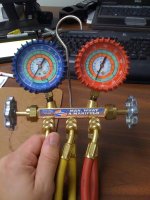
Something like these with automotive adapters. This sets does 134a, 404a, & R22. Good for alot of home and auto systems. Most if not all new home systems are using 410 thou.

Here is a link to a older thread where I posted a paragraph about general A/C operation.

http://www.toyota-4runner.org/4th-gen-t4rs/28727-c-refresh.html
 

Attachments

  • AC 001.jpg
    AC 001.jpg
    131.3 KB · Views: 345
Thanks I will look for a set. I saw them at Harbor Freight but a bunch of the reviews online make me want to stay away from them. I will just check elsewhere.
 

Members online

No members online now.

Forum statistics

Threads
278,316
Messages
3,554,112
Members
248,016
Latest member
Advally Service

Trending content

Back
Top