HOWTO: DIY Sliding Disconnects

Any swaybar ever invented has one function: to reduce sway. Sway is determined by roll-center, steering angle and sprung weight. There are no other factors which go into its design.

I find this puzzling.

If sway is the rotation of the chassis relative to the axles (suspension). Then would sway not also be the rotation of the axles (suspension) relative to the chassis?

As a mechanical system, on our trucks, I would have assumed the design cannot know the difference between sway caused by terrain at slow speeds vs sway caused by high speed cornering.

I think X-REAS could tell the difference because it operated on opposing corners, FL to RR, FR to RL

Is there a design feature in the mechanical sway bar system we have that prevents this?
 
Last edited:
I find this puzzling.

If sway is the rotation of the chassis relative to the axles (suspension). Then would sway not also be the rotation of the axles (suspension) relative to the chassis?

As a mechanical system, on our trucks, I would have assumed the design cannot know the difference between sway caused by terrain at slow speeds vs sway caused by high speed cornering.

I think X-REAS could tell the difference because it operated on opposing corners, FL to RR, FR to RL

Is there a design feature in the mechanical sway bar system we have that prevents this?

You are not taking into account lateral forces during cornering. In high speed cornering, a significant portion of the sprung weight pushes down on one tire and un-pushes down on the opposite tire. In low speed cornering, there is no change in the center of mass. The mass pushes down equally on both wheels. X-reas simply connects the LR shock to the FL shock and the RR shock to the FR shock to reduce parasitic oscillation when you jump the truck, or are on super bumpy roads to stop the body from rocking like a pendulum.
 
You are not taking into account lateral forces during cornering. In high speed cornering, a significant portion of the sprung weight pushes down on one tire and un-pushes down on the opposite tire. In low speed cornering, there is no change in the center of mass. The mass pushes down equally on both wheels. X-reas simply connects the LR shock to the FL shock and the RR shock to the FR shock to reduce parasitic oscillation when you jump the truck, or are on super bumpy roads to stop the body from rocking like a pendulum.

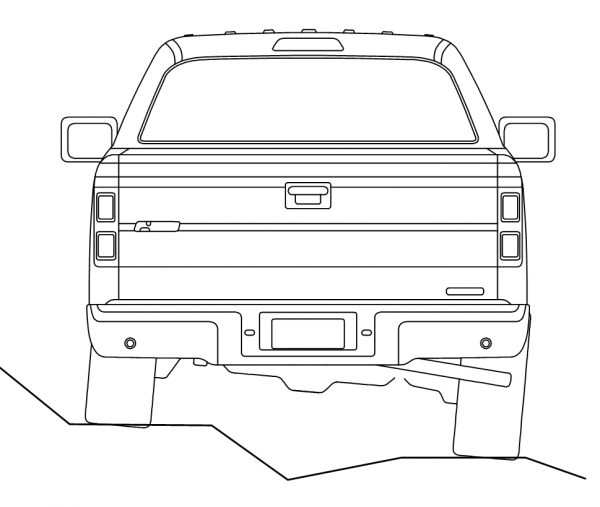
I've carefully read over your discussions, and to sum up your points, you posit that this sliding disconnect will have no impact on available upward wheel travel because the sway bar will not impact articulation offroad. However, the sway bar does make a difference in sway control on road, at high speed.

That is not the case. The concept that these sliding disconnects would make no difference would be predicated on the idea that this suspension loading situation at high speed (truck turning right):
keros-albums-diagrams-picture59864-high-speed.png

[insert Ford joke here]

Is different than this suspension loading situation off road:
keros-albums-diagrams-picture59865-off-road.png

[A Ford offroad? Don't worry, tow trucks are standing by]

As you can see, that is not the case at all. The suspension loading is precisely the same in both scenarios.

A sway bar, as our trucks have, is a simple linear spring that connects one wheel to the other across the chassis. If both front wheels move together, no force is induced by the sway bar. If only one wheel moves upwards, the sway bar will resist that upward movement in correlation with the sway bars' effective spring rate.

By allowing the sway bar some free-span on the sliding link, it will induce less force overall to the extremes of available wheel travel.

Duffdog, it would be very likely that your truck does not experience these apparent changes in sway bar action because A) Weight slung far over the front axle, increasing effective axle weight dramatically. B) Very heavy wheels, requiring more spring rate to control than the C) Worn out sway bar can now impart, due to it having been flexed to its extremes far too many times by your long history of offroading.

Your OEM sway bar is likely a toothpick trying to control sway on a battle tank at this point. Its effective spring rate is not substantial enough to make a notable difference.

KDSS, X-REAS, Auto-disconnect bars, (electronic/magnetic shocks?) are all fancy systems to allow the sway bars to only act in certain situations and under specific loading conditions. Unfortunately, we are subject to the whims of steel, and it does not care if the load is momentum from chassis kinematics under driving conditions, or stuffing a wheel to get over an obstacle.

The points made about the assembly flying apart during driving, yes, that can happen with any non-OEM assembly, or any OEM assembly not properly maintained, for that matter. I've broken endlinks on the race track and it certainly puckered up the ol' behind. Not something I'd look forward to, but that's the nature of the business.

 
Last edited:
I've carefully read over your discussions, and to sum up your points, you posit that this sliding disconnect will have no impact on available upward wheel travel because the sway bar will not impact articulation offroad. However, the sway bar does make a difference in sway control on road, at high speed.

That is not the case. The concept that these sliding disconnects would make no difference would be predicated on the idea that this suspension loading situation at high speed (truck turning right):
keros-albums-diagrams-picture59864-high-speed.png

[insert Ford joke here]

Is different than this suspension loading situation off road:
keros-albums-diagrams-picture59865-off-road.png

[A Ford offroad? Don't worry, tow trucks are standing by]

As you can see, that is not the case at all. The suspension loading is precisely the same in both scenarios.

A sway bar, as our trucks have, is a simple linear spring that connects one wheel to the other across the chassis. If both front wheels move together, no force is induced by the sway bar. If only one wheel moves upwards, the sway bar will resist that upward movement in correlation with the sway bars' effective spring rate.

By allowing the sway bar some free-span on the sliding link, it will induce less force overall to the extremes of available wheel travel.

Duffdog, it would be very likely that your truck does not experience these apparent changes in sway bar action because A) Weight slung far over the front axle, increasing effective axle weight dramatically. B) Very heavy wheels, requiring more spring rate to control than the C) Worn out sway bar can now impart, due to it having been flexed to its extremes far too many times by your long history of offroading.

Your OEM sway bar is likely a toothpick trying to control sway on a battle tank at this point. Its effective spring rate is not substantial enough to make a notable difference.

KDSS, X-REAS, Auto-disconnect bars, (electronic/magnetic shocks?) are all fancy systems to allow the sway bars to only act in certain situations and under specific loading conditions. Unfortunately, we are subject to the whims of steel, and it does not care if the load is momentum from chassis kinematics under driving conditions, or stuffing a wheel to get over an obstacle.

The points made about the assembly flying apart during driving, yes, that can happen with any non-OEM assembly, or any OEM assembly not properly maintained, for that matter. I've broken endlinks on the race track and it certainly puckered up the ol' behind. Not something I'd look forward to, but that's the nature of the business.

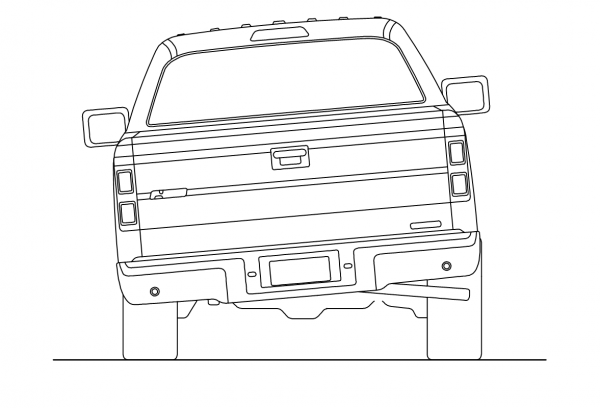
I agree with your description regarding weight of my truck on a swaybar. What I do not agree with are the two diagrams. The lower diagram is not possible under any circumstances. In a high speed turn, the center of mass shifts to the outside, in a low speed turn it does not. The second diagram shows the truck level and the suspension flexed in an offroad situation. This is impossible. If the wheels are connnected via a torsional spring, lifting one wheel would tilt the vehicle approximately 1/2 the total difference between the left and right wheels, this tilting is an exact approximation of the lateral forces during a high speed turn. By lifting one wheel, you are merely causing the truck to approximate what would happen during a high speed turn by moving the center of mass downhill. It is simply not possible to lift the suspension of a vehicle on one corner without a slight tilting of the body.

If you are talking about a hypothetical situation where the body of the truck is mounted on a rack that is holding it static and a "terrain simulator" is used to actuate the wheels up and down, then the lower diagram seems more plausible.

Furthermore, if I read your point correctly: Because my off-road vehicle is equipped with devices of greater mass that would enable one to go off-road, the now equipped off-road vehicle performs differently than an on-road vehicle, even to the point of making devices like a swaybar disconnecting system completely useless and of no beneficial function under any circumstances? If so, I agree.
 
I agree with your description regarding weight of my truck on a swaybar. What I do not agree with are the two diagrams. The lower diagram is not possible under any circumstances. In a high speed turn, the center of mass shifts to the outside, in a low speed turn it does not. The second diagram shows the truck level and the suspension flexed in an offroad situation. This is impossible. If the wheels are connnected via a torsional spring, lifting one wheel would tilt the vehicle approximately 1/2 the total difference between the left and right wheels, this tilting is an exact approximation of the lateral forces during a high speed turn. By lifting one wheel, you are merely causing the truck to approximate what would happen during a high speed turn by moving the center of mass downhill. It is simply not possible to lift the suspension of a vehicle on one corner without a slight tilting of the body.

If you are talking about a hypothetical situation where the body of the truck is mounted on a rack that is holding it static and a "terrain simulator" is used to actuate the wheels up and down, then the lower diagram seems more plausible.

Furthermore, if I read your point correctly: Because my off-road vehicle is equipped with devices of greater mass that would enable one to go off-road, the now equipped off-road vehicle performs differently than an on-road vehicle, even to the point of making devices like a swaybar disconnecting system completely useless and of no beneficial function under any circumstances? If so, I agree.

If you've never seen the lower diagram happen, you haven't wheeled with other people much. When your behind another vehicle out on Elephant Hill or in the mountains above silverton you can watch this happen on a stock Nissan Titan much less an upgraded 4Runner. Sure, the vehicle probably wouldn't sit that flat, but that's true of both the top and bottom diagram.

[MENTION=34192]Keros[/MENTION] thanks for thinking it through and putting the explainer. I planned to do some measurements, but my 4runner is currently covered in ice xD. Good explanation of what this is trying to do.
 
The only time I've seen the back end of an offroad rig look like the lower diagram is if there's appropriate flexing in opposite directions between the front tires and the rear axle.

If you park a truck sideways on a flat inclined plane, the CG of the truck moves laterally towards the low side, and causes the suspension on that side to compress, which is basically the opposite of what the lower diagram shows.
 
So..... anything else ever come of this??

I've taken mine off road, and they did seem to help. I didn't get them coated in tri-flow as quick as I should, so they're a little worse for wear corrosion wise. They need to be lubed up monthly I think.

I was unable to do a full articulation test, as my jack doesn't go high enough. With them disconnected I was only able to get half way down the slide.

That said, I've disconnected and reconnected them a few times and they work.
 
How are these holding up?

I made myself a set too
y4m6zya0mA1dnJwnt1xMyu1oXksQ64vtEizNRCL6lyRwY7ZqEu99--qr85WUPhaChjR080zpBbUCjF5DkgBco01Cs6txq-xuHFnyx953mjj-HX4Y5Bj0cEr4z1owFeO2KZgTqFLaerv4vVNjd7TWrZilAeET6aBqhRVG1ZuhbUzRp8

Mine are holding up pretty well. Greasing with tri-flo on a regular basis is really really important. They do have a little more play, so I've got a bit of a clunk from it some times, but its minimal and has as much to do with the relocation bracket as anything.
 

Members online

Forum statistics

Threads
278,316
Messages
3,554,111
Members
248,016
Latest member
Advally Service

Trending content

Back
Top