I decided to re-gear

Thanks for the great pointers and links I saw a tool listed on the fj write-up that I don't have (reverse torx) socket - that's a new one on me. My biggest tq wrench only goes to 150, so marking it is a good idea also. Most mfgs spec turns past a reasonable number for stuff like that. I have struggled with crank balancers before.
 
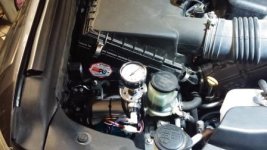
Not sure, didn't check. It looked exactly like the rear diff breather. For everything up front, there are already hoses attached and the breathers are in the engine compartment, near the master cylinder. I just pulled them all off and used T's and hose clamps to connect them all together and into my breather (universal fuel filter).
I figured it was two way. Why else would they have run lines up high. Worth checking.
 
Thanks for the great pointers and links I saw a tool listed on the fj write-up that I don't have (reverse torx) socket - that's a new one on me. My biggest tq wrench only goes to 150, so marking it is a good idea also. Most mfgs spec turns past a reasonable number for stuff like that. I have struggled with crank balancers before.
Dang, forgot about that one. The ADD has reverse torx bolts. I had to make a special trip for that one.

I figured it was two way. Why else would they have run lines up high. Worth checking.
It may be, again, I didn't check. I just grabbed them off my work bench, and one looks like it is 2 way, but I can't say for sure where it came from.
IMG_20141024_212715.jpg
 
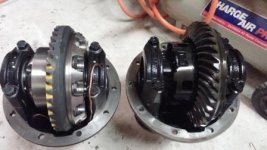
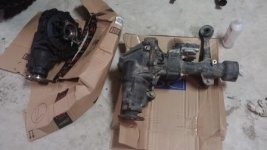
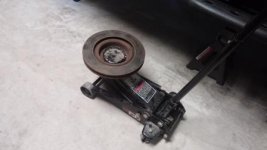
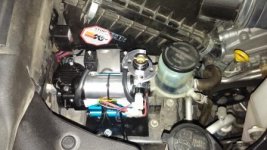
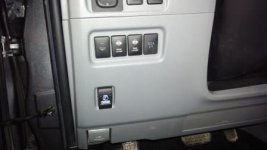
I finally finished my gear swap and locker install. It took me some time because I had a busy work schedule and many prior commitments on the weekends... Overall, it was a pretty easy job, but it took a decent amount of time (I would estimate 20hrs of my time). Much of that was spent on the compressor, lines, switches..... I did it on my own on jack stands with no assistants. Lifting the front carrier up was a bit of a challenge, but I used an old rotor as a plate on my floor jack and that formed a nice diff lift (its an awkward shape). I still had to push it up into place with brute force, but the jack got all the weight up high enough where I could get some leverage (otherwise it was impossible to get it off the ground while laying on your back).

The weight of these things is the only thing that makes this install difficult for one person to pull it off. Still very doable alone.

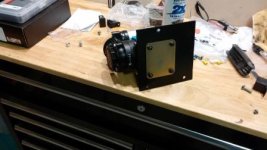
I'll post a few pics here in a bit, but it is nothing too exciting to look at. I did fab a custom mount for the compressor and rigged up a few unique things.

These threads over on the FJ forum were very useful and are pretty much all the documentation needed to swap both diffs. I did a few things a little different, but mainly followed these guides step by step. The OP over there (istambull), did a great job with the guides.

DIY clamshell swap - Toyota FJ Cruiser Forum

DIY 3rd Member swap - Toyota FJ Cruiser Forum

Some things I did differently (off the top of my head).
I used RTV for the rear gasket vs a stock part. Cleaning off the old gasket was a royal PITA. I ended up using a scotch brite pad on an angle grider with simply green. To me, this was the worst part of the entire install. Not fun.
I left the center support on the front carrier vs trying to remove it on the truck (which seemed very hard to me).
Tip: when removing the tie rods, don't hammer on castle nuts. Hit the end of the links instead.
Tip: don't forget to swap the front stub shaft over from the current front diff. ECGS has instructions on how to do this on their website, but one of the guides did not mention this and it is easy to miss. They apparently previously included one with the unit they shipped.


I just started the break in, so have not been able to really get a complete feel of the gears, but initial impression is that the truck feels so much lighter and the shifts result in very little rpm drop (making the motor feel much stronger). To be fair, I have not put all my armor back on, so the truck is probably 150lbs lighter at the moment.

Also, thumbs up to ECGS. I had my order within 5 days of placing it and everything looked great.

 
Last edited:
Keep in mind, you need to have 4wd engaged to break in the front diff. If it is disengaged, the ring and pinion don't spin, just the side gear. Try not to be alarmed at what is in the oil when you change it at 500 miles.
 
Keep in mind, you need to have 4wd engaged to break in the front diff. If it is disengaged, the ring and pinion don't spin, just the side gear. Try not to be alarmed at what is in the oil when you change it at 500 miles.

Yea, i know. Trying to decide when it is safe to 4hi on dry pavement. I know when going straight, but how straight is the question.
 
Here are a few pics.
 

Attachments

  • 3rdmember.jpg
    3rdmember.jpg
    28.4 KB · Views: 721
  • 1120142016.jpg
    1120142016.jpg
    24 KB · Views: 639
  • 1122141123.jpg
    1122141123.jpg
    19.9 KB · Views: 651
  • 1122142113.jpg
    1122142113.jpg
    30.7 KB · Views: 659
  • bracket.jpg
    bracket.jpg
    26.4 KB · Views: 655
  • compressor_mounted.jpg
    compressor_mounted.jpg
    32.9 KB · Views: 694
  • switches_mounted.jpg
    switches_mounted.jpg
    19.7 KB · Views: 637
Last edited:
A short vid.

<iframe width="560" height="315" src="//www.youtube.com/embed/M6i7avh4E9s" frameborder="0" allowfullscreen></iframe>
 
Last edited:
Yea, i know. Trying to decide when it is safe to 4hi on dry pavement. I know when going straight, but how straight is the question.
If you're going more than 20 mph, you're fine. Easiest way to tell is to try it out. Go to a parking lot, shift to 4hi, then make a slow turn, you'll start feeling it in the steering wheel, then just turn back the other way. You'll get the same effect from the lockers, the front especially. Don't fight the steering with the front locker engaged, or you will likely be replacing tie rod ends
 
If you're going more than 20 mph, you're fine. Easiest way to tell is to try it out. Go to a parking lot, shift to 4hi, then make a slow turn, you'll start feeling it in the steering wheel, then just turn back the other way. You'll get the same effect from the lockers, the front especially. Don't fight the steering with the front locker engaged, or you will likely be replacing tie rod ends

So if I'm on dry pavement with gradual curves going 60mph I don't have to worry about binding anything up in the transfer case? I've never really thought about it just had a rule in my mind to never be in 4wd on dry pavement with a locked center diff (even with open diffs front and rear).

I was planning on going on a long overland trip with stops (mainly dirt roads) to break the front in. I would rather just knock it out on my daily commute.
 

I've always wondered about this. I've known the concern about dry pavement with a locked center is over exaggerated by mfgs to avoid the idiot factor, but I figured it was never worth pushing it for no reason. Now I have a reason to try it.

I guess at speed you are always introducing more opportunity for the tires to unload and release tension in the drive train (even when the combined rpm of the front and rear wheels is unequal in a turn). Obviously, the tighter the turn the more potential for binding, but It seems like a speed of about 35mph would be a good rule of thumb, since speed pretty much dictates how tight your turn is.

With that in mind, the only other concern I have is that I make several sharp low speed turns on my daily commute. I would need to go in and out of 4h for those turns. Not a big deal, but a lot of in and out must add a little wear on the ADD.... Again, probably not worth being concerned about.
 
Everyone worries about this but in reality it is no big deal - unless you do doughnuts in a dry parking lot or drive 500 miles around town. Sure, you go around gentle turns and logic dictates that there will be some binding right? In reality the gradual left turn you just went through is followed by a right turn, negating any bind. Also air pressure plays a role here because of circumference.
When my son was little (junior working on his BSME right now) i was explaining this concept to him for some reason. He didn't believe me of course so we went out in the driveway, made a chalk mark on each sidewall right in the middle of the contact patch and drove about a mile. There were several turns and when we got back the chalk marks were all over the circumference lol. He couldn't believe in that short distance that tires wouldn't roll the same distance. Anyway, good mod and good write up.
 
Hey 1engineer, I'm not trying to argue here, but I don't follow you on right vs left turn and them negating each other. Between front and rear, the direction of the turn should not matter, right?
 
Yeah the binding happens very quickly :) Generally if you are turning right and left on a mountain switch back all your are really doing is going around a corner binding in one direction and then binding in the other. But on gentle curves, the lugs have enough play to work out the binding without problems.

IMHO, 4hi on a regular highway is no problem, on city streets no way and on country windy roads, I wouldn't (unless they are unpaved of course!) you're just putting a lot of stress on the gears for no reason.
 
Hey 1engineer, I'm not trying to argue here, but I don't follow you on right vs left turn and them negating each other. Between front and rear, the direction of the turn should not matter, right?

Absolutely the direction of the turn matters. Let's say you were making all left turns on a mile drive. Your front left tire would travel the least distance and the right rear would travel the most distance. Now if we reversed it and made all right turns for a mile the right front would travel the least distance and the left rear would travel the greatest. Let me put some numbers out here:

-Going through a one mile left turn that makes a 90 degree direction change.
-285 tires (for ease of math let's say 33" tire or 103.67" circumference = 8.64'.)

Roughly, your outside right rear tire would travel around 5 feet further than your inside left front tire. That's over a half a revolution. Conversely going the other direction the tires would swap.

In reality, your tires will scrub, you will lose or gain due to bumps or potholes, etc and everything will be fine. This example is a really gentle turn on an interstate but the rotational differences are there.

We have no straight roads where I live, including the interstates. What I do to exercise the 4WD is use it in 30 second increments lol. I have a a road close by that has a fairly straight section for about a quarter of a mile. Every so often when I hit this section I will engage 4WD and then in half a minute disengage it before I get to the hill. I do this several times a month and while it's not the best, it's adequate for lubrication.
 
Last edited:
I still don't follow on right vs left turns with open diffs (front and rear). The only thing that should matter is the rpm delta between the front (right wheel + left wheel) and the rear (right wheel + left wheel). All right turns vs all left turns should make no difference at all with how much bind is present.

The right vs left rotational delta is all handled by the front and rear differentials.
 
There is also a difference between the rotational speed of the current driving wheel on the front and the driving wheel on the back.

When you are turning, each tire is taking a different radius of arc between the front and rear of the vehicle making each tire turn at a different rate (As well as side to side as you mentioned) In 4x4 or center locked mode, the front driving wheel is permanently locked to the back driving wheel, thus the binding when turning, and the sharper the turn the worse it gets. Put it in 4x4 or center locked mode and try to make a sharp turn on pavement, the truck will barely move! :)
 
There is also a difference between the rotational speed of the current driving wheel on the front and the driving wheel on the back.

When you are turning, each tire is taking a different radius of arc between the front and rear of the vehicle making each tire turn at a different rate (As well as side to side as you mentioned) In 4x4 or center locked mode, the front driving wheel is permanently locked to the back driving wheel, thus the binding when turning, and the sharper the turn the worse it gets. Put it in 4x4 or center locked mode and try to make a sharp turn on pavement, the truck will barely move! :)
I think we are saying the same thing. If you add the rotations made by both front wheels and compare it with rotations made by both rear wheels, and come up with a significant delta you will have binding. What I don't quite grasp yet, is how this delta/binding is not additive over time/distance and what would be considered significant. I feel there must be some part of the system that relieves tension beyond the tires slipping. Otherwise, even very slight turns would eventually add up to a bind. Maybe I'm over thinking it and the reality is that it would take a bunch of miles of gradual turns to come up with a noticeable delta front to rear.

Just to clarify, I'm talking about dry even pavement here. The tires obviously slip on slick uneven terrain without issue.
 
Last edited:
I think we are saying the same thing. If you add the rotations made by both front wheels and compare it with rotations made by both rear wheels, and come up with a decent delta you will have binding. What I don't quite grasp is how this delta/binding is not additive over time/distance. I feel there must be some part of the system that relieves tension beyond the tires slipping. Otherwise, even very slight turns would eventually add up to a bind. Maybe I'm over thinking it and the reality is that it would take a bunch of miles of gradual turns to come up with a noticeable delta front to rear.

[MENTION=2798]JB.[/MENTION] did an excellent write up here http://www.toyota-4runner.org/5th-gen-t4rs/133871-using-part-time-4wd-dry-pavement-te-sr5.html that should help the explanation.
 
Last edited:

Members online

Forum statistics

Threads
278,312
Messages
3,554,085
Members
248,016
Latest member
Advally Service

Trending content

Back
Top