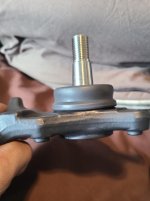
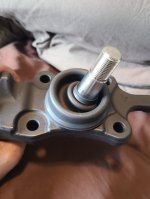
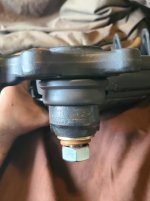
LBJ Uniball?

I've snapped the washer style bolts and the flange style bolts. Where did you hear that one was "much" stronger then the other? If you have any actual data to post please do. Then we can compare that to the known data for 10.9's. I have never been able to find out what grade the OEM bolts are. My best guess would be 8.8.

Metric grade numbers are very easy. The first number is the tensile strength of the bolt in Newton/mm2. So a 8.8 is 800 N/mm2. A 10.9 is 1000 N/mm2. Pretty easy to understand one is 25 stronger then the other in tensile applications.

I was watching Timmy the toolman's video on replacing the lower ball joint and I checked out this link that he mentioned.

The different LBJ bolts and why it's important, Prado 90 Series — Mighty 90s Forum

Basically it looks like there's two different bolts, a stronger one and a weaker one, why they made the weaker one I'm not really sure... I mean it's longer so that way they can use the dust cover or whatever but the bolt is definitely weaker than the other one.

Here is a snip from that link:

Without dust covers:
8x 90105-10406 - green coated flange head bolt - 80nm - tensile estimate 12.9

With added dust covers, use 2 of each per side:
4x 90119-10933 - longer washer-head bolt - 50nm~59nm* - tensile estimate 8.8
4x 90105-10505 - red coated flange head bolt - 50nm~59nm* - tensile estimate 8.8
* 50~59nm is an approximation, not 100% confirmed.
 
Here is a snip from that link:

Without dust covers:
8x 90105-10406 - green coated flange head bolt - 80nm - tensile estimate 12.9

With added dust covers, use 2 of each per side:
4x 90119-10933 - longer washer-head bolt - 50nm~59nm* - tensile estimate 8.8
4x 90105-10505 - red coated flange head bolt - 50nm~59nm* - tensile estimate 8.8
* 50~59nm is an approximation, not 100% confirmed.

That article is interesting, but I'd take it with a big grain of salt. He appears to be basing his tensile strength conclusions entirely on his torque test, which, as he says, were rudimentary. He doesn't say how many of each bolt type he tested - hopefully more than one, to get any statistical confidence.

And, as the one comment correctly points out, he is comparing torque to stretch, not load to stretch, which is dicey. Different bolt types have different friction properties (especially when comparing a flange head bolt to a bolt with washer), so 30 ft-lbs of torque may apply a 5,000 lbs load to one bolt type, but only 3,000 lbs to another bolt type. To do this correctly, he'd need to put the bolts in an Instron machine and measure the actual breaking load.

There may well be a difference in strength, but this test does not really prove that. And it would be really strange for Toyota to put the same bolt head markings on different grade bolts.
 
I went to the ARP bolts and torqued them to 54 pounds feet per ARP's recommendation. I'm opting to use loctite blue because I don't want to have to use heat to break the bond, it's just to keep them from wiggling loose for whatever reason.

I bought an extra pack (they come in a 5 pack) to keep on hand along with a small bottle of 242 and a torque wrench on the truck.

If this approach fails for whatever reason I will let y'all know.

Sent from my Pixel 4 XL using Tapatalk
 
That article is interesting, but I'd take it with a big grain of salt. He appears to be basing his tensile strength conclusions entirely on his torque test, which, as he says, were rudimentary. He doesn't say how many of each bolt type he tested - hopefully more than one, to get any statistical confidence.

And, as the one comment correctly points out, he is comparing torque to stretch, not load to stretch, which is dicey. Different bolt types have different friction properties (especially when comparing a flange head bolt to a bolt with washer), so 30 ft-lbs of torque may apply a 5,000 lbs load to one bolt type, but only 3,000 lbs to another bolt type. To do this correctly, he'd need to put the bolts in an Instron machine and measure the actual breaking load.

There may well be a difference in strength, but this test does not really prove that. And it would be really strange for Toyota to put the same bolt head markings on different grade bolts.

Well that may be true, but I think in a real world setting this could explain why some people have had failures and some people have not. In terms of the boat shearing. If nothing else his test does show that torquing the weaker bolt to the higher amount does cripple it, so it could be that both bolts are strong enough load wise, but over torquing the weaker one cripples it to where it is no longer strong enough if that makes sense.

I mean we definitely know, again that some people have this issue and some people don't, so I feel like this could be a good explanation.

With my lower ball joints I ordered the newer version of the stronger bolt, when it comes in I'll take a picture of it and see if it does have that same green coating

Lastly, I do agree that it would be very strange to give them the same markings, but honestly I've seen Toyota do other weird things that don't make sense so I wouldn't put this past them lol
 
Last edited:
That article is interesting, but I'd take it with a big grain of salt. He appears to be basing his tensile strength conclusions entirely on his torque test, which, as he says, were rudimentary. He doesn't say how many of each bolt type he tested - hopefully more than one, to get any statistical confidence.

And, as the one comment correctly points out, he is comparing torque to stretch, not load to stretch, which is dicey. Different bolt types have different friction properties (especially when comparing a flange head bolt to a bolt with washer), so 30 ft-lbs of torque may apply a 5,000 lbs load to one bolt type, but only 3,000 lbs to another bolt type. To do this correctly, he'd need to put the bolts in an Instron machine and measure the actual breaking load.

There may well be a difference in strength, but this test does not really prove that. And it would be really strange for Toyota to put the same bolt head markings on different grade bolts.

Speaking of the tests, that machine that you mentioned, do you happen to have one? If so I could send you a few of the bolts that I ordered so we can actually know for sure finally.

If not, do we know of anyone on the forms that has the equipment to do the actual test? I'd be more than willing to ship some of these bolts if they could do the test.
 
I was watching Timmy the toolman's video on replacing the lower ball joint and I checked out this link that he mentioned.

The different LBJ bolts and why it's important, Prado 90 Series — Mighty 90s Forum

Basically it looks like there's two different bolts, a stronger one and a weaker one, why they made the weaker one I'm not really sure... I mean it's longer so that way they can use the dust cover or whatever but the bolt is definitely weaker than the other one.

Here is a snip from that link:

Without dust covers:
8x 90105-10406 - green coated flange head bolt - 80nm - tensile estimate 12.9

With added dust covers, use 2 of each per side:
4x 90119-10933 - longer washer-head bolt - 50nm~59nm* - tensile estimate 8.8
4x 90105-10505 - red coated flange head bolt - 50nm~59nm* - tensile estimate 8.8
* 50~59nm is an approximation, not 100% confirmed.

It is an interesting article. There's no way any of those bolts are 12.9's though. I've said this before but I'd love for someone to do a proper test with 100 of each of these and going until failure. Then average those numbers. That would tell us all we need to know. I'm way to lazy and stand by my experience of after market 10.9s not breaking under hard wheeling conditions.


That article is interesting, but I'd take it with a big grain of salt. He appears to be basing his tensile strength conclusions entirely on his torque test, which, as he says, were rudimentary. He doesn't say how many of each bolt type he tested - hopefully more than one, to get any statistical confidence.

And, as the one comment correctly points out, he is comparing torque to stretch, not load to stretch, which is dicey. Different bolt types have different friction properties (especially when comparing a flange head bolt to a bolt with washer), so 30 ft-lbs of torque may apply a 5,000 lbs load to one bolt type, but only 3,000 lbs to another bolt type. To do this correctly, he'd need to put the bolts in an Instron machine and measure the actual breaking load.

There may well be a difference in strength, but this test does not really prove that. And it would be really strange for Toyota to put the same bolt head markings on different grade bolts.

Yep. A real test needs to be done. You are just the guy to do it. I'll donate $50 to help offset the bolt cost if you decide it would be a fun side project. I'm sure others will also help offset the bolt cost. One thing I'd like to see if it's done is all the bolts stripped of whatever coating they have applied. That way we can be relatively sure they are all being dry torqued.


I went to the ARP bolts and torqued them to 54 pounds feet per ARP's recommendation. I'm opting to use loctite blue because I don't want to have to use heat to break the bond, it's just to keep them from wiggling loose for whatever reason.

I bought an extra pack (they come in a 5 pack) to keep on hand along with a small bottle of 242 and a torque wrench on the truck.

If this approach fails for whatever reason I will let y'all know.

Sent from my Pixel 4 XL using Tapatalk

Contrary to popular opinion you do not need heat to back out red loctited bolts. You just need an impact with balls or a breaker bar. I've had blue fail and allow them to back out. It's why I switched to red. My next step if red didn't work was gonna be JB Weld. lol
 
Last edited:
Speaking of the tests, that machine that you mentioned, do you happen to have one? If so I could send you a few of the bolts that I ordered so we can actually know for sure finally.

If not, do we know of anyone on the forms that has the equipment to do the actual test? I'd be more than willing to ship some of these bolts if they could do the test.

Yep. A real test needs to be done. You are just the guy to do it. I'll donate $50 to help offset the bolt cost if you decide it would be a fun side project. I'm sure others will also help offset the bolt cost. One thing I'd like to see if it's done is all the bolts stripped of whatever coating they have applied. That way we can be relatively sure they are all being dry torqued.

I'd be happy to oblige. Let me see what skids I need to grease to get this done, and I'll get back to you. I think that 5 bolts of each type should be more than enough to get a reliable idea of their breaking strength.
 
I'd be happy to oblige. Let me see what skids I need to grease to get this done, and I'll get back to you. I think that 5 bolts of each type should be more than enough to get a reliable idea of their breaking strength.

Radical. I can send you 5 of the "newer" bolts, part number 90080-10066.
[MENTION=143526]theesotericone[/MENTION]

Since you offered to help as well, maybe you could get five of the newer, supposedly weaker bolts, and send them?

If we can make this happen, the whole community will finally know. Would definitely love to save people from using the wrong part. Especially if 90080-10066 is indeed strong and safe to use, because it's pretty damn cheap from Toyota!
 
I would be willing to send some "used" bolts that only have a few thousand miles and about 5 hard wheeling trips on them. Would be a good comparison to see if they lose strength after a bunch of hard hits.
 
One thing I'd like to see if it's done is all the bolts stripped of whatever coating they have applied. That way we can be relatively sure they are all being dry torqued.

I missed this part at first. I'd want to have them tensile tested, as that is the ultimate indication of the bolt's strength. All tests involving torque are going to be less indicative of the actual bolt strength, and more dependent on friction in the threads and under the head. Trying to strip any coatings will help, but still leaves room for inconsistency.

So I'll try to get access to an Instron to pull those suckers to failure and see what that tells us.
 
Okay so apparently I only have four spares versus five. For some reason I was really thinking that I had sex but I guess I only ordered for additional. Are we good with testing for? If not I can get some more but I just wanted to check.

Also for that last post, I don't think it would hurt to test that other brand, would be good to know if they do match up to what they list.
 
I have a couple spare ARPs and 8 spare early style LBJ bolts, new and not installed ever.

What do you think the tensile load will be to failure?
 
Awesome. Stoked to see this.

I am happy to help in whatever way I can as well. I used to be a Toyota Parts Manager and still have full access to the Toyota system and can still aquire parts very "cheap". Happy to purchase any of the bolts we are missing and send them out.

Another interesting thing I've been looking at is the 1G Tundra LBJ/Spindle conversion. This might be a stretch - but is it worth testing the Tundra bolts for comparison sake as well?

Another thought I had on the ARP bolts - I have physically seen a LBJ failure where the threads released on the spindle and the LBJ bolts popped out of the spindle causing the end result we all know and hate to see. I have no idea what bolts the owner was running, if/what loctite was used, if the bolts were new/used, etc etc. But it did make me wonder if that is a realistic failure point? If we upgrade to stronger bolts - how soon (or at all) does the spindle threads become the weak point? (hoping some of you engineers can shed some light).
 
It would be great to have an ARP bolt tested as well, for comparison to OEM.

I'm still working on getting this done on the side in our facility. If not, we'll have to go to an outside vendor, and the quotes I'm getting are about $3K.

I suppose if we spread this cost over all the folks that would be interested in the results over all the forums it won't be all that bad? Perhaps we can set up a GoFundMe page for that (I have zero experience with that).

Anyway, I'm happy to take the lead on getting this arranged from the technical standpoint, but who wants to volunteer to be the crowdsourcing POC if I can't get this done in-house? Maybe we need to recruit [MENTION=120071]mtbtim[/MENTION] :).
 
Boot update

I have found a viable boot option.
Howe Racing p/n 22399V. You MUST get the larger boots with p/n 22399V. The boots with p/n 223991 are slightly smaller and will not work.
I initially came across these while looking at shifter boots for tractors and forklifts; someone on some forum mentioned how these worked for his unit, yadda yadda. Ironically enough when these arrived from summit they even had a little sticker on them that straight up said "shifter boot"
It fits PERFECTLY around both the cup and the stud, fits perfectly between the LBJ and lower control arm, and allows for the ball joint to articulate fully in both directions without being yanked out of position. With a little bead of silicone around the bottom edge this would be absolutely water tight. Hell, maybe a zip tie would do the trick
Pics below. :reddance:
 

Attachments

  • 20220606_185422.jpg
    20220606_185422.jpg
    125.7 KB · Views: 253
  • 20220606_185433.jpg
    20220606_185433.jpg
    126 KB · Views: 253
  • 20220606_190342.jpg
    20220606_190342.jpg
    123.8 KB · Views: 264
Last edited:
Awesome. Stoked to see this.

I am happy to help in whatever way I can as well. I used to be a Toyota Parts Manager and still have full access to the Toyota system and can still aquire parts very "cheap". Happy to purchase any of the bolts we are missing and send them out.

Another interesting thing I've been looking at is the 1G Tundra LBJ/Spindle conversion. This might be a stretch - but is it worth testing the Tundra bolts for comparison sake as well?

Another thought I had on the ARP bolts - I have physically seen a LBJ failure where the threads released on the spindle and the LBJ bolts popped out of the spindle causing the end result we all know and hate to see. I have no idea what bolts the owner was running, if/what loctite was used, if the bolts were new/used, etc etc. But it did make me wonder if that is a realistic failure point? If we upgrade to stronger bolts - how soon (or at all) does the spindle threads become the weak point? (hoping some of you engineers can shed some light).

See this is what I wonder about as well.

So here's something I thought of last night. What if we switched to a longer bolt, it can be the same strength as the stronger oem, again assuming that one of the OEM ones is stronger than the other, and on the threads that come out above the top of the knuckle, we add a nut there. Basically the idea is to take some of the stress off of the knuckle threads bad "adding more" with a nut above the top of the knuckle threads.

You could almost think of it as if we were making the knuckle part a little bit thicker to have more threads.

No I don't know what you would torque the talking to, since obviously it wasn't designed to be set up this way, but I would be curious to see if this could provide more support.

I'll see if I can draw up some kind of a schematic example
 
I always like to use through bolts and nuts rather that tapped holes and screws, so I am all for the through bolt solution.

Is there room above the knuckle for a nut? If there is, the right way to do this would be to drill out the tapped holes in the knuckle to increase the diameter, and then use a longer and stronger bolt with a high strength flange nut - you can even step up to a locknut, to reduce the concern for loosening.

That would be a great setup - if there is room above the knuckle.

EDITED: this approach also requires that the top side of the knuckle be flat and perpendicular to the bolt - from the photos I'm seeing, it's not, so you can't use a nut on the back side without machining a flat on the knuckle first.
 
Last edited:

Members online

Forum statistics

Threads
278,310
Messages
3,554,077
Members
248,016
Latest member
Advally Service

Trending content

Back
Top