LBJ Uniball?

I seem to recall that in bolted joints the first 3-4 threads carry nearly all of the load. Extra threads are nice for redundancy but are not going to make the joint really stronger. The loaded shear area of the threaded portion is larger than that of the bolt so it's rare that the threads should strip out. If they do we need to be talking 'bout helicoils.
 
I have found a viable boot option.
Howe Racing p/n 22399V. You MUST get the larger boots with p/n 22399V. The boots with p/n 223991 are slightly smaller and will not work.
I initially came across these while looking at shifter boots for tractors and forklifts; someone on some forum mentioned how these worked for his unit, yadda yadda. Ironically enough when these arrived from summit they even had a little sticker on them that straight up said "shifter boot"
It fits PERFECTLY around both the cup and the stud, fits perfectly between the LBJ and lower control arm, and allows for the ball joint to articulate fully in both directions without being yanked out of position. With a little bead of silicone around the bottom edge this would be absolutely water tight. Hell, maybe a zip tie would do the trick
Pics below. :reddance:

Nice work!!! Ya dun good, Bubba! :first:

Note: these boots state they are made of Viton which is a fluoroelastomer. These should be super durable and last a long time -- not your run-of-the-mill crapperware as Uncle Rico would say.
 
Last edited:
OK, I may be able to get some Instron time. From what I am hearing, Instron time is "expensive", so we may need to limit how many of each type of bolt we test.

So whoever has (or can get) the bolts they want to contribute to this test, I'd love to start getting them ready for when the Instron time window opens up - I may need to jump at the opportunity quickly once it opens.

PM me for my shipping details.

I think 4-5 of each type should be plenty - two for tensile test, one or two for torque-to-failure test, and one spare.

Here is what I think we should test:

90105-10406 - (superceded by 90080-10066) - green coated flange head bolt
90119-10933 - longer washer-head bolt
90105-10505 - red coated flange head bolt
ARP (663-1003) - supposedly >180 ksi tensile strength

This will be fun and hopefully very useful to the community.
 
Nice work!!! Ya dun good, Bubba! :first:

Note: these boots state they are made of Viton which is a fluoroelastomer. These should be super durable and last a long time -- not your run-of-the-mill crapperware as Uncle Rico would say.

a9b185d9ccf030beb2b4ca493357349d.jpg


Sent from my Pixel 4 XL using Tapatalk
 
I seem to recall that in bolted joints the first 3-4 threads carry nearly all of the load. Extra threads are nice for redundancy but are not going to make the joint really stronger. The loaded shear area of the threaded portion is larger than that of the bolt so it's rare that the threads should strip out. If they do we need to be talking 'bout helicoils.

A bolt is considered fully engaged if it's threaded into the hole the bolts diameter. So 1/2" bolt needs 1/2" engagement to be at rated strength. You could very well be correct about some threads taking more load then others though.


OK, I may be able to get some Instron time. From what I am hearing, Instron time is "expensive", so we may need to limit how many of each type of bolt we test.

So whoever has (or can get) the bolts they want to contribute to this test, I'd love to start getting them ready for when the Instron time window opens up - I may need to jump at the opportunity quickly once it opens.

PM me for my shipping details.

I think 4-5 of each type should be plenty - two for tensile test, one or two for torque-to-failure test, and one spare.

Here is what I think we should test:

90105-10406 - (superceded by 90080-10066) - green coated flange head bolt
90119-10933 - longer washer-head bolt
90105-10505 - red coated flange head bolt
ARP (663-1003) - supposedly >180 ksi tensile strength

This will be fun and hopefully very useful to the community.

Shoot me a PM with your paypal and I'll send $50 to help offset the cost. Thanks for looking into this and trying to push it forward. I know it's a big ask. I'm pretty sure you like facts as much as I do. The data this produces will finally put an end to the wife's tales.
 
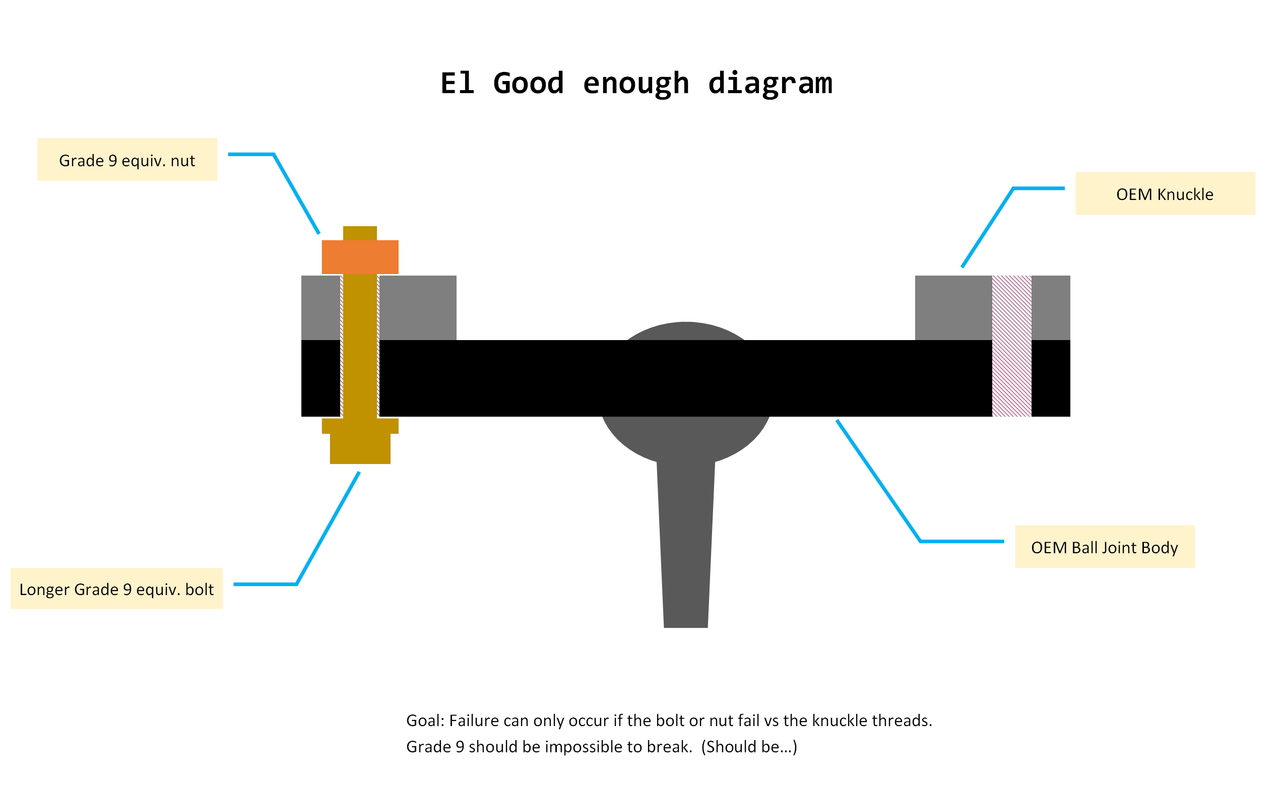
As others have said the top surface of the knuckle (where the nut sits) is not flat though. Maybe if you made a small spacer that would make it a flat surface that would work..

Ah I see, I wonder if it would be possible to forge some kind of mini adapter, something that would fit the top curve of the knuckle and then provide a flat top?

We should convert from bolts to high strength studs. Is there an ARP equivalent?

Oh so you're thinking just skip the threads of the knuckle entirely?
 
As others have said the top surface of the knuckle (where the nut sits) is not flat though. Maybe if you made a small spacer that would make it a flat surface that would work..

The outboard holes are blind, the end of the bolts don't protrude
We should convert from bolts to high strength studs. Is there an ARP equivalent?
A bolt head provides more protection than exposed thread and a fastener, plus, lifting a spindle loaded with brakes, axle, etc and aligning it into 4 holes while not damaging the threads on 4 studs is impractical. I like bolts I can replace.

Sent from my Pixel 4 XL using Tapatalk
 
The outboard holes are blind, the end of the bolts don't protrudek

You beat me to it, I was under the truck this morning to look into this :). As you said, the outer holes are blind. And the upper side of the knuckle is sloped/curved, not flat. You wouldn't want to use a nut on that surface without machining it:

sXtlYaEh.jpg


lpY6D8Kh.jpg


I wonder if it would be possible to forge some kind of mini adapter, something that would fit the top curve of the knuckle and then provide a flat top?

Not realistically - if you look at the rear bolt in the first picture (just to the left of the crimp on the axle boot clamp), you can see that the upper surface is not just a flat slope, it's some kind of a curved slope. We'd need some kind of a multi-faceted adapter, not just a wedge - way too hard to design and build, and likely to end up putting the bolt into bending, which is the last thing we'd want.

As discussed earlier, it'd be extremely unusual for a properly threaded and preloaded bolt to shear out of steel threads. I suspect that in the cases that it happened, the threads might have been damaged by cross-treading or wear.
 
Shoot me a PM with your paypal and I'll send $50 to help offset the cost. Thanks for looking into this and trying to push it forward. I know it's a big ask. I'm pretty sure you like facts as much as I do. The data this produces will finally put an end to the wife's tales.

Thanks for the offer man, but I'm happy to do it just for the fun of it, the bolts aren't all that expensive (especially if the other offers to send over some bolts come through). I'll even cover the donuts for the Instron guys.

If my Instron contact falls through, I found a much more affordable outside lab than the $3K-$6K quotes I got, so we have options.

So here's the tally for what we need and who volunteered what:

(5) 90105-10406 - (superceded by 90080-10066) - [MENTION=388984]jross20[/MENTION] will send them
(5) 90119-10933 - longer washer-head bolt - ??
(5) 90105-10505 - red coated flange head bolt - ??
(5) ARP (663-1003) - [MENTION=95183]octanejunkie[/MENTION] will send them - your PM Inbox is full, my friend :).
[MENTION=148218]JZiggy[/MENTION] - you said you have 8 spare early style LBJ bolts, which of the above part numbers are they?
[MENTION=63060]rickashay[/MENTION] says he can supply the remaining bolts.

 
Thanks for the offer man, but I'm happy to do it just for the fun of it, the bolts aren't all that expensive (especially if the other offers to send over some bolts come through). I'll even cover the donuts for the Instron guys.


If my Instron contact falls through, I found a much more affordable outside lab than the $3K-$6K quotes I got, so we have options.


So here's the tally for what we need and who volunteered what:


(5) 90105-10406 - (superceded by 90080-10066) - [MENTION=388984]jross20[/MENTION] will send them

(5) 90119-10933 - longer washer-head bolt - ??

(5) 90105-10505 - red coated flange head bolt - ??

(5) ARP (663-1003) - [MENTION=95183]octanejunkie[/MENTION] will send them - your PM Inbox is full, my friend :).


[MENTION=148218]JZiggy[/MENTION] - you said you have 8 spare early style LBJ bolts, which of the above part numbers are they?


[MENTION=63060]rickashay[/MENTION] says he can supply the remaining bolts.
ARP bolts shipped to Leon

Sent from my Pixel 4 XL using Tapatalk
 
Leon what I have are 8 of part number 9008010066

Ah, ok - I think [MENTION=388984]jross20[/MENTION] is supplying those.

I'll do a quick shout out to [MENTION=63060]rickashay[/MENTION] for the ones below, otherwise I'll grab them myself this weekend:

(5) 90119-10933 - longer washer-head bolt

(5) 90105-10505 - red coated flange head bolt
 
You beat me to it, I was under the truck this morning to look into this :). As you said, the outer holes are blind. And the upper side of the knuckle is sloped/curved, not flat. You wouldn't want to use a nut on that surface without machining it:

sXtlYaEh.jpg


lpY6D8Kh.jpg


Not realistically - if you look at the rear bolt in the first picture (just to the left of the crimp on the axle boot clamp), you can see that the upper surface is not just a flat slope, it's some kind of a curved slope. We'd need some kind of a multi-faceted adapter, not just a wedge - way too hard to design and build, and likely to end up putting the bolt into bending, which is the last thing we'd want.

As discussed earlier, it'd be extremely unusual for a properly threaded and preloaded bolt to shear out of steel threads. I suspect that in the cases that it happened, the threads might have been damaged by cross-treading or wear.

Well damn. Lol.

Yeah the only thing that I worry about is if you're adding a stronger bolt, and torquing it to the same amount as the standard bolt, since torquing has to do with stretch and creating a blocking connection, isn't the difference of stretch due to different tensile strength going to affect the threads on the knuckle?

That was why I originally was asking if we were sure it was safe, and also why I came up with the idea of taking the stress away from the threads of the knuckle with a bolt.

Beyond that, the only other idea I can come up with, which may not be possible, would be if somebody designed some kind of a clamp that mechanically holds the body of the ball joint to the knuckle. Like if you imagine a clamp on each side. But whether there's enough room or not or any way to attach something that will be strong enough to actually help I'm not sure...

Oh here's another idea. Is there any way that somebody might be able to donate a knuckle (maybe one that is damaged from a wrecked truck but the threads are still okay) in which we can test the maximum strength of the threads inside of the knuckle?
 
Ah, ok - I think [MENTION=388984]jross20[/MENTION] is supplying those.

I'll do a quick shout out to [MENTION=63060]rickashay[/MENTION] for the ones below, otherwise I'll grab them myself this weekend:

(5) 90119-10933 - longer washer-head bolt

(5) 90105-10505 - red coated flange head bolt

I’ll check my ETA tomorrow and send you a message.
 
Might be a stupid question so bear with me... but are uniballs supposed to move in only one direction as opposed to the free articulation in regular ball joints? I'm just now noticing these don't move 360 degrees like before, only back and forth one way
 
I've had knuckle threads strip on a different application ('87-'91 Camry) - same bolt-up-from-the-bottom setup. The threads strips because crap is pulled back down from the free threads and wears out the tapped hole in the knuckle. In that application, I used the bolt and nut method to 'fix' it. That one isn't under constant tension though, so less overall stress on the joint.

It is pretty clear that the different torque requirements for the bolts is the different head/washer design. Testing with stretch gauge and confirming head markings would be good evidence. Most Toyota bolts are marked with their strength, as called out in the FSM.

-Charlie
 

Members online

Forum statistics

Threads
278,309
Messages
3,554,075
Members
248,016
Latest member
Advally Service

Trending content

Back
Top