
You are using an out of date browser. It may not display this or other websites correctly.
You should upgrade or use an alternative browser.
You should upgrade or use an alternative browser.
LT tires need more air pressure.
- Thread starter JB.
- Start date


scanny
Senior Member
IMHO everything is quite clear. Your 4Runner user manual says what minimum load is required for tires, LT load tables provides information about tire pressure for the load. Tire itself have maximum pressure written on sidewall. So you can set pressure above minimum but no more than maximum.
For me good pressure for stock size C load LT tires is between 36 and 38 psi. If I remember correctly minimum pressure is 35 psi and maximum is 50.
For me good pressure for stock size C load LT tires is between 36 and 38 psi. If I remember correctly minimum pressure is 35 psi and maximum is 50.
The only thing I've given up on is trying to point out the limits of using static footprint to determine psi.
STATIC footprint? That's the real footprint in real driving conditions. You can also see from the pictures that BOTH sides of the tire are being affected.
Beats me how anyone can still stick to the theory when so much of this LT tire isn't being used even at stock P tire pressure. I don't even have to guess how uneven those tires will wear out, not to mention how badly the car handles if left tiptoeing on this aggressive type of tire at higher PSIs.
Last edited:
Mehrsaleem
New member
Tire
First of all, it's not a bad thing to have trust in your mechanics. They are going to have to fix a whole lot more than bad tires in the future. But, tires are one thing you have a little control over with just a little bit of knowledge. This way you can make sure you are getting exactly what you need for the price you deserve to pay.
Wood Lathes Canada | Just Another WordPress Site
First of all, it's not a bad thing to have trust in your mechanics. They are going to have to fix a whole lot more than bad tires in the future. But, tires are one thing you have a little control over with just a little bit of knowledge. This way you can make sure you are getting exactly what you need for the price you deserve to pay.
Wood Lathes Canada | Just Another WordPress Site

Dunehunter
New member
Addendum
So here it is, 2017 and this is STILL a great thread and starting post. Kudos to JB. Lots of information here for those who care to read all the details.
And let it be further noted that most of us here on this forum have already traded in the OEM P-rated tires for LT-rated tires of the same or possibly larger size. Based on everything I've read on this thread thus far, I can assume that there are a lot of people who have, in the past, had the same question regarding inflation pressure and their conclusions have run the gamut.
I traded in my Dunlops for a set of Light Truck Goodyears that were snow-rated but still at the stock size: 265 70R 17. I contacted Goodyear for the inflation pressure and they told me that I should inflate to 50psi to match the stock rating. But, as JB noted in one of the later posts, they did not de-rate the OEM P-rated tire (as did the manufacturer according to Federal Motor Vehicle Safety Standards spec of 1.10). Therefore, the number Goodyear gave me was high.
Using the original data provided by JB (via Toyo), I curve-fit exponential equations to the lines produced by both the P-rated and LT-rated 265 70R 17 data and was delighted to empirically produce what I think is the proper inflation pressure of 43psi--strikingly close to JB's 44psi. Either would work just fine, I think.
To conclude this rather longish post, I add a link (did it work?) to a service bulletin from Nitto regarding inflation pressures of LT tires and problems with heat build-up. This is for all of you who are trying to "feel" what the right pressure is. Pictures are worth a thousand words.
Good luck and great trucking!
...to match the load capacity of a P-metric tire.*
*A Standard Load tire (SL), usually P-metric (or metric, euro-metric -- a nearly identical twin). This is the tire found on nearly every new car, SUV, and Light Truck. On the sidewall it looks like P265/70/17 (or 265/70/17) as opposed to LT265/70/17.
How much more pressure?
- 10-15lbs, if an LT is switched for a P-metric tire with the same dimensions.
- LT load range (C,D,E) doesn't affect this.
- Tire size does.
This continues to come up and is often a source of confusion.
Not surprising though, considering that both of the following statements are true:
LTs carry less load than P-metric.
LTs carry more load than P-metric.
Throw Load Range into the discussion and things get nice and tangled. Describing the relationships in words doesn't paint a clear picture so I thought I'd try to make some -- pictures, that is.
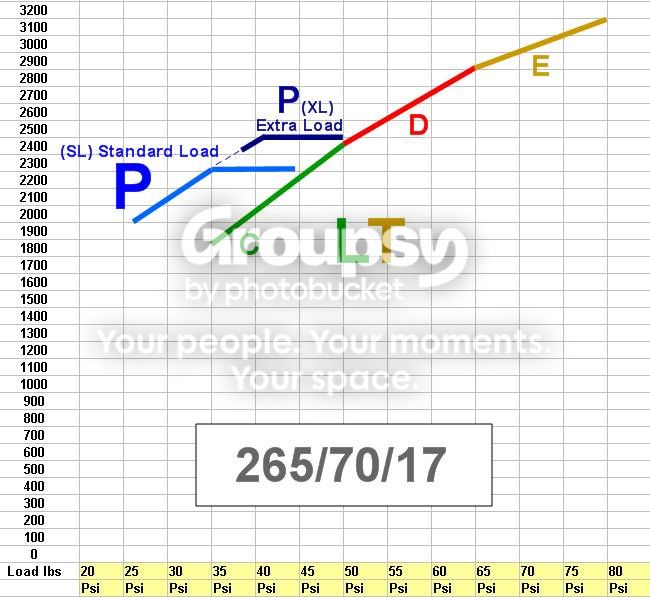
The charts are based on tire size 265/70/17 and, in the 2nd chart, how it relates to the 5th gen 4Runner because that proved easiest, but the application to other generations is obvious and not too dissimilar. The curves should be reasonably accurate and more than good enough to illustrate the point. P-metric tires get load capacity de-rated 9% when used on an SUV and the curves reflect that. The tables used for reference come from this.
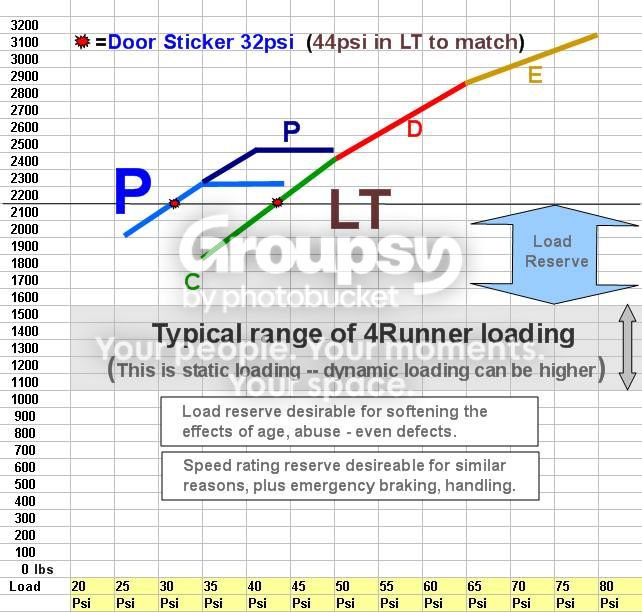
Hopefully it's easy to see how an LT can carry both less and more load than P-metric. It's all about air pressure and, for this tire size, it takes about 12psi added to the LT to match the load capacity of the P-metric tire. Hopefully it's also clear how pretty much the only distinction that matters is between P and LT. Load Range doesn't meaningfully affect the choice of air pressure for LT -- unless very high pressures are desired -- since the the longer load E curve is overlapped by the shorter D and C curves.There may, however, be implications for speed capability in the selection of load range. See Baldwin here.
Extending the line for LT down past where it ends (because load tables stop there) in this chart might seem to imply that making a pressure adjustment when switching to LT isn't important since it appears there would still be load reserve at 32psi even if no additional pressure was added, but that doesn't mean there's no benefit to adding more pressure (leaving it at 32 would be the equivalent of around 20psi in the stock tire). For one thing, the curve bends more as it goes down the chart towards zero psi, so calculating it as a straight line overestimates load capacity. Secondly, having plenty of load reserve is desirable since tires change over time -- and they don't get stronger. Lower pressures result in more heat which speeds the process. The cumulative effects of dynamic loading, speed, heat, age, hard use -- not to mention the inevitably lower speed rating in an LT -- are all good reasons the load reserve established by the factory tire at recommended pressure should be given due consideration. If nothing else, the level where the tpms triggers should be a good clue to that. Most of this is covered in the doc already linked. There is also the option to http://www.toyota-4runner.org/general-discussions/110300-ask-tire-engineer.html. The horizontal lines on the P-metric tires represent the ability to add pressure for special conditions (like high speed) but the extra psi assigns no additional load capacity. The language in load tables indicates that extra pressure for LTs at high speed is recommended, as well, and at lower speed thresholds than P-metric. The capability of a tire in both load and speed necessarily overlap each other.
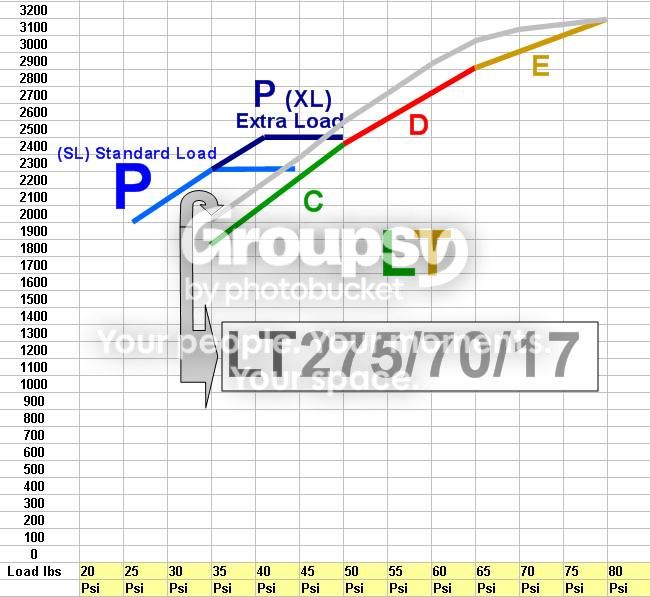
Tire size makes a difference. More air equals more load capacity, whether it's a bigger tire or more pressure in a given tire. The grey curve extends the full distance, so it would be Load E
So here it is, 2017 and this is STILL a great thread and starting post. Kudos to JB. Lots of information here for those who care to read all the details.
And let it be further noted that most of us here on this forum have already traded in the OEM P-rated tires for LT-rated tires of the same or possibly larger size. Based on everything I've read on this thread thus far, I can assume that there are a lot of people who have, in the past, had the same question regarding inflation pressure and their conclusions have run the gamut.
I traded in my Dunlops for a set of Light Truck Goodyears that were snow-rated but still at the stock size: 265 70R 17. I contacted Goodyear for the inflation pressure and they told me that I should inflate to 50psi to match the stock rating. But, as JB noted in one of the later posts, they did not de-rate the OEM P-rated tire (as did the manufacturer according to Federal Motor Vehicle Safety Standards spec of 1.10). Therefore, the number Goodyear gave me was high.
Using the original data provided by JB (via Toyo), I curve-fit exponential equations to the lines produced by both the P-rated and LT-rated 265 70R 17 data and was delighted to empirically produce what I think is the proper inflation pressure of 43psi--strikingly close to JB's 44psi. Either would work just fine, I think.
To conclude this rather longish post, I add a link (did it work?) to a service bulletin from Nitto regarding inflation pressures of LT tires and problems with heat build-up. This is for all of you who are trying to "feel" what the right pressure is. Pictures are worth a thousand words.
Good luck and great trucking!
Attachments
scanny
Senior Member
I still don't understand why people try to match stock tire maximum load with new LT tires. And nobody explained it to me so far : )
All we need to do is to "Check that the number given by dividing the maximum load by 1.10 of the replacement tire is greater than 1/2 of the Gross Axle Weight Ratings
(GAWR) of either the front axle or the rear axle, whichever is greater." as per manual.
So tire pressure should be set to support 1719.5 lbs of weight (for 2010 SR5) which is abut 35 psi on the graph above.
For those who have C load LT265/70R17 tires I can say that past 6 years I was running them at average 36 psi and it's perfectly fine unless you run your truck loaded over maximum weight rating.
All we need to do is to "Check that the number given by dividing the maximum load by 1.10 of the replacement tire is greater than 1/2 of the Gross Axle Weight Ratings
(GAWR) of either the front axle or the rear axle, whichever is greater." as per manual.
So tire pressure should be set to support 1719.5 lbs of weight (for 2010 SR5) which is abut 35 psi on the graph above.
For those who have C load LT265/70R17 tires I can say that past 6 years I was running them at average 36 psi and it's perfectly fine unless you run your truck loaded over maximum weight rating.
Dunehunter
New member
Just sayin'
Take a look at the article from Nitto Tire that I attached. Should answer a lot of questions for you.
I still don't understand why people try to match stock tire maximum load with new LT tires. And nobody explained it to me so far : )
All we need to do is to "Check that the number given by dividing the maximum load by 1.10 of the replacement tire is greater than 1/2 of the Gross Axle Weight Ratings
(GAWR) of either the front axle or the rear axle, whichever is greater." as per manual.
So tire pressure should be set to support 1719.5 lbs of weight (for 2010 SR5) which is abut 35 psi on the graph above.
For those who have C load LT265/70R17 tires I can say that past 6 years I was running them at average 36 psi and it's perfectly fine unless you run your truck loaded over maximum weight rating.
Take a look at the article from Nitto Tire that I attached. Should answer a lot of questions for you.
scanny
Senior Member
Take a look at the article from Nitto Tire that I attached. Should answer a lot of questions for you.
It's sort of not answering my main question, why to match stock P-metric tire maximum load rating when Toyota manual tells us that new tire has to match (or exceed) vehicle load rating. Same logic as with speed rating, nobody tries to match speed rating for stock tires, logical thing is to match your driving maximum speed : )
So I don't really understand the fact that if axles can support maximum of 6,878 lbs, why would we want to inflate our tires to support 8,300 lbs and reduce tires grip as a result.
Dunehunter
New member
It's sort of not answering my main question, why to match stock P-metric tire maximum load rating when Toyota manual tells us that new tire has to match (or exceed) vehicle load rating. Same logic as with speed rating, nobody tries to match speed rating for stock tires, logical thing is to match your driving maximum speed : )
So I don't really understand the fact that if axles can support maximum of 6,878 lbs, why would we want to inflate our tires to support 8,300 lbs and reduce tires grip as a result.
But that's exactly what Toyota is recommending with 32psi on their p-metric tires. If you look at the graph, that's 2200 lbs. Think of it this way: Toyota is overcompensating for the p-metric for potential offroad use by a factor of about 30%. CYA engineering. What they state in the owners manual is the absolute minimum; the lowest rated p-metric goes to around 2000 lbs (in this same size) and takes air at around 27 psi. Can't get anything lower in that size (that I'm aware of). And they're probably trying to avoid the situation that Ford ran into with their low-air Firestones (you know, the whole Explorer thing).
Note as well, there are no LT-metrics (again, in that size) that satisfy the owners manual minimum; the lowest is around 1900 lbs and has an air pressure of 35 psi. There is nothing lower than that (or at least not that I know of). In other words, these curves don't just continue downward other than theoretically.
So the idea is to put a known volume of air into your LT metric so that you are not under-inflated (leading to the high temps and problems down the road). Failure from this type of issue could well be catastrophic in nature and totally unexpected.
If you think of the tires as your foundation, it doesn't matter if they support more than the minimum weight as long as they're carrying the recommended air pressure. In a house, it doesn't matter if the design calls for 2x8 construction and you use 2x12's as joists instead. On the other hand, if the house calls for 2x12 construction and you use 2x8's --trouble.
Last edited:
scanny
Senior Member
But that's exactly what Toyota is recommending with 32psi on their p-metric tires. If you look at the graph, that's 2200 lbs. Think of it this way: Toyota is overcompensating for the p-metric for potential offroad use by a factor of about 30%. CYA engineering. What they state in the owners manual is the absolute minimum; the lowest rated p-metric goes to around 2000 lbs and takes air at around 27 psi. Can't get anything lower in that size (that I'm aware of). And they're probably trying to avoid the situation that Ford ran into with their low-air Firestones (you know, the whole Explorer thing).
Note as well, there are no LT-metrics that satisfy the owners manual minimum; the lowest is around 1900 lbs and has an air pressure of 35 psi. There is nothing lower than that (or at least not that I know of). In other words, these curves don't just continue downward other than theoretically.
So the idea is to put a known volume of air into your LT metric so that you are not under-inflated (leading to the high temps and problems down the road). Failure from this type of issue could well be catastrophic in nature and totally unexpected.
If you think of the tires as your foundation, it doesn't matter if they support more than the minimum weight as long as they're carrying the recommended air pressure. In a house, it doesn't matter if the design calls for 2x8 construction and you use 2x12's as joists instead. On the other hand, if the house calls for 2x12 construction and you use 2x8's --trouble.
I agree that it won't harm if you inflate tires to handle more weight than axles can support. Just don't see it necessary. Keep in mind though that tires won't be in full contact with pavement unless center knobs wear out a little bit.
I don't agree however that stock tire 32 psi is for overcompensating for off-road use. You normally want to lower tires pressure for off-road driving to provide more grip on rocks, mud and sand. 32 psi for P-metrics in my opinion is more about ride quality and maybe compensating for ambient temperature change. Tire inflation sensors are set for way less than 32 psi.
Dunehunter
New member
I agree that it won't harm if you inflate tires to handle more weight than axles can support. Just don't see it necessary. Keep in mind though that tires won't be in full contact with pavement unless center knobs wear out a little bit.
I don't agree however that stock tire 32 psi is for overcompensating for off-road use. You normally want to lower tires pressure for off-road driving to provide more grip on rocks, mud and sand. 32 psi for P-metrics in my opinion is more about ride quality and maybe compensating for ambient temperature change. Tire inflation sensors are set for way less than 32 psi.
For probably the vast majority of T4R owners, their vehicles will never see e a gravel road. Ever. It's a vehicle to schlep the kids around--to get groceries, etc. That's why the p-metric tires. They're far more comfortable--at pressure--than an LT metric. And, they get better gas mileage. Even though the p-metric tire they put on is called an "all terrain", it just doesn't have the characteristics of a tire you'd take off road. Number one, the sidewalls are not very strong so is not the tire you'd air down off road (and feel at ease). On your second point, you and I agree more than we disagree. At pressure (32 psi) I was getting around 22 mpg with the stock tires.
As to the first part, I think we're still pretty far apart. I'm not anything even close to a tire engineer but the tires they put on the vehicle are placarded at 32 psi for a reason. What you're saying is that it should be okay to run them at, say 28 psi, because of the axle loads. What I'm saying is that if I still had the original p-metrics on, I would be airing them to the manufacturers (both vehicle and tire) recommendation to assure the longest life and to avoid overheating at highway speed. I'm assuming there's other design specs at play other than just axle loads.
Saw the pic of your 2010 truck by the way. Nice!
scanny
Senior Member
As to the first part, I think we're still pretty far apart. I'm not anything even close to a tire engineer but the tires they put on the vehicle are placarded at 32 psi for a reason. What you're saying is that it should be okay to run them at, say 28 psi, because of the axle loads. What I'm saying is that if I still had the original p-metrics on, I would be airing them to the manufacturers (both vehicle and tire) recommendation to assure the longest life and to avoid overheating at highway speed. I'm assuming there's other design specs at play other than just axle loads.
Saw the pic of your 2010 truck by the way. Nice!
I'm not tire engineer either but I'm quite sure that tires are made to provide reasonable driveability and handle certain load. I guess we all agree here.
Under driveability I mean that tire should have reasonable grip, responsiveness, noise level, fuel economy and doesn't blow up on small potholes and sharp turns.
Also I assume that tire load table provides correct tire inflation for safe driving at your vehicle GVWR. So I believe that if we inflate tires between minimum pressure per load table and maximum tire inflation pressure we will be safe in terms of load carrying and overheating. As per load table P-metrics are not supposed to fail at about 25psi and LT tires are safe at 35psi. But if you run tires at minimum safe pressure you’re at risk if you have a small leak or if ambient temperature drops too sharp. In the other hand if you inflate tires close to maximum you’re at risk to go over maximum inflation if ambient temperature goes up. So I would say that for peace of mind tires should be inflated a couple psi over minimum allowed pressure or a couple psi less than maximum inflation rate.
If we agree that minimum psi (plus maybe 2 psi for peace of mind) is safe for general driving, then driveability comes up. This is where we have to find a balance and where Toyota recommended 32 psi comes up. As you know the more inflation means less tire contact with road and more tire stiffness. This is good to dry pavement, so if you inflate tires up to the maximum you’ll get better fuel economy, less noise and more stable cornering. But when it’s wet or slippery tire would perform worse due to less contact with road. Less pressure mean less slipping but more noise and worse fuel economy. So I guess that car manufactures test all tire pressures within safe inflation range to recommend best tire pressure for an average driver as they see him/her.
When I got my first set of Duratracs in 2011 I found that at 44psi my tires were as quiet as stock tires and fuel economy improved a little bit. But then when I got on gravel road I felt that my truck is not as stable as I expected from new Duratracs. Gravel road did some sort of chalk test for me, I saw that good portion of tread on my tires was not touching road at all (it was black as opposing dusty tread in the centre). So my next 50,000 miles I drove at average 37 psi including few trips when I drove 600 miles at highway speed in one day. I try to keep it at 36 psi at summer and 38 psi during winter anticipating that temperature drops and my tire pressure goes down overnight : )
So I’m just saying that it’s perfectly fine to run tires LT stock size C-load tires at 36 psi in theory and in practice : )
Dunehunter
New member
I have to confess, on the forest roads around here, I air down my LT metrics somewhat to alleviate that "sliding" feeling. Doesn't take too much to give me stability in the gravel but I'm airing down, nonetheless.

Wild Peak AT3 265/70-17
I picked up my '07 TR4 in March of 2017.
The tires on the truck were the Dunlap GrandTrek 265/70-17s.
I ran them at stock pressures and saw 16.5-18.5mgs city and 19.5-21 hwy.
(Corrected mileage using GPS and actual fuel used)
I recently installed the same size tires, but went with Falkin WildPeak AT3 SLs.
The garage set them to 42 psi and they sounded good while driving (quiet), but they coned out a little in the center, enough to rub on the front body mounts really easy.
I used the TR4 recommended pressures which really helped with any rubbing, but the truck wonders a little more at hway speeds and tires sound like I'm riding on wet tar.
Fuel mileage is really suffering too.
I'm currently up to 36psi F/R and around town seeing 14-14.5 mpg around town. Corrected, I'm still down about 3mpg.
I'm temped to bump up again, closer to 40 psi and see how that works to help bring up the fuel mileage more.
Side notes:
- Tire weights between the GTs and the WP are equal, obviously the tread is more aggressive on the new tires.
-The WP AT3s seem to always look flat with a huge front to back contact patch and sagging sidewalls; while the GTs never seemed that way even with 5-6 psi less.
- There is definitely an odd disconnect between the speedo and odometer too.
My speedo with the new tires is pretty much dead-on (by 3 different GPS devices until 55 mph, then by an indicated 60mph actual speed is 62-63 and by 70mph, it's closer to 6-7 mph off.
That said, my odometer consistently is off about 7-8% no matter the speed.
Anyone else running AT3's? What PSI are you running?
I picked up my '07 TR4 in March of 2017.
The tires on the truck were the Dunlap GrandTrek 265/70-17s.
I ran them at stock pressures and saw 16.5-18.5mgs city and 19.5-21 hwy.
(Corrected mileage using GPS and actual fuel used)
I recently installed the same size tires, but went with Falkin WildPeak AT3 SLs.
The garage set them to 42 psi and they sounded good while driving (quiet), but they coned out a little in the center, enough to rub on the front body mounts really easy.
I used the TR4 recommended pressures which really helped with any rubbing, but the truck wonders a little more at hway speeds and tires sound like I'm riding on wet tar.
Fuel mileage is really suffering too.
I'm currently up to 36psi F/R and around town seeing 14-14.5 mpg around town. Corrected, I'm still down about 3mpg.
I'm temped to bump up again, closer to 40 psi and see how that works to help bring up the fuel mileage more.
Side notes:
- Tire weights between the GTs and the WP are equal, obviously the tread is more aggressive on the new tires.
-The WP AT3s seem to always look flat with a huge front to back contact patch and sagging sidewalls; while the GTs never seemed that way even with 5-6 psi less.
- There is definitely an odd disconnect between the speedo and odometer too.
My speedo with the new tires is pretty much dead-on (by 3 different GPS devices until 55 mph, then by an indicated 60mph actual speed is 62-63 and by 70mph, it's closer to 6-7 mph off.
That said, my odometer consistently is off about 7-8% no matter the speed.
Anyone else running AT3's? What PSI are you running?
Ok so you guys have done a ton of great work here but I'm not smart enough to compile what I need for my situation. Anyone willing to give a suggested pressure I should run on my rig?
- 1997 4runner 4x4 Stock Weight
- LT33X12.5XR17 Atturo Trail Blade M/T Mud-Terrain Radial Tire 114Q 8 Ply D-Load
Your help is appreciated!
- 1997 4runner 4x4 Stock Weight
- LT33X12.5XR17 Atturo Trail Blade M/T Mud-Terrain Radial Tire 114Q 8 Ply D-Load
Your help is appreciated!
MaD HuNGaRIaN
New member
Funny, I switch my 2004 Durango from P245/70/17 to LT265/70/17 several years ago and consulted this very thread to find 44psi as where I wanted to be. Truck and tires did great.
I never really paid attention to this being a 4runner forum at the time, I was just out for tire info.
Fast forward to today. Durango died, got a 2016 4Runner and here I am again.
So who runs LT265/70/17 BFG All Terrain TA/KO on stock rims and what pressures have you found works best?
I never really paid attention to this being a 4runner forum at the time, I was just out for tire info.
Fast forward to today. Durango died, got a 2016 4Runner and here I am again.
So who runs LT265/70/17 BFG All Terrain TA/KO on stock rims and what pressures have you found works best?
LT 285 70/R18 Tire Pressure Chart
I am running 285 70/R17 Cooper ST Maxx on my 2005 4runner, below is the advise from Cooper tire customer support and a loading/psi chart is attached for everyone to review. I am setting all 4 tires to 35 psi on normal load.
======
Always follow the air pressure recommendation of the vehicle manufacturer (as listed on the placard on the door of your vehicle). Proper air pressure is based on the weight of your vehicle and not the brand or type of tire you have. Even though you've changed tire sizes you would still utilize the door placard recommended pressure settings. Also, never exceed the max air pressure as listed on the sidewall of the tire.
=====
I am running 285 70/R17 Cooper ST Maxx on my 2005 4runner, below is the advise from Cooper tire customer support and a loading/psi chart is attached for everyone to review. I am setting all 4 tires to 35 psi on normal load.
======
Always follow the air pressure recommendation of the vehicle manufacturer (as listed on the placard on the door of your vehicle). Proper air pressure is based on the weight of your vehicle and not the brand or type of tire you have. Even though you've changed tire sizes you would still utilize the door placard recommended pressure settings. Also, never exceed the max air pressure as listed on the sidewall of the tire.
=====
Attachments
Raggamuffin
New member
PSI Question
Hello All,
I just purchased a 2018 4R SR5 with the Predator Package. I love this truck so far, but have been getting roughly 11-12 mpg around town, while driving conservatively. I just increased my tires PSI from 27 to 41 and immediately saw an improvement to 17-18 mpg. Can anyone tell me if I have currently overinflated them?
My tire specs are Goodyear Wrangler Duratrac
165/70R/17
Load index of 115
Load Range SL
Speed Rating S
Max PSI 51
Max Load Per Tire 2,679
Thanks for the help!
Hello All,
I just purchased a 2018 4R SR5 with the Predator Package. I love this truck so far, but have been getting roughly 11-12 mpg around town, while driving conservatively. I just increased my tires PSI from 27 to 41 and immediately saw an improvement to 17-18 mpg. Can anyone tell me if I have currently overinflated them?
My tire specs are Goodyear Wrangler Duratrac
165/70R/17
Load index of 115
Load Range SL
Speed Rating S
Max PSI 51
Max Load Per Tire 2,679
Thanks for the help!
Similar threads
- Replies
- 8
- Views
- 6K


- Replies
- 3
- Views
- 15K


