Drivetrain Clunk
A little more info related to this topic that I found very interesting/informative. I posted this a few days ago in the warranty forum, intended to post it here. The info below is from a Tundra forum, but the problem appears to be common among Toyota vehicles:
"On the vast majority of Tundras that experience the thump or bump in the rear when you come to an abrupt stop, it is due to binding in the driveshaft slip yoke. When you come to an abrupt stop, the rear of the truck rises up and elongates the driveshaft (via the slip yoke) in the process. Once you come to a stop, the back of the truck settles back down and the driveshaft compresses. If the truck is in gear, there will be some rotational torque applied to the driveshaft even when stopped. This rotational torque tends to increase the sliding friction in the slip yoke. If the slip yoke is not really well lubricated or the machining is not perfect, the slip yoke will tend to bind up and not compress. Then after you come to a stop, the transmission will downshift. During the downshift, the torque on the driveshaft is released which reduces the friction in the slip yoke and it will compress rather abruptly. This is the "thump" or "bump in the rear" that you are likely feeling. As a test to comfirm, shift the transmission to nuetral before coming to an abrupt stop. If you don't get the "thump" when you do this, but you do get it when the transmission is in drive, then it is very likely binding in the slip yoke.
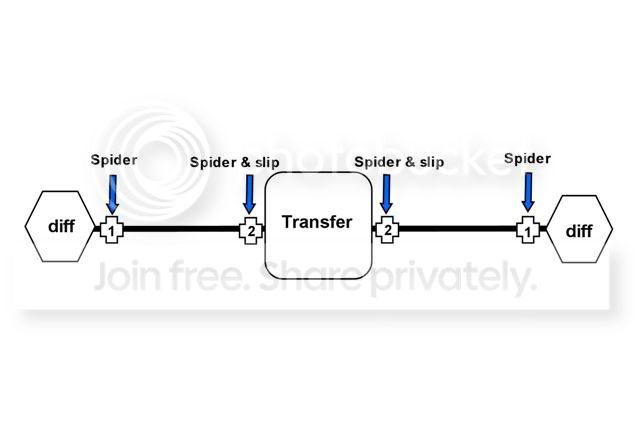
Ok, now that you have determined that it is binding in the slip yoke, you can either fix it yourself or convince your dealer to do it. Dealers don't make much money on warranty repairs unless parts are replaced, so they often may opt to replace the entire driveshaft assembly, which is fine as long as they hand lube the slip yoke with some good quality grease. But replacement of the driveshaft is typically not necessary. The slip yoke just needs to be greased properly, particulary on the 4x4s. 4x4s have the slip yoke at the back of the driveshaft where it connects to the rear end pinion shaft. The 4x4 driveshaft uses 4-bolt flanges at the rear end as well as at the transfer case output shaft. The 4x2 on the other hand has the slip yoke in the tailshaft of the transmission and as far as I know (I have a 4x4) is lubricated by the transmission fluid. I have heard of 4x2s with the thump, but most problems are with the 4x4s. The 4x2s may benefit from had greasing the slip yoke splines, but I have not confirmed this.
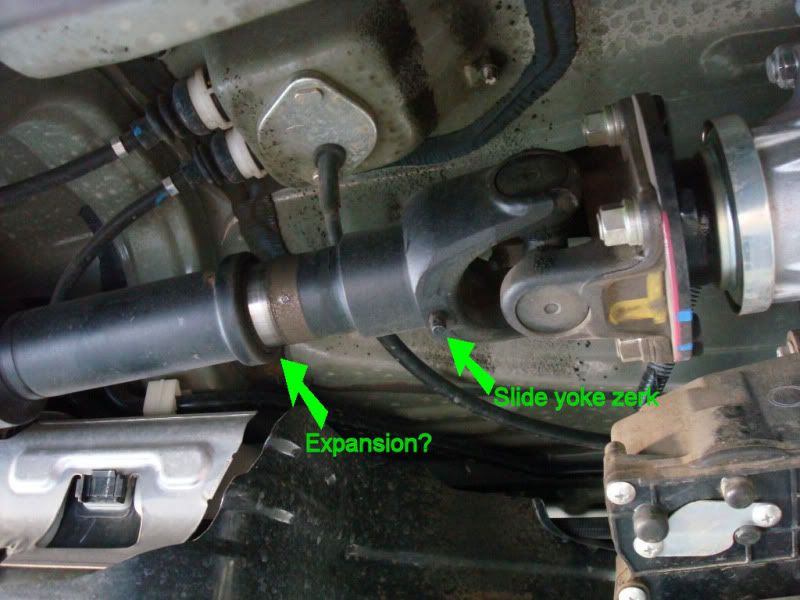
The 4x4 driveshaft slip yoke has a zerk fitting for adding grease; however, it is not very effective at getting grease at the point where the friction is taking place. There is a large void under the zerk fitting and it may take 30-40 pumps on a grease gun to actually get any grease on the splines, depending on how much if any grease was in there to begin with. The splines and seal are very tight and you may encounter significant resistance on the grease gun while grease is migrating along the splines. I've had my driveshaft apart examining the slip yoke and you have two options to properly grease the splines. One is to drop the rear driveshaft where it attaches to the rear end via the 4 bolts (always match-mark the two flanges to ensure you put them back in the same position - also, turn the bolts, not the nuts since the nuts have a high friction base flange to resist turning) and pull the slip yoke apart (again, match mark both halves of the slip yoke to ensure they go back together in the same relative position - the splines do have a wide spline to prevent mismatch; however, it is hard to see which one it is especially with grease on them and it's a pain trying to find just the right spot where they will slip together - match-marking the two halves before disassembly makes this much easier). Once the slip yoke is apart is then readily apparent why putting 5 or 10 shots of grease in the zerk fitting won't do any good. You can then hand lube the splines with a good quality grease. I would clean out as much of the existing grease as possible, but as long as you use a lithum base grease there should be no compatibility problems. Toyota recommends a lithium base NLGI#2 chassis grease for this. I recommend a lithium base molybdenum disulfide (moly) NLGI#2 chassis grease for this, the same grease that Toyota recommends for the double cardon joint. Once you've got everything greased up good, slide the yoke halves back together using the match marks to guide you then put the both flanges together, again using the match marks as a guide, install the bolts and nuts and torque. I think the torque is about 40 ft-lbs, but I don't have my manual handy at the moment. Torque from the bolt head, not the nut since the nut has a high friction base. After it is all together, shoot about 5-10 strokes of grease in the zerk fitting for "reserve", but you do not want it completely full as this will limit compression of the slip yoke.
If all that is a little more than you want to tackle, here is an easier way that is probably just about as effective. Take your grease gun loaded with lithum base moly chassis grease and start pumping grease in the slip yoke zerk fitting. At some point you will encounter significant resistance on the grease gun handle and will likely note that the slip yoke is expanding. Slowly add grease at this point. You will likely see the slip yoke expand on each pump of the handle and then slowly contract. Continue adding grease for about 5-10 more strokes unless you see grease coming around the seal, then stop. Now get on the rear bumper and bounce it up and down a few times. This will tend to compress the slip yoke and force more grease along the splines. Now take a wrench and remove the zerk fitting to allow excess grease to escape. Once the zerk is removed, if a tablespoon or so of grease doesn't come out, then gently bounce on the bumper again to give it a little help. Once the excess grease is out, re-install the zerk, clean up the mess, and you are good to go.
This was known as the "arkie6 fix" over at Tundrasolutions and it resolved many of the "thump" problems people were experiencing, mine included. I initially used the straight lithum base chassis grease on the slip yoke and I started getting a hint of "thump" after about 5,000 miles. I subsequently put in the lithium base moly (an extreme pressure additive) grease and haven't had any hint of "thump" in 15,000+ miles. My truck (2000 Tundra 4x4) now has 28,000+ miles and is "thump" free. "