Parking Brake Repair Procedure Question

https://youtu.be/YHuNLAff1ZY?t=354 Copy and paste into youtube, it will bring it up at the current time.
got it.

how about a video of what YOURS is doing?

if you have the hardware installed correctly, it will work.


when the park brake is applied, the cables pulls the lever out, which in turn pushes the strut. once the opposite shoe(the one the park brake lever is NOT attached to) hits the drum, and can no longer move, the force will then be applied at the park brake lever pivot, and push the other shoe against the drum.


you may or may NOT witness this happening unless the drum is in place. his does in the video, but I have seen it MANY times where they both don't move, unless met with some resistance.
 
got it.

how about a video of what YOURS is doing?

if you have the hardware installed correctly, it will work.


when the park brake is applied, the cables pulls the lever out, which in turn pushes the strut. once the opposite shoe(the one the park brake lever is NOT attached to) hits the drum, and can no longer move, the force will then be applied at the park brake lever pivot, and push the other shoe against the drum.


you may or may NOT witness this happening unless the drum is in place. his does in the video, but I have seen it MANY times where they both don't move, unless met with some resistance.

I will try my best to get a video today if i make it home before it gets dark.

I suspect everyone is right that i won't see this happen unless force is applied. I agree with your strut push return force push out analysis. I think that is what TechWrench was trying to explain.

One thing worries me is that my car did not come with the C (angled) shoe hold down pin. it was straight and slightly bent. Is this possible or was not installed right? every manual shows the C looking type. I will take a picture tonight. I will also compare to the other side and show you that picture as well.
 
I will try my best to get a video today if i make it home before it gets dark.

I suspect everyone is right that i won't see this happen unless force is applied. I agree with your strut push return force push out analysis. I think that is what TechWrench was trying to explain.

One thing worries me is that my car did not come with the C (angled) shoe hold down pin. it was straight and slightly bent. Is this possible or was not installed right? every manual shows the C looking type. I will take a picture tonight. I will also compare to the other side and show you that picture as well.
its been a while since I worked on one, but I think I remember that a straight one would ALMOST work. so perhaps a bent one could work, as long as it didn't rub too badly.

and yes, I believe that's what he was explaining also. its a lot harder with words, than if you were showing them in person.
 
thank you for the great detailed analysis. I Very very much appreciate it!!!!

Still analyzing the second paragraph (quoted text). I have not made it to the rest of the post. Still wrapping my head how that statement reads.
the parking lever rests with the trailing (rear side) shoe. And that is the side that is not actuating. so maybe this is where the problem is

by brake strut do you mean brake cable?

NO, I am referring to the bar that spans between the top part of the two shoes. When installed correctly, notches on each end fit around/in slots in each brake shoe. And, on the trailing shoe side, it rests against the parking brake lever that is attached to the trailing shoe.

The strut is touching the the lever, not attached persay, Yes
Sorry to be tediously strict, i really want to get this right. and the strut is above the pin not below.

NO, the strut sits on the lever just below the pivot pin that holds the lever to the trailing shoe.

unless you are refering to something else I'm not understanding. Edit: do you mean the pin holding the lever shim and trailing shoe together?

Yes, not the pin/spring that hold the shoe against the backing plate.

are you trying to say the parking brake lever pushing on to the strut thus pushes the trailing brake outwards?

Yes, there is a small notch on the inner edge of the lever that hits against the strut. The resistance against the strut at that point acts like a pivot point and causes the top of the lever to push the top of the trailing shoe outward.
so first the lever pushes the strut which pushes the leading brake shoe out, which (leading shoe hits the drum) then therefore pushes back on the trailing shoe pad pushing that out as well. Only way i can make sense out of this. I will read the rest of your post now. or maybe reread that sentence a 100 times.

Truly appreciate the details and length. :beer:

Edit I want to make it clear I'm doing this with the rotor off. but based on the video, I dont see why it won't work correctly. Despite what DG&BRM warning me that it won't work without the rotor. Just trying to understand a bit more .

All of this happens very quickly, and as the following poster states, none of it works as described if the drum is removed. It is the containment of the drum that allows both shoes to move. When one shoe contacts the drum, the pressure is transferred, through the strut and lever to the other shoe.

I have never done it, but I suppose if you could find a strap or hose type clamp large enough to circle the shoes, and act as the drum surface, the actuation would be easier to see.

Also remember, when the star wheel adjuster is adjusted properly, the total movement of each shoe is probably less that 1/16th of an inch outward. It doesn't take much to make it work, when adjusted properly.
 
Last edited:
its been a while since I worked on one, but I think I remember that a straight one would ALMOST work. so perhaps a bent one could work, as long as it didn't rub too badly.

and yes, I believe that's what he was explaining also. its a lot harder with words, than if you were showing them in person.

It too has been a while since I had mine apart, and I am not sure if the one pin was the 'C' type or not. I guess, as long as it didn't interfere with the movement of the lever, a "bent' straight pin would work.

And thanks, it is a bit harder trying to explain the process in words instead of demonstrating with the actual assembly.

I have the factory repair manual, and the best pic they provide is a drawn parts blow-up diagram, which shows all the parts, but doesn't show exactly how they interact or fit together. I have done so many drum brake repairs in the past, that I sometimes forget that what I 'see' in my mind isn't necessary readily evident to the one I am trying to describe it to. It can take WAY TOO many words to describe what may be a relatively easy function to someone who doesn't 'see' it the way you do.
 
Update: One side is working, I think once we freed the other side it started to work.

the angle C type shoe down pin was repalced by the lcoal shop, the other one was bent on the other side. so pretty sure they messed up .

brake shoe was a bit cracked on the side. going to put it back to very both sides working.

Keep you guys updated. You guys are awesome!
 
Success guys! brakes operation

however, the drum part of the rotor must be warped because as i spin it, the brake shoe is touching the drum. I hear this is normal and will fix itself by driving in reverse and engaging the brake a few times. i was planning on changing out the rear drums anyway, maybe even new brake shoes....

I shall make a new post on other problems that arise stay tuned :D
 
Success guys! brakes operation

however, the drum part of the rotor must be warped because as i spin it, the brake shoe is touching the drum. I hear this is normal and will fix itself by driving in reverse and engaging the brake a few times. i was planning on changing out the rear drums anyway, maybe even new brake shoes....

I shall make a new post on other problems that arise stay tuned :D
Not sure what you heard about driving in reverse and applying the parking brake to 'fix' things. On older vehicles, with drum style brakes in the rear, they had a self adjusting system which worked when you applied the brakes while backing up. But the parking brake system on the 4Runners, and most other rear disc systems does not have this self adjusting function. As long as all the moving parts in the parking brake system are working and lubricated, and it is adjusted properly, all you should need to do is apply and release the parking brake a few times while at rest to settle the shoes in their proper position.

Did you adjust the parking brakes after putting the rotor back in place? A suggestion. I use two of the lug nuts and a couple of oversize nuts to tighten the rotor in place before I make the final adjustment of the star wheel. If you don't, making the adjustment can be difficult.
 
Not sure what you heard about driving in reverse and applying the parking brake to 'fix' things. On older vehicles, with drum style brakes in the rear, they had a self adjusting system which worked when you applied the brakes while backing up. But the parking brake system on the 4Runners, and most other rear disc systems does not have this self adjusting function. As long as all the moving parts in the parking brake system are working and lubricated, and it is adjusted properly, all you should need to do is apply and release the parking brake a few times while at rest to settle the shoes in their proper position.

Did you adjust the parking brakes after putting the rotor back in place? A suggestion. I use two of the lug nuts and a couple of oversize nuts to tighten the rotor in place before I make the final adjustment of the star wheel. If you don't, making the adjustment can be difficult.


okay that is good to know then ! Yeah, i did tighten down with a washer and few lug nuts so the rotor was snug. even with the star adjuster all the way down there seemed to be a little drag on the drum. keep in mind the inside drum looked to be in bad shape... I assume its not a perfect circle. I was thinking of replacing them but my dad wants OEM And that is going to take forever to get also considering I want to get this car off the jacks today :( . I want oem too, but napa seems to be really really attractive now.

Also wondering if the brake shoes are warped ever so slightly

I think i might have to keep it on the jackstands for another week not sure if these calipers here are leaking either
http://www.toyota-4runner.org/4th-gen-t4rs/206627-rear-brake-caliper-leaking.html
 
okay that is good to know then ! Yeah, i did tighten down with a washer and few lug nuts so the rotor was snug. even with the star adjuster all the way down there seemed to be a little drag on the drum. keep in mind the inside drum looked to be in bad shape... I assume its not a perfect circle. I was thinking of replacing them but my dad wants OEM And that is going to take forever to get also considering I want to get this car off the jacks today :( . I want oem too, but napa seems to be really really attractive now.

Also wondering if the brake shoes are warped ever so slightly

I think i might have to keep it on the jackstands for another week not sure if these calipers here are leaking either
http://www.toyota-4runner.org/4th-gen-t4rs/206627-rear-brake-caliper-leaking.html

I can understand wanting to stay oem, but I have used NAPA brake parts for years, and I haven't had any problems with their products. As far as the drum inner surface goes. It depends on what you mean by "in bad shape". If one or more of the shoes had come loose from the retaining pins, and was wearing on the drum surface for a while, it could have worn a groove in the contact surface. It all depends on how and how much damage was done. The thing to remember is we are talking about the parking brake system, which as long as it hasn't fallen apart, will have no effect on how the disc brakes work. IMHO, as long as the inner drum surface isn't totally gone, and the shoes have friction material, and they are installed and working as designed, I wouldn't get too critical about small wear issues. If the disc part of the system works properly, and isn't worn enough to cause main braking issues, then I would not be in a rush to replace the rotor just for the parking brake system. After all, how many times do you actually use the parking brakes as compared to the main system? Since I can't see the wear you are seeing, you will have to make the call yourself. I am just trying to suggest that what you are seeing may not be as bad as you think.

I have 124k on my SR5, and it still has the original parking brake shoes. All I have ever had to do is replace two retaining pins that broke. I have had to replace the rear rotors once, but that was for wear to the disc surface, not because of the parking brake system. But, I remove the discs about every two years to clean and lube the parking brake system, and make sure all is working properly, since in NYS, the parking brake system function is part of the yearly safety inspection.
 
I can understand wanting to stay oem, but I have used NAPA brake parts for years, and I haven't had any problems with their products. As far as the drum inner surface goes. It depends on what you mean by "in bad shape". If one or more of the shoes had come loose from the retaining pins, and was wearing on the drum surface for a while, it could have worn a groove in the contact surface. It all depends on how and how much damage was done. The thing to remember is we are talking about the parking brake system, which as long as it hasn't fallen apart, will have no effect on how the disc brakes work. IMHO, as long as the inner drum surface isn't totally gone, and the shoes have friction material, and they are installed and working as designed, I wouldn't get too critical about small wear issues. If the disc part of the system works properly, and isn't worn enough to cause main braking issues, then I would not be in a rush to replace the rotor just for the parking brake system. After all, how many times do you actually use the parking brakes as compared to the main system? Since I can't see the wear you are seeing, you will have to make the call yourself. I am just trying to suggest that what you are seeing may not be as bad as you think.

I have 124k on my SR5, and it still has the original parking brake shoes. All I have ever had to do is replace two retaining pins that broke. I have had to replace the rear rotors once, but that was for wear to the disc surface, not because of the parking brake system. But, I remove the discs about every two years to clean and lube the parking brake system, and make sure all is working properly, since in NYS, the parking brake system function is part of the yearly safety inspection.

Let me ask you this, when i turn the wheel with washers + lug nuts holding down the rotor there should be no drag at all right? There is definitely noise indicating that there is some dragging as i turned the rotor. maybe the excess brake material will be removed while I'm driving? With the staradjuster completely in the down position, there is still some noise as I turn the wheel. (feels like a little bit of brushing) my guess is either the drum is not a perfect circle. or the brake pads are unevenly worn. Or the brake shoe got slightly bent. (They tried to remove the rotor without disengaging the parking brake)

I do realize this is a parking brake, but it can potentially interfere with the rotor no? The parking brake was definitively engaged as the person who tried to fixed it did a really bad job.

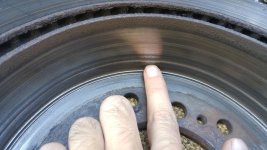
this is the condition of the inside drums.
 

Attachments

  • 0919151503c.jpg
    0919151503c.jpg
    64.1 KB · Views: 1,111
When I replaced my rotor/drum, I adjusted the parking brake all the way inwards to get the rotor off. When I put the rotor back on I had to adjust the parking brake back out quite a ways before I heard the shoes dragging on the new rotor/drum. I don't think that they should be making contact if adjusted all the way in.

More experienced people may quickly chime in and tell me that I'm wrong and I'm OK with that.
 
When I replaced my rotor/drum, I adjusted the parking brake all the way inwards to get the rotor off. When I put the rotor back on I had to adjust the parking brake back out quite a ways before I heard the shoes dragging on the new rotor/drum. I don't think that they should be making contact if adjusted all the way in.

More experienced people may quickly chime in and tell me that I'm wrong and I'm OK with that.

did you put the car back together knowing it was dragging a little bit? Or did you adjust it until you heard nothing?

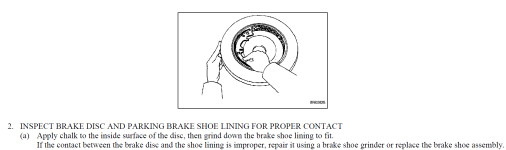
I believe the service manual says to use chalk to determine where it is touching and sand down those high spots?

edit instructions from manual attached as picture.
 

Attachments

  • brakeshoe.PNG
    brakeshoe.PNG
    47.1 KB · Views: 1,092
Last edited:
okay that is good to know then ! Yeah, i did tighten down with a washer and few lug nuts so the rotor was snug. even with the star adjuster all the way down there seemed to be a little drag on the drum. keep in mind the inside drum looked to be in bad shape... I assume its not a perfect circle. I was thinking of replacing them but my dad wants OEM And that is going to take forever to get also considering I want to get this car off the jacks today :( . I want oem too, but napa seems to be really really attractive now.

Also wondering if the brake shoes are warped ever so slightly

I think i might have to keep it on the jackstands for another week not sure if these calipers here are leaking either
http://www.toyota-4runner.org/4th-gen-t4rs/206627-rear-brake-caliper-leaking.html
I suggest you adjust the park brake up, so there is a slight bit of drag, then back it off just slightly then leave it.

you are probably hearing the shoes touch, because they aren't centered. just TOUCHING wont be an issue, as long as they aren't dragging, or putting pressure.

set/release the brake a few times, that should help center them. but, even if after that, you may still hear the shoes touching the drum. again, not a big deal, if there isn't any pressure.
ideally you do what them JUST touching. that ensures the park brake is able to stop/hold the vehicle sufficiently. these are a very weak brake compared to those with standard drums, or even integrated disc park brake.

When I replaced my rotor/drum, I adjusted the parking brake all the way inwards to get the rotor off. When I put the rotor back on I had to adjust the parking brake back out quite a ways before I heard the shoes dragging on the new rotor/drum. I don't think that they should be making contact if adjusted all the way in.

More experienced people may quickly chime in and tell me that I'm wrong and I'm OK with that.
yes, they likely aren't centered.
 
In my case, I didn't actually mess with the parking brake other than to adjust it inwards then back outwards again to clear the drum/rotor. I wasn't worried about straining the bolts and messing something up since I was fortunate enough to read about that peril before starting and didn't have to put any pressure on the rotor/drum to remove it.

When I reassembled everything I adjusted the brakes outwards a little at a time rotating the wheel by hand until I could just barely hear/feel the shoes touching the drum. My prior experience with drum brakes on a different vehicle told me that they should just barely touch after reassembly. The wheel still spins freely so there was very little friction and part of the shoe that was touching the drum was worn off within the first mile I drove.

In my case it was obviously shoe-on-drum noise that I could completely silence with one click of the star adjuster. There was no metal-on-metal action going on.
 
Let me ask you this, when i turn the wheel with washers + lug nuts holding down the rotor there should be no drag at all right? There is definitely noise indicating that there is some dragging as i turned the rotor. maybe the excess brake material will be removed while I'm driving? With the staradjuster completely in the down position, there is still some noise as I turn the wheel. (feels like a little bit of brushing) my guess is either the drum is not a perfect circle. or the brake pads are unevenly worn. Or the brake shoe got slightly bent. (They tried to remove the rotor without disengaging the parking brake)

I do realize this is a parking brake, but it can potentially interfere with the rotor no? The parking brake was definitively engaged as the person who tried to fixed it did a really bad job.

this is the condition of the inside drums.

Without actually hearing the noise myself, it would be hard to give an exact diagnosis. But let me try to clarify what you are hearing. When you turn the rotor, with the star wheel adjuster all the way in, is the noise constant during the entire revolution of the rotor, or only during part of it. If only during part of it, does it occur in the same spot of the rotation each time. Have you checked to see if the disc could be rubbing against the backing plate, this is fairly common, especially in older vehicles. If it is only a slight noise, it is probably nothing to worry about.

As for the geometry of the brake shoe setup, because the star wheel adjuster actually only spreads the bottoms of the shoes apart, (the upper spreader strut keeps the top half of the shoes as a fixed position, until the lever is pulled, the top part of one or both shoes may still slightly contact the drum surface. This, IMHO, would be normal and nothing to worry about, as long as you can't hear the noise from more than 10 feet. It is entirely possible that the wear grove you indicate in the pic was caused by the shoes not being help in the proper position after the previous failed repair. If the shoes are now installed properly, that groove should not be a serious issue.

If the parking brake shoe system fell apart, or one of the shoes broke apart, that could cause damage to the inside of the rotor, and possibly cause the rotor to jam from the inside. If one or more of the shoes are bent, because of an earlier incorrect installation, then it should be replaced. If the surface of the friction material is only slightly damaged, it could be sanded down, and still be used. Even a crack in the friction material, as long as the material wasn't ready to pull free from the shoe, shouldn't be a problem. Remember, these are not your everyday brakes, they are most often only applied when you are already stationary.

For your reference, the factory manuals procedure for adjusting the parking brakes is;

Adjust the star wheel outward, to spread the shoes, until you can no longer turn the disc, the back off about 8 clicks on the star wheel. Once that adjustment is done, and you still have too much pedal play to get the parking brake to set, then an adjustment to the cable assy. may be necessary to get the proper amount of pedal depression to apply the parking brakes.

 
Last edited:
Without actually hearing the noise myself, it would be hard to give an exact diagnosis. But let me try to clarify what you are hearing. When you turn the rotor, with the star wheel adjuster all the way in, is the noise constant during the entire revolution of the rotor, or only during part of it. If only during part of it, does it occur in the same spot of the rotation each time. Have you checked to see if the disc could be rubbing against the backing plate, this is fairly common, especially in older vehicles. If it is only a slight noise, it is probably nothing to worry about.

As for the geometry of the brake shoe setup, because the star wheel adjuster actually only spreads the bottoms of the shoes apart, (the upper spreader strut keeps the top half of the shoes as a fixed position, until the lever is pulled, the top part of one or both shoes may still slightly contact the drum surface. This, IMHO, would be normal and nothing to worry about, as long as you can't hear the noise from more than 10 feet. It is entirely possible that the wear grove you indicate in the pic was caused by the shoes not being help in the proper position after the previous failed repair. If the shoes are now installed properly, that groove should not be a serious issue.

If the parking brake shoe system fell apart, or one of the shoes broke apart, that could cause damage to the inside of the rotor, and possibly cause the rotor to jam from the inside. If one or more of the shoes are bent, because of an earlier incorrect installation, then it should be replaced. If the surface of the friction material is only slightly damaged, it could be sanded down, and still be used. Even a crack in the friction material, as long as the material wasn't ready to pull free from the shoe, shouldn't be a problem. Remember, these are not your everyday brakes, they are most often only applied when you are already stationary.

For your reference, the factory manuals procedure for adjusting the parking brakes is;

Adjust the star wheel outward, to spread the shoes, until you can no longer turn the disc, the back off about 8 clicks on the star wheel. Once that adjustment is done, and you still have too much pedal play to get the parking brake to set, then an adjustment to the cable assy. may be necessary to get the proper amount of pedal depression to apply the parking brakes.

I will try that method of adjusting the star adjustor

but now that you mention it we did have to pry the backing plate back with a c clamp/hands. the noise is coming from one spot hence why we thought the rotor being warped due to damage. My dad was saying they did use a crow bar to try and pry the rotor off without disengaging the parking brake. (Morons) . it was really bent compared to the other side..

maybe just warping the dust shield a bit back should do the trick? (if that is indeed the problem) I will give this a shot before i go chasing my tail...

Thanks again !!!
 
Last edited:
Added: I think Ill put a thin layer of antiseize (thin line) on the back of my rotor do a complete turn and then see where it touches the backing plate. If that doesn't find the issue. what ill do is put painters tape on the surface of the parking shoes, then put a thin layer or antiseize on the tape. turn the wheel and if it touches the inside of the rotor I will know where the noise is coming from.

Antiseize is just the best thing i can come up with, im sure ill come up with some better better when i get home. But for now it seems like the best thing that just gets everywhere so im sure i can narrow it down and finish this job this weekend :)
 
So, in this case, the assembly would have me attach the brake pads at the top and bottom with all springs, then insert the retaining pin from behind the back plate, then put the plate and spring on manually, and finally use vise grips to force the front retaining plate on.
66.gif
 
So, in this case, the assembly would have me attach the brake pads at the top and bottom with all springs, then insert the retaining pin from behind the back plate, then put the plate and spring on manually, and finally use vise grips to force the front retaining plate on.
66.gif

I'd suggest you use some string. turn the wheel hub so you have extra space to work with, then use a screw driver to guide retaining pin into place....you may need an extra set of hands. this job is much easier with 2 people.

Thanks.
 

Members online

No members online now.

Forum statistics

Threads
278,315
Messages
3,554,102
Members
248,016
Latest member
Advally Service

Trending content

Back
Top