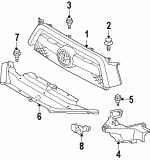
I just bought a 2014 SR5 about 3 weeks ago. I went to find the radiator cap and it appears that there is a large plastic "hood" covering the radiator and radiator cap. Any simple way to access this? Couldn't find any help in the Manual. Thanks.
Yeah I thought that was kind of strange first time I looked under my hood. I was (am) seriously tempted to just cut out that raised part that covers it so if/when I do need emergency access to it I don't have to fight taking off a body part to get at it.
Thanks for the details. I was afraid that there would be a "process" to get to it. It seems like it would have been easy for Toyota to leave the cap exposed and make it easier for the owner to check their fluid. Thanks again!
Does this "Sight Shield " do anything other than cover the radiator, such as modifying air flow or something like that. Can it be removed without causing problems?
Can anyone confirm, definitively, that a rad cap with a higher pressure rating than the stock cap will produce more heat? My LE runs below the half-way point on the gauge in cold and hot weather. In winter, I'd like it to be above the half way mark to give me a pinch more heat. A higher-rated cap, say, moving from 15 to 17 psi would in theory raise the boiling point, thus the coolant temp, no?
I have no idea what the stock cap is even rated at....

A radiator cap with a higher pressure rating won't increase the operating temperature of the cooling system.Can anyone confirm, definitively, that a rad cap with a higher pressure rating than the stock cap will produce more heat? My LE runs below the half-way point on the gauge in cold and hot weather. In winter, I'd like it to be above the half way mark to give me a pinch more heat. A higher-rated cap, say, moving from 15 to 17 psi would in theory raise the boiling point, thus the coolant temp, no?
I have no idea what the stock cap is even rated at....
Not confusing them at all, well aware of what both do. A different cap is a one-minute change, the thermostat a one hour job.
I do know that shroud is put there to channel as much outside air as possible to the complete radiator and not just the fins.