
You are using an out of date browser. It may not display this or other websites correctly.
You should upgrade or use an alternative browser.
You should upgrade or use an alternative browser.
Rec Trailer - Anyone Have One?
- Thread starter Swacer
- Start date


Forest RnR
New member
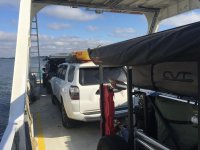
here it is with my FJ
Awesome SSDuck8! We checked out the little guys, nice, well made trailers.

Overland Kwest
New member


Overland Kwest
New member


Ducmonsta
New member
I work with Teardrop Trailers - Oregon Showroom | Tear Drops NW, Salem Oregon ? and own the 1st built "Recon".
Building your own would be the most economical way to go about it if you have the skill set and the tools already. Otherwise, you're going to spend more from the mistakes, learning curves, and tooling you'll need to get going.
There are multiple manufacturers out there that build teardrop trailers. All of them have their pros and cons. But, if teardropping is seriously something you want to consider, then be prepared to spend a lot of money for something without the amenities of a traditional pop up or travel trailer.
I've learned throughout my extensive research before deciding on going with teardropsnw, the actual manufacturing process and choice of materials is what makes the difference in price between one maker and another. You have to ask yourself what the most important features are.
For example, do you want a frame that is fully boxed, C channel, welded, or bolt together...etc. Will this camper ever see an unmaintained forest service road? Do you want to have access to your cooler while camping? Will the cooler be on a slide? How important are cabinets and storage? Do you want quality wood such as marine grade birch or are you ok with plywood? How thick are the walls? Is everything screwed together or just stapled and glued?
All of these types of questions increase the price of a camper. Whether its something from a company like LittleGuy who makes thousands of these a year off a production line or a company like Moby1 who make less than 25 per year. To give you an idea, you can have a LittleGuy teardrop for about 10K loaded whereas the Moby1 XTR will set you back 30-40K for something similarly equipped.
If you're genuinely interested in learning more about teardrop campers and the lifestyle itself, shoot me a pm and I'd be happy to give you an honest and unbiased opinion.
Building your own would be the most economical way to go about it if you have the skill set and the tools already. Otherwise, you're going to spend more from the mistakes, learning curves, and tooling you'll need to get going.
There are multiple manufacturers out there that build teardrop trailers. All of them have their pros and cons. But, if teardropping is seriously something you want to consider, then be prepared to spend a lot of money for something without the amenities of a traditional pop up or travel trailer.
I've learned throughout my extensive research before deciding on going with teardropsnw, the actual manufacturing process and choice of materials is what makes the difference in price between one maker and another. You have to ask yourself what the most important features are.
For example, do you want a frame that is fully boxed, C channel, welded, or bolt together...etc. Will this camper ever see an unmaintained forest service road? Do you want to have access to your cooler while camping? Will the cooler be on a slide? How important are cabinets and storage? Do you want quality wood such as marine grade birch or are you ok with plywood? How thick are the walls? Is everything screwed together or just stapled and glued?
All of these types of questions increase the price of a camper. Whether its something from a company like LittleGuy who makes thousands of these a year off a production line or a company like Moby1 who make less than 25 per year. To give you an idea, you can have a LittleGuy teardrop for about 10K loaded whereas the Moby1 XTR will set you back 30-40K for something similarly equipped.
If you're genuinely interested in learning more about teardrop campers and the lifestyle itself, shoot me a pm and I'd be happy to give you an honest and unbiased opinion.

Jetboy
New member
I had never heard of marine birch. Interesting. I wonder if it's really "marine grade" in the sense of typical marine grade okume or similar. Lloyds stamped. No knots in any ply. No voids. Etc. I'm not sure I could justify the cost for a camp trailer. The regular marine ply is $150/sheet. The profit margins on these are obscene so it wouldn't totally surprise me to see it on some.
Last edited:

Moxxy
New member
Build your own
For anybody thinking about building your own (and without a CNC router) this kit is worth considering - although you'd have to find the right frame and axle for off road/overland adventures. We're about 75% complete building one of their kayak kits - quality all the way around. Build-your-own Teardrop Camper Kit and Plans
For anybody thinking about building your own (and without a CNC router) this kit is worth considering - although you'd have to find the right frame and axle for off road/overland adventures. We're about 75% complete building one of their kayak kits - quality all the way around. Build-your-own Teardrop Camper Kit and Plans

phillyd2
Senior Member
make your own...
don't be a skinny jeans, flannel shirt, I got a beard, metro sexual hipster that can't do shit other than defrag a hard drive....buy some godamn beer ,go get some tools and build something...
This is like Jimmy Page telling you to man up, buy a guitar and become an icon. :hatsoff:
Forest RnR
New member
If I won the lottery I'd buy a Kimberly Karavanalas I am looking for a decent used anything w/ a kitchen.
I had never heard of a Kimberly Karavan, they look increadible, but damn, that price!

jrandom
New member
The US dollar is really strong now you can get an $80k Karavan for around $50k shipped.I had never heard of a Kimberly Karavan, they look increadible, but damn, that price!
Forest RnR
New member
I guess with an exchange rate that strong in our favor it's closer to reality. Kind of like a moby, not exactly my thing but i can totally respect how bad ass they are!

Titanpat57
Senior Member
I guess with an exchange rate that strong in our favor it's closer to reality. Kind of like a moby, not exactly my thing but i can totally respect how bad ass they are!
There is NOTHING built to that level stateside...if that's in your budget...in the words of Pete Henwood..."buy once , cry once"
Wow, those prices are incredible.
I am only looking at a maximum of probably $17k. What attracts me to my first option, and a couple of the others, is the option of the full kitchenette. I would prefer something more "full" as compared to stripped storage areas.
Plus, I'm holding out for engine work on the Camaro, so gotta keep the trailer cost modest haha.
I am only looking at a maximum of probably $17k. What attracts me to my first option, and a couple of the others, is the option of the full kitchenette. I would prefer something more "full" as compared to stripped storage areas.
Plus, I'm holding out for engine work on the Camaro, so gotta keep the trailer cost modest haha.
Jetboy
New member
Wow, those prices are incredible.
I am only looking at a maximum of probably $17k. What attracts me to my first option, and a couple of the others, is the option of the full kitchenette. I would prefer something more "full" as compared to stripped storage areas.
Plus, I'm holding out for engine work on the Camaro, so gotta keep the trailer cost modest haha.
Agreed on the price. I was kinda sticker shocked by the little trailers. They're just so simple to build I do not understand the markup on them. Especially for basically cabinetry type construction. I know they're low volume, but I can't wrap my head around it. Custom carbon fiber composite sailboats cost less and are about 1,000 times more complex to manufacture. I've also built a honeycomb composite trimaran. It's not even remotely close. And they have a trailer with them as well...
This is more like what they should cost RunawayCampers.com - Home
Any trailer shop can modify one of these for probably around $500 and new wheels/tires to put any size of tire you want on it.
Last edited:
Ducmonsta
New member
There is NOTHING built to that level stateside...if that's in your budget...in the words of Pete Henwood..."buy once , cry once"
Except maybe yours!
Wow, those prices are incredible.
I am only looking at a maximum of probably $17k. What attracts me to my first option, and a couple of the others, is the option of the full kitchenette. I would prefer something more "full" as compared to stripped storage areas.
Consider a few things about a kitchenette. A sink can make things convenient for cleaning up however, it takes up quite a bit of counter space..which is hard to come by. You have to consider how you'll be transporting and disposing the water. Some stoves are built into the trailer so you're dealing with even less counter space. For example, the Little Guy offers very little counter space because of the sink and stove design. While this may be ok for some people, it was a deal breaker for myself.
Agreed on the price. I was kinda sticker shocked by the little trailers. They're just so simple to build I do not understand the markup on them. Especially for basically cabinetry type construction. I know they're low volume, but I can't wrap my head around it. Custom carbon fiber composite sailboats cost less and are about 1,000 times more complex to manufacture. I've also built a honeycomb composite trimaran. It's not even remotely close. And they have a trailer with them as well...
This is more like what they should cost RunawayCampers.com - Home
Any trailer shop can modify one of these for probably around $500 and new wheels/tires to put any size of tire you want on it.
It's always hard for me to justify the costs of a lot of things in life. Especially when there is an equivalent for less than half the cost. But in reality, when we compare (in this case), the frames of some of these trailers, there is night and day difference. I see a lot of less expensive trailers that bolt or weld the tongue separately from the main frame. Usually, you'll find them underneath the frame assembly itself. Then consider what size tubing they use and that's if they even use a full tube. If someone plans on taking any trailer off road, the center of the tongue should be a part of the entire frame, like a spine.
Also consider the cabinet construction. Quality companies will use better/proper techniques when building cabinetry. They will use dove tail joints, mortise and tenon, dowels, and dado for the shelving and drawers. Many of the "production" units will just use butt and lap joints if you're lucky. Then look at how they construct it... staples and glue. It makes for an easier production line. Custom manufactures use high quality construction techniques which take longer and are more durable in the long run.
Trailer shops can't modify the frame to be stronger without completely disassembling the unit. You can't add frame spars to something that is already completed. At least not cost effectively. Even upgrading to a different suspension from a typical torsion style (which is cheap and easy to put into production) to a Timbren/air/leaf would be somewhat difficult. Now you also have to deal with new hub and bearing assemblies because the trailer you bought was only designed to have a small trailer tire and wheel. You just can't add a larger tire/wheel package without the consequence of wearing out the tiny bearings it came with.
Jetboy
New member
I can appreciate quality construction, but the question is whether glue and staples will fail. If not - it's a perfectly acceptable method. If it will fail, then there is value in a better method. Otherwise it's just wasted effort with no benefit. Either way it doesn't justify the price. Cabinets aren't particularly complicated items to manufacture.
The trailers are very simple. They are probably not engineered - at all. I don't think you can justify the cost of actually modeling the forces to minimize weight. There's no need for a single longitudinal frame member like running the tongue all the way through. In fact it would be a very odd engineering choice to add weight in that way with basically zero structural benefit. Again we're at the same issue - will it fail? What is the designed safety factor? If we're building them in steel - 2x3 tube with 18ga walls is more than enough. 12ga is probably overkill. A simple rectangle frame is basically all that they're using. They're all sitting on some version of a $500 trailer.
Upgrading suspension should be easy for any trailer shop with basic fab skills. They weld on trailer frames all the time. They probably come with 1500lb leaf sprung axles. You can swap out a 3500lb axle with hubs of your choice for about $150 with new springs. I paid $180 for a full kit with new spring hangers and then narrowed it to suit. Then put larger tires on.
If they're torsion axles it's even easier. You just choose a different angle torsion axle and bolt it on. Add some spacers if you want.
As an aside:
I don't know why trailers stick with 1950's trailer bearings. I didn't get my prototype in for this trailer, but my next one will use off the shelf unit bearings instead of trailer bearings. I have two sets I've been engineering adapter plates for - GM 1500 front 2wd 6 lug sets, and rear Highlander sets. The plates will match the OEM bolt plate on the spindle and you will then weld that into your trailer axle tube. Have a bad bearing? You can guy a GM 1500 unit bearing at any auto parts store anywhere. No messing around with trailer bearings and all the nonsense that goes along with them. And it's 4 bolts to replace just like any unit bearing. (GM only uses 3). Never have to service them. Never have to grease them. Never have to repack them. They just work.
The trailers are very simple. They are probably not engineered - at all. I don't think you can justify the cost of actually modeling the forces to minimize weight. There's no need for a single longitudinal frame member like running the tongue all the way through. In fact it would be a very odd engineering choice to add weight in that way with basically zero structural benefit. Again we're at the same issue - will it fail? What is the designed safety factor? If we're building them in steel - 2x3 tube with 18ga walls is more than enough. 12ga is probably overkill. A simple rectangle frame is basically all that they're using. They're all sitting on some version of a $500 trailer.
Upgrading suspension should be easy for any trailer shop with basic fab skills. They weld on trailer frames all the time. They probably come with 1500lb leaf sprung axles. You can swap out a 3500lb axle with hubs of your choice for about $150 with new springs. I paid $180 for a full kit with new spring hangers and then narrowed it to suit. Then put larger tires on.
If they're torsion axles it's even easier. You just choose a different angle torsion axle and bolt it on. Add some spacers if you want.
As an aside:
I don't know why trailers stick with 1950's trailer bearings. I didn't get my prototype in for this trailer, but my next one will use off the shelf unit bearings instead of trailer bearings. I have two sets I've been engineering adapter plates for - GM 1500 front 2wd 6 lug sets, and rear Highlander sets. The plates will match the OEM bolt plate on the spindle and you will then weld that into your trailer axle tube. Have a bad bearing? You can guy a GM 1500 unit bearing at any auto parts store anywhere. No messing around with trailer bearings and all the nonsense that goes along with them. And it's 4 bolts to replace just like any unit bearing. (GM only uses 3). Never have to service them. Never have to grease them. Never have to repack them. They just work.

Ducmonsta
New member
I can appreciate quality construction, but the question is whether glue and staples will fail. If not - it's a perfectly acceptable method. If it will fail, then there is value in a better method. Otherwise it's just wasted effort with no benefit. Either way it doesn't justify the price. Cabinets aren't particularly complicated items to manufacture.
I agree wholeheartedly. It is acceptable to use glue and staples and in fact, it is the standard in almost ALL travel trailer designs. Only time will tell if they fail. Although I have read numerous failures in "off road" designed pop ups and travel trailers because the staples would not hold while driving over washboard forest service roads consistently. If you're going to stay at campgrounds that have paved driveways, your trailer will last forever. I'm only speaking to those that want to actually take a trailer off the pavement. Cabinets are definitely not complicated to make. Its the installation process that makes the difference. Again, is it worth it to someone? Only the buyer can determine that.
The trailers are very simple. They are probably not engineered - at all. I don't think you can justify the cost of actually modeling the forces to minimize weight. There's no need for a single longitudinal frame member like running the tongue all the way through. In fact it would be a very odd engineering choice to add weight in that way with basically zero structural benefit. Again we're at the same issue - will it fail? What is the designed safety factor? If we're building them in steel - 2x3 tube with 18ga walls is more than enough. 12ga is probably overkill. A simple rectangle frame is basically all that they're using. They're all sitting on some version of a $500 trailer.
Again, there is no NEED to have a single longitudinal frame member. However, I know that a 2x2 steel tube frame at 15ft (tongue to tail) will have a 1/4" of deflection with a teardrop body on it. Is that significant, maybe not for someone that is just going to take it to campgrounds. What's going to happen to those staples once this thing goes off road?
Upgrading suspension should be easy for any trailer shop with basic fab skills. They weld on trailer frames all the time. They probably come with 1500lb leaf sprung axles. You can swap out a 3500lb axle with hubs of your choice for about $150 with new springs. I paid $180 for a full kit with new spring hangers and then narrowed it to suit. Then put larger tires on.
If they're torsion axles it's even easier. You just choose a different angle torsion axle and bolt it on. Add some spacers if you want.
I didn't get into the details of changing suspension because you're right. It isn't difficult to add leaf springs if a trailer started with torsion bars. That is the simplest way to upgrade the suspension. However, in order to modify the frame for Timbrens or air bags would be very challenging. The mounts for the Timbren style require the frame to be wider than designed. I've seen some people just weld a plate so that the Timbrens have a place to bolt onto. Will it work? yes. Will it be durable? Who knows in the long run.
As an aside:
I don't know why trailers stick with 1950's trailer bearings. I didn't get my prototype in for this trailer, but my next one will use off the shelf unit bearings instead of trailer bearings. I have two sets I've been engineering adapter plates for - GM 1500 front 2wd 6 lug sets, and rear Highlander sets. The plates will match the OEM bolt plate on the spindle and you will then weld that into your trailer axle tube. Have a bad bearing? You can guy a GM 1500 unit bearing at any auto parts store anywhere. No messing around with trailer bearings and all the nonsense that goes along with them. And it's 4 bolts to replace just like any unit bearing. (GM only uses 3). Never have to service them. Never have to grease them. Never have to repack them. They just work.
Absolutely agree with you here. But the bearings used ARE off the shelf units. The Timbren 3500lb bearing assembly uses the same bearings on a 1 ton chevy. Not the sealed hub/bearing assembly found on 96+ GMs, but the same repackable/replaceable bearings before then. It would be more convenient to use a hub bearing style and I'd like to see those more often. Especially since they won't see the daily use a front end of a GM truck would, I imagine they would last quite a long time.
Ultimately, its hard for anyone to justify the cost of anything if they don't appreciate the value. Why do some people buy watches that cost over $2k? When you can buy a Casio that probably gives you more information. Shoot, just use your cell phone and not even wear a watch. Who doesn't have a phone with a clock on it?
Why do people buy homes with a large lot? Are they going to farm it? Will they raise animals that require 5+ acres? Why do we buy homes with more bedrooms than occupants? Surely we can buy a small home with enough space to live for a lot less. But it's the value they see in having the privacy or the space to roam around in. Because they don't want to live spitting distance from a neighbor.
When it comes to the teardrop lifestyle, you have to have the desire to camp that way. Because otherwise, you can buy a damn nice travel trailer with a ton more amenities for $10-$20k.
Jetboy
New member
I don't wear a watch...
I agree you really need to want a small trailer to not go buy a 20' ultra light bumper pull that has much nicer amenities. I'll probably never take mine off road. I just like the style.
My cabinets are non-structural, which isn't an ideal design. But my walls are laminated foam and are much stronger than typical plywood walls, so I really have no structural need from the cabinets. The curve of the teardrop profile also adds an incredible amount of lateral sheer stiffness to the body structure that you lose if you make it squareish.
I don't think the tongue running all the way through makes any sense structurally because it's in the wrong location to offer support of the body. The flex will almost entirely be in the floor between the supporting frame rails. The long tongue design offers very little torsional resistance and will still require frame rails near the outer edges. So a rectangular frame with lateral light weight cross members is a better design from a weight/stiffness perspective. That's why no commercial trailers are made that way. The triangle tongue design is basically the same thing. It's stiffer and lighter. The one thing it doesn't do is offer the maximum turning angles, so in that respect the straight 3x3 or 2x2 tongue may have some advantage. Either way IMO it would only need to extend to first cross member for a very solid interface with the rest of the frame.
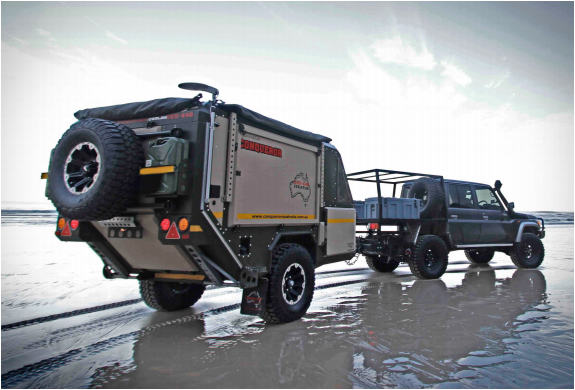
Like this trailer - wasted a ton of time and effort to add basically zero benefit with the long beam through the center.

This is a better design

I agree you really need to want a small trailer to not go buy a 20' ultra light bumper pull that has much nicer amenities. I'll probably never take mine off road. I just like the style.
My cabinets are non-structural, which isn't an ideal design. But my walls are laminated foam and are much stronger than typical plywood walls, so I really have no structural need from the cabinets. The curve of the teardrop profile also adds an incredible amount of lateral sheer stiffness to the body structure that you lose if you make it squareish.
I don't think the tongue running all the way through makes any sense structurally because it's in the wrong location to offer support of the body. The flex will almost entirely be in the floor between the supporting frame rails. The long tongue design offers very little torsional resistance and will still require frame rails near the outer edges. So a rectangular frame with lateral light weight cross members is a better design from a weight/stiffness perspective. That's why no commercial trailers are made that way. The triangle tongue design is basically the same thing. It's stiffer and lighter. The one thing it doesn't do is offer the maximum turning angles, so in that respect the straight 3x3 or 2x2 tongue may have some advantage. Either way IMO it would only need to extend to first cross member for a very solid interface with the rest of the frame.
Like this trailer - wasted a ton of time and effort to add basically zero benefit with the long beam through the center.
This is a better design
Similar threads

- Replies
- 24
- Views
- 12K

- Replies
- 0
- Views
- 2K


