*** SOLVED***!!!Filled up to the "click" drove 80ft and it died. No Spark!

Attachments

  • IMG_9847a.jpg
    IMG_9847a.jpg
    137.8 KB · Views: 1,098
Last edited:
When that is mostly "good news, bad news".

Did the dealership have any thoughts about what prompted the failure?
 
[MENTION=83083]rigtec[/MENTION]

Hey [MENTION=2839]Akkording[/MENTION] ,

Looks like [MENTION=106009]flybooey[/MENTION] got the answer(s) that he sought! It would've taken some time to "Ring out a problem like this"; what, with the electrical and "CAN-bus" system; to say nothing of the firmware/ecu diagram study, hands-on operations, and the schedule work-around!

But you guys had everything under control because everyone was really thinking, and "NO ONE" was just guessing some random (bull-shipp stuff), lol! BTW: Should there be anything further that I can help with, Let me know! 'Best to you ALL',

rig
 
Yes that is exactly how I feel, all that spared time from their busy lives to chime in to help out were genuine and thoughtful in their insight.
True....I never would have found the culprit.
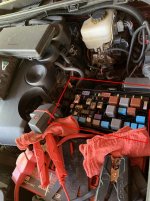
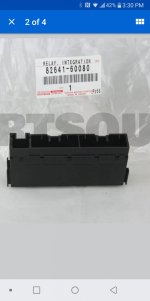
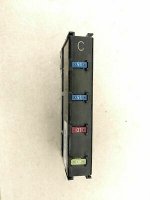
So this is the relay....and why i assume they call it integration relay because there are fuses stuck in the top of it. I never would have known it was a Relay too.


Hey [MENTION=2839]Akkording[/MENTION] ,

Looks like [MENTION=106009]flybooey[/MENTION] got the answer(s) that he sought! It would've taken some time to "Ring out a problem like this"; what, with the electrical and "CAN-bus" system; to say nothing of the firmware/ecu diagram study, hands-on operations, and the schedule work-around!

But you guys had everything under control because everyone was really thinking, and "NO ONE" was just guessing some random (bull-shipp stuff), lol! BTW: Should there be anything further that I can help with, Let me know! 'Best to you ALL',

rig
 

Attachments

  • Screenshot_2019-07-01-15-30-05.jpg
    Screenshot_2019-07-01-15-30-05.jpg
    108 KB · Views: 1,010
  • 04-09-Toyota-Prius-Relay-Integration-Oem-82641-47020.jpg
    04-09-Toyota-Prius-Relay-Integration-Oem-82641-47020.jpg
    11.3 KB · Views: 1,031
Last edited:
True....I never would have found the culprit.

Don't sell sell your abilities short. I'd bet that you would have found it in the first 5 minutes if you would have had the schematics in time. You gave it go and in the end, have contributed to collective knowledge base.
337764d1561698002-filled-up-click-drove-80ft-died-no-spark-101_1-jpg


That Violet wire on pin 9 of the ECM leads to the EFI Main relay which is part of the Integration Relay (AKA Unit K).
I've heard of this unit failing with only the horn as a symptom; almost always associated with overloading by aftermarket horns. Never heard of it killing the whole shebang.
 
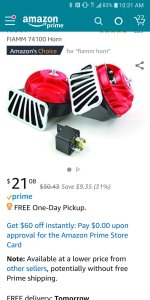
Well..... I do have these horns that i installed in 2017


I've heard of this unit failing with only the horn as a symptom; almost always associated with overloading by aftermarket horns. Never heard of it killing the whole shebang.
 

Attachments

  • Screenshot_2019-07-02-10-31-16.jpg
    Screenshot_2019-07-02-10-31-16.jpg
    130.2 KB · Views: 943
I think that may be a proper idea. I have this desire to also pick up one of those relays to keep on hand (or in my glovebox)
 
I think that may be a proper idea. I have this desire to also pick up one of those relays to keep on hand (or in my glovebox)
This sounds like an unusual failure and - since it is only commonly found with a mod you have - then removing that mod should resolve the threat.
 
I think that may be a proper idea. I have this desire to also pick up one of those relays to keep on hand (or in my glovebox)

I mentioned it earlier, anything in the fusebox, other than the block relays and blade fuses, you pretty much have to remove the fuse box and pull the components out from the bottom. It's pretty ridiculous.

I'd just ditch the aftermarket horn and pick up one of those canned air horns :D
 
I mentioned it earlier, anything in the fusebox, other than the block relays and blade fuses, you pretty much have to remove the fuse box and pull the components out from the bottom. It's pretty ridiculous.

I'd just ditch the aftermarket horn and pick up one of those canned air horns :D

The integration relay (unit K) in the diagrams is an exception. This little magic box is lifted out with all of the connectors attached and has enough spare wire to pull clear of obstructions.

As to relationship between aftermarket horns and this relay unit; If the horns are powered via an aftermarket relay and the stock one only switches the add-on relay I can't see any logical path to failure. However, if aftermarket horns are driven directly by the Unit K relay then who knows how they fail, but they do.

The internals of Unit K are a mystery, but I assume there is a circuit board with magic smoke devices and at least 4 standard coil relays. A mechanical horn produces it's sound by rapidly making and breaking contact on a magnetic coil so I can find some logic to them over-driving an IC that was designed for a lighter load.
 
This I horn swap was not a mod or upgrade but just a replacement 2+ hrs ago as the oem dual horns slowly failed to just one then none.
They are driven by the oem relay and not an external one.
And im not a horn a horn honker by any stretch.


How often do you use your horn to even require the need for a louder one? Yeah stock horns should be sufficient
 
This I horn swap was not a mod or upgrade but just a replacement 2+ hrs ago as the oem dual horns slowly failed to just one then none.
They are driven by the oem relay and not an external one.
And im not a horn a horn honker by any stretch.
I suspect you meant years (not hours). If so, then not being a horn honker is the reason that the magic box lasted as long as it did.

Did you perhaps honk your horn right before the failure?
 
so...I have the same horns installed as OP. I bought them on several recommendations from members here. Should I go back to stock?
 
Last edited:
Totally agree. The only 'failures' I've had on my rig were due to aftermarket modifications.

I know a lot of guys are running these same horns, curious if this is the first case of this particular failure?
 
The integration relay (unit K) in the diagrams is an exception. This little magic box is lifted out with all of the connectors attached and has enough spare wire to pull clear of obstructions.

As to relationship between aftermarket horns and this relay unit; If the horns are powered via an aftermarket relay and the stock one only switches the add-on relay I can't see any logical path to failure. However, if aftermarket horns are driven directly by the Unit K relay then who knows how they fail, but they do.

The internals of Unit K are a mystery, but I assume there is a circuit board with magic smoke devices and at least 4 standard coil relays. A mechanical horn produces it's sound by rapidly making and breaking contact on a magnetic coil so I can find some logic to them over-driving an IC that was designed for a lighter load.


If you look under the engine fuse box cover you will see that the Integration Relay include fuses (and presumably relays) for IG2, HORN, EFI, A/F. Perhaps there are also integrated circuits (ICs) in this unit that drive the coils of the relays. These ICs would have a diode included to protect it from inductive kickback when the relay contacts open. The electrical explanation is here:
Flyback diode - Wikipedia

Without knowing what’s really in the Integration Relay circuitry here’s a WAG and a bunch of maybes.

Maybe the horn relay driver IC is designed to handle the current of the stock horns and not much more. Maybe the two Fiamm horns take a lot more current than stock horns. (Looking at the spec sheet it says 9A but not clear if that is each horn or total). Maybe there is more of an inductive kick from the Fiamms that destroyed the horn driver IC and/or its diode. Maybe in the process a voltage spike propagated to the nearby IG2 or EFI relay/driver circuitry and caused a problem there. This doesn’t have to be instantaneous, like blowing the horn at the time, the damage could have slowly built up and weakened the circuit until ultimate failure.

If the aftermarket horns are suspected as being the culprit, it may be a good idea to drive them from an external relay. (It is interesting that a relay is included in the Amazon package). That is, battery 12 volts supplied to the external relay contact. And the coil driven from the contacts of the OEM horn relay, not from the OEM horn (coil) signal.

On the other hand the aftermarket horn theory could be just a coincidence. The IG2, EFI, or A/F circuit could have just chosen that time to crap out. Electronics do fail due to many reasons.

It was great that the community put their heads together to try to resolve it with you. It was a tough one. Good call in ultimately going to the dealer. I bet that Toyota dealers have diagnostic equipment that is not available to independent shops that can quickly pinpoint these kind of failures. It just takes time and money. OP, glad you’re back in action. :thumb3:
 

Members online

Forum statistics

Threads
278,317
Messages
3,554,129
Members
248,016
Latest member
Advally Service

Trending content

Back
Top