Temperature of alternator housing

4RExplorer

New member
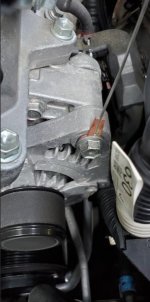
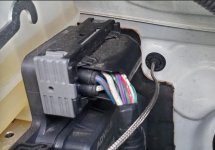
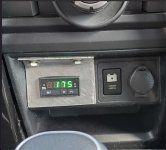
I installed a temperature sensor on the top front mounting bolt of the alternator. The wire goes through a small grommet in the firewall to an LED display on the dash, just below the air conditioner knobs.

On a sunny 90 degree F day, the alternator housing hit 175 degrees F after 15 minutes of driving around.
 

Attachments

  • Temperature sensor on alternator mounting bolt.jpg
    Temperature sensor on alternator mounting bolt.jpg
    28.8 KB · Views: 1,195
  • Temperature sensor wire through firewall.jpg
    Temperature sensor wire through firewall.jpg
    38.1 KB · Views: 1,129
  • Temperature of alternator - LED display.jpg
    Temperature of alternator - LED display.jpg
    40.8 KB · Views: 1,110
Register to hide this ad
Interesting. I'm curious why you did this?

You are possibly the only point of data on record for that measurement.
 
Interesting. I'm curious why you did this?

You are possibly the only point of data on record for that measurement.

I could not find any post about the alternator temperature under normal operation. The best I could find was that the engine block is somewhere in the 200 to 220 degree F range.

I will be charging an auxiliary LiFePO4 battery using a RedArc BCDC1240D, which pulls around 40A from the alternator (via the starter battery). Instead of getting a high-output alternator (Nations Starter and Alternator makes the 270XP, but not for the 2019 model year, which I have), I will be using Toyota's OEM alternator. The concern is that the alternator will overheat from the extra load from the RedArc charger. The temperature sensor will let me know if that is about to happen. Then I can turn off the charger using the "Charge LiFePO4" switch that I installed next to the temperature sensor LED display (replacing the OEM USB ports). That switch will operate a relay that sends or blocks power to the RedArc charger. When the alternator cools off a bit, I can push the switch again to resume charging.
 
Last edited:
Instead of getting a high-output alternator (Nations Starter and Alternator makes the 270XP, but not for the 2019 model year, which I have)

Have you called them? It was my understanding that they do make one that will fit the 2019.
 
Have you called them? It was my understanding that they do make one that will fit the 2019.

Thanks for the tip. Last I talked to them (a year or so ago?), they did not have one. But I just called, and they said they have both a 180A and 270A alternator for the 4.0 liter 2019 4Runner. They just have to update their website to show they are in stock and ready to go, but they can take orders over the phone.
 
Thanks for the tip. Last I talked to them (a year or so ago?), they did not have one. But I just called, and they said they have both a 180A and 270A alternator for the 4.0 liter 2019 4Runner. They just have to update their website to show they are in stock and ready to go, but they can take orders over the phone.

It appears Nations sources it from DC Power; if you look at the photos on the Nations site, you can see the "DC POWER ENGINEERING" text on the front of their product.

There appear to be some differences: Nations offers powder coating options, and the positive stud appears to be plated, or maybe stainless, not plain copper. Nations also offers a 5 year warranty for $100.

DC Power has recently released this alternator for up through at least 2021 4Runners.
 

Attachments

  • Nations alternator.jpg
    Nations alternator.jpg
    109.1 KB · Views: 969
I installed a temperature sensor on the top front mounting bolt of the alternator. The wire goes through a small grommet in the firewall to an LED display on the dash, just below the air conditioner knobs.

On a sunny 90 degree F day, the alternator housing hit 175 degrees F after 15 minutes of driving around.

That's awesome...you could use that thermometer in a back country medical situation...just make sure the lead is long enough and you could use it as a rectal thermometer
 
During winter and Spring, the alternator temperature was generally 70 to 90 degrees F above ambient temperature. But it got to 110 degrees above ambient in a recent highway traffic jam, stop and go for 20 minutes, when it was about 55 degrees outside.
 
There have been times when I thought my alternator housing seemed unusually hot but, I never checked the temp and never did anything about it. The windings even looked like they may be burned a little too. I also never had any alternator problems either.

I think you may be chasing ghosts. If the alternator dies and the replacement dies prematurely, it may be time to take a hard look at what is going on.

Everybody needs a hobby, a deep dive into the 4 Runner electrical system is not a bad one either. There is surely knowledge to be gained.

Now I'm curious. I'll warm mine up and check the housing temp with a temp gun or thermocouple and report back.
 
After letting my 4 Runner warm up completely and driving around some. I left my refrigerator on most of the day so my aux battery was charging 15-17 amps, with AC on and 90 degree weather, my alternator case was at 190 degrees. Seems pretty hot.
 
Since the alternator is bolted directly to the engine it only make sense it will be about the same temperature as the running engine....which is around 185 to 190 degrees and as such is designed to operate at that temperature, so I don't understand what the big deal is!! :shrug:
 
After letting my 4 Runner warm up completely and driving around some. I left my refrigerator on most of the day so my aux battery was charging 15-17 amps, with AC on and 90 degree weather, my alternator case was at 190 degrees. Seems pretty hot.

100 degrees above ambient temperature, with the extra load of 15-17 amps from the aux battery charger, seems reasonable, since I'm finding 70 to 90 degrees (and once, during a traffic jam, 110 degrees) above ambient when there were no non-Toyota loads. I haven't measured the alternator temperature on a really hot summer day yet.

If the alternator dies from normal wear and tear, that's fine, I'll get a new one, maybe the DC Power 270 XP. I just don't want to kill it prematurely from overheating because I'm charging the auxiliary battery when the alternator is already too hot.
 
After changing the oil, the alternator is typically measuring around 60 to 70 degrees above ambient temperature instead of 70 to 90 degrees. I like that it's running cooler.
 
After changing the oil, the alternator is typically measuring around 60 to 70 degrees above ambient temperature instead of 70 to 90 degrees. I like that it's running cooler.

Can you post a link to the temperature sensor and read out you have?
 
Last edited:
Can you post a link to the temperature sensor and read out you have?

This is the temperature sensor and digital readout display:

CHT Digital PMD1XT Pryometer Gauge + CHT Cylinder Head Temperature Sensor Kit FS

Options:
(1) 0 to 5 VCD Analog Output. I got this option to automate the charging based on the alternator temperature, but ended up not using it. While charging, I just look at the temperature display every once in awhile, and manually turn the charger off if the temperature gets too high. I also manually feel the RedArc charger (installed within reach behind the front passenger seat) while driving and charging, and manually turn it off when it gets too hot to touch.

(2) Protective Aluminum Enclosure Housing. Not necessary if installing in a DIY cutout in the lower dashboard with a simple piece of aluminum plate that I had lying around. The housing might be useful if installing on top of the dashboard.

(3) Audible Alarm. Your choice.

(4) A 10mm inner diameter ring terminal fits the front alternator mounting bolt.

A few installation notes:

Once the sensor is secured under the alternator mounting bolt, I bent the shaft of the sensor slightly to avoid hitting the underside of the 4Runner hood. The sensor wire went through the rubber grommet in the firewall on the driver's side. I did this by duct taping the ends of the wires from the sensor to a piece of coat hangar wire, then pushing the coat hangar wire through the grommet, then pulling it out from the driver's side footwell inside the vehicle.

In my installation, the LED temperature display is set just above the tiny rectangular cubby in front of the gear shift knob. The DIY metal plate has a rectangular cutout that just fits the LED temperature display, but is large enough to enable screwing to the OEM plastic cubby surround.

On the back of the LED temperature display, Terminal #7 goes to the power wire from the temperature sensor (on mine, a yellow wire). Terminal #6 goes to the ground wire from the temperature sensor (on mine, a red wire). Terminal #1 goes to the pigtail from the Add-a-Circuit in the 12V fuse block in the driver's side front footwell. That Add-a-Circuit is in one of the ignition-switched fuse positions that has power only when the vehicle is turned on, to prevent draining the starter battery if the "Charge LiFePO4" button is accidentally left on. Finally, Terminal #2 goes to ground.

 

Members online

Forum statistics

Threads
278,316
Messages
3,554,113
Members
248,016
Latest member
Advally Service

Trending content

Back
Top