The 3.4L TRD Supercharger Thread

Sac works as I have in-laws there. Thanks!!!

To get a rough idea on labor cost, how many hours (each) would it take to install the supercharger and 7th injector kit?

I think the supercharger might be less time than the 7th injector kit to be honest. Supercharger is literally bolt-on. 7th injector requires wiring to be done.

You really can do the supercharger install yourself, it's not too hard and the instructions are easy to follow. Only cutting or modification is the upper timing belt cover.
 
steps were taken

Completed the wiring harness on the URD harness kit this morning. I went this way in case I ever need to remove it, and it was easier to work on outside of the car.

Just need to clip the zip ties off and its ready to go.

LBLJAWFl.jpg

UhrFM5wl.jpg
 
Completed the wiring harness on the URD harness kit this morning. I went this way in case I ever need to remove it, and it was easier to work on outside of the car.

Just need to clip the zip ties off and its ready to go.

That's all it takes? Gosh, you should see my AEM FIC 6 patch harness:

gamefreakgc-albums-engine-performance+mods-picture49404-img-2064-1024x768.jpg
 
Install bolts

Hey guys , I have a 1st gen gray supercharger that I bought used . I don’t have the long bolts that go through the top to mount it. URD is out of stock but it looks like I can source the bolts elsewhere online. My question is are the bolts for the gray supercharger the same length as the long bolt for the 2nd gen black supercharger? M8x1.25x170. Thats the only specs I can get . Thanks in advance.
 
Last edited:
Hey guys , I have a 1st gen gray supercharger that I bought used . I don’t have the long bolts that go through the top to mount it. URD is out of stock but it looks like I can source the bolts elsewhere online. My question is are the bolts for the gray supercharger the same length as the long bolt for the 2nd gen black supercharger? M8x1.25x170. Thats the only specs I can get . Thanks in advance.


Idk if they are the same from gen 1 to gen 2 but you can just go to your local hardware store and get the bolts.
That’s what I did just cause I wanted to install new ones.
 
Hey guys , I have a 1st gen gray supercharger that I bought used . I don’t have the long bolts that go through the top to mount it. URD is out of stock but it looks like I can source the bolts elsewhere online. My question is are the bolts for the gray supercharger the same length as the long bolt for the 2nd gen black supercharger? M8x1.25x170. Thats the only specs I can get . Thanks in advance.


Idk if they are the same from gen 1 to gen 2 but you can just go to your local hardware store and get the bolts.
That’s what I did just cause I wanted to install new ones.
 
Is the 7th injector kit necessary for the 2nd gen supercharger?

Just bought the supercharger and 7th injector kit bundle and my mechanic says he can't install the 7th injector kit because it's not smog approved. Will running just the supercharger really cause damage to the engine?
 
Just bought the supercharger and 7th injector kit bundle and my mechanic says he can't install the 7th injector kit because it's not smog approved. Will running just the supercharger really cause damage to the engine?

No, but a lot of engines pass smog with the 7th, even the dreaded "visual inspection" in CA. There's actually a Toyota EO# sticker that will probably work for your year that says it includes an extra injector for the supercharger which is smog approved. Your average smog tech won't be able to tell the difference between a URD 7th injector and a TRD 7th injector.

Take it to a tuning shop or another place that installs performance engines and they should be able to do the install & tune it for you too.
 
Just bought the supercharger and 7th injector kit bundle and my mechanic says he can't install the 7th injector kit because it's not smog approved. Will running just the supercharger really cause damage to the engine?


You will be fine if its just the superchanger, you might get some pinging but nothing that would damage the engine. I had the 7th injector installed with a fuel pump and for me it really didnt make a difference, if I started over I would retro fit a front mount intercooler
 
Wanted to throw the question out there to see if anyone has had first hand experience with it or not before I make myself the guinea pig.

My truck sees most if not all of it's driving below 3k rpm which is where I want to be making my best power. It's real easy to make a motor throw huge numbers on a Dyno but it always seems like it's up past 4k rpms which to me isn't usable.

In an effort to help my motor make more low end power I am planning to advance my cam timing by 5 degrees and since I'll have the truck down I figured I may as well pull the supercharger and lower intake manifold off to do a light port and polish on them to just remove any casting imperfections and open up the blower ports slightly to help reduce intake charge temps. Don't want to do anything crazy as part as reshaping intake port Chambers and all that especially since I'm not planning to pull heads anytime soon. Not expecting a huge improvement from the smoothing of the ports either but when your chasing volumetric efficiency every but counts.

Wanted to see if anyone has had real world results to report with this or any strong opinions on the matter lol.


EDIT
Got bored today and decided to tear the front end of the motor down to advance the cams. Ended up sleeping the timing belt by 1 tooth at the crank which worked out to be exactly 5 degrees advance at the cams.

Initial results were actually really impressive. Before doing a cold compression test my compression in all 6 cylinders was 150psi. Keep in mind I'm at 6000 feet elevation which is why it's so low. After changing the cam timing the compression jumped up to 170 psi so a 13% increase. I

didn't get much time to test drive it and will need to rework my tune to optimize ignition timing and all that good stuff but so far the power band has definitely shifted down and is nice and low and I can really feel it around 2500 which is perfect. My egts also came down under load by roughly 75 degrees which is awesome. I'll need to mess with it and see how big of an improvement it makes but I've got a good feeling. Once I get that to a solid point I'll set about redoing the exhaust to 2.5" tubing and polishing the intake and then hopefully some dyno runs
 
Last edited:
Wanted to throw the question out there to see if anyone has had first hand experience with it or not before I make myself the guinea pig.

My truck sees most if not all of it's driving below 3k rpm which is where I want to be making my best power. It's real easy to make a motor throw huge numbers on a Dyno but it always seems like it's up past 4k rpms which to me isn't usable.

In an effort to help my motor make more low end power I am planning to advance my cam timing by 5 degrees and since I'll have the truck down I figured I may as well pull the supercharger and lower intake manifold off to do a light port and polish on them to just remove any casting imperfections and open up the blower ports slightly to help reduce intake charge temps. Don't want to do anything crazy as part as reshaping intake port Chambers and all that especially since I'm not planning to pull heads anytime soon. Not expecting a huge improvement from the smoothing of the ports either but when your chasing volumetric efficiency every but counts.

Wanted to see if anyone has had real world results to report with this or any strong opinions on the matter lol.


EDIT
Got bored today and decided to tear the front end of the motor down to advance the cams. Ended up sleeping the timing belt by 1 tooth at the crank which worked out to be exactly 5 degrees advance at the cams.

Initial results were actually really impressive. Before doing a cold compression test my compression in all 6 cylinders was 150psi. Keep in mind I'm at 6000 feet elevation which is why it's so low. After changing the cam timing the compression jumped up to 170 psi so a 13% increase. I

didn't get much time to test drive it and will need to rework my tune to optimize ignition timing and all that good stuff but so far the power band has definitely shifted down and is nice and low and I can really feel it around 2500 which is perfect. My egts also came down under load by roughly 75 degrees which is awesome. I'll need to mess with it and see how big of an improvement it makes but I've got a good feeling. Once I get that to a solid point I'll set about redoing the exhaust to 2.5" tubing and polishing the intake and then hopefully some dyno runs

Well if it ain't Phoenix the Science guy, great work brother.
 
Wanted to throw the question out there to see if anyone has had first hand experience with it or not before I make myself the guinea pig.

My truck sees most if not all of it's driving below 3k rpm which is where I want to be making my best power. It's real easy to make a motor throw huge numbers on a Dyno but it always seems like it's up past 4k rpms which to me isn't usable.

In an effort to help my motor make more low end power I am planning to advance my cam timing by 5 degrees and since I'll have the truck down I figured I may as well pull the supercharger and lower intake manifold off to do a light port and polish on them to just remove any casting imperfections and open up the blower ports slightly to help reduce intake charge temps. Don't want to do anything crazy as part as reshaping intake port Chambers and all that especially since I'm not planning to pull heads anytime soon. Not expecting a huge improvement from the smoothing of the ports either but when your chasing volumetric efficiency every but counts.

Wanted to see if anyone has had real world results to report with this or any strong opinions on the matter lol.


EDIT
Got bored today and decided to tear the front end of the motor down to advance the cams. Ended up sleeping the timing belt by 1 tooth at the crank which worked out to be exactly 5 degrees advance at the cams.

Initial results were actually really impressive. Before doing a cold compression test my compression in all 6 cylinders was 150psi. Keep in mind I'm at 6000 feet elevation which is why it's so low. After changing the cam timing the compression jumped up to 170 psi so a 13% increase. I

didn't get much time to test drive it and will need to rework my tune to optimize ignition timing and all that good stuff but so far the power band has definitely shifted down and is nice and low and I can really feel it around 2500 which is perfect. My egts also came down under load by roughly 75 degrees which is awesome. I'll need to mess with it and see how big of an improvement it makes but I've got a good feeling. Once I get that to a solid point I'll set about redoing the exhaust to 2.5" tubing and polishing the intake and then hopefully some dyno runs

Wow, you are bold. I can't advance timing on mine, I see up to 29* of timing advance when under light boost situations under 3k RPM (no knock sensor input) so that'd put me at 34* which I think would mean engine replacement #2. Be careful about those low boost situations, that's where the timing will get you in trouble. You might want to pull timing by 2-5 degrees on every cell under 3K RPM to be safe until you get some more hours and driving situations on it.

I have a spare intake manifold if you want a few photos. I can see a few spots where it can be cleaned up, as well as porting the runners coming out of the supercharger (they are curved but not very long).

My next project will be to port the roof & intake of the supercharger. Here's some good reads if you are interested as well since we also have M62's:

M62 supercharger porting port answers - Page 3 - Saturn ION RedLine Forums

Eaton Superchargers Modification Guide - Cobalt SS Network

You will also like headers. Pricey, but their power starts as low as 1500 RPM's. It's always there. Larger exhaust will see gains mostly on the high end above 4K RPMs.

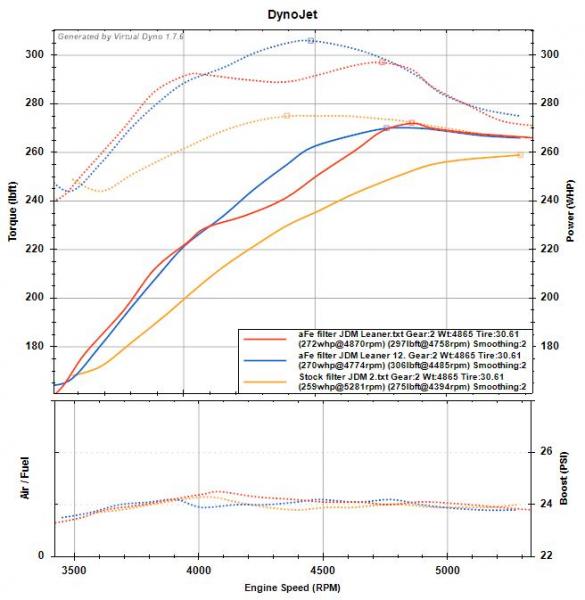
One more thing, I think you will enjoy this program: Virtual Dyno. It allows you to take your data logs from your piggyback and import them as dyno graphs. I have found it to be very accurate, I took my dyno run from a couple years ago and adjusted the settings until the log matched the dyno. Since then I have real-time data on how much power I am making. My build thread has a few examples on it like this:

gamefreakgc-albums-engine-performance-mods-picture55402-afe-filter-leaner-afr-12-1-a.jpg
 
Last edited:
:iagree:
Wow, you are bold. I can't advance timing on mine, I see up to 29* of timing advance when under light boost situations under 3k RPM (no knock sensor input) so that'd put me at 34* which I think would mean engine replacement #2. Be careful about those low boost situations, that's where the timing will get you in trouble. You might want to pull timing by 2-5 degrees on every cell under 3K RPM to be safe until you get some more hours and driving situations on it.

I have a spare intake manifold if you want a few photos. I can see a few spots where it can be cleaned up, as well as porting the runners coming out of the supercharger (they are curved but not very long).

My next project will be to port the roof & intake of the supercharger. Here's some good reads if you are interested as well since we also have M62's:

M62 supercharger porting port answers - Page 3 - Saturn ION RedLine Forums

Eaton Superchargers Modification Guide - Cobalt SS Network

You will also like headers. Pricey, but their power starts as low as 1500 RPM's. It's always there. Larger exhaust will see gains mostly on the high end above 4K RPMs.

One more thing, I think you will enjoy this program: Virtual Dyno. It allows you to take your data logs from your piggyback and import them as dyno graphs. I have found it to be very accurate, I took my dyno run from a couple years ago and adjusted the settings until the log matched the dyno. Since then I have real-time data on how much power I am making. My build thread has a few examples on it like this:

gamefreakgc-albums-engine-performance-mods-picture55402-afe-filter-leaner-afr-12-1-a.jpg


The cam timing and ignition timing are two entirely different things. I see the same number for ignition timing but the cam timing effects the timing of the intake and exhaust valve events. By advancing the cams it opens up the intake vales sooner in the intake stroke so that theres more time to get the air fuel mix in which is beneficial at low rpms where the intake velocity isnt supper high. It also closes off the valve sooner so the compression starts sooner building more cylinder pressure and in turn ore power. By advancing the cams it actually raised my ping threshold and there is room for more ignition advance in my case but I like to play to the conservative side on ignition timing so I have left it where it was. Fortunately the way the 5vz ecu understands things it sets the ignition based off the crank sensor and the injector pulses off the cam sensor so ignition timing isnt affected and the injectors will still be firing in phase with the intake valves,

I spent some time in the junkyard last week looking at some 5vzs that were partially torn down and could see quite a few areas in the lower intake manifold that could be slightly smoothed out and I think that would really help a lot. Sucks since porting and polishing is a largely uncharted area on this motor because most just bolt the blower on with a 7th injector and drive blissfully unaware. The blower will be tricky since I have the second gen that doesn't come apart but I think some decent casting flash can be smoothed off which is all I plan to do. Anything after 3500 rpm power wise is useless to me and thats all a heavy port job on the blower will do. If nothing else cleaning up the rough surfaces will help keep all the shit from the pcv system from sticking to everything overtime.

Can confirm too the larger exhaust is a waste on this motor. I redid my exhaust from the collector back last weekend in 2.5 inch tubing and lost a tooonnn of torque on the highway and barely gained anything above 3500. Sounded like shit too so Ill be going back to 2.25 tubing this coming weekend. Seems to be the best balance for torque at low and cruising rpm and decent flow up top.

I tried the virtual dyno program awhile back and for whatever reason it wouldn't let me import my log files from the piggyback but I cant remember why.
 
:iagree:


The cam timing and ignition timing are two entirely different things. I see the same number for ignition timing but the cam timing effects the timing of the intake and exhaust valve events. By advancing the cams it opens up the intake vales sooner in the intake stroke so that theres more time to get the air fuel mix in which is beneficial at low rpms where the intake velocity isnt supper high. It also closes off the valve sooner so the compression starts sooner building more cylinder pressure and in turn ore power. By advancing the cams it actually raised my ping threshold and there is room for more ignition advance in my case but I like to play to the conservative side on ignition timing so I have left it where it was. Fortunately the way the 5vz ecu understands things it sets the ignition based off the crank sensor and the injector pulses off the cam sensor so ignition timing isnt affected and the injectors will still be firing in phase with the intake valves,

I spent some time in the junkyard last week looking at some 5vzs that were partially torn down and could see quite a few areas in the lower intake manifold that could be slightly smoothed out and I think that would really help a lot. Sucks since porting and polishing is a largely uncharted area on this motor because most just bolt the blower on with a 7th injector and drive blissfully unaware. The blower will be tricky since I have the second gen that doesn't come apart but I think some decent casting flash can be smoothed off which is all I plan to do. Anything after 3500 rpm power wise is useless to me and thats all a heavy port job on the blower will do. If nothing else cleaning up the rough surfaces will help keep all the shit from the pcv system from sticking to everything overtime.

Can confirm too the larger exhaust is a waste on this motor. I redid my exhaust from the collector back last weekend in 2.5 inch tubing and lost a tooonnn of torque on the highway and barely gained anything above 3500. Sounded like shit too so Ill be going back to 2.25 tubing this coming weekend. Seems to be the best balance for torque at low and cruising rpm and decent flow up top.

I tried the virtual dyno program awhile back and for whatever reason it wouldn't let me import my log files from the piggyback but I cant remember why.

Ah yeah, you're right about the timing. I was thinking it would alter the spark timing but the engine still thinks it's normal.

For porting, the newer black kind can still be ported on the exhaust side as well as the intake port into the rotor housing. If you are going to polish and open up the lower intake manifold, it's worth also opening up the exhaust runners coming out of the base of the supercharger. It's about a 30 degree bend but nothing too bad, can be done with a narrow Dremel or with an extension piece. It would be too difficult to try and port the exit channel on the bottom of the rotor housing though. I am going to port the roof of the rotor housing (nowhere that the rotors contact) to increase the capacity of the supercharger housing for more airflow. I have an overbored throttle body so it's on my to-do list. Just need a better Dremel and some down time with the 4Runner.

I've been told though not to polish the intake downstream of the injectors. Something about the smooth surface and the gas will stick and collect on it but on a rough surface it won't.
 
That's all it takes? Gosh, you should see my AEM FIC 6 patch harness:

gamefreakgc-albums-engine-performance+mods-picture49404-img-2064-1024x768.jpg

Completed the wiring harness on the URD harness kit this morning. I went this way in case I ever need to remove it, and it was easier to work on outside of the car.

Just need to clip the zip ties off and its ready to go.

LBLJAWFl.jpg

UhrFM5wl.jpg


Which letter URD harness kit did you guys use??...


Type "C"???


.
 

Attachments

  • Screen Shot 2019-12-31 at 8.51.44 AM.jpg
    Screen Shot 2019-12-31 at 8.51.44 AM.jpg
    59.8 KB · Views: 3,132
Which letter URD harness kit did you guys use??...


Type "C"???


.

Depends on what year truck you have. There are two types of ecus in these trucks, some use 4 plugs others use 5 I think depending on the year. That will determine which letter harness you need from urd
 
Got a question. I found a 1st gen SC and I been reading the installation instructions. They have a tranny cable with the throttle cable. My 01 doesn't have this. So can I go on without it.
 
Depends on what year truck you have. There are two types of ecus in these trucks, some use 4 plugs others use 5 I think depending on the year. That will determine which letter harness you need from urd

I have a 2002. Just wondering what harnesses you or that other guy got.


.
 
Last edited:
I have a 2002. Just wondering what harnesses you or that other guy got.


.

For mine I chose to hardwire my piggyback into the ecu harness so no plug and play harness. I did this for cost and simplicity sake. I also dont see myself having the need to remove the piggyback anytime soon and if I did Id just solder the wires back together.

Being an 02 yours should have the 5 plug ecu which would need the type e harness from urd if Im not mistaken. Id double check that and maybe shoot urd an email they should be able to confirm that.
 

Members online

No members online now.

Forum statistics

Threads
278,312
Messages
3,554,089
Members
248,016
Latest member
Advally Service

Trending content

Back
Top