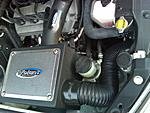
Well, I dont know about the Volant... but K&N does their own dynos to prove both HP and Torque gain.
http://www.knfilters.com/dynocharts/63-9029_dyno.pdf
I think the torque is more noticeable than the actual HP gain.
Someone above had an analogy of two straws, one bent and one not. Thats an ok analogy, but the truth behind a CAI over a stock intake is a few things
1st of all, the CAI is much wider in diameter from start to finish. The stock airbox brings air in thru a much smaller diameter tube (dont have the runner in front of me to measure right now) Take a Straw, suck air thru that and then take a pvc pipe and suck thru that, which one lets more air thru more easily?
2nd, the temperature of the air matters. Your stock air tubes are softer less heat resistant plastic tube... The CAI are made of way thicker, heat resistant tubing which allows the air to be colder after traveling thru the hot engine bay. Its not necessarily how hot the air is at the filter, its how hot the air is at the Intake manifold (hence why meth/water injections can cool down intake temps and increase hp and torque in turbo and Supercharged applications)
If anything the only true argument Ive heard is that the K&N and other filters like it allow small particles thru, this is somewhat/partially true although Ive run K&N cone filters on every single car Ive owned for the last 15 or so including 10 straight years on my 96 4runner and never had an issue. Overoiling can be a bigger problem but thats user error.
Ill pay 240$ for the extra 12 hp and 12lbs of torque and associated fuel economy that the K&N provide.
Amazon.com: K&N 63-9029 Air Charger: Automotive
Also, dont forget, you are paying 20$ or so everytime you replace a stock air filter...
2007 TOYOTA 4RUNNER Parts - ToyotaPartSales.com
I dont remember how often you have to replace those, but 12 of those is 1 CAI... over 10 years how many air filters will you buy??