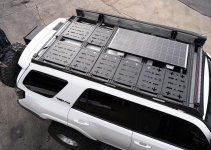
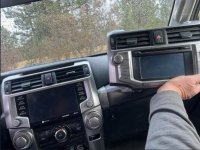
What did you do to/in your 5th Gen today?!

awesome tires. do yours have the pull to the right or are you used to it already?

Got to thinking about this a bit and realized i had certainly seen it before.

My wife has a ‘20 T4R SR5 Premium and fresh of the lot at 5 miles it had a horrible right pull. Seemed to dart right when turned right and fight me when turning left.

We went through the tires in about 10,000 miles and during that time we had the dealer align the vehicle 3 times. Every time it was “perfect” and never needed an adjustment. Until I asked the dealer to replace the tires as warranty and asked to see the results of the 4 wheel alignment (I’m ASE certified).

The result came back that the rear thrust angle was out by 2 degrees which was pushing the rear of the vehicle left making it want to go around and pushing the front right. Not a “pull” right but more of a “push” right.

She now has 62k and has never had anything more the regular rotations done. That’s saying something for Toyota steering on the roads in Maine.

Hope this helps.
 
Last edited:
Got to thinking about this a bit and realized i had certainly seen it before.

My wife has a ‘20 T4R SR5 Premium and fresh of the lot at 5 miles it had a horrible right pull. Seemed to dart right when turned right and fight me when turning left.

We went through the tires in about 10,000 miles and during that time we had the dealer align the vehicle 3 times. Every time it was “perfect” and never needed an adjustment. Until I asked the dealer to replace the tires as warranty and asked to see the results of the 4 wheel alignment (I’m ASE certified).

The result came back that the rear thrust angle was out by 2 degrees which was pushing the rear of the vehicle left making it want to go around and pushing the front right. Not a “pull” right but more of a “push” right.

She now has 62k and has never had anything more the regular rotations done. That’s saying something for Toyota steering on the roads in Maine.

Hope this helps.

that tread pattern tends to pull right. or was it left? idk. mine did it. after googling i saw it was hit or miss with those coopers. but man theyre awesome tires.
 
I had a piece of door weather-stripping that started to sag at the bottom of the door. the rest of the stripping was in good shape so I set out to fix it. I saw that many people use super glue, while probably effective, super glue can also expand and lead to a loose fit. so I went to my workbench and pulled out some black butyl rubber seal - what they use for the vapor barriers in car doors

cleaned the area and flattened out some of that seal and it works very well and can be flattened so the weather stripping sits tight to the door. give it a try if you have some sagging weather stripping and don't want to or need to replace the entire piece
 
Just brought her home from the dealership, well, yesterday actually. It seems that it takes quite a bit of pressing down the accelerator pedal before the acceleration rate gets to be anything decent. I've never experienced this with other vehicles that are more underpowered than this. Is this common with the 5th generation? I see many threads and videos about devices that can be installed to remap the throttle response. Maybe that is what is needed. I mean it does get up to highway speeds when entering from almost a stop on an entrance ramp but you really have to press down on it.

I did the upgrade on both my 2014 and my wife's 2023 trd pro...... it works great, and is configurable to meet your driving needs / style

I went with sprint booster......a member had a discount code that worked to save a few bucks.

The install took 10 mins including opening the box. We had the configuration controller (see picture in link) taped to the small indentation below the key - perfect fit, but once we found the setting we liked best we disconnected the attachment that allows you to configure your settings on the fly and store it on the center console.

You can call me if you want candid comments after almost 3 years of use

txt me at 617.903.0213
 
Nothing. It was parked in the driveway when I took this photo of Comet Tsuchinshan-ATLAS from my back porch at 7:37 last night.

daw89446-albums-misc-picture63300-2024-10-14-05-kodak.jpg
 
oh hell yes

Swapped out my TRD Pro muffler finally. Went with the OEM 4R muffler. So nice and quiet now! Should have done this sooner for sure ...

I'm not quite sure how I managed to live with the TRD Pro exhaust on my last 4R for 3 years. Just recently picked up my new '24 ORP and the stock exhaust is my favorite thing about it.
 
No clue

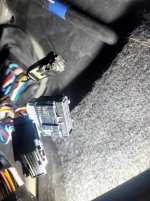
Tried figuring out why my rear lights are not working . Think it has something to do with this burnt diode.
" help be nice please "
 

Attachments

  • VideoCapture_20241022-015704.jpg
    VideoCapture_20241022-015704.jpg
    136.3 KB · Views: 1,379
Rear brake pad change, swapped out the cornfed 1" spacers on the rear springs for 1.5" and finally installed the BOTCK I bought a year ago.
 
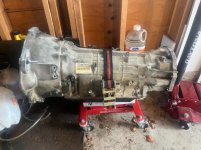
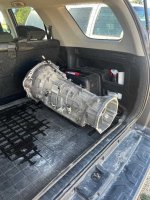
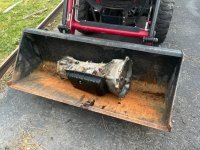
I opted not to do the transmission replacement in our 2014 and let our local mechanic handle the replacement transmission install in the 2014 4Runner. The truck is back to running good as new. Mechanic said it would take him 4 hrs, but it took him 6. Said there were 6 bolts that were a challenge, but relative to a 10 year old car with 365K miles, it was nothing.

$800 for salvage takeout transmission with 43K miles delivered to Missoula for free.

$1,085 for removal and install.

$85 for rear main engine seal, front and rear transmission seals.

$85 for transmission fluid.

By comparison, a reman Aisin 750 transmission runs $2,700.

We did good on this.

Pics 1 and 3 of the old transmission, middle pic is the replacement transmission. Finding many uses for the tractor I bought this summer.
 

Attachments

  • A 750F.jpg
    A 750F.jpg
    136.2 KB · Views: 987
  • A750E.jpg
    A750E.jpg
    124.1 KB · Views: 970
  • thumbnail (1).jpg
    thumbnail (1).jpg
    140.7 KB · Views: 971
Last edited:
ECM Replacement

This was a months long proces for my 2015 SR5 (about 165,000 miles)

- This past summer, while on a 6 hour drive back home, the CEL and TRAC OFF light came on. When I was able to pull off the interstate, I unplugged the battery for about half an hour. About ten minutes down the road, the light came back on and it went into limp mode. When it was able to get into an Autozone parking lot, it was diagnosed to have a VVT Solenoid or Crankshaft Position Sensor fault, with zero help from the employee on finding the part. I was able to pull the parts out, clean them, and the faults went away. The vehicle went about 2 more hours before the CEL came on alone flashing and I experienced a misfire. The vehicle was towed back to my house, where it now showed that it was a camshaft position overretarded, with a new fault for O2 sensor heater circuit.

- I changed out every VVT, Crankshaft position sensor, and sparkplugs/coils.

- About a month ago, the CEL and TRAC OFF lights came back on for P0057 and P0161 (B2S2 O2 heater circuit). It showed both of those codes as "permenant" and P0161 as "stored" and "pending." I had previously put in a Bosch O2 sensor, so I put in a new Denso sensor. The CEL came back on...

-Unsure if I just received a bad O2 sensor, I tried another Denso sensor, and the light came back on, with all the codes again showing as above.

- I inspected wiring for any chaffing, the A/F fuse, the Integrated Relay for resistance based on the "ALLDATA" troubleshooting guides. Everything was good.

-Here is where I may have gotten "fleeced" by a bad dealership. I brought the vehicle to the Toyota Dealership for a diagnostic ($175), and to hopefully pinpoint the issue. They said it was an O2 sensor issue and recommended I put in the OEM part... Which was already in. They refused to work on the vehicle until I put in a "Toyota" part from their service department. Not sure why I did it, but I fancied their request and purchased the sensor ($200) that said "Denso" on the part. To not pay $600 for installation, I did it myself in about 15 minutes. The CEL came back on as expected.

- I brought it back to Toyota, where they further troubleshooted it down to the Integrated Relay. I opted to have that replaced ($350) because the technician claimed that they tested it to be bad, and there wasn't really a labor charge for installation. Once they called and said that the part was replaced, the vehicle was test ran, and it was "running great," I went and picked up the vehicle. About a mile down the road, the CEL came back on. I checked the trip meter, and the vehicle had only been driven 2 miles since the battery was re-installed after the relay replacement. No way they ran a full drive cycle and checked for any codes.

- This time, I was obviously not happy, because I was $725 into "troubleshooting" at the dealership and it seems like they didn't do any actual troubleshooting, and lied about the condition of the vehicle. They finally did resistance checks on wiring, which checked to be okay and left the ECM as the only possible issue in the circuit. The quote for this was $1400, and a call to another trusted mechanic in town was $2000.

- With a lack of trust for the mechanic, and already being deep into this issue, I started looking at options for me to do this myself. I figured that if I bought a used ECM with a warranty, if it didn't work I could return it and buy the more expensive option. LKQ had a used one from a similar model for $165. I couldn't find any information on Gen 5 vehicles having similar issues, but a little bit on Gen 4, and other Toyota models. From what I read, syncing the immobilizer was the only real "required" thing to do, and VIN matching may only be necessary for Emissions testing, or possibly selling.

- I recieved the ECM, and begun my work. Unplug the battery, first! For removing the glovebox to access the ECM, I followed this video which is required to access the ECM. Once the trim and glovebox were removed, the ECM was unplugged, and a bolt on the top/nut on the bottom were removed to take it out. There was another item on that bracket, that was just removed via a clip and slid right off.

- You have to move the metal brackets from the old ECM to the new one. This was a few phillips head screws, and easy. Just install it back in, and plug in the connectors/battery.

- Don't put all the trim back together until after you sync the immobilizer in case there was an issue... You wouldn't want to have to take everything back apart.

- The immobilizer sync isn't hard, I just followed this video for the steps. It takes about half an hour for this process.

- After everything was done, the vehicle started back up, and ran for about half an hour without an issue. While it was running, I reinstalled all of the trim and glovebox.

It has ran great since, including two trips of about 1.5 hours and normal daily drives. Now the next steps aren't completely necessary, but I just did it because I wanted to ensure there weren't any issues if I were to sell it in the future/move somewhere that requires emissions testing.

- I learned that diagnostic tools that are capable of changing the VIN need the "Techstream" software, or there are some OBD tools that can do it.. most are very expensive. I was able to find this tool on Amazon for about $150 on sale I have heard you can buy a cable that can connect to a computer with some downloaded software as well, but this was easier for me. I confirmed with the seller that it was capable of re-writing the VIN. If it didn't work, I would just return it.

- I got the diagnostic tool in, and was able to go through menus to re-write the VIN. There aren't any real instructions on how to, I just had to go through menus until I found the option. I was able to match the VIN written in the ECM to the vehicle. Again, this is not required, and did not affect the vehicle performance. Someone can comment and maybe find a cheaper or easier option.

In conclusion, I just wanted to write all of this because I couldn't find any information regarding Gen 5s with this issue. I hope it helps others with similar cases to find cheaper options for an ECM replacement than what dealerships/mechanics charge. After quotes of $1400 and $2000 for new ECMs, I was able to find an ECM for $160 and a diagnostic tool for $150 (again, not necessary). The entire replacement process takes about 2 hours on the conservative side. This saved me over $1000.

 
This was a months long proces for my 2015 SR5 (about 165,000 miles)
...

interesting post - thanks. I read all of it. I wonder at what point do you know it's the ECU or do you have to go through all the previous troubleshootings to get to that point. maybe the (unrelated?) codes are a clue, replacing O2 sensor easy enough. I find the OEM parts aren't usually the issue, it's paying the labour hourly rate to do some of this stuff or do more advances troubleshooting with the right tools
 
interesting post - thanks. I read all of it. I wonder at what point do you know it's the ECU or do you have to go through all the previous troubleshootings to get to that point. maybe the (unrelated?) codes are a clue, replacing O2 sensor easy enough. I find the OEM parts aren't usually the issue, it's paying the labour hourly rate to do some of this stuff or do more advances troubleshooting with the right tools

I think it was a result of troubleshooting the DTC given. It was essentially O2 Sensor > Fuse and Relay > Wiring > ECM. Maybe the issues this past summer are unrelated, but no real way to tell. There just wasn’t much info on Gen 5 ECM replacement, so I figured this would help people save money if they are able to. Although I am more mechanically inclined from my days fixing airplanes in the military, this really isn’t that difficult of a process.
 
After experiencing the Entune 3.0 with CarPlay and larger screen in her 2023 ORP, my wife asked for CarPlay and bigger screen in her 2014. I went the retrofit route with the Entune 3.0 and retrofit harness by autoharnesshouse.com. Took a bit to figure out, but I got it there and it's working. One issue left, the salvage goons cut the navigation cord thinking it attached to the harness of the salvage vehicle. It does not. It simply jumps from the back of the navigation box to the rest of the head unit. New cord on order and it's $73.
 

Attachments

  • Screenshot 2024-11-25 092415.jpg
    Screenshot 2024-11-25 092415.jpg
    90.6 KB · Views: 714
Last edited:
arb compressor question

hi folks - question for all of you that have arb under the hood that live in winter climates

I had an arb single, mounted under hood near passenger firewall with the LFD stainless steel bracket (excellent bracket btw). after not even two years I noticed my compressor sounded louder, vibrated a bit and didn't seem to work as good as I remember. Took it off and found that the relay pins were all corroded and there was some melted plastic. took the power connector to the compressor out and found corroded leads as well. any steel parts of that compressor (the black mounting base attached to the compressor) was so badly corroding the paint was all flaked off exposing rusty metal. screws, rusted

with winter here almost 5 months of the year I drive through a lot of salt spray on the highway which is where I do most of my driving. I suspect this was the issue - moisture getting into the connectors. arb connectors are not moisture proof, too bad, I don't think the compressor is either. I do miss on board air it was convenient and found arb dual at a good price. but fool me once... the arb dual will also not be moisture proof since it's basically two singles, even if the relay is housed under that cover. arb says IP55 protection on their website, which is only limited dust/moisture ingress, but arb claims dust proof which I don't believe. I suspect another arb compressor will suffer the same fate as my single if I did install one

any of you with arb compressors in winter climates that have them mounted in the engine bay, how have they held up? I separately asked Viair about their hardmount options and spoke to a sales rep. told him my situation with arb and asked how they suggest to hardmount. he basically told me not to mount it in the engine bay if you live in a winter climate - the salt spray and moisture would ruin the compressor far sooner than it would naturally die out. so I've been hauling around my viair 400 Auto compressor which is a beast, but just something else that takes up valuable space
 
hi folks - question for all of you that have arb under the hood that live in winter climates

I had an arb single, mounted under hood near passenger firewall with the LFD stainless steel bracket (excellent bracket btw). after not even two years I noticed my compressor sounded louder, vibrated a bit and didn't seem to work as good as I remember. Took it off and found that the relay pins were all corroded and there was some melted plastic. took the power connector to the compressor out and found corroded leads as well. any steel parts of that compressor (the black mounting base attached to the compressor) was so badly corroding the paint was all flaked off exposing rusty metal. screws, rusted

with winter here almost 5 months of the year I drive through a lot of salt spray on the highway which is where I do most of my driving. I suspect this was the issue - moisture getting into the connectors. arb connectors are not moisture proof, too bad, I don't think the compressor is either. I do miss on board air it was convenient and found arb dual at a good price. but fool me once... the arb dual will also not be moisture proof since it's basically two singles, even if the relay is housed under that cover. arb says IP55 protection on their website, which is only limited dust/moisture ingress, but arb claims dust proof which I don't believe. I suspect another arb compressor will suffer the same fate as my single if I did install one

any of you with arb compressors in winter climates that have them mounted in the engine bay, how have they held up? I separately asked Viair about their hardmount options and spoke to a sales rep. told him my situation with arb and asked how they suggest to hardmount. he basically told me not to mount it in the engine bay if you live in a winter climate - the salt spray and moisture would ruin the compressor far sooner than it would naturally die out. so I've been hauling around my viair 400 Auto compressor which is a beast, but just something else that takes up valuable space

This seems to be the best option for your particular scenario. Even regular car components exposed to the road salts that are supposed to be exposed, don't fare well in salt environments.

I keep a Viair 88p(?) in my trunk at all times. Yeah, it sucks that it takes up space, but having a vital tool that takes up cargo space that works, is better than a vital tool that is tucked away neatly, but doesn't work.
 

Members online

Forum statistics

Threads
278,316
Messages
3,554,121
Members
248,016
Latest member
Advally Service

Trending content

Back
Top