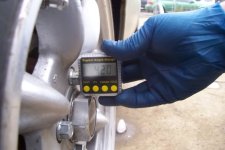
1/2° is probably acceptable, but I doubt that you can really achieve that in your driveway.
Aha! That's great information. Thanks!
You cannot meet the 1/2° accuracy because you cannot verify it.
Ah, but we can.
There's nothing stopping us from verifying using multiple methods, one of which is always the fallback professional alignment check, which I would do the first time anyway ... just to doublecheck that it actually worked.
you still won't be able to match the accuracy of a shop grade alignment system.
I don't think we're trying to match a professional tool.
I'm not sure I know all the requirements of the professional tools - but certainly the scope has to be vastly more encompassing than that of the typical home DIY. For one, professional alignment rigs have to handle many more measurements than just camber. They have to work on many model years. They have to be robust as they are in use day in and day out for years. They are used by a variety of technicians with a variety of skills and intelligence levels. They must handle a huge diversity of vehicles and model years. They have to be easily read, quick, and fool proof in the shop. They have to be repeatable and accurate and efficiently calibrated, and they have to provide fancy color printouts that impress their clients. They have to have huge databases of cars I can't even imagine ever owning - or even wanting to own. They have to handle a horridly dusty greasy rough-and-ready environment. They have to allow visual measurement from one end of the car to the other without changing the jig or moving the position of the technician inefficiently.
Comparing the cost and requirements of a professional tool versus a home DIY tool for measuring camber, is a bit like comparing the cost and capabilities of a laser eye surgery tool, which handles a hundred patients a day, to the old country doctor who has you stand 20 feet away to read an eye chart on the wall so that he might prescribe the correct glasses for you.
The requirements aren't the same for the eye chart and the laser surgery tool.
Even lower tech alignment machines will be better than plumb lines and tape measures.
Is red a better color than green?
Given the spec is ± ¾°, seems to me our first goal should simply be to get the camber within spec.
Note: I suspect if a technician is within ± ¾°, that's good enough for him; but if I can get ½° accuracy, I'll spend an hour or three trying to turn that ± ¾° into ±½°, if I can.
What do you mean by "having been burned twice by the crooks"?
I guess that's my fault for mentioning it ... so the question, while having nothing to do with the camber tool question at hand, is fair enough for one to ask.

Especially since my goal is to check the alignment before and after taking it to the shop.
< long story warning >
Years ago, after failing inspection and replacing the idler arm, pitman arm, tie rod ends, and ball joints, I brought my decade-old American car in to Sears for an alignment.
Previously I had read about how to do an alignment and concluded that I just didn't have the skills nor the tools because a home alignment requires more intelligence and effort than simply replacing components does.
Still ... I had marked all the eccentrics and the threads of the tie rod ends, pitman arm, idler arm, anything and everything I could (many of which turned out to have had nothing to do with the alignment) so that I could learn what was done during the alignment process.
I had already roughly adjusted the toe, by twisting the tie rod ends ... and using as a tool, a long board, with a swinging stick bolted on each end, with a nail on the end of that stick aligned with a chalk line scribing the midline of the tire tread.
At Sears, from afar, I watched the technician like a hawk (as I always do). I never saw him do anything to the car. I didn't even see him once he lifted it up. In fact, there was nobody around the car for about 45 minutes. At one point, I went to the bathroom briefly, and lo and behold, within a few minutes of returning, I heard from someone, clipboard in hand, "your car is ready".
I drove home. I jacked it up. I looked at all the parts I had just replaced. Not a single mark was disturbed. Not one.
I brought it back to Sears the next day. Spoke to the manager. We took a look. The only number correct was the toe. Nothing else was even close! Turns out my car was 11 years old and the tech admitted to the manager his charts only went back 10 years. So he faked the alignment. They apologized. They subsequently aligned the cars based on MY NUMBERS! (which was the shock of my life because that's when I realized they didn't even have the right numbers!). And that was it. I vowed never to return to Sears the rest of my life (and I've kept that vow!).
And, I was made wary of alignment techs ... because this must be happening to thousands of people every single day!
Fast forward to about a year ago.
Notice in my pictures above the yellow marks and the new front shocks. I had replaced the shocks and bought new tires from Tirerack. Guess what I did BEFORE the car went in to Goodyear for the subsequent tire mounting and alignment? Yup. I marked everything! Guess what I did AFTER I got back from the alignment? Yup. I looked! The good news is that the cams were definitely moved by the technician. So he did "something". It took him all of ten or fifteen minutes or so - and I did watch him the whole time ... so I simply 'assumed' he at least performed a proper alignment.
Fast forward to today...
Notice the tire wore out prematurely on the outside and that I can't find a fault in the ball joints or bushings or tie rod ends (that's the topic of a different thread). Also notice that the 'bad side' has a grossly different setting than the good side on some of the eccentrics (which are no where near the 12 o'clock position). Notice how much the marks are off from the yellow originals on the bad side ... but not so on the good side.
I can't prove anything without another alignment - and even then - a year has passed - so we all know what that means ... but ... I suspect there is a chance that the alignment was done wrong.
I already don't trust Sears for life. Maybe I don't trust Goodyear. I don't know yet. However, if you can't trust Sears/Goodyear ... whom can you trust?
There's only one 100% correct answer.
< / of long story >
I agree with everyone that has suggested looking for a better shop, or watching the tech do it
All I want to find is a way to check my alignment before and after going to the shop.
While there's nothing wrong with having a 'better shop' do my next alignment, this thread seems to be going off track a bit like this:
Q1: What glasses should I buy? And what should I look for?
A1: Get laser surgery. Everybody is doing it.
....
Q2: Thanks. I know all about laser surgery. I've had it in the past many time. But I'm nearsighted as I age and I just want glasses. Do you have any idea about how to choose glasses?
A2: Laser eye surgery tools cost $50K. Glasses cost $250. Do the math. Get laser eye surgery.
....
Q3: But I'm happy with plain old $250 glasses. They work fine for what I need them to do.
A3: You don't get it. Nobody can afford to buy a $50K tool. Pay a doctor to use the $50K tool on you. It's much better than $250 glasses. Why do you think it costs so much?
....
Q4: But my $250 glasses don't have anywhere near the same requirements as the laser?
A4: Look. I'm telling you the math. The laser costs $50K. It has to be better. Just look up the best laser machine on the net and find a doctor who uses that. It's what I do.
...
Q5: I know what 'you' do. But I just want glasses to do the job given a simple spec?
A5: The laser costs $50K and glasses only cost $250. Use the Hunter laser. It costs $80K. What more do you need to know?
...
Point is, the professional $50K tool has different requirements than just buying a pair of the $250 glasses ... so they can't be compared any more than a jet can be compared to an ultralight ... and this thread isn't about the fancy laser guide tool at the alignment shop.
This thread is all about finding a <$250 camber gauge that achieves the necessary accuracy, which, at the moment, we're assuming is roughly about ½° accuracy.
There are lots of ways you can measure camber, you have to decide which way is best for you at home
I know! I know. Googling, I find PLENTY.
But I've never done an alignment. I prefer to take my cues from the team, many of whom must have done an alignment or two themselves. That's why I ask the question! (Note: You know as well as anyone, people get mad at me when I present 'research' on the web.)
Don't assume this is possible.
Hmmm... That sentiment does confuse me. For example, if I set my camber to 0° with a plumb bob, that's probably good enough (because it's within specs). Of course, I'd like to do better ... ... and I'd also have to check other alignment criteria ... but it sure seems 'possible' to me to get the camber within spec.
I'm assuming some of the tools give me at least ½° accuracy & repeatability. But, again, I want to hear from others first before buying the tool and finding out for myself.
not many people do their own alignments (like nearly no one), there isn't much market for at home tools for it
That might explain why I couldn't find a single DIY in the 3rd-gen T4Runner forum!
My goal, some day, is to write that DIY ... so others benefit from all this effort ... but that's a different topic altogether!
Your cost would be $88 for an alignment. You don't need a front end inspection first.
It's my fault for bringing that up because it's not really germane to the tool quest.
But, I'm not sure I understand you. What if, perchance, my LBJ or tie-rod end is bad (and I just didn't test it correctly). Now I'm going to have an $88 alignment ... yet I didn't fix anything.
Are you saying that, in the process of the $88 alignment, that they will tell me that my ball joint or bushings or tie rod ends need replacing?
I asked that question and "Norman" at Capitol Toyota said that they will do the alignment whether or not the components are bad. That's why (he said) I needed the additional $145 checkup.
But this thread isn't about that ... so I apologize for bringing it up.
This thread is about finding a camber measuring tool that can work in the home DIY environment.
So far, we've established an accuracy goal of ±½°.