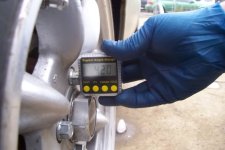
Where do you buy your tools for checking front camber at home on your 4runner?

Status
Not open for further replies.

mom

Banned
Camber gauge TOOL thread: What accuracy needed to DIY alignment & what tool at ~$250?

To check camber before & after taking the vehicle to the shop to be aligned:
Q: What accuracy is needed in a home DIY camber tool?
Q: What tools are available that achieve that accuracy at home?

And would you recommend the camber gauge shown in the FSM?
8975762.png

Note: I searched for, and read all the threads in the 3rd gen T4Rs forum which had camber in the title, but not a single 3rd-gen thread showed what tools they used nor the procedure they used to check camber at home.

The closest I found was this Yotatech home alignment DIY:
* 86-95 Trucks & 4Runners 2nd/3rd gen pickups, and 1st/2nd gen 4Runners with IFS

Which, amazingly, used a plumb bob.

But it's for the wrong model years (mine is a 1997 2WD Base 4Runner) so I'm not sure how much applies.

To check camber before & after taking the vehicle to the shop to be aligned:
Q: What accuracy is needed (for example, is 1/8° desired?)
Q: What tools are available that achieve that desired accuracy at home?
8975532.jpg
 
Last edited:
Register to hide this ad
When I did a quick set up of my own after the lift to get it by for the drive to the alignment shop I used a piece of wood across the wheel and an angle finder

AngleFinderFrontFullSize.jpg


similar to that.

If you are looking for something to actually set your alignment perfectly, they do make specific tools for that but I have never used them myself to recommend one over another.
 
I used a piece of wood across the wheel and an angle finder

Thanks for the advice.

I saw many camber DIYs similar to what you suggest, where the user measures the offset of the 12 o'clock & 6 o'clock positions of the wheel with respect to a line perpendicular to the ground, and then uses trig to calculate the angle based on the distance delta.

The good news is that available measurement technology is constantly improving. For example, just as you described, this camber DIY used a block of wood & an iPhone as the measuring device.
3025271110_ffee13e89e.jpg


The key question is what accuracy is needed ... and what accuracy can be obtained?

BTW, here's a picture showing the result of what may turn out to be grossly maladjusted camber ... the tread is worn off to the belts (even though the vehicle was presumably aligned 12K miles ago by Goodyear when the tires were installed).

8975479.jpg


Here are pictures of the passenger side front eccentric:
Note: The yellow line was done by me prior to the alignment ... so it shows how much the alignment guy moved the eccentric. After having been burned, I always mark before an alignment and check after.
Note: I don't trust any alignment shops anymore - after having been burned twice by the crooks - so I want to check the alignment both before and after I take it to the shop to be aligned again!
8975686.jpg

Driver's side front eccentric:
Note: The rust is from unrelated battery acid spillage.
8975697.jpg


The goal of this thread is to scope what accuracy is needed and obtainable for a home DIY camber gauge ... so that I can check my camber before and after bringing it to the shop to be aligned.
 
Last edited:
Thanks for the advice. I'm shocked that there isn't a single 3rd-generation 4Runner home alignment DIY on this entire forum!

Let's hope we can find a good supplier for the necessary camber measurements.

Here's a picture showing why I think my camber is grossly off, by the way ... the tread is worn off to the belts in just about 12K miles (even though the vehicle was aligned prior).

8975479.jpg


Notice the eccentric on that side of the vehicle is set vastly different than the complementary eccentric for the other side:

Passenger side front eccentric:
Note: The yellow was done by me prior to the alignment ... so it shows how much the alignment guy moved the eccentric.
Note: I don't trust any alignment shops anymore - after having been burned twice by the crooks.
8975686.jpg

Driver's side front eccentric:
Note: The rust is from unrelated battery acid spillage.
8975697.jpg
All alignments ive had done professionally have been spot on.. try to find places that use the hunter systems and watch them while they actually do it to make sure the techs are actually following the computerized measurements
 
Besides tire wear, are there any other issues? If not, it could be a defective tire.

If you want to solve this, you need to start with two new tires on the front, so you have some kind of base line to work from.

From there, you can:
1) Put a wrench on the camber adjustment, and put it back to where you think it should be, assuming the original alignment tech made a mistake 12k miles ago. Of course you without an alignment rack and precision tools would just be guessing...
2) Go back to the original shop, complain about the job and ask for a re-do. The shop may point out a) you could have a bad tire, b) you may have hit a curb, c) any other thing that may have happened over the past year to knock the camber out of whack.
3) Take it to a new shop, have it aligned, keep the print out and receipt.

Once you have made a choice, check every 2k miles. One idea would be to pick a nice level concrete driveway. Make a large puddle with a garden hose, drive through, and observe the water marks the tires make. The tread should look about the same side to side, there shouldn't be crabbing to the side, etc. First sign of trouble or wear, take it back to the shop that does the work and get it back on the rack.

Good luck!
 
My guess is that the right tools would cost far more than the alignment (~$60).

Like I always recommend, find a shop with a guy who has lots of gray hair, smokes like a chimney and cusses like a sailor -that's the guy you want. Someone who's been doing alignments for 30 years, and has done them on something other than McPherson struts, will know what they're doing and usually do a good job. It'll be more accurate and cheaper than trying to do it yourself (there's probably a reason they use very expensive alignment racks instead of tape measures and level/inclinometers :) - you're probably not going to get it measured correctly down to .25 degree with an inclinometer).

I've done 'driveway alignments' and gotten it close enough to drive to the alignment shop but would never trust them long-term. An alignment is much cheaper than one tire, much less two.
 
Last edited:
buy 2 new tires and then align. How can you get an accurate alignment when your tires look like you entered in the local burn out contest?
 
I haven't had a good alignment guy in a while since I've been moving a bit in the last few years, and for the truck I went firestone lifetime. partially for the fact that I knew it wouldn't stay stock, and partially for the fact that it takes the biggest risk of needing suspension replaced and the alignment touched up before a long drive back home. I figured if I can minimize the potential cost of an out of town repair that's a win win.

I will ask some of the guys at work who have lived in the bay area much longer than I who a good shop is around here. My usual suggestion is to stay away from tire store and find a shop that specializes in frame repair.
 
There's a great shop in Santa Cruz Stick Figure if you ever need it. Soquel Alignment and Exhaust. The guy deals with lifted vehicles all the time and does strictly alignments and exhaust. In an hour he was able to fix my alignment issues that another shop couldn't do after four trips and multiple hours.
 
Besides tire wear, are there any other issues? If not, it could be a defective tire.

It's OT, but a separate thread with gory details about the tire-wear problem is here:
- Advice sought for the likely cause of premature front right tire wear (11k miles)
8982060.jpg


you need to start with two new tires

That's a different issue than what tool to buy that tests camber.

For example, this camber measuring tool mounts on the wheel:
8982113.jpg

And, this camber measuring tool mounts on the rotor:
8982195.jpg


With or without new tires, this thread is posed to ask what camber tool is available today that will do a good enough job at a decent enough price.

without an alignment rack and precision tools would just be guessing...

I agree "guessing" would occur if we spec out a tool that doesn't have the desired accuracy.

The question then becomes ...

Q: What accuracy do we 'need'?

The camber spec for my 4Runner is - ¼° ± ¾° which indicates, I think, that all we need is roughly about ½° accuracy in the home alignment camber tool. (Is my math correct?)

In fact, I think that's why a plumb bob worked in the Yodatech home alignment DIY (i.e., 0°).
8982121.jpg


Since you bring up the great point about accuracy, may I ask:
Q: What accuracy do we need for camber measurements on our 3rd-generation 4Runners?
Q: Does at least ½° accuracy seem reasonable to you?

observe the water marks the tires make.

That's an interesting idea for checking camber!

My guess is that the right tools would cost far more than the alignment (~$60)

I agree. Cost is a relevant factor when selecting a tool.

To quick-price the alternative, I just called Capitol Toyota in San Jose.
Here's their pricing for what I'd need to do for the current problem.

1. Check front end components = $145 (exclusive of repairs)
2. Alignment = $88 (Note: an alignment w/o a prior check would be a waste of money in this case, even if the ultimate problem turns out to be 'only' the alignment because you can't do it in the reverse order!)

So the cost, for me, is roughly $150 + $100 ~= $250, which becomes (roughly) my initial budget for the caster gauge. If I can identify the problem for about $250, then I break even with having Toyota identify the problem.

Note: If you can show me an alignment shop in the Silicon Valley who does an alignment for appreciably less than $88, I would be thankful as that changes the math (but I called around before posting this query and found that this is a pretty good price in this area).

The good news is that we can use the camber gauge again and again and again, which makes its ultimate cost about 1/10<sup>th</sup> the original cost, which is roughly about $25 per use over time.
8982140.jpg

you're probably not going to get it measured correctly down to .25 degree

Accuracy is definitely relevant.

What 'accuracy' do you think we need, given the spec is - ¼° ± ¾° (and given that one wheel may be grossly out of spec)?

An alignment is much cheaper than one tire, much less two.

An alignment out here is roughly around $100 ... which is roughly the price of one tire, certainly not anywhere near the price of two tires (out here anyway).

But that's all moot because the topic is camber gauges that fulfill, I think, these conditions:
I) Accurate enough (how much accuracy do we need given Toyota specs are ±¾°)?
II) Cheap enough, i.e., roughly under around $250 (which means the cost per alignment is about $25 assuming it will be used ten times in my lifetime)

buy 2 new tires and then align.

That's a different issue than what tool to use. That information will eventually be useful for the upcoming first-ever Toyota-4Runner.org 3rd-gen garage alignment diy. :)

find a shop that specializes in frame repair.

The point of this thread is the tool. May I ask if these are the key specs we should strive to satisfy?

a) Somewhere around ½° accuracy?
b) Somwhere less than about $250 in cost?
 

Attachments

  • digital_angle_gauge.jpg
    digital_angle_gauge.jpg
    38.8 KB · Views: 7,698
Last edited:
Q: Where did you buy your tools for checking your front camber at home?

And do you use the tools shown in the FSM?
forum which had camber in the title, but not a single 3rd-gen thread showed what tools they used nor the procedure they used to check camber at home.

The closest I found was this Yotatech home alignment DIY:
* 86-95 Trucks & 4Runners 2nd/3rd gen pickups, and 1st/2nd gen 4Runners with IFS

Which, amazingly, used a plumb bob.

But it's for the wrong model years (mine is a 1997 2WD Base 4Runner) so I'm not sure how much applies.

Q: What tools do you use and where do you buy them when you check your front camber at home?

Thanks for the advice. I'm shocked that there isn't a single 3rd-generation 4Runner home alignment DIY on this entire forum!

Let's hope we can find a good supplier for the necessary camber measurements.

Here's a picture showing why I think my camber is grossly off, by the way ... the tread is worn off to the belts in just about 12K miles (even though the vehicle was aligned prior).

Notice the eccentric on that side of the vehicle is set vastly different than the complementary eccentric for the other side:

Passenger side front eccentric:
Note: The yellow was done by me prior to the alignment ... so it shows how much the alignment guy moved the eccentric.
Note: I don't trust any alignment shops anymore - after having been burned twice by the crooks.

Driver's side front eccentric:
Note: The rust is from unrelated battery acid spillage.

Take a step back before jumping right into doing your own alignment... Make sure you fully understand what an alignment is before shunning the shops.

First, camber is the same animal no matter the model, year, etc., they just adjust differently and have different specs. The procedure in the yotatech link would not change 1 iota if it were written specifically for the 3rd gen (except for the pics and video's, which don't show up for me anyway). The measurement system he describes is valid for any vehicle on the road; you don't need a toyota brand ruler to measure the size of your toyota wheels.

Second, even if you diligently follow this system, you still won't be able to match the accuracy of a shop grade alignment system. Not all shops have the latest and greatest, but the last shop I went to had an $80k optical machine that gave the live readout on the screen, and the tech just had to adjust while staring at the screen; super easy to get it dead center in spec. That isn't to say they won't still screw it up (my steering wheel didn't get centered properly), but as far as the alignment goes, it is way more foolproof than doing it in your driveway. Even lower tech alignment machines will be better than plumb lines and tape measures.

What do you mean by "having been burned twice by the crooks"? The alignment shop screwed you over twice, or just "shops" in general? I agree with everyone that has suggested looking for a better shop, or watching the tech do it (if they'll let you). Actually understand what the alignment is before you watch them do it, ask questions, and above all, be very friendly.


Q: Where did you buy your tools for checking your front camber at home?

And do you use the tools shown in the FSM?
Note: I searched for, and read all the threads in the 3rd gen T4Rs forum which had camber in the title, but not a single 3rd-gen thread showed what tools they used nor the procedure they used to check camber at home.

The closest I found was this Yotatech home alignment DIY:
* 86-95 Trucks & 4Runners 2nd/3rd gen pickups, and 1st/2nd gen 4Runners with IFS

Which, amazingly, used a plumb bob.

But it's for the wrong model years (mine is a 1997 2WD Base 4Runner) so I'm not sure how much applies.

Q: What tools do you use and where do you buy them when you check your front camber at home?

There are lots of ways you can measure camber, you have to decide which way is best for you at home (meaning which can you get the most accurate, reliable measurement with)


Don't assume this is possible. Less than 1° accuracy is decently tight. it's nothing for porfessional equipment, but that is way out of the price range, and since not many people do their own alignments (like nearly no one), there isn't much market for at home tools for it.

I agree. Cost is a factor. I just called Capitol Toyota in San Jose. Here's the pricing:

1. Check front end components = $145 (exclusive of repairs)
2. Alignment = $88

So the cost, for me, is roughly $150 + $100 ~= $250, which becomes my initial budget for the caster gauge.

Your cost would be $88 for an alignment. You don't need a front end inspection first. They are trying to get you to pay them extra for the privilege of them telling you need even more work done to your vehicle than the alignment, which they will happy to charge you even more to do.

This is relevant. What 'accuracy' do you think we need, given the spec is ¼° ± ¾° (and given that one wheel may be grossly out of spec)?

An alignment out here is roughly around $100 ... which is roughly the price of one tire, certainly not anywhere near the price of two tires (out here anyway).

But that's all moot because the topic is caster gauges that fulfill, I think, these conditions:
a) Accurate enough (how much accuracy do we need? I'm guessing ½° should be fine)?

b) Cheap enough, i.e., roughly under around $250.

1/2° is probably acceptable, but I doubt that you can really achieve that in your driveway. You may be able to "measure" within 1/2°, but that will be with an unverifiable, un-calibrated measurement system.

That's a different issue than what tool to use. That information will eventually be useful for the upcoming first-ever Toyota-4Runner.org 3rd-gen garage alignment diy. :)

Here's where I will sound a little bit like a jerk. Please don't do a DIY alignment write-up. I know you write extremely detailed and illustrated write-ups, which is fine, but honestly, because of the questions you are asking about this, I don't think you understand the subject well enough to provide sound advice for people to follow and do a good job (that won't mess up their shop alignment, or cause premature wear like you have).

I don't mean that as an insult, there's a reason engineers design the tools and adjustment mechanisms, and a reason that Toyota pays someone with a degree in engineering good money to design and write the procedure for the shops. It is not as simple as it looks. If it were, then Toyota wouldn't have to include it in the FSM, it would just be a common procedure like pumping up a tire.

The point of this thread is the tool. May I ask if these are the key specs we should strive to satisfy?

a) About ½° accuracy?
b) About $250 in cost?

You cannot meet the 1/2° accuracy because you cannot verify it. You may be able to get it acceptably aligned, but you cannot make any statements about X° accuracy. If you understand wheel alignment, your measurement system, etc. then you can take the risk upon yourself to do your own alignment in your own way, but you cannot write up a DIY saying that your method works, and gets the vehicle within spec.
 
Last edited:
you need guide plates to allow the tire to set in a neutral position.
aswell as a way to properly connect the caster/camber gauge to the wheel. generally a wheel clamp is used. these parts are very expensive. i think the wheel clamps are around $250 each.


for the price of the correct tools, you would be able to purchase a dozen alignments. not to mention, even with the tools, if you dont know what you're doing, how do you know the ends results will be what you want?
 
you need guide plates to allow the tire to set in a neutral position.
aswell as a way to properly connect the caster/camber gauge to the wheel. generally a wheel clamp is used. these parts are very expensive. i think the wheel clamps are around $250 each.


for the price of the correct tools, you would be able to purchase a dozen alignments. not to mention, even with the tools, if you dont know what you're doing, how do you know the ends results will be what you want?

Hmmmmm, that was a much more succinct way of saying what I said... I think I wasted 15 minutes of my life typing...
 
also, having a tool with 1/2* of accuracy wont help. it needs to be correct.

if you have a 1/2 to play with, and the vehicle allows 1/2 for its specificed range, you could be a FULL degree out, if they both end up being "off" the same direction.


or you could have one side off 1 degree to the positive, and the other side could be off 1 degree to the negative.
this is BAD, and will likely cause a bad pull, aswell as excessive tire wear.
a driveway alignment is a bad idea. unless its just to get you to the shop to have it done correctly.

alignments are cheap compared to tires.
 
Last edited:
The other thing that I don't know if it has been mentioned is the Caster vs Camber adjustment. Most of the tools that you have posted will work for adjusting camber, the problem is how easy it is to absolutely screw your caster up trying to bring the camber into spec.

I'm about as big of a DIYer as you will find and work in the auto field (have for over 16 years) but alignments are one of those things that I have learned are easier to pay someone else to do than to buy everything you need to do it right at home.

I have adjusted camber as said before with a angle finder and 2x4 and have used two equal length pieces of angle iron clamped to the rotors to adjust toe. You can certainly get things close enough to drive to an alignment shop or to get your off road vehicle set up well enough to crawl over rocks.

I would still suggest to find a GOOD alignment shop (like the one SCRunner12 suggested) and make sure they stand behind their work to take care of a vehicle that sees high speeds and daily driving on concrete where tire where and vehicle stability is a major concern.
 
i use the a string stuck to the ceiling with a bolt tied to the end. Hang it about 6" from the wheel in the center. measure the distance from the top edge of the rim to the sting then the bottom edge of the rim to the string. Use the difference combined with the distance apart. say you have a 1/4" difference and a 16 inch rim you can solve for the angle with some basic trig. after a little math your left with .89˚ and then you can adjust from there. using the alignment chart in the fsm. I just let the caster go. It only effects the recentering of the wheels not tire wear. Camber is important to me.

I did this awhile back in my garage and after a few thousand miles the tire wear looks real good.
 
1/2° is probably acceptable, but I doubt that you can really achieve that in your driveway.

Aha! That's great information. Thanks!

You cannot meet the 1/2° accuracy because you cannot verify it.

Ah, but we can.
There's nothing stopping us from verifying using multiple methods, one of which is always the fallback professional alignment check, which I would do the first time anyway ... just to doublecheck that it actually worked.

you still won't be able to match the accuracy of a shop grade alignment system.

I don't think we're trying to match a professional tool.

I'm not sure I know all the requirements of the professional tools - but certainly the scope has to be vastly more encompassing than that of the typical home DIY. For one, professional alignment rigs have to handle many more measurements than just camber. They have to work on many model years. They have to be robust as they are in use day in and day out for years. They are used by a variety of technicians with a variety of skills and intelligence levels. They must handle a huge diversity of vehicles and model years. They have to be easily read, quick, and fool proof in the shop. They have to be repeatable and accurate and efficiently calibrated, and they have to provide fancy color printouts that impress their clients. They have to have huge databases of cars I can't even imagine ever owning - or even wanting to own. They have to handle a horridly dusty greasy rough-and-ready environment. They have to allow visual measurement from one end of the car to the other without changing the jig or moving the position of the technician inefficiently.

Comparing the cost and requirements of a professional tool versus a home DIY tool for measuring camber, is a bit like comparing the cost and capabilities of a laser eye surgery tool, which handles a hundred patients a day, to the old country doctor who has you stand 20 feet away to read an eye chart on the wall so that he might prescribe the correct glasses for you.

The requirements aren't the same for the eye chart and the laser surgery tool.

Even lower tech alignment machines will be better than plumb lines and tape measures.

Is red a better color than green?

Given the spec is ± ¾°, seems to me our first goal should simply be to get the camber within spec.

Note: I suspect if a technician is within ± ¾°, that's good enough for him; but if I can get ½° accuracy, I'll spend an hour or three trying to turn that ± ¾° into ±½°, if I can.

What do you mean by "having been burned twice by the crooks"?

I guess that's my fault for mentioning it ... so the question, while having nothing to do with the camber tool question at hand, is fair enough for one to ask. :)

Especially since my goal is to check the alignment before and after taking it to the shop.

< long story warning >

Years ago, after failing inspection and replacing the idler arm, pitman arm, tie rod ends, and ball joints, I brought my decade-old American car in to Sears for an alignment.


Previously I had read about how to do an alignment and concluded that I just didn't have the skills nor the tools because a home alignment requires more intelligence and effort than simply replacing components does.


Still ... I had marked all the eccentrics and the threads of the tie rod ends, pitman arm, idler arm, anything and everything I could (many of which turned out to have had nothing to do with the alignment) so that I could learn what was done during the alignment process.


I had already roughly adjusted the toe, by twisting the tie rod ends ... and using as a tool, a long board, with a swinging stick bolted on each end, with a nail on the end of that stick aligned with a chalk line scribing the midline of the tire tread.


At Sears, from afar, I watched the technician like a hawk (as I always do). I never saw him do anything to the car. I didn't even see him once he lifted it up. In fact, there was nobody around the car for about 45 minutes. At one point, I went to the bathroom briefly, and lo and behold, within a few minutes of returning, I heard from someone, clipboard in hand, "your car is ready".


I drove home. I jacked it up. I looked at all the parts I had just replaced. Not a single mark was disturbed. Not one.


I brought it back to Sears the next day. Spoke to the manager. We took a look. The only number correct was the toe. Nothing else was even close! Turns out my car was 11 years old and the tech admitted to the manager his charts only went back 10 years. So he faked the alignment. They apologized. They subsequently aligned the cars based on MY NUMBERS! (which was the shock of my life because that's when I realized they didn't even have the right numbers!). And that was it. I vowed never to return to Sears the rest of my life (and I've kept that vow!).


And, I was made wary of alignment techs ... because this must be happening to thousands of people every single day!

Fast forward to about a year ago.


Notice in my pictures above the yellow marks and the new front shocks. I had replaced the shocks and bought new tires from Tirerack. Guess what I did BEFORE the car went in to Goodyear for the subsequent tire mounting and alignment? Yup. I marked everything! Guess what I did AFTER I got back from the alignment? Yup. I looked! The good news is that the cams were definitely moved by the technician. So he did "something". It took him all of ten or fifteen minutes or so - and I did watch him the whole time ... so I simply 'assumed' he at least performed a proper alignment.


Fast forward to today...

Notice the tire wore out prematurely on the outside and that I can't find a fault in the ball joints or bushings or tie rod ends (that's the topic of a different thread). Also notice that the 'bad side' has a grossly different setting than the good side on some of the eccentrics (which are no where near the 12 o'clock position). Notice how much the marks are off from the yellow originals on the bad side ... but not so on the good side.


I can't prove anything without another alignment - and even then - a year has passed - so we all know what that means ... but ... I suspect there is a chance that the alignment was done wrong.


I already don't trust Sears for life. Maybe I don't trust Goodyear. I don't know yet. However, if you can't trust Sears/Goodyear ... whom can you trust?


There's only one 100% correct answer.


< / of long story >
I agree with everyone that has suggested looking for a better shop, or watching the tech do it

All I want to find is a way to check my alignment before and after going to the shop.

While there's nothing wrong with having a 'better shop' do my next alignment, this thread seems to be going off track a bit like this:

Q1: What glasses should I buy? And what should I look for?
A1: Get laser surgery. Everybody is doing it.
....
Q2: Thanks. I know all about laser surgery. I've had it in the past many time. But I'm nearsighted as I age and I just want glasses. Do you have any idea about how to choose glasses?
A2: Laser eye surgery tools cost $50K. Glasses cost $250. Do the math. Get laser eye surgery.
....
Q3: But I'm happy with plain old $250 glasses. They work fine for what I need them to do.
A3: You don't get it. Nobody can afford to buy a $50K tool. Pay a doctor to use the $50K tool on you. It's much better than $250 glasses. Why do you think it costs so much?
....
Q4: But my $250 glasses don't have anywhere near the same requirements as the laser?
A4: Look. I'm telling you the math. The laser costs $50K. It has to be better. Just look up the best laser machine on the net and find a doctor who uses that. It's what I do.
...
Q5: I know what 'you' do. But I just want glasses to do the job given a simple spec?
A5: The laser costs $50K and glasses only cost $250. Use the Hunter laser. It costs $80K. What more do you need to know?
...

Point is, the professional $50K tool has different requirements than just buying a pair of the $250 glasses ... so they can't be compared any more than a jet can be compared to an ultralight ... and this thread isn't about the fancy laser guide tool at the alignment shop.

This thread is all about finding a <$250 camber gauge that achieves the necessary accuracy, which, at the moment, we're assuming is roughly about ½° accuracy.

There are lots of ways you can measure camber, you have to decide which way is best for you at home

I know! I know. Googling, I find PLENTY.

But I've never done an alignment. I prefer to take my cues from the team, many of whom must have done an alignment or two themselves. That's why I ask the question! (Note: You know as well as anyone, people get mad at me when I present 'research' on the web.)

Don't assume this is possible.

Hmmm... That sentiment does confuse me. For example, if I set my camber to 0° with a plumb bob, that's probably good enough (because it's within specs). Of course, I'd like to do better ... ... and I'd also have to check other alignment criteria ... but it sure seems 'possible' to me to get the camber within spec.

I'm assuming some of the tools give me at least ½° accuracy & repeatability. But, again, I want to hear from others first before buying the tool and finding out for myself.

not many people do their own alignments (like nearly no one), there isn't much market for at home tools for it

That might explain why I couldn't find a single DIY in the 3rd-gen T4Runner forum!
My goal, some day, is to write that DIY ... so others benefit from all this effort ... but that's a different topic altogether!
Your cost would be $88 for an alignment. You don't need a front end inspection first.

It's my fault for bringing that up because it's not really germane to the tool quest.

But, I'm not sure I understand you. What if, perchance, my LBJ or tie-rod end is bad (and I just didn't test it correctly). Now I'm going to have an $88 alignment ... yet I didn't fix anything.

Are you saying that, in the process of the $88 alignment, that they will tell me that my ball joint or bushings or tie rod ends need replacing?

I asked that question and "Norman" at Capitol Toyota said that they will do the alignment whether or not the components are bad. That's why (he said) I needed the additional $145 checkup.

But this thread isn't about that ... so I apologize for bringing it up.

This thread is about finding a camber measuring tool that can work in the home DIY environment.

So far, we've established an accuracy goal of ±½°.

 
Last edited:
As you point out, it is 2012. We have the internet. Opinions on businesses are so readily available, that you can probably fine reviews of just about every business out there. You know this. Start there, and find a shop that has mostly good reviews, and give them a shot.

The other thing you can do to make sure the work is done right is to request the print out of your before and after measurements. Marking is fine, but you don't know if either the old and new is within spec unless you have the printout. And it makes sure that they at least have to adjust it to an in-spec measurement.

As far as the accuracy, no, measurement technology hasn't gotten so much better in the last 20 years that you can accurately do at-home alignments. Rulers, angle gauges, and plumb lines are pretty much the same as they have been for a long time

My whole point on the accuracy is that you don't have a measurement system that can give you any kind of gauging of accuracy, so just stop talking about it. And on top of that, when you say that you can watch them do your alignment and not really know if they are doing it wrong, that just emphasizes the fact that you don't have the expertise to do this properly on your own. Again, that's not an insult, there's no reason for you to know this stuff, but again, please listen to the guys here that are experienced in automotive work, and are engineers. If their consensus is that it is a much better option to have a shop do it, then be open to that. I won't tell you to just heed our advice and give up on it, but actually consider it, and if you are going to continue with it, be sure that you fully understand the issue.
 
Ok, so you edited your post...

Ah, but we can.
There's nothing stopping us from verifying using multiple methods, one of which is always the fallback professional alignment check, which I would do the first time anyway ... just to doublecheck that it actually worked.

So verifying isn't at all our problem.

I don't think we're trying to match a professional tool.

No, you can't. Your answer demonstrates the fact that you are not an engineer and not qualified to judge measurement systems. As an engineer that has done multiple measurement systems analysis, let me tell you that no, you cannot verify the measurement system and assign any kind of accuracy to it.

To be totally accurate, you could verify it, but it would require more work then you could imagine to do it, so just drop the accuracy issue.

I'm not sure I know all the requirements of the professional tools - but certainly the scope has to be vastly more encompassing than that of the typical home DIY. For one, professional alignment rigs have to handle many more measurements than just camber. They have to work on many model years. They have to be robust as they are in use day in and day out for years. They are used by a variety of technicians with a variety of skills and intelligence levels. They must handle a huge diversity of vehicles and model years. They have to be easily read, quick, and fool proof in the shop. They have to be repeatable and accurate and efficiently calibrated, and they have to provide fancy color printouts that impress their clients. They have to have huge databases of cars I can't even imagine ever owning - or even wanting to own. They have to handle a horridly dusty greasy rough-and-ready environment. They have to allow visual measurement from one end of the car to the other without changing the jig or moving the position of the technician inefficiently.

There are probably plenty more professional requirements they probably have - each of which adds a thousand dollar here, five thousand there, and ten thousand somewhere else ... all of which increase the cost of the professional tool - but which may have little bearing on the practical home DIY camber measurement question at hand, which is the following:

Q1: What is the accuracy necessary for a typical home T4R camber measurement?
A1: We're assuming ½° achievable accuracy at this point.

Q2: What are the best tools for that measurement which are affordable (i.e., less than ~$250)?
A2: This is our next quest (given the price and accuracy points above).

Again, drop the accuracy talk. You can't say you can achieve 1/2deg accuracy. Just because you measure it as Xdeg doesn't mean it is actually Xdeg. It could just mean your measurement sucks, and you have no way of checking it. And taking it to the shop afterwards to see if they get the same is NOT verifying your measurement system.

Is red a better color than green?
Given the spec is ± ¾°, seems to me our first goal should be to get the camber within spec.

Note: I suspect if a technician is within ± ¾°, that's good enough for him; but if I can get ½° accuracy, I'll spend an hour trying to turn that ± ¾° into ±½°, if I can.

This doesn't even make sense. Quit talking about what accuracy you can achieve.

I know! I know. Googling, I find PLENTY.

But I've never done an alignment. I prefer to take my cues from the team, many of whom must have done an alignment or two themselves. That's why I ask the question! (Note: You know as well as anyone, people get mad at me when I present 'research' on the web.)

Holy crap, TAKE YOUR CUES FROM THE TEAM! The "team" is saying, just take it to a shop. What more do you want?

Hmmm... That sentiment does confuse me. For example, if I set my camber to 0° with a plumb bob, that's probably good enough (because it's within specs). Of course, I'd like to do better ... ... and I'd also have to check other alignment criteria ... but it sure seems 'possible' to me to get the camber within spec.

I'm assuming some of the tools give me at least ½° accuracy & repeatability. But, again, I want to hear from others first before buying the tool and finding out for myself.

Ok, so explain to how you "set your camber to 0 with a plumb line". That is a whole process that has it's own spots for error to come in. You can't just "set it to 0". The fact that you don't understand this shows that you have no idea how measurement systems work. Leave this to the engineers.

That might explain why I couldn't find a single DIY in the 3rd-gen T4Runner forum!
My goal, some day, is to write that DIY ... so others benefit from all this effort ... but that's a different topic altogether!

Having a write-up that states facts like it's written by an expert, but is actually written by a novice that refuses to even listen to more experienced people here in this forum, is not going to help anyone. It is only going to give false confidence and convince newbies to follow invalid or at best unproven methods.

It's my fault for bringing that up. I'm not sure I understand you. What if, perchance, my LBJ is bad (and I just didn't test it correctly). Now I'm going to have an $88 alignment ... yet I didn't fix anything.

Are you saying that, in the process of the $88 alignment, that they will tell me that my ball joint or bushings or tie rod ends need replacing?

I asked that question and "Norman" at Capitol Toyota said that they will do the alignment whether or not the components are bad. That's why (he said) I needed the additional $145 checkup.

Check the LBJ's and TRE's yourself. This is alot easier than doing an alignment, and there is all the info you need to do it here on the forum.

You're kidding, Norm and Capital Toyota told you that they will take your money even if that isn't exactly what you need? SHOCKING! It like they really only want your money. If you are paying for a service and they are unwilling to spend 1 minute walking around and shaking the wheels, then they are a rip-off. Checking these items literally take about a minute of the vehicle is off the ground. Norm wants your money, I can't believe that you don't understand that by now...

Gulp.

Hmmm.... I admit ... at this point, I don't have the tool to measure camber and I don't know the procedure to measure & adjust camber (other than what's in the shop manuals & DIYs).

I can buy the tool. I can follow the procedures.

I'm not sure why that wouldn't be enough to write up how I did it. It's like science. You do it. You publish it. It stands on its own merit ... or people shoot it down. You learn from the result.

Don't tell me what "science" is. I am a professional engineer. Millions of dollars of income for my company relies on my understanding of the scientific method and my ability to do MSA and run experiments. I write specs and procedures for measuring our product, and I audit manufacturing and inspection lines. That qualifies me to comment on whether you are applying the scientific method to this measurement, and to comment on the validity of your measurement system. It doesn't make me an expert on automotive alignments, but the experienced consensus here is "take it to a shop for this".

I have a thick skin. I'm not a young kid. I generally simply delete the threads where posts turn childish. As you well know, this forum is chock full of immaturity ... vastly more so than the many other forums I'm on. So, if the alignment DIY turns into an emotional catfight, I'll just delete it. But it's worth trying. To help others.

Actually, this forum is very civil compared to other automotive forums. The heated threads tend to follow certain individuals that make inaccurate statements, and don't respect the expertise of others. You are one of the worst at this. You don't have to like me, but I can back up every single one of my criticisms of your threads with real engineering logic or data.

Again, it is not helping others if you are giving them false or unverified information.
 
Last edited:
I just let the caster go. It only effects the recentering of the wheels not tire wear.


Not quite .... Caster will not only effect stability which i find important in my street driven vehicles, but think about what it can cause your camber to do when the wheel is turning.
 
Status
Not open for further replies.

Members online

No members online now.

Forum statistics

Threads
278,317
Messages
3,554,129
Members
248,016
Latest member
Advally Service

Trending content

Back
Top