
You are using an out of date browser. It may not display this or other websites correctly.
You should upgrade or use an alternative browser.
You should upgrade or use an alternative browser.
Compiled: FJ Springs Lift Info for 4th gen
- Thread starter Toy4R4Me
- Start date

subspd
New member
I've got the 5100's, FJ rears and a 1.5 spacer for the rear. Cannot find a damn set of FJ fronts....any suitable replacement? As asked above, what are the fitment issues with the MOOG replacements?
Thanks in advance.
More of us are using Tacoma TRD springs for the front now since the supply is much greater and you can find low mileage parts.
fitment issues were for the FJ rear moog springs from what i read.Are people still finding FJ springs to be readily available or are more people moving towards the Moog springs? Are people still having fitment issues with the moog springs?
I have an 06 4Runner, i need up to 2009 FJ springs or has it turned out that the later years work too?
also, the up to 09 rule only applied to the shocks (the lower bushing on teh front and the rear diameter of the shaft were different sizes) if you are only using the springs and going with 4runner shocks, any year will fit. i think guys were saying make sure to get 4x4 springs, but i dont know if that matters or if they are truly different.
More of us are using Tacoma TRD springs for the front now since the supply is much greater and you can find low mileage parts.
Is there a year range to look for? Also, is the lift comparable to the FJ? Thank you so much for the reply!!!
search around, there are a few threads about the tacoma springs.
supposedly the TRD offroad (progressive) springs are a little stiffer. but a lot of guys forget that since it is a progressive spring, if you jack the 5100 bottom ring up (to the 1.5, 2.25 settings) or you throw a spacer between the spring and top hat for lift, you essentially compress the "soft" part of the progressive spring and are just lift with the "stiffer" part of the spring. therefore completely rendering the progressive part of the spring useless! makes me laugh every time!
the TRD sport springs are liner and are better suited for applications where the 5100 ring will be set on the higher settings or a spacer is installed between the spring and top hat.
i do have a set of springs lying around from my tacoma and they appear to be slightly thinner than the offroad progressive springs i picked up.
i think any year tacoma springs will work, but dont quote me. those threads you search for will have a lot more info from guys that actually have ran them.
i personally plan on running the 5100s at the stock setting with the TRD offroad progressive springs. supposedly i'll get just over 1" of front lift...we'll see. i'll be posting some pics in my build thread when i install.
supposedly the TRD offroad (progressive) springs are a little stiffer. but a lot of guys forget that since it is a progressive spring, if you jack the 5100 bottom ring up (to the 1.5, 2.25 settings) or you throw a spacer between the spring and top hat for lift, you essentially compress the "soft" part of the progressive spring and are just lift with the "stiffer" part of the spring. therefore completely rendering the progressive part of the spring useless! makes me laugh every time!
the TRD sport springs are liner and are better suited for applications where the 5100 ring will be set on the higher settings or a spacer is installed between the spring and top hat.
i do have a set of springs lying around from my tacoma and they appear to be slightly thinner than the offroad progressive springs i picked up.
i think any year tacoma springs will work, but dont quote me. those threads you search for will have a lot more info from guys that actually have ran them.
i personally plan on running the 5100s at the stock setting with the TRD offroad progressive springs. supposedly i'll get just over 1" of front lift...we'll see. i'll be posting some pics in my build thread when i install.
subspd
New member
Is there a year range to look for? Also, is the lift comparable to the FJ? Thank you so much for the reply!!!
The newer the better in my options opinion. I just did 2015 springs on my 06 with no issue. I agree the sport springs are preferred. And with the right lower bushing you can also reuse the rear TRD shocks as well.

84ability
New member
Cool, me too. I'm assuming the rears can be swapped without a spring compressor too...I'll have to look again. I'm getting '15 TRD Sport front springs and f/r shocks with 15k, and '11 FJ (normal 4x4) rear springs w/5k miles.^ yes sir, thats what i plan on doing. i plan on swapping them out with the "no spring compressor" method.
subspd
New member
If I buy the TRD Sport springs/shocks and they don't come with the top caps/hardware, can I re-use the stock ones from my OEM '06 4runner on the tacoma springs?
You can also do what I did and buy new KYB top hats on Amazon cheap. This way you get all new rubber you can also then have someone compress them for you.
84ability
New member
Great idea, that would make the install a little more straightforward. Looks like KYB SM5640 is the part number, $20-30 depending where you get them and seem to be sold as singles, so need two. Thanks.You can also do what I did and buy new KYB top hats on Amazon cheap. This way you get all new rubber you can also then have someone compress them for you.
Last edited:

scd969
New member
I finally jacked up the Bilsteins to 1.75 and cut the daystar spacers to 1" on driver side and 3/4" on passenger side to offset some of the lean. Ended up with just under 1.5 inches of rake, which is what I was hoping for. Figured it was a good time to add the new wheels and tires too. :smokin:
Attachments
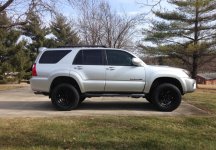
Cool, me too. I'm assuming the rears can be swapped without a spring compressor too...I'll have to look again. I'm getting '15 TRD Sport front springs and f/r shocks with 15k, and '11 FJ (normal 4x4) rear springs w/5k miles.
Where did you find the springs?

pjbrownva
New member
...
According to the Bilstein web site the 5100 perches are spaced 5/8" or .625" apart. So using the OE coils bottom #1 = 0 lift, #2=.625 lift, #3= 1.25" lift and #4=1.85 lift.
...
So does this sound right? :infidel:
Bilstein 5100 shock perches are 0", .85", 1.75" and 2.5" of lift. FJ coils give 1/2 - 1" of lift depending on 2wd, 4wd and V6 or V8. Also depends on how much your stock coils are sagging as to how much lift you'll actually see. I got over an inch of lift in the rear with fj coils because my stock springs were toast!
[MENTION=101553]t-man[/MENTION] is correct about the lift.
[MENTION=2262227]jrm[/MENTION], you're right that the actual perches are spaced 5/8" inches apart on the front 5100's, but because of the geometry of the suspension, the lift experienced at the front wheels starting with the bottom setting on the 5100's is :
- setting #1 = 0" lift
- setting #2 =0.85" lift
- setting #3 = 1.75 lift
- setting #4 = 2.5" lift
Below is my attempt to explain why.
The shocks don't mount directly to the tires. They mount to the lower control arms several inches inboard of the tires, and the lower control arms themselves can pivot from where they are attached to the truck's frame. Thus you have a dynamic system that includes a "lever" effect.
Also, when you move the spacer on the front shocks, you are only INDIRECTLY making the shock longer. Technically, what you are doing is moving a collar up by 5/8", and this collar supports the bottom of front coil springs.
So, what you are really doing is raising the attachment point of the bottom of the front springs to the front shocks in 5/8" increments, which will increase the effective length of the shock some amount and also may also increase the pre-compression of the front springs by some amount So, when the truck is still on level ground, the change in the anchor point of the front spring, and amount of pre-compression on the front springs work together to determine the effective increase in the length of the front shock.
Thus, when you add an additional 5/8" inches of height to where the front springs attach to the front shocks, you increase the effective length of the front shocks by some amount that may be more or less than 5/8" (I suspect less... but I'm not sure).
However, the height to the top of the wheel well increases by more than 5/8", and this "extra" increase is primarily due to the geometry (meaning the shock is NOT attached AT the wheel, it's attached several inches inboard from the wheel, and is attached to the lower control arm which can pivot... so you have a lever effect that gives you more than a 5/8" increase at the wheel). However, the springs and their compression rates, along with the slight change in weight distribution that comes from the height changes... and that impact on the compression of all four springs might also play a small role in the final outcome.
This is probably why all the predicted changes in height are approximate or average... there are several different factors that affect your exact outcome, and these
factors are probably slightly different for each truck depending on equipment and the particular types and condition of your truck's components.
On the 5100's, for each 5/8" inch increase in the attachment point of the front springs, you gain between 0.75 and 0.9 inches of extra clearance at the wheel.
I suspect the non-linear gain in height has to do with how the weight distribution shifts, and slight changes in the compression from all four springs when you change the effective length of the front shocks by raising the anchor points for the front springs.
What I mean by non-linear is that for each 5/8" increment on the shocks you go from 0" of front lift, to 0.85" of lift, to 1.75" of lift, to 2.5 in lift", so the gain is 0.85", 0.9" and 0.75 in lift. I also don't know if these gains are approximate or exact. If they are only approximate, then it is probably the impact of the spring compression and slight changes in weight distribution that causes the differences.
Make sense? If I've confused anyone, just remember the bulleted list above. That's correct, and it's most important.
One last thing... which is more of a fine-tuning issue.
FOR THE FJ FRONT SPRINGS, THE LEFT AND RIGHT SPRINGS ARE DIFFERENT. THEY ARE COLOR CODED TO TELL YOU WHICH IS LEFT SIDE AND WHICH IS RIGHT SIDE

On the FJ cruiser, the left side (driver's side in the US) would tend to sit a little lower because of the the gas tank being off-center and the weight of the driver. As a result, the FRONT FJ springs are color coded to tell you which side they go on.
The left front FJ spring is has one extra coil in it, so that it doesn't compress as much as the right spring, and this helps the truck sit more level, instead of leaning towards the driver's side.
In the photo above, notice that the coil with the purple and green paint marks has eight coils (if you count them). This purple / green marked spring goes on the left (driver's in the USA) side.
The other coil, marked with purple and orange (or purple and red) only has seven coils if you count them. This coil goes on the right (passenger's side in the USA) side of the truck. If you have FJ cruiser coils with different color codes, use google to find out which is the left and which is the right front spring... or count the number of coils.
The one with more coils goes on the left side (driver's side in the USA).
You may have noticed that some posters have mentioned putting a small spacer (maybe 1/4" spacer") above the left front shock, or using only a single 1.5" spacer on the only ONE of the rear shocks. These are all attempts to make the truck sit level from side-side, meaning to have the right front be the same height as the left front, and have the right rear be the same height as the left rear.
The FJ springs help with this side-to-side difference by making a different spring for the left front than for the right front.
I haven't played around with any further leveling adjustments. On my setup, (FJ springs, Bilstein 5100's set at 0.85" lift, 1.5" daystar spacers on both sides in the rear), my left REAR is 0.5" lower then my right REAR.
Some have suggested the removing the right rear daystar spacer will level out the rear height. I haven't tried it yet... but I might some day. More importantly, if I try it, and it's still not level, based on the measurements with and without the 1.5 rear right spacer, I should be able to figure out how much to cut down the rear right spacer to make the truck level from left to right.
Of course, the truck does sit on 4 tires, each with springs, so messing with just one tire's height, MIGHT have an impact on the height of other tires. I'd assume that lowering the right rear, might also impact the height of the front let tire to some degree, but I haven't played with it to be sure.
Just more info and and FYI. I'll either update this post or post a new thread if I do mess around with the rear spacers on one side, and I'll let people know what impact, if any I observed.
P.S. -- I also have air-ride rear air boosters inside my rear coil springs, but I have the pressure equal in each of the air bags, and it is low, so I don't think that they really impact my height much if at all. Their real purpose it to allow me add air to boost the rear height if/when I attach a boat and load up the rear cargo area.
Then I can add more air to the rear air bags so that I can offset any rear sag. The air adjustment is manual. It has a Schrader valve, and takes regular air. I have a good compressor which I plan to mount on-board, but I'll still manually use an air hose to inflate the rear air bags, or I might even buy and use a portable, small bicycle hand pump, since the air bags don't hold much air and it seems that they can easily be over-filled.
Last edited:
scd969
New member
I can attest to the 1.5" daystar spacer on the driver side fixes the lean perfectly.
What did you get as far as lift on the driver side rear and passenger rear?
84ability
New member
I posted some WTB ads on Craigslist and people emailed me with what they hadWhere did you find the springs?

bauch68
New member
fj spring oem part #'s
Hey all,
just joined the forum earlier today! I recently bought a 2008 urban runner 4x4 w/ the 4.0. I have been trying to find the correct oem part #'s for the fj springs and i can't seem to find them. I have 6 #'s right now for a 2007-2009 fj but theres no way i can tell which ones have the higher spring rate/extra coil for the drivers side. I'm located in Erie, PA so if anyone is nearby and has a full set front a rear i may consider taking them off your hands.
hopefully this isn't a stupid question or a waste of time. if it is i apologize in advance. Im trying not to be too noobish lol
But anyways, thanks a lot everyone for your help!
Hey all,
just joined the forum earlier today! I recently bought a 2008 urban runner 4x4 w/ the 4.0. I have been trying to find the correct oem part #'s for the fj springs and i can't seem to find them. I have 6 #'s right now for a 2007-2009 fj but theres no way i can tell which ones have the higher spring rate/extra coil for the drivers side. I'm located in Erie, PA so if anyone is nearby and has a full set front a rear i may consider taking them off your hands.
hopefully this isn't a stupid question or a waste of time. if it is i apologize in advance. Im trying not to be too noobish lol
But anyways, thanks a lot everyone for your help!

Oneluv13T4R
New member
Hey all,
just joined the forum earlier today! I recently bought a 2008 urban runner 4x4 w/ the 4.0. I have been trying to find the correct oem part #'s for the fj springs and i can't seem to find them. I have 6 #'s right now for a 2007-2009 fj but theres no way i can tell which ones have the higher spring rate/extra coil for the drivers side. I'm located in Erie, PA so if anyone is nearby and has a full set front a rear i may consider taking them off your hands.
hopefully this isn't a stupid question or a waste of time. if it is i apologize in advance. Im trying not to be too noobish lol
But anyways, thanks a lot everyone for your help!
4813135551 - Spring 4wd left
4813135541 - Spring 4wd Right
Similar threads
- Replies
- 3
- Views
- 2K
- Replies
- 3
- Views
- 2K


