...got bass?

"With a mono block amp, won't you have 4 ohms with 2-2 ohm voice coils wired in series?

Hi reid,

Absolutely YES! Two 2ohm VC's when wired together 'In Series' will yield a total impedance load of 2ohms.

If you have a bridged 2-channel amp with the same driver wired in series you'd see 2 ohms then.

Ummm... No, the speaker wiring has nothing to do with whether the amplifier is a stereo amp in bridge/mono mode, or a single channel mono-block. I think what you're referring to is something different e.g., When two 4ohm amplifiers are wired together for bridge/mono mode and presented with an 8ohm speaker load, each individual amp will see only (half the load) 4ohms, but the speaker will still remain an 8ohm load. That's why there's a 'Caution' on the rear panel of most amps that are bridgeable. This could present a very dangerous hazard for an amplifier that has a minimum impedance of only 4ohms. Imagine if you presented the same (bridged) amp with a total load of 4ohms... then each amp: Channel A and B, would each see an electrical load of 2ohms, and the end result could be a catastrophic Thermal overload/shutdown (Fault mode). Rgds!
 
Last edited:
Hi swapmeet,

"Try not to laugh(?)" let me see... You knew about the importance of bracing. You knew about calculating the chamber's 'gross inner volume'... You seem to know more about this subject than you think you do, Kudos!

Thanks, I was kinda heavy into car audio in High School. In my current profession we discuss 3db points and doubling of power to get 3db etc. So I guess you could say i'm not an amateur, but my problem is I still think Orion HCCA2100's are the cats ass. LOL.... These new small footprint digital amps freak me out a little. I love them, but i'm still stuck in that mindset that to get big power, you need a big amp.
I doubt the enclosure is perfect in terms of rigidity. But I think for my application it will do fine.
What is your thoughts on polyfill to increase the air space the sub sees? A friend who worked for Car Toys for 14 years said that I could fake the sub into seeing .55cu/ft. Seems a little optimistic but i'd be interested in hearing your thoughts.

Unfortunately, I have no particular experience with 'Kicker" products. A lot of people like them and they've been around a long time. I am However, familiar with JL Audio and Alpine products; here are two subs that might interest you. 8W3v3-4 - Car Audio - Subwoofer Drivers - W3v3 - JL Audio And Alpine Electronics of America, Inc.

They are both very similar in their mounting depths (4-1/2 inches) and their 'Sensivity' (= 83.5 dB); which is likely a bit higher than the stock JBL driver. If these are too long in depth, you can use a 'shim' to move the magnetic structure away from the back of the enclosure. If that doesn't work, you could (if you feel comfortable) enlarge the mounting hole from 7 inches to 9 inches; removing ONLY one inch from each side (all the way around) of the original baffle cut-out, and install a Ten inch, shallow frame (about 3") speaker; thereby increasing your overall surface area: I explain this in depth earlier in this thread, I think on the first page.

I read that bit about surface area. Makes sense, almost seems obvious.

I'll check the available mounting depth, as I think that JL will be too deep. I do like the option though. JL makes legit product, as does Kicker IMO.
Worst case I might be able to push the sub out with a MDF speaker ring, but my goal is to keep this under the factory cover, so we'll see how it pans out.

Because of the design of the enclosure, a 10" would be extremely labor intensive to pull off. Nothing is impossible but I'd like to keep the fiberglass and resin in their totes in the garage if at all possible. Saying that, its obvious that i've considered it. :D


As a result of what I've said to you here, you're going to (doubtlessly) have more questions about your project... feel free to come back here and talk about your concerns; if I can't answer you, I'm sure someone else here can!

Until then, Chow!

Thanks for the great suggestions. Its hard to know what's good product any more, as you've touched on. Lots of vendors making wild claims its hard to know what's accurate.
I had considered running this amp Power-Acoustik-RZ1-2300D

On this sub and running two 1ohm coils in series so the amp sees 2ohms.
Kicker-40Comp RT81

I figured the amp doesn't put out what its rated at, but if I run it at 2ohms it should be plenty enough to drive the sub, and I can dial back the gain etc so I don't kill the sub.

But I haven't pulled the trigger because it seemed like a mismatch. Everyone else I talk to, even friends, they all work in the industry and offer/ push what they sell, even though I pay 5% over cost. Their suggestions are sincere, and well meaning, but I don't want the best thing this guy happens to carry... I want the best thing available. I don't want to compromise on this set up because its going to struggle to deliver the amount of SPL I want.

Thanks again for the great suggestions. I'm vaguely knowledgeable but I know enough to realize you know a lot more than I ever will. Always best to refer to an expert.
 
Hi reid,


Absolutely YES! Two 2ohm VC's when wired together 'In Series' will yield a total impedance load of 2ohms.


Ummm... No, the speaker wiring has nothing to do with whether the amplifier is a stereo amp in bridge/mono mode, or a single channel mono-block. I think what you're referring to is something different e.g., When two 4ohm amplifiers are wired together for bridge/mono mode and presented with an 8ohm speaker load, each individual amp will see only (half the load) 4ohms, but the speaker will still remain an 8ohm load. That's why there's a 'Caution' on the rear panel of most amps that are bridgeable. This could present a very dangerous hazard for an amplifier that has a minimum impedance of only 4ohms. Imagine if you presented the same (bridged) amp with a total load of 4ohms... then each amp: Channel A and B, would each see an electrical load of 2ohms, and the end result could be a catastrophic Thermal overload/shutdown (Fault). Rgds!


Gosh Rigtec, you're such a nice guy I hate to disagree with you!!! Just for the sake of my sanity let break this down together.

Do we agree that 2- 2 ohm (voice coils or speakers, doesn't matter) wired in series is 4 ohms. A DVM can be used to verify. Right?

That to a mono (1 channel) amp should be 4 ohms. We may not agree here yet...

A brigable two channel amp sums both channels and effectively puts the amp into a 2 ohm load even though the speakers remain at 4 ohms. Most amps are 2 ohm stable but some are down to ½ an ohm; though this is at the cost of dampening (the amps ability to control the speaker). Do we agree on this?

So if we're on the same page with everything except the mono amp, why would the amp see 2 ohms unless only one voice coil was used?
 
"...my problem is I still think Orion HCCA2100's are the cats ass. LOL.... These new small footprint digital amps freak me out a little. I love them, but i'm still stuck in that mindset that to get big power, you need a big amp.

Oh my; where do I start with you... Hahaha

One great thing about these modern 'Class D' amplifiers is not only that they're smaller and lighter, they're also much more efficient; and that really counts when you DO NOT have an unlimited power supply like when using 120VAC/600A distribution circuit in a club or concert hall... we have to consider our alternators BEFORE the install.

"...What is your thoughts on polyfill to increase the air space the sub sees?

There are many different formulas regarding the 'Area to weight' ratio of stuffing, but I've finally come to a happy medium with it. I'll use one to 1.5 lbs per cuft. It will absorb the 'Standing waves'; midrange turbulence in the box that cause phase anomalies and degrade good sound. As far as stuffing adding more area for the driver to use... It will 'to a degree' cause the driver(s) to behave as if they were in a larger enclosure. That's because the stuffing acts as a buffer, creating a delay in the reflected soundwaves that travel through-out the box and back to the driver. Theory is: You can expect to gain enough extra area to compensate for your 'Bracing', driver (physical) displacement, and hardware in the box, and the Air-ducts in a ported system when it applies; depending on the stuffing material used and the amount... it's not an exact science, more of an art form to be experimented with.

You mentioned using mfd rings as shims... that's a great idea depending how far you need to compensate the driver, 1 to two inches would be okay if it were secured properly (8 or 10 bolts to mount the ring).

"...Lots of vendors making wild claims its hard to know what's accurate. I had considered running this amp Power-Acoustik-RZ1-2300D

Be cautious(!) when an electronics manufacturer offers you everything that the leaders of the electronics industry offer you for 1/5th the cost: Their cutting the cost of building from somewhere or making false claims (a wish list) about their products capabilities.

"...But I haven't pulled the trigger because it seemed like a mismatch... ...I want the best thing available. I don't want to compromise on this set up because its going to struggle to deliver the amount of SPL I want."

Well said!! Find a good amp and sub that you like and don't compromise by buying something because it was cheap. There's a reason that it's cheap and you'll find that out after you buy and install it. Don't be afraid to shop around; and check the reviews on the products that you're interested in. Make sure that the seller gives you a "No questions asked, money back guaranty", Like amazon. Hope I answered most of your questions, just post again if you still have concerns and need some assistance... I'll be glad to try and help out!

Cheers
 
Last edited:
Gosh Rigtec, you're such a nice guy I hate to disagree with you!!! Just for the sake of my sanity let break this down together.

Do we agree that 2- 2 ohm (voice coils or speakers, doesn't matter) wired in series is 4 ohms. A DVM can be used to verify. Right?

That to a mono (1 channel) amp should be 4 ohms. We may not agree here yet...

Hahaha! Yes, so far we agree!

A brigable two channel amp sums both channels and effectively puts the amp into a 2 ohm load even though the speakers remain at 4 ohms.

Not exactly. The way the two amps are joined together, configures them in such a way that allows them to safely drive the 4ohm load 'as a team', but each individual amp will be working as if it were a 2ohm load; this is only okay if the two partnering amps are rated for 2ohms. If they're only stable to 4ohms then they cannot be bridged to drive a 4ohm load together because they will exceed their 'Electrical Current'/thermal limit. ...We are almost on the same page lol!

So if we're on the same page with everything except the mono amp, why would the amp see 2 ohms unless only one voice coil was used?

I just copied this excerpt directly from "Basic car audio electronics" "A very good electronics info source", just for better illustration: Bridgeable Amplifiers "See below"

VERY IMPORTANT... from "Basic car audio electronics"

If a bridgeable amplifier is rated to drive a 4 ohm minimum load on each of its channels, it WILL fail if you try to drive a 4 ohm bridged mono load. If you have an amplifier rated to drive a 2 ohm stereo load (2 ohms on each channel), it's only going to be able to drive a 4 ohm (or higher) bridged mono load. A 2 ohm bridged mono load will more than likely destroy the amplifier. Too many people think that all large amplifiers can drive low impedance loads. In general, only amplifiers designated high-current and class D amps can drive low impedance loads. Even class D amplifiers have a limit as to the lowest impedance and when bridged with a second amplifier, the rated impedance is 2x the rated impedance when run normally (not bridged with a second amplifier).

Most amps are 2 ohm stable but some are down to ½ an ohm; though this is at the cost of dampening (the amps ability to control the speaker). Do we agree on this?

Not really...

I see that a lot of amp manufacturers may Claim that their amplifiers are 2ohm stable; this may be true as long as they're not driven to Full output. But when these amps are driven anywhere near their claimed full output rating, they start shutting down on thermal overload because their output device mounting plates don't have enough surface area to reject the heat fast enough (convection cooled) to keep the output devices cool, so they run out of (SOA) safe operating area and go into FAULT/PROTECT mode. There are some that are 2ohm stable, but not most. The ones that are, are very expensive due to their substantially 'Over-built' heat rejection systems, output stages and capacitor banks, used to stay cool when driven; not the ones that you see on-sale for $210 bucks!

reidbailey,

This has been the most pleasant debate that I've engaged in, in a very long time (and we can pick this up later, right where we left off if need be.); thank you for that... "you are a true gentleman"!

Rgds
 
Last edited:
Hi swapmeet,

"Try not to laugh(?)" let me see... You knew about the importance of bracing. You knew about calculating the chamber's 'gross inner volume'... You seem to know more about this subject than you think you do, Kudos!


Well, you start off by finding an "Ideal" driver candidate for a low frequency application to meet your requirements, which would be: a Top shelf, high sensitivity eight inch sub with a 'Shallow' frame, that will operate properly in a low inner vol. air environment. Next, we find you an amp that has about double the output of the driver's power handling capacity... this is to be used as headroom. Alpine Electronics of America, Inc. So if the speaker is rated at 250W, then the amp needs to be capable of 500W rms to get the most out of the box... don't worry, the speaker is designed for that (a measurement known as the "Crest factor"!)


Unfortunately, I have no particular experience with 'Kicker" products. A lot of people like them and they've been around a long time. I am However, familiar with JL Audio and Alpine products; here are two subs that might interest you. 8W3v3-4 - Car Audio - Subwoofer Drivers - W3v3 - JL Audio And Alpine Electronics of America, Inc.

They are both very similar in their mounting depths (4-1/2 inches) and their 'Sensivity' (= 83.5 dB); which is likely a bit higher than the stock JBL driver. If these are too long in depth, you can use a 'shim' to move the magnetic structure away from the back of the enclosure. If that doesn't work, you could (if you feel comfortable) enlarge the mounting hole from 7 inches to 9 inches; removing ONLY one inch from each side (all the way around) of the original baffle cut-out, and install a Ten inch, shallow frame (about 3") speaker; thereby increasing your overall surface area: I explain this in depth earlier in this thread, I think on the first page.

As a result of what I've said to you here, you're going to (doubtlessly) have more questions about your project... feel free to come back here and talk about your concerns; if I can't answer you, I'm sure someone else here can!

Until then, Chow!
great info here. thanks for posting. i have a quick question:

you recommend an amp with 2X the output of the speaker's rated capacity, but the spec page for that JL you recommended, for example, specifically cautions against that, stating that the amp's output should be much lower... :confused:
 

Attachments

  • image.jpg
    image.jpg
    99.2 KB · Views: 1,131
Last edited:
great info here. thanks for posting. i have a quick question:

you recommend an amp with 2X the output of the speaker's rated capacity, but the spec page for that JL you recommended, for example, specifically cautions against that, stating that the amp's output should be much lower... :confused:

Hi sandcrawler,

As you have likely seen at one time or another, all high quality, low frequency woofers will have more than one rating for power handling. That's because different audio program material will inevitably have more than one type of energy in it's signal e.g., continuously long high energy bass notes (drown), Dynamic attack bass drums (kicks), low energy pulsating swells (conga drums, funky guitars...etc). Speakers are expected to be capable of reproducing this vast range of program material all at the same time. So a speaker's moving system (cone, surround, spider, voice-coil...) has a range of distance that it can travel forward and backwards known as X-max; which is the linear amount of distance the cone can travel (in millimeters) in one direction from it's resting point, creating no more than 10% THD (total harmonic distortion). This is just an overview.

So there are three ways that a speaker is tested to determine it's power handling capabilities... Thermal, mechanical, and a combination of both. The first: Thermal, is a worst case scenario called continuous sinewave. This test places a tremendous amount of energy in it's constant signal with a dynamic range having 3 dB (double) peaks; three decibels is when you increase the amount of power by a factor of 2 times e.g., our continuous sinewave signal is set at 200 watts rms with a 'Swept' range between 50hz and 500hz and dynamic peaks set at 400 watts at a frequency rate of 20 times per sec.

The next test is mechanical; which tests the speaker's ability to travel in both directions (in and out) with no appreciable damage to the moving system and showing no fatigue. This parameter is known as X-lim; meaning the maximum limit to it's travel without slamming into the magnetic back plate or ripping it's surround or spider. This test will subject the speaker to full power with a 6 decibel crest factor; six decibels is when you feed the driver an amount of electrical energy equivalent to four times that of the continuous sinewave e.g., the speaker is fed a 200 watt rms signal with dynamic peaks set at 6 decibels (or 800 watt crests).

And the last test is a combination of both of the previous tests e.g., this speaker test sets the continuous sinewave at 150 watts true rms with concentrated program energy within a swept frequency range between 250 hertz and 1000 hertz, and program material peaks set at 6 decibels (or 600 watt crests).

PS: "The above test process examples are only 'hypothetical examples' of how an "E.I.A" or "A.E.S" driver power handling lab test is conducted; the parameters used in these examples; e.g., power values, frequency range sweeps... etc, are (for the most part) random for the purpose of demonstration and may deviate from an actual In Lab test situation."

Just so you can see it in a standard spec sheet, I'm posting one of my 'ProSound Eighteens' here; "See below":

The top one is just so you can see the type of driver it is; pretty typical 18 inch low frequency driver.


The lower one shows it's spec sheet: Note the three power handling nomenclature "Highlighted in three different colors".

PINK: The pink one on top denotes the 'Continuous sinewave' power. It's rated for 700 watts RMS, this is the worst case scenario meaning... the kind of signal energy that they tested it with will never happen in the real world, because the saturated signal that they used when testing it will never be found in a real music program recording.

BLUE: The Blue trace 'Continuous program'. It's rated at 1400 watts with 'Double power', and represents a more realistic scenario with many Holes in the music. The holes are the many, many rests (time for the voice coil to cool down) in between the pulsating beats in the program. There are actually more rests (Blank spaces) in the music in between the notes than there are notes. So they bumped the power handling up to 1400 watts program.

YELLOW: And then the yellow trace; 'Peak' which has a '10 dB crest factor' or ten times the 'continuous sinewave' (RMS), and denotes the dynamic peaks that can suddenly happen during some intense music or home theater programs. So that speaker claims it can handle 7,000 watts peak... even if only for a few milliseconds.


So that being said... The speaker that you've posted does have a dynamic range above 250 watts like: 250w continuous sinewave (rms), 500w continuous program; which is for those dynamic peaks that are in most musical program material.

There's one more very important reason that we should always insure that we have more amplifier power than we will actually use. As long as an amp has plenty of (Headroom) power, it will likely never cause damage to a speaker. BUT: when an amp runs out of headroom; like when it's turned all the way up and the sound starts to degrade and distort... that's because after the amp runs out of power to drive the speaker(s), it starts to Chop-off the tops of the musical peaks, creating "Square waves". This forces the speaker to try and mimic the amp's distorted, unnatural wave pattern. Because a speaker is not designed to 'TRACK' a square wave signal, this will cause the speaker to overheat and possibly mis-figure it's voice-coil former as a result. Believe it or not more low freq drivers are damaged as a result of 'Under powered / Over-driven' amplifiers operating at 'Full Power'; which are then prone to run low on electrical resources and resulting in 'Thermal' damage to the driver's motor assembly.

Hope this explanation helps just why it is better to have more power than we plan to use, Best to you!
 
Last edited:
Hey forum,

There have been a variety of interesting comments and questions here on the topic of 'Amp's & Subs'. And I see how many true audio buffs and guys who have, just an enormous amount of talent' on the subject of audio systems and so I thought I'd share this. This is a tutorial from Crown Audio; the Pro-Sound amplifier manufacturer on the topic of "Matching your speakers with the right amount of power". There are different formulas for calculating this but in this publication, I think they really did a great job of explaining the theory, here's the link: How Much Amplifier Power Do I Need? | Crown Audio - Professional Power Amplifiers Hope you will enjoy it! Cheers
 
Last edited:
Hi sandcrawler,

"... that's because after the amp runs out of power to drive the speaker(s), it starts to Chop-off the tops of the musical peaks, creating "Square waves". This forces the speaker to try and mimic the amp's distorted, unnatural wave pattern. Because a speaker is not designed to 'TRACK' a square wave signal ,this will cause the speaker to overheat and possibly misfigure it's voice-coil former as a result. Believe it or not, more speakers are damaged as a result of under powered amplifiers, than those that are over powered!"

The way this was explained to me was a term called "clipping" of the amp. When you have an amplifier that is driven to clipping, something happens to the current/voltage reaching the speaker. I'm sure you have seen home speakers that had fuses on the tweeters because those are more delicate than woofers.

Rigtec - your speaker knowledge is much greater than mine, I would love to pick your brain. I am intrigued by the other poster bringing up the 8" JL. I had been considering a "minor upgrade" instead of going full out like many have done on here. I would love to be able to put a better driver then put a dedicated amp only for the sub. If you have what I would call a budget upgrade, I would appreciate it.
 
"...I would love to be able to put a better driver then put a dedicated amp only for the sub. If you have what I would call a budget upgrade, I would appreciate it.

Hi Ezlife,

Okay, there are always things that we can do to make the system sound better! The question is... what does "Better" mean to you... Does it mean, louder, lower, cleaner, puncher, what's your expectation... Also, what is meant by "Budget"(?) "Is that the limiting factor"? I know it sounds like I'm interrogating you or trying to be a smart @$$, but I'm really not. In order for anyone here to Effectively help another member, they need to gather as much information about the vehicle... (and in this case, the driver's personal taste) as possible.

I'll also need to know which 4runner it is; Limited, SR5, or Trail Edition, and what year? Why don't you give me a few more details before we get started BRAINSTORMING and then we'll see what we can come up with, okay? Cheers!
 
Last edited:
Here's what I mean by better.
One day when the honey do's are caught up, I'll be able to lay up my 2014 LE with JBL and Navi for mods. I have the higher system, can't remember how many speakers.
I'm OK with the mids/highs for now but want a little more low end, slightly tighter etc. I want to open my doors and do maybe 50% coverage on the flat panels of my doors with a cheaper dynamat alternative I've used before. I would likely either pull the seats and carpet or simply roll back the carpet after the seats are pulled to get a little more under the carpet. Then I would think about pulling panels in the back to get a little mat around the rear section. I would likely use minimum matting in the rear hatch because I'm concerned about changing the way the lift struts work with weight.

On the audio, I am interested in doing a sub upgrade with a sub amp. I was hoping to spend maybe 100-200 for a sub and hopefully not much more for an amp. I was hoping I could get by with a mid-level amp with speaker level inputs and simply put the speaker leads directly to the sub amp. The amp I want would likely have the kind of detection to turn on from signal detection because I don't want to have to think about running a turn on wire to something. How's that for starters?
 
"Here's what I mean by better,

...On the audio, I am interested in doing a sub upgrade with a sub amp. I was hoping to spend maybe 100-200 for a sub and hopefully not much more for an amp. I was hoping I could get by with a mid-level amp with speaker level inputs and simply put the speaker leads directly to the sub amp. The amp I want would likely have the kind of detection to turn on from signal detection because I don't want to have to think about running a turn on wire to something..."

Okay, and what can I help you with?
 
Understanding your speaker's specs: 'the basics'

Hi folks,

Working in the 'Commercial Building Hvac Technical' industry, I've become increasingly aware of the importance of: 'The Written Spec Sheet'. These data provisional documents have certainly proven to be a tech's very best friend! But dabbling also in the 'Pro-Sound' and 'Car Audio' fields (just for fun), can be every bit as rewarding when you begin to Understand (/käm.prə.hend/) some of the theory "THAT MAKES IT ALL WORK!" Believe it or not... I've been paying attention to the questions and comments that are being exchanged throughout this entire thread (ALL PAGES); particularly to the levels in which you've expressed your understanding of audio systems. And may I say I am more than impressed with some of you, and the things that you've discussed with me!

The reason that I'd like to keep an open dialog on the subject of "Car Audio Systems" is that every time someone asks a question about modifying the stock sound system in their trucks, or engages in a discussion about a new idea or concept, it inspires so many others to voice their own ideas and consequently, lends an opportunity for our members (both junior and senior) to come to the table "On one accord"! Having said that... I'd like to try posting links to address some of the... 'Most frequently misunderstood specifications' e.g., Power handling: Explained!, Sensitivity/spl: What does this mean?, Impedance: Explained, Our Tailgate speakers: Are they sub-woofers, bass drivers, or mid-bass? For now, I'm posting a 'new link' that I think will be 'VERY HELPFUL' to those of you who are self educating and would like to be just a little bit more knowledgeable on these subjects! Speaker specifications: A consumer guide - CNET Best!

...and cheers!
 
Last edited:
Understanding an amplifier's power ratings: 'No more tricks'

Hi team mates,

I've been studying and have been involved with 'Pro-sound audio' and 'Musical Instrument Amplification' Systems since the mid seventies and then later got myself involved with 'Mobile audio systems'. Out of all the hobbies I've been involved with, Audio Engineering / System building are my absolute favorites! Now I see a lot of guys here building and modifying these cargo area bass speaker/Sub systems... Very impressive! ...e.g., 2013 4Runner - SQL Install (Randyman) - Car Audio | DiyMobileAudio.com | Car Stereo Forum ...and... http://www.toyota-4runner.org/5th-gen-t4rs/195720-trd-pro-custom-fiberglass-subwoofer-enclosure.html to name just a few (I hope [MENTION=89075]Randyman...[/MENTION] and [MENTION=121331]BustedPretext[/MENTION] don't mind me referring to them) and may I say... they both are quite 'OUTSTANDING'! Thank you for posting these gents! Originally I had planned on posting a few more essential facts about the subwoofer drivers themselves (Chassis speakers or Raw drivers); less their enclosures. And I still do plan on doing that but I know that there are some folks out there right now that are planning to purchase their first "mono-block" amplifier and so I'd like to make available some "Things to watch-out for when buying an amp for your sub"!

When approaching this subject there are a few things that you MUST know and understand before buying an amp! There are still plenty of electronic audio gear manufacturing companies out there that will try an exploit you (or your ignorance) using their tricky phrases, semantics, meaningless acronyms and building for you a baseless theoretical premise so they can hand you their 'Surmised/Wishful' power ratings! To explain what I mean... In order to have a reliable rating system there must first be an 'agreed upon' standard measure, for instance... If I say: "there are some air planes that can travel faster than sound..." Well, you may have an idea that, that must be pretty darn quick, but that's not grounds to develop a reliable 'Rating system'. However, if I explain that sound travels at a rate of 1,125 ft/sec or 4,050,000.00 ft/hr (767 mph *conditional*)... Then we have a reliable standard for comparison!

We do have some reliable standards by which we can measure the True RMS wattage output of an amplifier but the trouble is that as long as there are still some people that do not understand what their spec sheets are communicating to them, then there will ALWAYS be some evil electronics manufacturers/Marketing agents that are glad to exploit them! I'm really going to try and keep this ultra simple because this is sooo important and I don't want to see anyone here taken advantage of. Example: One amplifier company advertises an amp for $400 that is said to be 250 watts into a speaker load of 8ohms, and 500 watts into 4ohms, and will create a 'Total Harmonic Distortion'(THD) at Full output of 0.05%. Now another amplifier company advertises that their amplifier @ $375, will yield an output of 250 watts into a speaker load of 8ohms and 500 watts into 4ohms, and will create 5% 'THD' when at 'Full output'.

Now your average Joe' doesn't really know what all that means because they both claim to make 500 watts so... NO PROBLEM! So he chooses the latter because it's cheaper. The second guy, Bob, remembers some of this stuff from his sophomore year in High school. He knows that even though the latter amp is marginally cheaper, this amp will not be nearly as loud because the amp will generate so much distortion (5% is VERY HIGH by today's standards) at 4ohms full output, he won't be able to use this amp at 4ohms (which would've generated 500 watts) because the sound is so terrible; he'll have to limit it to 8ohms ONLY for a nominal 250 watts, and still may need to trim the volume back because of the severe clipping/distortion! ..."Still seem like such a great bargain Joe?"...

Getting a better understanding:

"This is 'the main reason' I'll usually recommend buying an amplifier having twice (3 dB's) the output power of the sub's 'Continuous sinewave' (RMS) rating"! It takes some of the stress off of the amp when pushing the sub-woofer/driver(s) hard, It sounds much cleaner, the amp stays cooler; to say nothing of the fact that the sub never has to reproduce the amp's Square waves; a clipped signal generated by an amplifier who's output devices have run out of S.O.A.: The 'Safe Operating Area' of the output transistors used to produce/reproduce a CLEAN, accurate, undistorted, amplified output signal. One last thing, I'm leaving you with a typical spec sheet (A JL audio HD-750/1 mono-block) power amp data sheet. Take a glance at it from time-to-time just to become familiar with it's parameters. All High-end, 'Class D' mono-block power amps will have similar specs. And remember: whenever choosing a power amplifier, ALWAYS consider it's THD+N (total harmonic distortion+noise) ratio 'Along With' it's published power output rating because High Power ratings mean Nothing if the amp begins to distort when driven only to 50% of it's full rated power output!! HD750/1 - Car Audio - Amplifiers - HD - JL Audio


rigtec, Rgds!

 
Last edited:
got bass? pt-II

Hi team,

Well, I've got that 'ITCH' again! It's that thing that makes you want to improve upon that which has already met your VERY HIGHEST expectation and beyond! Last July (2014) I decided to build a 'Subwoofer' System that would yield a much higher output (in dBs) than the one that I was using at that time. The one I was using had plenty of acoustic output; more than most would ever actually need. But I guess I got a lil' greedy and so, was no longer satisfied... 'So here we go AGAIN'!

Last summer, my objective was to limit the power output of the amplifiers but, to increase the speaker cone surface area/displacement; which 'usually' translates to more Acoustic output (Volume) and lower frequency Extension (in Hertz/cycles per sec). This year my objective will be to Decrease the total surface area/displacement of the low frequency drivers, but to Increase the power output capability of the Mono-blocks (amplifiers). Remember the four fifteen inch 'Alpine SWR 1522D' sealed subs that I built last summer:

rigtec-albums-%26quot%3Bgentilmen+prefer+redheads%26quot%3B-picture27300-imag0014.jpg
rigtec-albums-%26quot%3Bgentilmen+prefer+redheads%26quot%3B-picture27302-imag0015.jpg


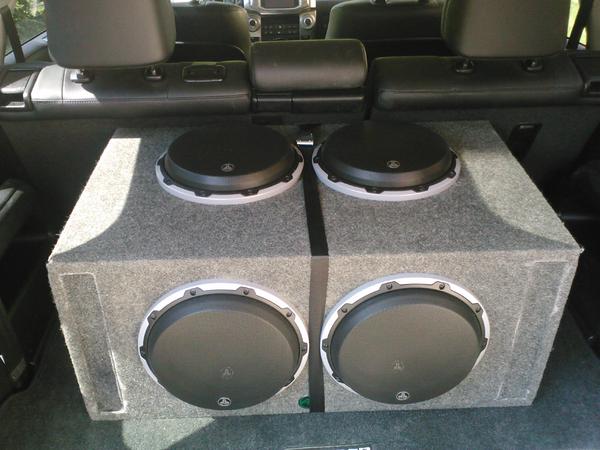
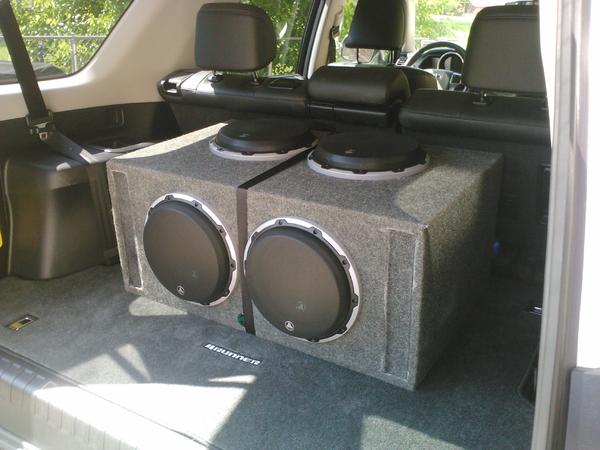
Those are GONE! This year, I'm going stream-line. As stated earlier in the above post, I'm using less cone surface area (four tens instead of four fifteens), but I'll be pushing each driver a little harder with the two 'Alpine PDX M-12s'... should be interesting! ...And here's that 4 x 10 sub:

rigtec-albums-%26quot%3Bmy+new+white+chick%26quot%3B%21-picture27113-latest-cell-phone-pics-217.jpg
rigtec-albums-%26quot%3Bmy+new+white+chick%26quot%3B%21-picture27112-latest-cell-phone-pics-218.jpg


The four fifteens were very impressive; particularly when I'd pull up at the supermarket parking lot or the gas station... just to see people's faces light up when they felt that bass... people from ALL walks of life; kids, grandma's! They'd just start dancing around right in the lot "and we'd all be laughing"! ...'PRICELESS' hahaha! But that was just an experiment for my own education in low frequency wave-front reproduction theory... "purely for the fun of it!"

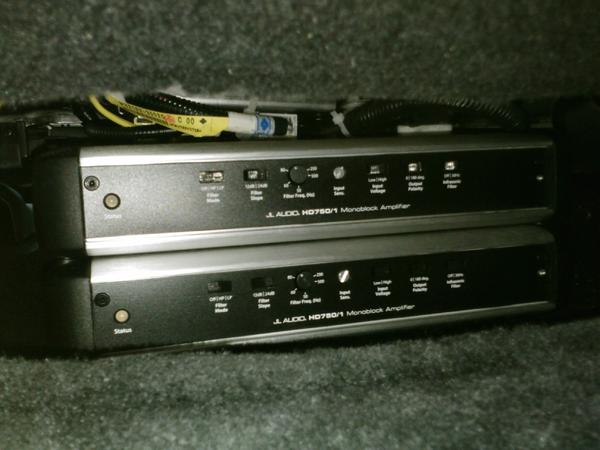
The amps that I was using last summer were (2) JL Audio HD-750/1 750W + 750W = 1500W RMS.

rigtec-albums-%26quot%3Bmy+new+white+chick%26quot%3B%21-picture34876-latest-cell-phone-pics-237.jpg


This time I'll be auditioning (2) Alpine PDX M-12 1200W + 1200W = 2400W RMS.

s-l225.webp
s-l225.webp

These new amps were just ordered on Sunday 8/2/15 and are expected to arrive later this week. I plan to do the installation shortly after they get here, along with a full set of photo docs, and an Alpine PDX M-12 vs JL Audio HD-750/1 Pros & Cons, "See you then"!

Rgds!
 
Last edited:
WOW! These amps got here sooo fast (arrived next day), I called ebay to be sure that these were intended for me, lol!

"THE UN-BOXING"


"THE ANTICIPATION"


AND..."THE WOWING!"

:usa2: WOW! :usa2:

I've been pretty impressed with this latest vers of the 'Alpine PDX M-6' and M-12' Mono-block series; they're way up there with JL Audio's HD-1200/1 Mono-block series... and possibly even a notch above; hard to say! I'm looking fwd to the install/start-up soon; hoping to get a cooler day outdoors... been hovering around 90 degrees here in Jersey!

BTW: Both Alpine 2 x 15 boxed subs and both JL Audio HD-750/1 mono-block amps will be sold; just shoot me a pm if interested. Thanks! ...and Rgds!
 
Last edited:
on the 4 10 setup, the box can be ported right? wouldnt a ported box with the extra power from the alpine amps drive the speakers couple more db louder now compared to the 4 15 sealed? i think it should sound just a little bit louder, but i would perfer 4 15s ported tho.:boom:
 
on the 4 10 setup, the box can be ported right? wouldnt a ported box with the extra power from the alpine amps drive the speakers couple more db louder now compared to the 4 15 sealed? i think it should sound just a little bit louder, but i would perfer 4 15s ported tho.:boom:

Hi riceandpho,

The 4 x 10 box in the photo above was once ported (tuned to about 31 cps). If you look closely at the carpet on opposite sides, you can see the two vertical chokes I've installed to close them. And yes, a ported (bass reflex) box is 'Far Superior' in efficiency; which does translate into higher dBs (apparent volume), but at a substantial sacrifice... SQ (sound quality)! Most people that are using their subs to listen to music, will opt for a 'Sealed box'; due to it's powerful transients and smooth low end roll-off. OTOH... the I.B. or Infinite Baffle (Sealed) alignment, doesn't even come close where raw loudness is the objective. Because the front and rear soundwaves (from the speaker cone) are naturally 180 deg out of phase, they must be prevented from coming in contact with one another 'at close range' or they will combine destructively; a baffle (a speaker box) is used to isolate the two for an Infinite duration of time... hence it's name: 'Infinite Baffle'.

The problem with this method is that it's hugely inefficient because HALF of the power that the amplifier generates to move the cone will never make sound; to say nothing of the fact that even the very best cone speakers (woofers) e.g., JBL, KENWOOD, PIONEER, ALPINE etc, are only between 2-4 % efficient to start with: 96 to 98 % of the energy generated will end up being part of the Heat by-product inside of the box; that's astounding, but absolutely true! I may do a little writing about this at some point in the future. So anyone who is planning to implement a high sound quality, I.B. (sealed) sub, must approach this knowing that they will need to prepare the vehicle's electrical platform for a high current consumption ...'BEFORE GETTING STARTED'!

One more thing: The 4 x 10 box started out as a Ported 2 x 10 box. It was tremendously loud with only two tens, but lacked tone, definition and clarity. Ported boxes have SQ issues because the rear-wave must 'first' be aligned with the front-wave before it can be released from the enclosure, and because of the extended amount of time it takes for this realignment to take place. As a result of this process, a sudden transient burst of energy e.g., a Kick, or a 'plucked bass string', would be released as a slow 'Swell' of energy, instead of a sudden 'Burst' of energy! So there's a trade-off/compromise between raw LOUDNESS and sound QUALITY! ...Sorry for the long answer!

Rgds
 
Last edited:

Members online

Forum statistics

Threads
278,309
Messages
3,554,067
Members
248,016
Latest member
Advally Service

Trending content

Back
Top