Understanding an amplifier's power ratings: 'No more tricks'
Hi team mates,
I've been studying and have been involved with
'Pro-sound audio' and
'Musical Instrument Amplification' Systems since the mid seventies and then later got myself involved with
'Mobile audio systems'. Out of all the hobbies I've been involved with,
Audio Engineering / System building are my absolute favorites! Now I see a lot of guys here building and modifying these cargo area bass speaker/Sub systems...
Very impressive! ...e.g.,
2013 4Runner - SQL Install (Randyman) - Car Audio | DiyMobileAudio.com | Car Stereo Forum ...and... http://www.toyota-4runner.org/5th-gen-t4rs/195720-trd-pro-custom-fiberglass-subwoofer-enclosure.html to name just a few (I hope [MENTION=89075]Randyman...[/MENTION] and [MENTION=121331]BustedPretext[/MENTION] don't mind me referring to them) and may I say... they both are quite
'OUTSTANDING'! Thank you for posting these gents! Originally I had planned on posting a few more
essential facts about the subwoofer drivers themselves (Chassis speakers or Raw drivers); less their enclosures. And I still do plan on doing that but I know that there are some folks out there right now that are planning to purchase their first
"mono-block" amplifier and so I'd like to make available some
"Things to watch-out for when buying an amp for your sub"!
When approaching this subject there are a few things that you
MUST know and understand before buying an amp! There are still plenty of electronic audio gear manufacturing companies out there that will try an exploit you (or your ignorance) using their tricky phrases, semantics, meaningless acronyms and building for you a baseless theoretical premise so they can hand you their 'Surmised/Wishful' power ratings! To explain what I mean... In order to have a reliable rating system there must first be an
'agreed upon' standard measure, for instance... If I say: "there are some air planes that can travel faster than sound..." Well, you may have an idea that, that must be pretty darn quick, but that's not grounds to develop a reliable
'Rating system'. However, if I explain that sound travels at a rate of 1,125 ft/sec or 4,050,000.00 ft/hr (767 mph *conditional*)... Then we have a reliable standard for comparison!
We do have some reliable standards by which we can measure the
True RMS wattage output of an amplifier but the trouble is that as long as there are still some people that do not understand what their spec sheets are communicating to them, then there will
ALWAYS be some evil electronics manufacturers/Marketing agents that are glad to exploit them! I'm really going to try and keep this ultra simple because this is sooo important and I don't want to see anyone here taken advantage of.
Example: One amplifier company advertises an amp for
$400 that is said to be
250 watts into a speaker load of 8ohms, and 500 watts into 4ohms, and will create a 'Total Harmonic Distortion'(THD) at
Full output of 0.05%. Now another amplifier company advertises that their amplifier @
$375, will yield an output of
250 watts into a speaker load of 8ohms and 500 watts into 4ohms, and will create 5% 'THD' when at 'Full output'.
Now your average Joe' doesn't really know what all that means because they both claim to make 500 watts so...
NO PROBLEM! So he chooses the latter because it's cheaper. The second guy, Bob, remembers some of this stuff from his sophomore year in High school. He knows that even though the latter amp is
marginally cheaper, this amp will not be nearly as loud because the amp will generate so much distortion (5% is VERY HIGH by today's standards) at 4ohms full output, he won't be able to use this amp at 4ohms (which would've generated 500 watts) because the sound is so terrible; he'll have to limit it to 8ohms
ONLY for a
nominal 250 watts, and still may need to trim the volume back because of the severe clipping/distortion! ...
"Still seem like such a great bargain Joe?"...
Getting a better understanding:
"This is
'the main reason' I'll usually recommend buying an amplifier having twice (3 dB's) the output power of the sub's 'Continuous sinewave' (RMS) rating"! It takes some of the stress off of the amp when pushing the sub-woofer/driver(s) hard, It sounds much cleaner, the amp stays cooler; to say nothing of the fact that the sub never has to reproduce the amp's
Square waves; a clipped signal generated by an amplifier who's output devices have run out of
S.O.A.: The '
Safe
Operating
Area' of the output transistors used to produce/reproduce a
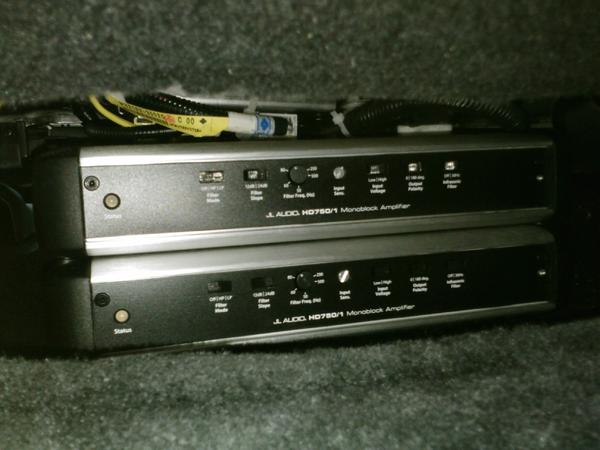
CLEAN, accurate, undistorted, amplified output signal. One last thing, I'm leaving you with a typical spec sheet (A JL audio
HD-750/1 mono-block) power amp data sheet. Take a glance at it from time-to-time just to become familiar with it's parameters. All
High-end, 'Class D' mono-block power amps will have similar specs. And remember: whenever choosing a power amplifier,
ALWAYS consider it's
THD+N (total harmonic distortion+noise) ratio
'Along With' it's published power output rating because High Power ratings mean
Nothing if the amp begins to distort when driven only to 50% of it's full rated power output!!
HD750/1 - Car Audio - Amplifiers - HD - JL Audio

rigtec, Rgds!