Is a Hi Lift Jack Absolutely Needed?

The same could be said for a lot of features/mods

Exactly. While it's a useful tool in the right hands, it's not absolutely necessary.
There are many more useful, and safer, tools that I would recommend long before I would tell the average offroader to buy a Hi Lift.
I've seen people do some pretty entertaining things with high lifts, and I'm surprised they walked away without injuries.

YMMV
 
Exactly. While it's a useful tool in the right hands, it's not absolutely necessary.
There are many more useful, and safer, tools that I would recommend long before I would tell the average offroader to buy a Hi Lift.
I've seen people do some pretty entertaining things with high lifts, and I'm surprised they walked away without injuries.

YMMV

Yes a hi-lift jack, while it has the potential to be a very useful tool, also has the potential to hand out a lot of Darwin awards.
 
I have one, and many of the attachments (larger base, lift-mate, winch kit). It seems to be a recommended component of what should be included in a recovery kit. It adds a lot of weight when I go out, but I feel it's like insurance - you never want to use it, but you are glad you have it when it's needed.

Ditto on the advice on making sure you know how to use it safely. I watched the safety videos on YouTube and then practiced on pavement.
 
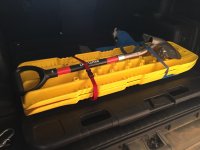
..echoing others, good judgment is probably the most valuable tool, know your limitations! Also, geography plays a big role in deciding what recovery devices are necessary. Here in the Mojave, I encounter a lot of sand, loose gravel and hard drainage ditches. This is part of my recovery kit that goes everywhere; has saved me once already.
 

Attachments

  • IMG_1469.jpg
    IMG_1469.jpg
    120.3 KB · Views: 1,183
I've seen arguments for both sides when researching this. I'm not constantly taking my vehicle off road, but I'd also like to make sure I have the tools needed if I get stuck.

I know, dumb question. I'll hang up and listen.

Lots of good advice in this thread. Short answer, if you're not out looking for trouble, carrying a hi lift is probably overkill. It's a lot of weight and space to tie up for a truck that only sees dirt roads.

I don't hit the trail without mine, but I DO go out looking for trouble, and I find it sometimes :D. The hilift has saved my bacon a couple times, and other fellows bacon even more. I think if you frequently find yourself in situations where four wheel drive is necessary, you could benefit from carrying a hi lift for sure.

Make sure you know how to use it, and that you're carrying the right accessories, and that you understand all the many and various ways the hilift can eat your face. Here's a cool article that kinda lays out what a hi lift can do: Jack of all Trades | Expedition Portal
 
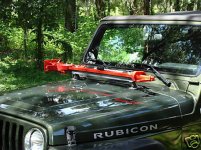
hi-lift jack applications on 4Runner

...Make sure you know how to use it, and that you're carrying the right accessories, and that you understand all the many and various ways the hilift can eat your face. Here's a cool article that kinda lays out what a hi lift can do: Jack of all Trades | Expedition Portal

That's a good article. Having read part way through it I still have to ask the same question the OP asked. Where can you lift the 4Runner with a hi-lift jack?

If you have solid rock sliders you can use those, with the right attachment for lifting a round bar. With the tire strap device you can lift the tire pretty quickly and then place rocks, boards or other debris for getting the vehicle off of high spots or out of the sand or mud. But there is no where on the body or frame where you can lift a 4Runner. Does this require having a steel bumper?

And for the Jeep shown above (or any other 4x4 stuck in the mud) you wouldn't want to try to get a bottle jack down under the frame. That's a good example of the hi-lift being an essential tool. The same would apply to a vehicle stuck in deep sand. Without the hi-lift you'll be digging for a while.
 
That's a good article. Having read part way through it I still have to ask the same question the OP asked. Where can you lift the 4Runner with a hi-lift jack?

If you have solid rock sliders you can use those, with the right attachment for lifting a round bar. With the tire strap device you can lift the tire pretty quickly and then place rocks, boards or other debris for getting the vehicle off of high spots or out of the sand or mud. But there is no where on the body or frame where you can lift a 4Runner. Does this require having a steel bumper?

Not sure I understand the question. If you can lift the vehicle by a wheel, you can lift the vehicle. No sliders or steel bumpers necessary. If you absolutely had to lift by the front or rear, you can slip the nose of the jack into a 2" reciever. Sometimes you can put the jack under a recovery point or frame horn, if the bumper doesn't stick out too much. With a factory metal bumper, you can use the hooks on the Lift Mate under the bumper to lift without damaging your body work. On a modern vehicle like the 5th gen with waaaaaaaaaay too much plastic in the way, I suspect you're screwed. But again, if you can lift the vehicle by a wheel, you can lift the vehicle.
 
Hi-lift jack on 4Runner

Not sure I understand the question. If you can lift the vehicle by a wheel, you can lift the vehicle. No sliders or steel bumpers necessary. If you absolutely had to lift by the front or rear, you can slip the nose of the jack into a 2" reciever. Sometimes you can put the jack under a recovery point or frame horn, if the bumper doesn't stick out too much. With a factory metal bumper, you can use the hooks on the Lift Mate under the bumper to lift without damaging your body work. On a modern vehicle like the 5th gen with waaaaaaaaaay too much plastic in the way, I suspect you're screwed. But again, if you can lift the vehicle by a wheel, you can lift the vehicle.

Good question. Yes, the Hi-lift can be used and would work much better than a bottle jack under the frame in the case of deep mud, water or sand, where getting a jack under the vehicle is not possible.

You can't lift a 4Runner by the 2" trailer receiver, IMHO. It's only designed for a few hundred pounds of tongue weight. And there is no receiver in the front unless you add one.

There are ways to lift the 4Runner with the right accessories, but only if you have those with you. Otherwise, take a winch or a come-along or a tow strap or kinetic rope and pull it out of whatever mess you got into. And that requires a 2nd vehicle so there's no self-rescue.

For the example of any 4x4 stuck in deep mud or sand with the wheels buried up to the axles, the high lift attached to the tires is going to be the easy way to get out.
 
Not sure I understand the question. ...
On a modern vehicle like the 5th gen with waaaaaaaaaay too much plastic in the way, I suspect you're screwed. But again, if you can lift the vehicle by a wheel, you can lift the vehicle.
The bold part is the question. This is in the 5th Gen section, and the 5th Gen has lots of extra plastic blocking access for a hi-lift.

I grew up using a hi-lift for use on tractors, old vehicles, and old fence posts. But when buying stuff for my beginner's recovery kit I went with an 8-ton come-along and extra straps instead of a hi-lift. Mainly because it fit inside the container along with all my other recovery gear.

I may reevaluate when I get slides.

That said, with a wheel adapter and the trailer hitch you have five very handy pick-up points. So... the direct answer to your question is that no, a hi-lift isn't absolutely necessary. But it could be useful in the right situation. YMMV. :noidea:
 
You can't lift a 4Runner by the 2" trailer receiver, IMHO. It's only designed for a few hundred pounds of tongue weight.

Of course you can use the receiver to lift the vehicle. It's designed to handle 5,000 lbs of towing weight, and the forces incurred with towing. It's also a great recovery point to attach a strap to.
 
The bold part is the question. This is in the 5th Gen section, and the 5th Gen has lots of extra plastic blocking access for a hi-lift.

Right, and the part after the part you bolded is the actually relevant bit. You don't need sliders and hard bumpers if you can lift by the wheel. And if you carry a Lift Mate or a sturdy ratchet strap with your Hi Lift, you can lift by the wheel.

If your goal is to change out the tire, you'll need a way to prop the axle up. I carry a small jackstand in my tool box, a log or big rock under the axle would work too.
 
Of course you can use the receiver to lift the vehicle. It's designed to handle 5,000 lbs of towing weight, and the forces incurred with towing. It's also a great recovery point to attach a strap to.

If you want to use the hitch as a recovery point and apply that force laterally, that's ok, but lifting a 5000lb+ vehicle - while it might work - wouldn't exactly be advisable.
Not to mention, the vehicle would get very unstable lifting from the rear-center, even if you did have it chalked.
I dunno, go ahead and do it if you want.
 
Last edited:
I feel 100% confident with lifting a 4Runner by the rear hitch.
It's not fragile. It's actually quite sturdy and mounted DIRECTLY to the frame rails.
 
Last edited:
I feel 100% confident with lifting a 4Runner by the rear hitch.
It's not fragile. It's actually quite sturdy and mounted DIRECTLY to the frame rails.


and only rated for 500 lbs of tongue weight....which is basically "down" pressure, not "up" pressure...haven't seen it directly or indirectly implied by Toyota to use it for any such thing.
 
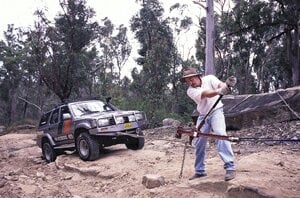
Don't forget you can use it as a winch too...

4b3f524c3ac1576a89cb683c3d41be9d.jpg

^^^ This. I bought mine with some quality chains before I started shopping for a winch. way more work to winch with this, but way more affordable from an initial investment. and take a class... I really enjoyed the one at the Overland Expo West.

You can also use it as a spreader (in case your jeep buddy rolls and crunches the roof/doors)... so it's really a multi function tool.

Okki
 
There should be no trouble at all lifting from the hitch. It's actually a very good spot due to the nature of the shape that captures the jack's lift hook. 500lbs of dynamic tongue weight is much more force than lifting would apply. And the design is basically identical in strength down or up. There's nothing like cable stays or other unique specialty directional design that would make it stronger in either direction. It's just a piece of steel tube that's bent and welded to the frame. Anyone who's towed much with a 4runner has almost certainly lifted the rear from the hitch at least once in a while when decoupling the trailer.
 
No force on the receiver hitch

Of course you can use the receiver to lift the vehicle. It's designed to handle 5,000 lbs of towing weight, and the forces incurred with towing. It's also a great recovery point to attach a strap to.

No offense intended here, I just don't want you to damage your vehicle. Don't use the receiver hitch for a lifting point and it's not the best point to use for a recovery point. The best recovery points are attached to the frame directly, or in line with the frame such as the loops or shackles on a steel bumper.

As others have said above, You can't lift 5000 pounds with the 2" trailer receiver. As someone said above, the tongue weight limit is 500 pounds.

The 5000# trailer rating applies to trailered loads on their own axles with their own brakes. It does not mean you can apply 5000# in any direction on the receiver hitch. It will not stop a 5000# trailer at a reliable, safe speed. For that you need trailer brakes. I would not expect it to be the strongest recovery point to pull on. For that I would use a hook or loop tied directly to the frame.

I've seen the receiver hitch recovery shackles listed on line but I wouldn't use one. I'd rather have a couple of recover shackles through plates welded onto both sides of the frame

Just look at the receiver hitch tube itself. It's connected on the sides laterally to the frame. That's a weak means of support. The forward-direction, 2" square strut is interrupted by the spare tire. Any pull or lift on the receiver tube will apply a much larger force to the lateral supports, due mainly to the sideways direction of the supports.

As an example, consider the sag force on a line. On a clothes line type of support, for every pound of force in the vertical direction you must have many times more capacity in the direction of the line. That's why pulling a vehicle out of the mud by running a cable from a fixed point to one side, through the recovery hook and out sideways to the recovering vehicle, with both ends at steep angles, applies much more force to the stuck vehicle at a shorter pull distance. There's some difference between a line with pinned (free to rotate) ends and the fixed (welded) ends of a receiver mount, but the comparison should make it easy to comprehend the forces at play.

 
I would only want a high lift if I could see it everywhere I went. That way I would feel like I really got my moneys worth out of it... This is pretty much how every jeep with 20" rims is around my area.

Someone mentioned a recovery class. That is really what I need before I even buy any recovery equipment.
 

Attachments

  • toadhop.jpg
    toadhop.jpg
    96.6 KB · Views: 981

Members online

Forum statistics

Threads
278,316
Messages
3,554,109
Members
248,016
Latest member
Advally Service

Trending content

Back
Top