Jerod's Supercharged T[u]RD Build

I'm just getting started on my rebuild. 97 4Runner had 310k on supercharged motor. Supercharger has recently been rebuilt.

I opted to go with 9:1 CR forged pistons because I found pinched rings when I pulled the motor. As for the motor, it already has the old 315cc injectors/URD box installed. I do have a 2.2" pulley for the supercharger but that's it for mods. Just dropped pistons off at machine shop today.

With the motor out, is it a good time to install the DT headers? Can I torque down the exhaust manifold sections and just leave the crossover pipe loose while dropping the motor in? Other than a new starter...anything else I should really do with the motor out and disassembled?
 
I'm just getting started on my rebuild. 97 4Runner had 310k on supercharged motor. Supercharger has recently been rebuilt.

I opted to go with 9:1 CR forged pistons because I found pinched rings when I pulled the motor. As for the motor, it already has the old 315cc injectors/URD box installed. I do have a 2.2" pulley for the supercharger but that's it for mods. Just dropped pistons off at machine shop today.

With the motor out, is it a good time to install the DT headers? Can I torque down the exhaust manifold sections and just leave the crossover pipe loose while dropping the motor in? Other than a new starter...anything else I should really do with the motor out and disassembled?

Yes, it's much easier to install the headers with the motor out, especially when it comes to removing the stock crossover pipe. The mechanic who installed mine (as well as every other person on here) says it's a nightmare to take off in the engine. You will most likely have to keep the exhaust manifold sections loose until you drop the motor back in, but you can try.

If you want to save a few bucks you can just replace the starter contacts instead of the starter itself. Only costs around $10.

I would also suggest dropping down a size to the 2.1" pulley. You've got more than enough fuel to run it, that's what I learned when I put bigger injectors in. There are not a whole lot of "bolt-on" performance upgrades and most are not CARB approved at that.

Other than that, these engines are pretty easy on maintenance so break in your engine and go enjoy it!
 
310K on a supercharged engine....amazing.

If I ever rebuild mine, I'll go with the 10.0:1 compression pistons. I'm thinking a little more compression on these things would be a good thing, especially with forged pistons.

Stock compression is 9.6:1 I think. Toyota either intended to run FI on this motor or they had trouble passing emissions as that's pretty low for NA.
 
2.0 Tuning and Results

Took the 4Runner out again today near the airport to do some spirited driving and tuning. The end result is: I'm very underwhelmed and I'm going to take off the 2.0" pulley. Here's why:

Fitment: You can see from the photos above the fit wasn't quite right. I got the nut on snug, or so I thought, and I've been driving it for a few weeks. After tuning it this afternoon I came home and found the nut was gone! The pulley must have shifted in the heat and caused the nut to come loose and the torque from how fast it was spinning took the nut right off. I cannot put the pulley on any tighter since if I do there's no clearance between the pulley and the housing so it will rub real bad on the housing. Also, because it's not flush it's causing wear on my belt and squealing.

Performance: I was not impressed at all. It does build boost a little faster but the top end is identical to the 2.1" pulley I tuned before. Now I understand why URD discontinued theirs, it adds more wear to the supercharger but very little power, if any. This was also the experience of a user over on Customtacos.com, no real improvement with the 2.0" pulley.

I compared the graphs side by side, 2.1" vs 2.0" pulley. In WOT runs, in first gear the 2.0" ran at an identical 9.6 PSI. Strike one. In second gear, the 2.0" eeked out a measly 0.5 PSI gain at 10.8 PSI. Strike two. And in third in mid 4000 RPM's (pushing 100+ MPH now so this is NEVER used) it gained a peak of 0.8 PSI gain at 11.5 PSI max. Strike three!

The 2.1" pulley is superior in fitment and spins the supercharger slower, meaning bearings last longer. I'm keeping the tune in case I change enough on the engine to make the 2.0" worth my time or take to a track, but for me I'll never notice a <1PSI gain and the 4Runner runs exactly the same on the street.

HP Increase:

+Basically 0!!!

Running Total:

+91 HP (dyno run coming soon!)
 
Last edited:
Good detailed analysis, thanks for doing this testing. Amazing going from 2.2 to 2.1 is quite a big jump (when tuned) and the 2.0 doesn't provide any more oomph.

Guess the little blower is at it's limit on the 2.1.
 
Good detailed analysis, thanks for doing this testing. Amazing going from 2.2 to 2.1 is quite a big jump (when tuned) and the 2.0 doesn't provide any more oomph.

Guess the little blower is at it's limit on the 2.1.

Yeah, the supercharger itself would need to be ported and have better airflow to use anything more I think. There's just too many restrictions to cfm's at that point: the throttle body, supercharger, intake manifold, cams, heads, it would be a complete overhaul to get it to flow the amount of air needed for the 2.0" pulley or anything smaller.

Someone on the supercharger thread posted up about using a 1.8" pulley. I've never seen one but know of people that ran them 10+ years ago (and a 1.7") on the track when 4Runners were some of the faster SUVs on the block, not sure of what kind of boost is possible on those sizes though.
 
Truetrac installed!

Upon recommendation for improving traction in snow/mud as well as for performance on the road, I had a Truetrac installed. It's the exact model as seen here from Summit Racing: https://www.summitracing.com/parts/dtl-913a610/overview/.

2016-01-28_23-56-19.jpg

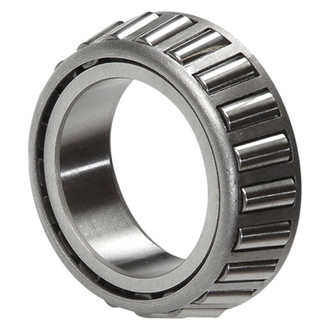
I had a local shop do the work, since I know diddly-squat about differentials. Turns out my differential bearings were also destroyed and were causing a ton of noise but I never knew since I got it that way! These are the bearings that were completely shot, he showed me what mine looked like and they were gauged out so bad. I should have taken a photo, but these are the ones I'm talking about:

306vvl_6.jpg

So I drive it around and when decelerating, it's so quiet! I can't believe how thrashed mine were, I always thought that grinding/whining noise when I let off the gas was the supercharger rotors! Nope, it's the rear end making a ton of noise.

I'm yet to go up in the snow/mud again but looking forward to how well it performs. The last time I kept getting stuck in the slush in 2wd since my tire tread is not very aggressive, so this allows me to run quiet M+S tires but still have great traction. Plus helps with launches from a complete stop since it essentials locks the rear end with very little slip on either side. A lot of fun in the turns as well :)

Dyno run scheduled for May 7th!
 
I hope this doesn't seem off topic but do you think it is worth the investment of buying a SC new vs used, totally worth or just nice to have. I've been thinking about it a bit lately. I've already got CAI, exhaust and headers and I've been getting by well enough. I live at Sea level. The brand new ~$3k kit seems like best bet. I assume I would benefit from existing modifications. I noticed you've commented a lot in the SC thread but with over 100 pages of replies I'll admit I haven't read every page in that thread.
 
You'll like the TrueTrac I think...Put one in mine years ago.

As for the new/used supercharger question.....I paid $1700 for mine brand new years ago. At $3K it's almost equal to the value of the truck these days. Add some add'l items you'll need like the 7th inj kit for another $1K and you're getting up there. I'd find a used one and have it rebuilt if it were my money or wait for a good sale.
 
I hope this doesn't seem off topic but do you think it is worth the investment of buying a SC new vs used, totally worth or just nice to have. I've been thinking about it a bit lately. I've already got CAI, exhaust and headers and I've been getting by well enough. I live at Sea level. The brand new ~$3k kit seems like best bet. I assume I would benefit from existing modifications. I noticed you've commented a lot in the SC thread but with over 100 pages of replies I'll admit I haven't read every page in that thread.

Yeah the supercharger thread has become ridiculously long. Too long, really.

For me, it's totally worth it. It's the very reason why I got a 3rd gen with the 5VZ-FE engine in the first place as opposed to other generations. We both have the same headers and they play very nice with the supercharger.

All the extra fuel systems are really for smaller pulleys and trying to squeeze more power out of it. Your intake/exhaust parts provide almost as much HP as a 7th injector would provide on a stock pulley, so you could simply just install a supercharger as-is and go enjoy it. You'll be leaving power on the table at WOT but if we are honest, rarely any of us actually redline our 4Runners.

If you have no plans on ever changing the pulley size, used will work fine since you won't be spinning too much RPM's on the supercharger. Maybe replace the nose cone (if it's a black one) if it's noisy, then bolt it on and go enjoy it. If you do plan on going to a smaller pulley, a brand new one will last longer and obviously won't need to be rebuilt at all.
 
You'll like the TrueTrac I think...Put one in mine years ago.

I stumbled across your site and saw you put one in as well. How has it aged over time? Still as good as everyone says they are? I like that it's a clutch-less LSD so I don't have to worry about repairing the clutch plates down the road.
 
Have my dyno run scheduled for Monday. I've been looking at a few dyno charts of new, stock vehicles and have an educated guess on where I'll be at power-wise.

The stock 4Runners dyno'd at around 145-148 RWHP when fairly new. They also have a drivetrain loss of 17%, this has been confirmed multiple times with stock 4Runners on a dyno. Add a TRD supercharger, and that jumps to about 185-190 RWHP, when new (don't get confused with peak vs maximum gain, peak supercharger gain is 40 HP while maximum is 62 HP).

Enter my 4Runner with 200k miles. My wife's 2011 Altima puts out 203 HP at the crank, and my 4Runner was slightly faster than it 3 years ago so I'm guessing I was not too far off from the 180 RWHP mark, seeing the Altima was putting out around ~170 RWHP.

Enter the mods I've done over the past few years. You might have noticed this little guy at the bottom of my posts:

HP Increase:

+5-10 HP increase, not a whole lot but it's there.

Running Total:

+91 HP (dyno run coming soon!)

This is estimated from manufacturer's claims or dyno's I could find online. Also based of RWHP, so I'm hoping to be somewhere in the neighborhood of 266 RWHP. Torque is unknown, since it was not always referenced in part performance claims. I also don't think I'm at 17% drivetrain loss because of the electric fan conversion since that add 0 HP at the crank, but did at the wheels.

However, I'm having this dyno'd at 4,000 ft elevation and the shop said the numbers tend to be a little low, even after correction for altitude. I'll ask again on Monday on how much lower they tend to dyno at. Taking this into account, I'm guessing it'll read about 10 HP low and have a dyno run somewhere around 255 RWHP on Monday. I'd be pretty happy with that!

Anyone else want to take a guess or share dyno results? :D
 
Last edited:
That value of 17% drivetrain loss is pretty interesting. I've often wondered but never seen any real data.

Have you ever seen a comparison of auto vs manual with regards to drivetrain loss?


I'll guess 250 RWHP even :)
 
A few people asked about my final O2 sensor tune/skew, so here's what I landed on.

EDIT: I have a newer, better tune as of 2/24/19. See later post.

Dyno run in the morning! So excited!
 
Last edited:
First Dyno Run Results

<iframe width="560" height="315" src="https://www.youtube.com/embed/0hIotwCwv_o?rel=0" frameborder="0" allow="autoplay; encrypted-media" allowfullscreen></iframe>

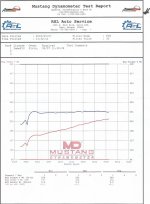
Dyno run is complete, but with mixed results. Ran into some problems due to the elevation and the speed governor! Short version, on a Mustang dyno (more on that later) I made 229.1 RWHP and 256.6 TQ at 4800 RPM. Those numbers seem a bit low? 'Cause they are. There are 3 main factors on why it dyno'd low:

1. The shop is at 4400 ft elevation. I knew I'd drop a little boost but what I didn't realize is that atmospheric pressure AND boost pressure are lower. So my F/IC 6 is tuned based on both of them. It reached a max of 11 PSI boost at 14.7 atmospheric pressure at sea level but only 12.7 atmospheric pressure at 9 PSI of boost at 4400 ft. So my tune was off by 4 PSI! It was basically useless. I had to created some new values on the fly and didn't get it back to 11.5-11.8 AFR's until the last run. The first run made the same power at 10.2 AFR on the bad tune, so I lost about 10 RWHP just from heat soak alone (difference between 3rd run with bad tune and 5th run with good tune). This was unexpected for me and a bit of a bummer.

2. The dyno run needed to be done in 3rd gear because it has a 1 to 1 drive ratio. However, the governor kicked in at just under 110 MPH and kept cutting fuel! We could not get past 4800 RPM without it cutting fuel so I don't have the full HP and TQ curve to ~5500...

3. It's a Mustang dyno so the numbers are lower than a Dynojet. The technician explained the difference, he said it reads more consistent since it applies force to the rear tires similar to that you see on the road since there's resistance against the rollers. This makes it really nice for getting a tune on it since it will mimic the conditions you'll see out on the street. He said if I had gone to the other shop and town and ran it on the their Dynojet, I would have made 280 HP on paper, that's how different they are.

So overall, I learned a lot about my vehicle and how it performs. Did it go as I had hoped? No, the two major issues I encountered were a bit of a disappointment, but at least I have an idea on where I'm at. I'm even more tempted than ever to put 4.56's or 4.88's in my rig, since that'll lower my speed but increase my RPMs, since 700 of top end RPM's in 3rd are basically unusable! But look at how flat that torque curve is... gosh is it fun to drive!
 

Attachments

  • Dyno Run 5-7.jpg
    Dyno Run 5-7.jpg
    132 KB · Views: 3,401
Last edited:
After the dyno run I have been thinking about some things to try to crank even more power out of this engine. Here's my thoughts so far in no particular order:

  • Index spark plugs to face intake/fuel
  • Throttle body coolant hose bypass
  • LCE Lightweight Crankshaft pulley
  • Performance camshaft from local engine builder or Colt Cams (22 HP dyno proven)
  • Mandrel bent exhaust 2.5" cat-back, re-use Borla muffler
  • Bigger methanol nozzle, current one is less than 10% of total cc's, go from 175 cc to 225 cc
  • Redline or Royal Purple ATF (cheapo store stuff in there right now)

And my more extreme thoughts:


I'd do these after installing camshafts I think though.

The more conservative list could push another 35+ RWHP out of this engine. The bottom ones are unknown, with cams I should be able to make plenty of power up to 6000 RPM's and the gears would up my RWTQ about 19%. This would not reflect on a dyno due to the final drive ratio not being 1:1 though so I'd probably do gears last and dyno run it first. I will need to remove the speed governor to get a true dyno run done though.

Oh the possibilities.
 
Wife gave the green light on me spending more money! Coming soon is Colt Cams performance camshaft, bigger nozzle (225cc/min) and the LCE crankshaft pulley! Gonna do the timing belt/water pump while I am in there as well since I'll have it all apart. Can't read the sticker anymore on when it was last done so figured it's about time anyway.
 

Members online

Forum statistics

Threads
278,312
Messages
3,554,083
Members
248,016
Latest member
Advally Service

Trending content

Back
Top