LT tires need more air pressure.

ragamuffin I don't no anything about the tire psi but I just bought the same vehicle but 2019 an have a vibration at 55 to 60 mph had dealer balance an still have a slight vibration they said it would go away after breakin did you experience this I believe they are bs ing me .
 
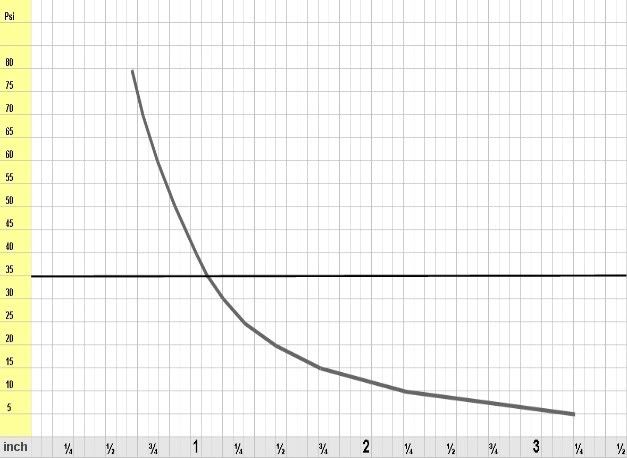
Was playing around with a small compressor in the garage a few weeks ago. One thing led to another and I ended up measuring tire deflection on the passenger front in 5lb increments from 80psi down to 5psi. The result is the graph below. One thing I wanted to know is what the curve looked like below 35psi where the load tables end for LT tires. I originally drew the lines in the charts, above, straight down to 20psi to make the relationships more obvious at a glance. They are a little too straight as it is, but continuing them straight past the end of the load tables needed to be fixed, and now it is.

It's interesting to me how 35psi is just about the spot where the curve below really starts to bend. I'm assuming it's no coincidence that's where the LT load tables end.

Deflectioncurve.jpg~original

old post, but this is great stuff, enough to convince me to never run an LT below 35 psi, thanks
 
This is a great thread.

I don't think I know anyone personally who runs proper pressures on LT tires on offroaded vehicles. I know they can be unbearable in daily driving. I used mine at 10% less than optimal but still at 39 psi, not under 35. And 39 was far too much for an empty vehicle.

Still, looking at pages 2-3 in this Nitto tech bulletin is a good thing to do:
https://www.nittotire.com/media/152964/TechBulletin_NTSD-12-011.pdf

30 psi on an LT on pavement is just asking for trouble; whether it happens is another question.
 
I have an '03 V8 LTD AWD and have had Michelin LT 265/65R17 installed for 2-1/2 years and 25K miles, all on road, and run 37psi. Tires perform very well in all conditions (Chicago area) and are wearing very evenly. I rotate one tire to spare every November and May. MPG is 14.5-15.2 mostly 25 mile per day crawling around streets.
 
I have an '03 V8 LTD AWD and have had Michelin LT 265/65R17 installed for 2-1/2 years and 25K miles, all on road, and run 37psi. Tires perform very well in all conditions (Chicago area) and are wearing very evenly. I rotate one tire to spare every November and May. MPG is 14.5-15.2 mostly 25 mile per day crawling around streets.

do you run that pressure all the way around? Right now i have the same size LT M's and run 33 in the rear and 35 front. Currently not trailering or carrying extra weight in the rear. i rotate every 5K miles. wear and ride comfort is fine. if i'm doing something wrong, it sure doesn't show, but i do have the impression Michelin quality has something to do with that.

if no-one can chime in on whether this is wrong, i will probably call Michelin and/or research elsewhere.
 
Last edited:
do you run that pressure all the way around? Right now i have the same size LT M's and run 33 in the rear and 35 front. Currently not trailerng or carrying extra weight in the rear. i rotate every 5K miles. wear and ride comfort is fine. if i'm doing something wrong, it sure doesn't show, but i do have the impression Michelin quality has something to do with that.

if no-one can chime in on whether this is wrong, i will probably call Michelin and/or research elsewhere.

You should ask them anyway, I suppose they will reply something in the 42-44 range. They will calculate it so as to ensure the same % of spare capacity that the OEM P-metric tire had.

Driving lower first eliminates that safety buffer.

You can bet they will say it is wrong to run them at 35/33 because at those pressures the capacity is decreased by a lot (but then there is the issue of what size one is running).

People get away with a lot but I did drive over a burst MT from a Jeep on the highway last week. My non-expert understanding is that driving LTs on the highway consistently under 35 if really pushing it.

I am sure there is a way to calculate the load capacity at various pressures.
 
Yes, 37psi all around and the ride is great. These tires feel better in every way than the B-stone P-metrics they replaced.
 
You should ask them anyway, I suppose they will reply something in the 42-44 range. They will calculate it so as to ensure the same % of spare capacity that the OEM P-metric tire had.

Driving lower first eliminates that safety buffer.

You can bet they will say it is wrong to run them at 35/33 because at those pressures the capacity is decreased by a lot (but then there is the issue of what size one is running).

People get away with a lot but I did drive over a burst MT from a Jeep on the highway last week. My non-expert understanding is that driving LTs on the highway consistently under 35 if really pushing it.

I am sure there is a way to calculate the load capacity at various pressures.

Well, the convo with the Michelin CSR did not inspire confidence. She told me the PSI without asking which tire, though she did ask the size. So, the first response was 33 psi front/rear.

Then I told here they were LT's, and she said 44 psi front/rear. Even though I did not like how the call went, her advice seems consistent with what is recommended here.

Another thing, the dealer rotates and corrects inflations every 5K miles, and they aren't paying attention either...???!!! The sidewall indicates "X RADIAL LT 2"...hard to miss.
 
PSA: If a Michelin tire product is marked "P265/65R17" and "X RADIAL LT2", they are not LT tires. Little confusing, but an email and another call resolved this.

I do not have LT tires, recommended inflation 32 psi all around.

I will unsubscribe from the thread within 10 seconds...LOL

10, 9, 8,...
 
PSA: If a Michelin tire product is marked "P265/65R17" and "X RADIAL LT2", they are not LT tires. Little confusing, but an email and another call resolved this.

I do not have LT tires, recommended inflation 32 psi all around.

I will unsubscribe from the thread within 10 seconds...LOL

10, 9, 8,...

Well, yeah, it is whatever goes with the tire size, like P265 70 17 or LT265 70 17. Good you got it sorted out quickly because some P-metric tires have 44 psi as their max pressure, others have 51.

LTC are 50, LTD are 65, and LTE is 80.
 
I've been running my LT KO2s for a while at 35 psi, and always felt like it was under-inflated.
So after inflating my tires yesterday I went through a quick calculation to see what number makes sense.

The goal is to see, given the same load per tire, at what LT tire pressure we get the same as stock P-rated tire pressure? Here's how it went:

Stock 4runner suggested tire pressure is 32psi

Bridgestone A/T Revo (P 265/70 r17)
load @ max pressure = 2535lbs @ 44psi


My tires: BFG KO2 (LT 275/70/r17)
load @ max pressure = 3195lbs @ 80psi


going by per tire load @32psi = (32/44)* 2535 = ~1844 lbs per tire (meaning at 32 psi the stock tires can each carry this load)

to get the same above per tire load on the LT: (1844/3195)*80 = ~46 psi

The above assumes a linear relationship between tire pressure and tire load capacity, which may not be 100% true.

However, this tells us that the LT tire needs ~46psi to provide the same load rating per tire as the P-rated stock tire. Again, not 100% accurate, but to me seems like a good start point.

Ride will suffer (LT tires are stiffer) but may helps some mpgs. Plus they finally 'look' right!
 
I've been running my LT KO2s for a while at 35 psi, and always felt like it was under-inflated.
So after inflating my tires yesterday I went through a quick calculation to see what number makes sense.

The goal is to see, given the same load per tire, at what LT tire pressure we get the same as stock P-rated tire pressure? Here's how it went:

Stock 4runner suggested tire pressure is 32psi

Bridgestone A/T Revo (P 265/70 r17)
load @ max pressure = 2535lbs @ 44psi


My tires: BFG KO2 (LT 275/70/r17)
load @ max pressure = 3195lbs @ 80psi


going by per tire load @32psi = (32/44)* 2535 = ~1844 lbs per tire (meaning at 32 psi the stock tires can each carry this load)

to get the same above per tire load on the LT: (1844/3195)*80 = ~46 psi

The above assumes a linear relationship between tire pressure and tire load capacity, which may not be 100% true.

However, this tells us that the LT tire needs ~46psi to provide the same load rating per tire as the P-rated stock tire. Again, not 100% accurate, but to me seems like a good start point.

Ride will suffer (LT tires are stiffer) but may helps some mpgs. Plus they finally 'look' right!

Nice reasoning, makes sense to me.

I got the 265 in C rating and after a few tests I ended up deciding running it at 38-40psi, which sits in between the stock 32psi and your range E 46psi, so I guess it was a good guess lol
 
I recently moved to LT295/70R17 Patagonia MT (E) and was doing a little research on what the appropriate tire pressures should be. Discount Tire filled them to the door jam specs (bad) so I've been giving 40 psi a go driving around today but I decided to dig a bit deeper.

Using the calculations here and cross referencing the data from the Toyota load inflation tables I was able to calculate the stock P-Metric load value for the 4th gen (265/65R17 - load index 110) is 2260 lbs @ 32 psi.

Correcting for the P-Metric to LT-Metric (2250/1.1) we're left with 2055 lbs. The Patagonias are load index 121Q which hold 2215 lbs. @35 psi. This seems to show you could indeed safely run the 35 psi minimum in your LTs on 4th gens (which is the actually the minimum recommended on this size). The stock 5th gen size (265/70R17) is able to carry a bit more weight (2425/1.1 = 2205 lbs) but since 35 psi still satisfies this requirement (2215 lbs), it's the same.

35 psi puts me well within spec of both the factory recommendations and the tire manufacturer's recommendations so I'm moving to that.

Sorry for the hair splitting, but it was kinda fun for me lol.

Edit: Tire Pressure Calculator - this seems to be very accurate and based on industry load inflation tables. Interestingly enough the LT high flotation in sizes we might run can be run as low as 25psi (vs LT Metric tires that start at 35 psi). Something I'm now researching since I'm moving to 35s...
 
Last edited:
Long time lurker first time poster. I came across this thread while looking for cheap mods for the 4th gen. I decided I would chime in and give my .02 cents. I use the chalk method when I change model or size of tire. This has been the best way for me to make sure the tires are properly inflated. It's kind of a pain in the butt because you need the tires to be cold and you need a flat level spot to roll forward a couple of revolutions.

I recently discovered a calculator for get the pressure correct and I have tested it out on my Tundra, my GF's 4th Gen 4R, my buddies Tacoma and another buddies FJ Cruiser. We did the chalk method with all of the mentioned rigs and when I put the information in the online calculator I came up with the same PSI as I did with the chalk method. There are other useful tools on this website like gearing and speedo calculations as well as more. Check it out when you have a minute, I have found it very useful.

Tire Pressure Calculator
 
Last edited:
This tool was within 1 PSI of what I had hand calculated for my tire change. Very nice.

Sent from my moto g power using Tapatalk
 
This tool was within 1 PSI of what I had hand calculated for my tire change. Very nice.

Sent from my moto g power using Tapatalk

As I already mentioned for me the chalk method has always been the most accurate way to ensure proper tire contact. I feel confident in using the calculator from now on instead of the chalk. They also have a wheel offset calculator that is pretty cool and gives a nice visual.
 
I’ve read this thread, and several others on the topic, and it seems to me there may be 2 different conversations happening. Hear me out...

One line of thinking is trying to determine the correct tire pressure based on load capacity. Either by converting from P to LT or working from the load characteristics of the LT and factoring in GVWR. This seems to land around 43-44psi. Higher if you are maxing out on vehicle weight.

The other line of thinking is trying to optimize road contact, either by chalking or heat measurements (or whatever). This seems to come in lower than the previous method, somewhere in the mid to high 30s.

If you’re towing, or otherwise heavily loaded, and need to ensure the tires can handle the weight, the first approach makes perfect sense...the tires need to be able to support the weight. But...for the majority of us (or the majority of the time) when it’s just a stock(ish) 4Runner and 1 or 2 people, doesn’t the 2nd approach make more sense? My runner is a bone stock 2020 with 265 K02s, and with the tires at 38psi, on a cool/cold day with wetish roads, there is a very noticeable lack of traction. The same pressure on a warm/hot day (yes, tires adjusted as temp changes) and the traction seems fine. So I have dropped the pressure to 34 to try that out, and it seems to be much improved.

Does this thinking make sense, or do you think 34 is just too low for an LT on this rig?

 
I’ve read this thread, and several others on the topic, and it seems to me there may be 2 different conversations happening. Hear me out...

One line of thinking is trying to determine the correct tire pressure based on load capacity. Either by converting from P to LT or working from the load characteristics of the LT and factoring in GVWR. This seems to land around 43-44psi. Higher if you are maxing out on vehicle weight.

The other line of thinking is trying to optimize road contact, either by chalking or heat measurements (or whatever). This seems to come in lower than the previous method, somewhere in the mid to high 30s.

If you’re towing, or otherwise heavily loaded, and need to ensure the tires can handle the weight, the first approach makes perfect sense...the tires need to be able to support the weight. But...for the majority of us (or the majority of the time) when it’s just a stock(ish) 4Runner and 1 or 2 people, doesn’t the 2nd approach make more sense? My runner is a bone stock 2020 with 265 K02s, and with the tires at 38psi, on a cool/cold day with wetish roads, there is a very noticeable lack of traction. The same pressure on a warm/hot day (yes, tires adjusted as temp changes) and the traction seems fine. So I have dropped the pressure to 34 to try that out, and it seems to be much improved.

Does this thinking make sense, or do you think 34 is just too low for an LT on this rig?

There's is 3rd line of thinking - chose LT tire inflation using Toyota 4runner manual which is says:
"Maximum load of tire
Check that the number given by dividing the maximum load by 1.10 of
the replacement tire is greater than 1/2 of the Gross Axle Weight Ratings
(GAWR) of either the front axle or the rear axle, whichever is greater."
If you use this line of thinking - the minimum tire pressure for C load stock size tire should be not less than 35 psi when you have your truck fully loaded..
 

Members online

Forum statistics

Threads
278,316
Messages
3,554,111
Members
248,016
Latest member
Advally Service

Trending content

Back
Top