Lug nut torque...what value do YOU use?

Best torque wrench in the world is pretty much useless if you don't keep it calibrated.

Just stirring the pot. lol:couch2:

My momma said a shiny torque wrench is compensation for a small toolbox*

*Hacked by [MENTION=81573]Stifler[/MENTION]
 
The reality is the quality of your wrench (unless its grossly out of range) wont matter as the k values will vary greatly and IIRC industry standard (petrochem) for using a torque wrench to determine fastener preload was in the range of +/-20%. Get strain gauges on your studs then I will be impressed :)

I feel better now for having tested my click torque wrench that had been sitting for a couple of decades by dialing it to 25lbs and then resting a 25lb weight 1-foot out on the handle.

It passed with flying colors and has passed all the other estimate tests that I probably would never have admitted to doing before your 20% number gave me a get out of jail free card.
 
Best torque wrench in the world is pretty much useless if you don't keep it calibrated.

Just stirring the pot. lol:couch2:

where I worked there was a program procedure set up by the engineers on the install of this huge bearing used in the vehicle. this torque was to be 180ft lbs. they wanted this to be exactly 180.

so they mounted a torque wrench calibrator on the 12 inch building I beam. we were required to check the calibration before we did the torque. had several torque wrenches never had any issues on the calibration . all within a few foot lbs like 2-4 %...

the program had 100 vehicles and about 30 bolts each. lots of torquing much more than a DIY guy will be doing .

if your really concerned have it calibrated after your purchase, before using it...

DON'T DROP IT ! NOT GOOD.
 
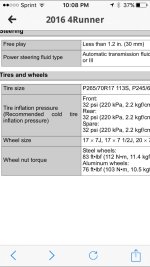
While rotating my tires today, I stumbled upon an interesting issue in the FSM.

One section of the FSM calls for a torque value of: 97 ft-lbf

Another section of the FSM calls for a torque value of: 83 ft-lbf

And finally the owner's manual calls for a torque value of: 81 ft-lbf

To the lay person like me, it seems like ~97 ft-lbf might be a bit overkill since the studs don't really look any thicker than passenger car studs? I recall most of my hondas and toyotas with similar diameter studs being ~80ish ft-lbf...

Personally I've always torqued my lug nuts to ~84 ft-lbf on the 4runner and called it good, but I'm curious about how tight you guys like to twist yo nuts?

According to my manual based on steel or aluminum wheels.
 

Attachments

  • image.jpg
    image.jpg
    89.4 KB · Views: 5,755
Ok, lets add to the complexity now! Many changed their wheels for aftermarket one. The OEM nuts don't fit anymore since many need to have conical nuts. This affects the friction between the wheel. Probably, the torque specified by Toyota doesn't apply anymore. I am guessing that the required torque is higher a bit since there is more surface so more friction opposing the the nut tightening. Just guessing. Funny to see something that look simple get complicated.

I will mount my new FN Wheels this week with their supplied conical nuts On the invoice they indicate their recommendation for mounting the wheels:

---YOU MUST USE CONICAL SEAT LUG NUTS WITH THESE WHEELS. TIGHTEN ALL LUG NUTS USING HAND TOOLS ONLY. TIGHTEN LUG NUTS GRADUALLY IN A STAR PATTERN, AND THEN TORQUE ALL LUG NUTS TO FACTORY SPEC (80 FT / LBS). RETORQUE ALL LUG NUTS AFTER 50 MILES. DO NOT USE ANY IMPACT GUNS OR TORQUE STICKS TO TIGHTEN LUG NUTS. YOU MAY NEED TO INFORM YOUR TIRE INSTALLER OF THESE INSTRUCTIONS / REQUEST HAND TOOLS ONLY TO BE USED ON YOUR TRUCK.

For sure, I will respect this.
 
Nobody look at me.
I put a dab of antiseize, sometimes more, on the studs before installing. Also some to the hub.
Something about salt that makes stick those rims on the hub and make it a massive ordeal of laying down on cold spring ground to kick rims loose..
 
Nobody look at me.
I put a dab of antiseize, sometimes more, on the studs before installing. Also some to the hub.
Something about salt that makes stick those rims on the hub and make it a massive ordeal of laying down on cold spring ground to kick rims loose..

Beat the shit out of them with a rubber mallet. My old Audi the wheels use to fuse on routinely. You could almost drive on them with the lugs off.
 
A better question may be who has actually had their torque tools calibrated since purchase...
 

Attachments

  • 19702097_10155734853652223_3956187318134693627_n.jpg
    19702097_10155734853652223_3956187318134693627_n.jpg
    23.9 KB · Views: 3,233
FWIW:

If you leave your torque wrench set at a value when you store it - it will go out of calibration. The spring will fatigue over time and you'll end up with a wrench out of calibration. I worked at a mechanic/tire shop for a couple years and we found Snap-On torque wrenches in particular to need constant calibration. Snappy was always good about calibrating and/or replacing if necessary. Leaving them with the spring under tension significantly shortens the calibration life.

All you have to do is loosen the spring when your done and it'll last a long time.

I tend to use 85 ft lbs on mine.
 
Last edited:
Beat the shit out of them with a rubber mallet. My old Audi the wheels use to fuse on routinely. You could almost drive on them with the lugs off.

You can whack them with hammer but don't do it too often because of stress on wheel bearing. better option is to use antiseize on the inner hub.
 
Rubber mallet? LOL Not unless it's 10lbs at the end of a 4 foot bar.
No son, the shit we get up here (Toronto), requires a 200lbs soccer player, crawling underneath, and straight up karate kicking xfewtimes for it to break loose.
 
You can whack them with hammer but don't do it too often because of stress on wheel bearing. better option is to use antiseize on the inner hub.

Ive used anti sieze on the hubs. Some will still have some very minor stick even with it.
 
you could always just use "german torque"!! (good'n tight!)

i used to tq the lugs on my 2010 to 85.

and yes, tq wrenches are finicky bi**ches. always set it back to nominal after using it.

we had inch lbs, and ft lb ones in the army. Always needed calibration. DO NOT drop one off the top of a helicopter!!!
 
I got new tires a few weeks ago and happened to notice on my invoice that they torqued my alloys to 85 ft lbs. Do I bother re-torquing to the manual recommended 76 ft lbs or just leave it at the shop tightened ~85 ft lbs? I read through this thread but still not sure sure if + ~10 ft lbs is going to be considered "too tight" for the alloys even though it seems that in the past the recommended torque was higher.

Also I'm aware that my uncalibrated torque wrench might put me near the same value as what the lugs are currently set at lol :eyebrows:
 
I got new tires a few weeks ago and happened to notice on my invoice that they torqued my alloys to 85 ft lbs. Do I bother re-torquing to the manual recommended 76 ft lbs or just leave it at the shop tightened ~85 ft lbs? I read through this thread but still not sure sure if + ~10 ft lbs is going to be considered "too tight" for the alloys even though it seems that in the past the recommended torque was higher.

Also I'm aware that my uncalibrated torque wrench might put me near the same value as what the lugs are currently set at lol :eyebrows:

Just leave it.
 

Members online

Forum statistics

Threads
278,309
Messages
3,554,070
Members
248,016
Latest member
Advally Service

Trending content

Back
Top