
Lug nut torque...what value do YOU use?

Had new tires installed recently and I asked before our key was given to the tech how they torque the lugs. They assured me they wouldn’t be installed with an air gun and that they’d be torqued by hand using two different torque wrenches. Since I had planed ahead and brought one of my torque wrenches I still backed them all off slightly (a short distance away from the shop) and torqued them myself according the owners manual. Naturally it took much greater effort than it ever had before to loosen the lugs. I can only imagine how much harder a time I would have had when rotating them later had I not done so.

And I have never left my torque wrenches stored at anything but the minimum setting to prevent stress on their springs as others have mentioned above.
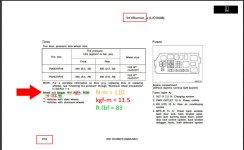
 
I got new tires a few weeks ago and happened to notice on my invoice that they torqued my alloys to 85 ft lbs. Do I bother re-torquing to the manual recommended 76 ft lbs or just leave it at the shop tightened ~85 ft lbs? I read through this thread but still not sure sure if + ~10 ft lbs is going to be considered "too tight" for the alloys even though it seems that in the past the recommended torque was higher.

Also I'm aware that my uncalibrated torque wrench might put me near the same value as what the lugs are currently set at lol :eyebrows:

Alloy wheels should be re-torqued after 100 miles of installation anyway so it wouldn't hurt. I'd torque them to 90 and call it good.
 
Since some people may be worried about their el-cheapo (autozone, harbor freight, walmart etc) generic 1/2" torque wrenches being way off, I tested mine after YEARS of abuse and figured it would be way out of whack: storing it with the spring set at whatever I was using it at, jumped on it to break axle nuts loose on my VW because I had no breaker bar and I was too broke to buy one, anyways I can go on but years of use/abuse.... At my work, our test services/calibration guys have a huge tool calibration machine that was probably $50k, and I decided to test my wrench... it went up to 150ft/lbs and at 150 ft/lbs it was within 3%. It gave me some faith in my $25 purchase, and I was glad I didn't blow hundreds of $ on a fancy one.

Disclaimer: I am just a DIY guy who works on my own stuff at home, I am not a mechanic by any means, but I just want people to not worry much about being super precise about this stuff.
 

Attachments

  • 2001 4RUNNER OWNERS MANUAL P 274.jpg
    2001 4RUNNER OWNERS MANUAL P 274.jpg
    90.6 KB · Views: 1,422
Last edited:
Lug nuts are tight enough

I recently torqued my new wheel lugs on the new rims once to 85 ft lbs and then removed them with a good x-shaped lug nut wrench that I've had for many years. I go a feel for how tight that was. Now I just tighten them to the same torque by hand when I put them back.

All of my life I've never worried about how tight to tighten lug nuts. We just tightened them almost as tight as we could get them. You have to be able to get them off later, by hand with a lug wrench when you have to change a tire out on the road.

Watch out for tire shops that use an air hose impact wrench to install your lug nuts. They can easily over-tighten them so that you can't get them off with your lug wrench.
 
Watch out for tire shops that use an air hose impact wrench to install your lug nuts. They can easily over-tighten them so that you can't get them off with your lug wrench.

Anytime I take mine to the shop, I ask if they are putting them back on with a air impact. I had one shop strip out 4 out of 5 lugs on a previous vehicle that way. I request by hand and then check torque with a torque wrench when I get home.
 
Anytime I take mine to the shop, I ask if they are putting them back on with a air impact. I had one shop strip out 4 out of 5 lugs on a previous vehicle that way. I request by hand and then check torque with a torque wrench when I get home.
Every time a shop touches any of the lugs on any of our cars, first thing I do when I get home is get out the breaker bar and loosen them all about a turn, then retorque to 85.

Sent from my SM-G900V using Tapatalk
 
I used to work at Discount Tire back in the day. i also went there a couple days ago to pick up a set of Methods(i still get a discount). They torque the lugs at 85 ft-lbs. i remember from i worked there(2004-2007) and its always been 85.
 
The reason to torque is multifaceted.

1). You torque to ensure that you don't overtirque and sheer off a stud, which is very easy to do with anything more than a 3/8 drive ratchet.

2). You torque so that you verify even load on the lugs. With one piece rotors, you don't want to torque much more than 80 lbs because it runs the risk of snapping studs but also deflects the rotor which leads to feeling like you have warped rotors and uneven wear if some of them are overtorqued and some are not.

With a 6 lug layout you don't need as much individual load as a 5 or a 4 lug setup.

On my Ford the lug specs are 119lb-ft which is nuts but it's a two piece rotor and meant for harsh duty and continuous race use. No one wants a wheel failure at 140 mph and not only are the stresses more but the vibrations and chance of mechanical action loosening greater.

With off-roading I'd check before and after but I wouldn't torque more than 85 on an OEM one piece rotor with skinny studs
 
Question: Lug Nut Washers

Hi Everyone - I just acquired a 2008 4Runner Sport and excited to be a part of the group!

Vehicle came with locking lug nuts that I do not want. I bought a set of Dorman lug nuts to replace all the lug nuts and locking lug nuts. I noticed that the the OEM nuts come with washers. The Dormans do not have washers.

Are washers necessary on the lug nuts?
 
Hi Everyone - I just acquired a 2008 4Runner Sport and excited to be a part of the group!

Vehicle came with locking lug nuts that I do not want. I bought a set of Dorman lug nuts to replace all the lug nuts and locking lug nuts. I noticed that the the OEM nuts come with washers. The Dormans do not have washers.

Are washers necessary on the lug nuts?

Show us the photos of your wheel (rim) and lug nut (old one and new one). The factory lug nuts have washers on them.
 
Been reading a lot on the correct torque for our wheels. 83 seems to be the norm many go by and just to make it easy, many set their wrenches to 85. I have no issue with this. Makes perfect sense.

I'm running the TRD Pro alloy wheels. PTR20-35110-BK.
My 2018 owner's manual states the following (page 472):
Steel wheels: 83 ft•lbf (112 N•m, 11.4 kgf•m) Aluminum wheels: 76 ft•lbf (103 N•m, 10.5 kgf•m)
So I figure I should probably go with 76ft.lbs. Right? But then I research some more and find a specific Toyota pdf on the Pro alloy wheels and they suggest 83 just like a steel wheel.

https://www.toyotapartsdeal.com/installation/4runner fj trd wheels ptr20-35110 issb.pdf

What the heck? Why the disparity Toyota?
 
Last edited:
Somewhere between 80-85, have had certain shops go higher (they probably used an impact and called it good.)

FSM for my '01 4Runner Alloy Wheels says 83ft lbs.

Honestly, higher than 90 feels like I might stretch a stud...
 
Last edited:
I snapped 1 lug stud off torquing to 85 ft-lbs and another lug was stretched and ready to snap.

Fortunately the studs were easy to replace. Too bad they are so weak.

I never snapped a stud on my 12yr old 2nd gen Tacoma with the same torque values.
 
I snapped 1 lug stud off torquing to 85 ft-lbs and another lug was stretched and ready to snap.

Fortunately the studs were easy to replace. Too bad they are so weak.

I never snapped a stud on my 12yr old 2nd gen Tacoma with the same torque values.

Either your lug studs were damaged or your torque wrench is really out of calibration. There is no way 85 ft-lbs will be enough to shear off the stud. Someone over-torqued and over stretched them.
 

Members online

No members online now.

Forum statistics

Threads
278,309
Messages
3,554,071
Members
248,016
Latest member
Advally Service

Trending content

Back
Top