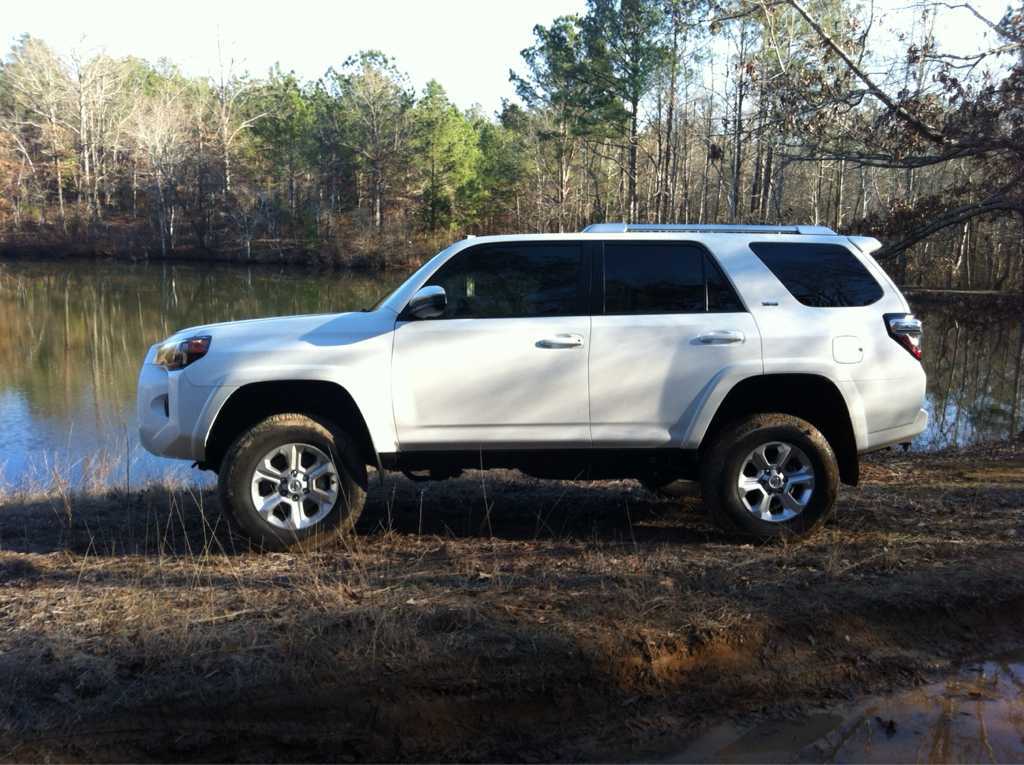
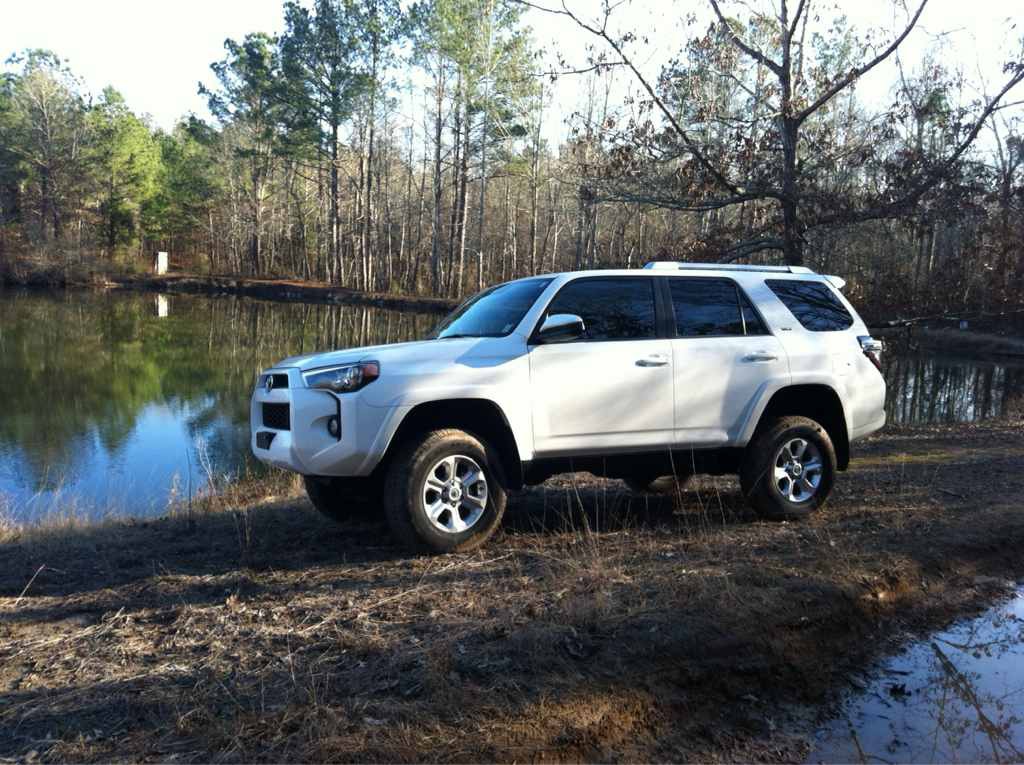
Post your LIFTED pix here!

Work in progress...

This is my 2014 Trail Premium KDSS Remote Start (it's a work in progress with lots more to come) but this thread is about lifts, and the lift is done; so here's the lift, before & after:

d7n4.jpg


q6ik.jpg
 
Last edited:
The tech is wrong. There's no maybe in the discussion. Your CV boots won't survive for more than a few thousand miles if they are rubbing. When the boots fail, joint failure will follow shortly.

2.5" is the max safe lift on a Toyota IFS. If you are looking for near factory reliability, that's it - no more. That is NOT the point where the boots are usually touching, that's just the max that's OK for the CV joints. 2.5" suspension lift + 0.5" from running 285/70R17's vs stock size and you have 3" lift, which is what most people are shooting for. The center hub to center of the fender measurement should be no more than 23" (more like 22.75", depends on the truck).

Lots of people push it past that point. Some do it because they don't know they have accelerated wear. Some do it because they are looking to maximize their Off Road potential and accept that breaking parts is part of the deal. It's impossible to say if you lift XXX amount your CV joints will fail in XXX miles, but it's pretty well accepted that once you go beyond 3" suspension lift (3.5" total w/ tires) you are living on borrowed time. Your center hub to top of fender measurement should be 23.5" max - even there, you may need to spread/secure your CV boots w/ hose clamps to keep the fins from touching.

Again, if the fins are touching, they are rubbing w/ every revolution of the wheel. That rubber will NOT stand up to that wear. It will fail and your CV joints will fail shortly after that.

My advice would be to drop it a full inch to 23" in the front, bare minimum a 1/2" drop to 23.5" and check your boots. The "look" isn't worth the expense in my book.

HTH
David

Actually, the angles look about the same as on my 4th gen that has over 50,000 miles on it lifted 3".
I just bought a 2014 Trail and lifted it last week. I will post pictures of the angles tomorrow. The CV boots will rub fins on a stock truck. They are designed to flex and rub. The outer boots have more of an angle while turning on a stock truck than they do in the lifted position
 
Thanks for replying David. The tech said he's done plenty of lifts and that looks okay, he's even seen it worse on some Tundras, yikes!? I had them put it down 1inch and hopefully that improves the angle much more. I'll report back tonight.

I would trust the dealer tech who lifts Toyota trucks more than I would someone on a forum...Just saying!
 
Actually, the angles look about the same as on my 4th gen that has over 50,000 miles on it lifted 3".
I just bought a 2014 Trail and lifted it last week. I will post pictures of the angles tomorrow. The CV boots will rub fins on a stock truck. They are designed to flex and rub. The outer boots have more of an angle while turning on a stock truck than they do in the lifted position

Please post your pics w/ your lift specs. We would love to take a look.

David
 
Please post your pics w/ your lift specs. We would love to take a look.

David

Not posting for your evaluation, you already stated that your not an expert. Just posting information others may find helpful.
Here are the angles of the CVs on my 2007 4Runner with 76,000 miles on it, this has been lifted over 3" in the front since I bought it in 2008 with 20 something thousand miles on it. CV axles and boots are OE.
moabrunner-albums-2014+trail-picture22859-cv-angles-011r.jpg


This is my new 2014 Trail with 1000 miles on it. It is just under 3" lift in the front, need to crank it up to 3.

moabrunner-albums-2014+trail-picture22860-cv-angles-006r.jpg
 
Last edited:
Not posting for your evaluation, you already stated that your not an expert. Just posting information others may find helpful.
Here are the angles of the CVs on my 2007 4Runner with 76,000 miles on it, this has been lifted over 3" in the front since I bought it in 2008 with 20 something thousand miles on it. CV axles and boots are OE.
moabrunner-albums-2014+trail-picture22859-cv-angles-011r.jpg


This is my new 2014 Trail with 1000 miles on it. It is just under 3" lift in the front, need to crank it up to 3.

moabrunner-albums-2014+trail-picture22860-cv-angles-006r.jpg

Ah I see my rude friend.

Your boots look just like [MENTION=75517]whodat[/MENTION] 's after pictures - after he had them adjusted down from where the Toyota tech originally set them.

This is what I had to say about that:

That looks a lot better! The inner CV boot looks like you've still got some minor touching/rubbing. You can see in the last pictures on each side the dark "clean" rub rings on the interior cv boots - that's where they were rubbing before.

Certainly where you are now, a lot of people drive for a long time and ignore w/ few problems. If it was mine, I would drive it for a few days and see if it settles more. If it doesn't, I would probably look at getting it dropped another 0.25", followed up w/ another 0.25" drop if needed to get the boots not to touch. I'm pretty conservative though, and I'm sure there are lots of people driving around w/ boots like yours are now w/ no problems.

Some interesting reading on the subject:

my CV boot mod - Tacoma World Forums

David

I don't see how that conflicts with your experiences or why you seem to be so intent on being obnoxious as possible.

David
 
Actually, the angles look about the same as on my 4th gen that has over 50,000 miles on it lifted 3".
I just bought a 2014 Trail and lifted it last week. I will post pictures of the angles tomorrow. The CV boots will rub fins on a stock truck. They are designed to flex and rub. The outer boots have more of an angle while turning on a stock truck than they do in the lifted position

Not going to start an argument with you in this thread, but please don't spread mis-information for other potential members reading along if you're not absolutely positive. Your conclusory statements hold as much validity as David's (in that we're all just taking a wild guess), except his actually make more sense to the lay person and also err towards the side of caution.

Unless you are a Toyota engineer you have no idea what operating limits the CVs were designed for. Yes the boots fins rub on a stock truck too, but that's only for a very limited amount of time when the suspension is flexed or when you are turning.

When you lift a truck to the point where the fins are rubbing at static height, you are causing them to rub 99% of the time while you're driving; which obviously is way more rubbing than at stock height. Besides that, you're also not taking into account the spider bearings inside the inboard joints which have their operating limits as well.
 
I would trust the dealer tech who lifts Toyota trucks more than I would someone on a forum...Just saying!

Oh yeah. I would trust them MUCH more than some of the guys here who are engineers, technicians, scientists and enthusiasts. Maybe some forums but not this section. What a joke.
 
I would trust the dealer tech who lifts Toyota trucks more than I would someone on a forum...Just saying!

From some of my experiences with Toyota service techs regarding simple routine maintenance/service, I would disagree with your statement, let alone having them install a lift. The incompetence with some of these techs is overwhelming at times. I have very little trust in dealers' techs.
 
Not going to start an argument with you in this thread, but please don't spread mis-information for other potential members reading along if you're not absolutely positive. Your conclusory statements hold as much validity as David's (in that we're all just taking a wild guess), except his actually make more sense to the lay person and also err towards the side of caution.

Unless you are a Toyota engineer you have no idea what operating limits the CVs were designed for. Yes the boots fins rub on a stock truck too, but that's only for a very limited amount of time when the suspension is flexed or when you are turning.

When you lift a truck to the point where the fins are rubbing at static height, you are causing them to rub 99% of the time while you're driving; which obviously is way more rubbing than at stock height. Besides that, you're also not taking into account the spider bearings inside the inboard joints which have their operating limits as well.

If you do much research on the subject you will find pretty quickly that its not just my opinion. The engineering for max lift on Toyota IFS was done in the crudest, yet most proven way possible - people kept fooling with it till they quit breaking parts. 2.5" is the proven number, lots of people get away w/ 3" (some aren't as lucky). If you go much over 3" w/o a diff drop broken parts are heading your way.

The diff drop on the 4th and 5th gen 4Runners, any FJ Cruiser and 2nd Gen Tacomas aren't the same as the diff drops on the 3rd Gen 4Runner and 1st Gen Tacomas. The general consensus is that they are not effective at reducing CV strain and place the front differential in a bind. For that reason most people choose not to run diff drops on 4th, 5th Gen 4Runners, FJ Cruisers, 2nd Gen Tacomas.

I'm merely passing on the collective wisdom of a lot of enthusiasts that have learned the expensive way. Obviously anyone can ignore that experience and do as they please. There are a lot of new Toyota IFS 4wd owners on this board and I'm trying to help them. I think a lot of people would be more conservative w/ their lifts if they knew the potential problems, certainly I fall into that category.


David
 
My local Toyota dealer forgot a skid plate bolt and over tightened the filter housing. Then they told my wife it needed an alignment even with perfectly wearing tires. After the alignment she needed new tires because they screwed it up so bad.

I'm sure there are good techs out there but my local dealer is a butcher. I did my lift and had it aligned by a professional. I'm very happy with the results. It's really not that difficult to do it yourself.
 
If you do much research on the subject you will find pretty quickly that its not just my opinion. The engineering for max lift on Toyota IFS was done in the crudest, yet most proven way possible - people kept fooling with it till they quit breaking parts. 2.5" is the proven number, lots of people get away w/ 3" (some aren't as lucky). If you go much over 3" w/o a diff drop broken parts are heading your way.

The diff drop on the 4th and 5th gen 4Runners, any FJ Cruiser and 2nd Gen Tacomas aren't the same as the diff drops on the 3rd Gen 4Runner and 1st Gen Tacomas. The general consensus is that they are not effective at reducing CV strain and place the front differential in a bind. For that reason most people choose not to run diff drops on 4th, 5th Gen 4Runners, FJ Cruisers, 2nd Gen Tacomas.

I'm merely passing on the collective wisdom of a lot of enthusiasts that have learned the expensive way. Obviously anyone can ignore that experience and do as they please. There are a lot of new Toyota IFS 4wd owners on this board and I'm trying to help them. I think a lot of people would be more conservative w/ their lifts if they knew the potential problems, certainly I fall into that category.


David
Yeah, 3" of lift is about the max you can do on most Toyotas without having to replace other things like brake lines and doing a diff drop. I think the thing that always confuses me about people getting huge lifts is that they don't fit bigger tires. The whole point in getting a lift is to fit a bigger tire that'll raise the lowest point on the vehicle - the rear diff - to clear obstacles. Many have shown that you can easily clear 285s with 2.5" of lift, myself included. What's the point in going even higher than that unless you're going to fit 35s? Raising your CoG for no good reason so you can roll the truck on a sharp corner or not be able to handle as much off camber stuff on the trail? And if you do want to go higher and fit 35s you'll need to do other things like lowering your bumpstops and probably regearing. And really, what would be the point in having all that extra tire that compresses less and doesn't have any more droop, so you better at least go long travel to take full advantage. The dollars start adding up pretty quick and we haven't even touched on the parts that will no longer be under warranty plus the additional maintenance that aftermarket parts require and Toyota techs won't touch when you bring it in for regular service.

By the way, a replacement CV axle for a 5th gen is over $500 CAD just for the part and that's only for one side. Probably want to add a couple hours labour onto that to replace one side, so you're looking at well over a grand to replace both CV axles.
 
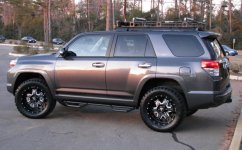
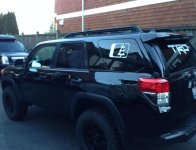
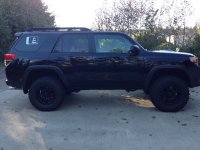
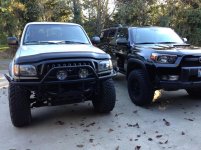
Been lurking here for awhile. Here is mine.
 

Attachments

  • IMG_1583.jpg
    IMG_1583.jpg
    129.4 KB · Views: 6,220
  • IMG_1318.jpg
    IMG_1318.jpg
    135.5 KB · Views: 6,559
  • IMG_1320.jpg
    IMG_1320.jpg
    137.1 KB · Views: 6,607
Not going to start an argument with you in this thread, but please don't spread mis-information for other potential members reading along if you're not absolutely positive. Your conclusory statements hold as much validity as David's (in that we're all just taking a wild guess), except his actually make more sense to the lay person and also err towards the side of caution.

Unless you are a Toyota engineer you have no idea what operating limits the CVs were designed for. Yes the boots fins rub on a stock truck too, but that's only for a very limited amount of time when the suspension is flexed or when you are turning.

When you lift a truck to the point where the fins are rubbing at static height, you are causing them to rub 99% of the time while you're driving; which obviously is way more rubbing than at stock height. Besides that, you're also not taking into account the spider bearings inside the inboard joints which have their operating limits as well.

I'm not spreading miss information, and actually I am not an engineer but I worked at a Toyota dealer for 15 years as a master tech. I posted what my experience has been and the fact fins are rubbing is not going to be an immediate failure.
 

Members online

Forum statistics

Threads
278,312
Messages
3,554,085
Members
248,016
Latest member
Advally Service

Trending content

Back
Top