Steering wheel vibration poll -- responses appreciated

First post has been updated with the results from 70 people (thanks again everyone). Sliders and maybe KO2 tires are the only things that stand out (question 5 and 8). Nothing definitive overall though.

I'd like to pull the raw data for further analysis, but Survey Monkey wants to charge for that feature and I don't see enough to justify paying.
 
Last edited:
i wonder if a common thing is kdss on the vehicle. i know mine has kdss and i have noticed that when im riding to work i need to add some right trim to the steering so the truck drives straight.
 
Aftermarket Wheels

additional thoughts..

When I was researching balancing issues, I also came across information about aftermarket (most) wheels and even some Toyota Light Truck/SUV wheels are Lug Centric (our 5th Gen 4Runners OEM wheels are Hub Centric - thanks [MENTION=113833]e60ral[/MENTION]), so the best technique is to balance them using the Lugs mounted to the balancer - not the typical Cone System.


This is an old video, but I think it's still very valid today...
https://www.youtube.com/watch?v=ocWAZqNGhM4
 
Last edited:
I test drove a new 2017 4Runner Off Road at the local dealership today. The steering wheel started shaking pretty noticeably at around 60-65 mph. It also had a bad nose dive when braking at all speeds(easing through the parking lot and highway).

I really want to buy a new 4Runner, but not if it's gonna be like that.
 
additional thoughts..

When I was researching balancing issues, I also came across information about aftermarket (most) wheels and even Toyota Light Truck/SUV wheels are Lug Centric, so the best technique is to balance them using the Lugs mounted to the balancer - not the typical Cone System.

This is an old video, but I think it's still very valid today...
https://www.youtube.com/watch?v=ocWAZqNGhM4

That's an interesting thought. I have a new 2017 TRD Off-Road that had minimal if any vibration with stock wheels/tires. After 300 miles I replaced with Konig Countersteer Type X wheels and BFG KO2 tires and noted some immediate mild vibration, most notably between about 40-60 mph. I've just returned from a 3000-mile road trip and noticed the vibration the entire time. I didn't think that it could be a balance issue, as the tires were just mounted and balanced. But this makes me wonder. My only other thought was a tire out of round.

I'm certainly not happy to hear that so many others have a similar issue, but I am relieved to know that it's not a problem specific to my truck.
 
additional thoughts..

When I was researching balancing issues, I also came across information about aftermarket (most) wheels and even Toyota Light Truck/SUV wheels are Lug Centric, so the best technique is to balance them using the Lugs mounted to the balancer - not the typical Cone System.

This is an old video, but I think it's still very valid today...
https://www.youtube.com/watch?v=ocWAZqNGhM4
Ours are hub centric

Sent from my SM-G930V using Tapatalk
 
That's an interesting thought. I have a new 2017 TRD Off-Road that had minimal if any vibration with stock wheels/tires. After 300 miles I replaced with Konig Countersteer Type X wheels and BFG KO2 tires and noted some immediate mild vibration, most notably between about 40-60 mph. I've just returned from a 3000-mile road trip and noticed the vibration the entire time. I didn't think that it could be a balance issue, as the tires were just mounted and balanced. But this makes me wonder. My only other thought was a tire out of round.

I'm certainly not happy to hear that so many others have a similar issue, but I am relieved to know that it's not a problem specific to my truck.
My KO2s took 4 attempts to balance, keep taking them back to fix the balance until they do.

Sent from my SM-G930V using Tapatalk
 
additional thoughts..

When I was researching balancing issues, I also came across information about aftermarket (most) wheels and even some Toyota Light Truck/SUV wheels are Lug Centric (our 5th Gen 4Runners OEM wheels are Hub Centric - thanks [MENTION=113833]e60ral[/MENTION]), so the best technique is to balance them using the Lugs mounted to the balancer - not the typical Cone System.


This is an old video, but I think it's still very valid today...
https://www.youtube.com/watch?v=ocWAZqNGhM4

no, do not use the lugs, our wheels our hub centric

your entire video is about lug centric wheels... our wheels are not lug centric
 
My KO2s took 4 attempts to balance, keep taking them back to fix the balance until they do.

Sent from my SM-G930V using Tapatalk

Good to know. Thanks. I'm planning on going back to Discount Tire tomorrow to ask them to check the balance.
 
80 responses now (thanks again) and still no trend. The theory has been floated around in other threads that it's possible the 4Runner's steering/front suspension are strangely sensitive to vibrations, so it might be luck of the draw since even some stock vehicles are exhibiting this issue.

My steering wheel has inexplicably stopped vibrating for the past few days without any significant changes that I'm aware of besides tire pressure going from 40/38 to 40/40 (front/rear) after my 10k dealer service. I had tested that combination of tire pressures (and several others) in the past and it didn't change anything (not even a little bit), so I don't think that's what made it go away.
 
80 responses now (thanks again) and still no trend. The theory has been floated around in other threads that it's possible the 4Runner's steering/front suspension are strangely sensitive to vibrations, so it might be luck of the draw since even some stock vehicles are exhibiting this issue.

My steering wheel has inexplicably stopped vibrating for the past few days without any significant changes that I'm aware of besides tire pressure going from 40/38 to 40/40 (front/rear) after my 10k dealer service. I had tested that combination of tire pressures (and several others) in the past and it didn't change anything (not even a little bit), so I don't think that's what made it go away.

I have had the same vibration in my FJ too. It comes and goes at times, ie. Same road, same speed, no vibration one pass. Later in the day, vibration. Sometimes a few days I go without it, some days worse than others. Happened with stock tires, AT and MT. Lift and no lift. Sometimes I think its the brakes, and other times I remember on my Pathfinder when lifted, it had that center shock that went across the front end, which may have helped support something causing vibration. Weird as can be though. Hope you find a trend!
 
Wheel Vibration

My wheels used to vibrate @ 60-65mph. Road Force balancing solved the problem. The dealer said that sometimes tires vibrate after a RF balance. What he does then is to deflate the tire and rotate it on the rim to a different position.
 
My wheels used to vibrate @ 60-65mph. Road Force balancing solved the problem. The dealer said that sometimes tires vibrate after a RF balance. What he does then is to deflate the tire and rotate it on the rim to a different position.

My tire shop actually completely pulled the tires off the rims and swapped them onto different rims before performing a road force balance. The vibration didn't change in the slightest.
 
Resource

Found this while browsing vibration related issues. Hope it helps.

This is from https://forum.ih8mud.com/threads/driveline-vibration-check-list.425495/

Vehicle vibration can be caused by:
² Tire/wheel unbalance or excessive runout
² Defective tires with extreme tread wear
² Nylon overlay flat spots (performance tires only)
² Incorrect wheel bearing adjustment (if applicable)
² Loose or worn suspension/steering components
² Certain tire tread patterns
² Incorrect drive shaft angles or excessive drive
shaft/yoke runout
² Defective or worn U-joints
² Excessive brake rotor or drum runout
² Loose engine or transmission supports/mounts
² And by engine operated accessories
Refer to the appropriate Groups in this manual
for additional information.

VIBRATION TYPES
There are two types of vehicle vibration:
² Mechanical
² Audible.
Mechanical vehicle vibration can be felt through
the seats, floor pan and/or steering wheel.
Audible vehicle vibration is heard above normal
background noise. The sound can be a droning or
drumming noise.
Vibrations are sensitive to change in engine torque,
vehicle speed or engine speed.

ENGINE TORQUE SENSITIVE VIBRATION
This vibration can be increased or decreased by:
² Accelerating
² Decelerating
² Coasting
² Maintaining a constant vehicle speed

VEHICLE SPEED SENSITIVE VIBRATION
This vibration condition always occurs at the same
vehicle speed regardless of engine torque or engine
speed.

ENGINE SPEED (RPM) SENSITIVE VIBRATION
This vibration occurs at varying engine speeds. It
can be isolated by increasing or decreasing the engine
speed with the transmission in NEUTRAL position.

VIBRATION DIAGNOSIS
A vibration diagnosis should always begin with a
10 mile (16 km) trip (to warm the vehicle and tires).
Then a road test to identify the vibration. Corrective
action should not be attempted until the vibration
type has been identified via a road test.
During the road test, drive the vehicle on a smooth
surface. If vibration exists, note and record the following
information:
² Identify the vehicle speed range when the vibration
occurs
² Identify the type of vibration
² Identify the vibration sensitivity
² Determine if the vibration is affected by changes
in vehicle speed, engine speed and engine torque.
When the vibration has been identified, refer to the
Vibration Diagnosis chart for causes. (see below)Consider correcting
only those causes coded in the chart that are
related to the vibration condition.
Refer to the following cause codes and descriptions
for explanations when referring to the chart.

http://i112.photobucket.com/albums/n171/Billy_Ray_2006/VehicleVibrations.jpg


TRR—Tire and Wheel Radial Runout: Vehicle
speed sensitive, mechanical vibration. The runout
will not cause vibration below 20 mph (32 km/h).
WH—Wheel Hop: Vehicle speed sensitive, mechanical
vibration. The wheel hop generates rapid
up-down movement in the steering wheel. The vibration
is most noticeable in the 20 - 40 mph (32 - 64
km/h) range. The wheel hop will not cause vibration
below 20 mph (32 km/h). Wheel hop is caused by a
tire/wheel that has a radial runout of more than
0.045 of-an-inch (1.14 mm). If wheel runout is acceptable
and combined runout cannot be reduced by repositioning
the tire on wheel, replace tire.
TB—Tire/Wheel Balance: Vehicle speed sensitive,
mechanical vibration. Static tire/wheel unbalance
will not cause vibration below 30 mph (46 km/h). Dynamic
tire/wheel unbalance will not cause vibration
below 40 mph (64 km/h).
TLR—Tire/Wheel Lateral runout: Vehicle speed
sensitive, mechanical vibration. The runout will not
cause vibration below 50 - 55 mph (80 - 88 km/h). Excessive
lateral runout will also cause front-end
shimmy.
TW—Tire Wear: Vehicle speed sensitive, audible
vibration. Abnormal tire wear causes small vibration
in the 30 - 55 mph (88 km/h) range. This will produce
a whine noise at high speed. The whine will
change to a growl noise when the speed is reduced.
W—Tire Waddle: Vehicle speed sensitive, mechanical
vibration. Irregular tire uniformity can cause
side-to-side motion during speeds up to 15 mph (24
km/h). If the motion is excessive, identify the defective
tire and replace it.
UAJ—Universal Joint (Drive Shaft) Angles:
Torque/vehicle speed sensitive, mechanical/audible vibration.
Incorrect drive shaft angles cause mechanical
vibration below 20 mph (32 km/h) and in the 70
mph (112 km/h) range. The incorrect angles can also
produce an audible vibration in the 20 - 50 mph (32 -
80 km/h) range. Caster adjustment could be required
to correct the angles.
UJ—Universal Joints: Engine torque/vehicle
speed sensitive, mechanical/audible vibration. If the U-joint is worn it will cause vibration with almost
any vehicle speed/engine torque condition.
DSY—Drive Shaft and Yokes: Vehicle speed sensitive,
mechanical/audible vibration. The condition
will not cause vibration below 35 mph (56 km/h). Excessive
runout, unbalance or dents and bends in the
shaft will cause the vibration. Identify the actual
cause and repair/replace as necessary.
WB—Wheel Bearings: Vehicle speed sensitive,
mechanical/audible vibration. Loose wheel bearings
cause shimmy-like vibration at 35 mph (56 km/h)
and above. Worn bearings will also produce a growl
noise at low vehicle speed and a whine noise at high
vehicle speed. The wheel bearings must be adjusted
or replaced, as applicable.
AN—Axle Noise: Engine torque/vehicle speed sensitive,
mechanical/audible vibration. The axle will not
cause mechanical vibration unless the axle shaft is
bent. Worn or damaged axle pinion shaft or differential
gears and bearings will cause noise. Replace the
defective component(s) as necessary.
SSC—Suspension and Steering Components:
Vehicle speed sensitive, mechanical vibration. Worn
suspension/steering components can cause mechanical
vibration at speeds above 20 mph (32 km/h).
Identify and repair or replace the defective component(
s).
EA—Engine Driven Accessories: Engine speed
sensitive, mechanical/audible vibration. Vibration can
be caused by loose or broken A/C compressor, PS
pump, water pump, generator or brackets, etc. Usually
more noticeable when the transmission is shifted
into the NEUTRAL position and the engine speed
(rpm) increased. Inspect the engine driven accessories
in the engine compartment. Repair/replace as
necessary.
ADB—Accessory Drive Belts: Engine speed sensitive,
audible vibration. Worn drive belts can cause a
vibration that produces either a droning, fluttering or
rumbling noise. Inspect the drive belt(s) and tighten/
replace as necessary.
DEM—Damaged Engine or Transmission Support
Mounts: Engine speed sensitive, mechanical/
audible vibration. If a support mount is worn, noise
or vibration will occur. Inspect the support mounts
and repair/replace as necessary.
ES—Exhaust System: Engine speed sensitive,
mechanical/audible vibration. If loose exhaust components
contact the vehicle body they will cause noise
and vibration. Inspect the exhaust system for loose,
broken and mis-aligned components and repair/replace
as necessary.

 
On a local 4runner Facebook group there was a guy who had vibrations that followed him through multiple sets of tires and multiple road force balancing attempts. He had spent a lot of time and money and was convinced it was something more serious than balancing.

He finally took the suggestion of trying a recommended balancer - he has no more vibrations

Sent from my SM-G930V using Tapatalk
 
This info from research, not saying it will work for you.

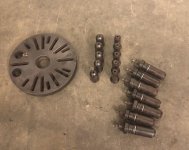
The front ends on the 4Runner and Tacoma are super sensitive. If you have something just slightly out of whack you will definitely know it on these trucks. If you have a vibration and believe it to be cause be the wheels and/or tires, then you should not waste your time by going to a shop with old technology. If your time is as valuable as mine then you should find a shop with the needed Haweka adapter, a GSP-9700, and a technician that has a clue.
The easiest way to find what you need is to get a list of shops near you that has one. Next call the shops and make sure that they have the Haweka adaptor for your wheels. If they tell you that they do not have it or don’t need it, then hang up and call the next shop. Do not waste your time with them. If they are willing to spend $10,000 on the state of the art road force balancer, and not get a set of Haweka adapters to go with it then they probably are not smart enough to work the machine anyway. An experienced tech may index each wheel/tire.
When you find a shop that has both items make an appointment and have them do a road force variation work up and see if you need to replace your wheels or tires and then get a good old-fashioned balance. The combination of the GSP-9700 and the Haweka adaptor should cure the most common cause of vibration in the 4Runners and Tacomas. This combination will give you the greatest chance of getting you vibration problem fixed on the first visit as possible.
Every new 4Runner I have purchased, immediate trip to tire store, new Michelin LTX/MS. This tire has been updated by Michelin thru the years, new designation, Defenders. Not saying this is the best, just IMO.
 

Attachments

  • Haweka-1.jpg
    Haweka-1.jpg
    117.1 KB · Views: 486
Last edited:
Are our wheel actually hub centric??? Last I checked it was impossible to Center the wheel on the hub without the lugnuts. If it where hub centric it should just center when you put the wheel on... Can so actually proof they are hubcentric like... Paperwork or something. Because I'm 90% sure they are lug centric.

Sent from my SM-G930T using Tapatalk
 
We had the vibration issue in our GX460 as well running stock p rated tires.

Easily solved via proper balance. I also had the rotors turned due to the braking vibration.
 

Members online

No members online now.

Forum statistics

Threads
278,316
Messages
3,554,111
Members
248,016
Latest member
Advally Service

Trending content

Back
Top