The 3.4L TRD Supercharger Thread

Looking for some advice from the supercharger experts here. So my wife was driving my truck, and the supercharger belt broke. Without knowing what happened, she continued driving it for another 2 hours (all highway) until she got home. Obviously the battery was dead when she got home, since the alternator wasn't charging it. Would driving the truck without the supercharger spinning cause any damage to anything?

I changed the belt, and the truck is making boost again. However, it seems different somehow. The supercharger is definitely making a different noise when making boost now. Its like an air flow "whoooosh" type sound. Also the AFR's seem to be bouncing around more now than they were before. Any ideas on what could be going on?

Could it just be that the computer has to relearn, due to the battery being dead?

Thanks.
 
Likely just the computer relearning. Nothing should get damaged from running it without the belt as it just sends all the air through the bypass valve. Same way it would driving normally in vacuum.

Speaking of supercharger related issues though I was pulling a trailer this last weekend. Things were going great untill I went to leave from a stop light. Went to pull into traffic and the truck fell flat on it's face as soon as it hit boost. Dropped the trailer off and started limping it home, not exactly easy with a 5200lb 4runner in 35s going uphill and not being able to get into boost lol. About halfway home I got the dreaded knock sensor code. P0330. So started tearing into the truck and on a whim tore the supercharger down to rebuild it since I don't know it's exact history.

Anyway I'm now debating if I just replace the harness and sensors, real expensive with OEM parts, or do I create a dummy stock sensor to make the computer happy and use the knock sensor function of my piggyback with a GM knock sensor in the stock locations? The second route would be cheaper just not sure if I could use it to gain some more performance or reliability
 
Likely just the computer relearning. Nothing should get damaged from running it without the belt as it just sends all the air through the bypass valve. Same way it would driving normally in vacuum.

Speaking of supercharger related issues though I was pulling a trailer this last weekend. Things were going great untill I went to leave from a stop light. Went to pull into traffic and the truck fell flat on it's face as soon as it hit boost. Dropped the trailer off and started limping it home, not exactly easy with a 5200lb 4runner in 35s going uphill and not being able to get into boost lol. About halfway home I got the dreaded knock sensor code. P0330. So started tearing into the truck and on a whim tore the supercharger down to rebuild it since I don't know it's exact history.

Anyway I'm now debating if I just replace the harness and sensors, real expensive with OEM parts, or do I create a dummy stock sensor to make the computer happy and use the knock sensor function of my piggyback with a GM knock sensor in the stock locations? The second route would be cheaper just not sure if I could use it to gain some more performance or reliability

Although the OEM knock sensors definitely have a lifespan, I've never heard of anyone having to do it twice. I just went through this last month and ended up tearing it down once to replace the harness and after the codes came back on, a second time to replace the sensors.

The concern about the GM sensors is they are untested as to how well they actually detect knock. I just finished repairing my dad's GMC pickup and I'm now completely sure I will never buy a used GM vehicle from the same era as our 4Runners. The quality of parts is not equal. There were so many part and sensor failures on that vehicle that it was not really worth fixing (he really likes the truck though).

Normally, people relocate with GM sensors to avoid doing the knock sensor repair in the first place. If you're going to tear down to the engine valley, might as well just put OEM sensors in.
 
Although the OEM knock sensors definitely have a lifespan, I've never heard of anyone having to do it twice. I just went through this last month and ended up tearing it down once to replace the harness and after the codes came back on, a second time to replace the sensors.

The concern about the GM sensors is they are untested as to how well they actually detect knock. I just finished repairing my dad's GMC pickup and I'm now completely sure I will never buy a used GM vehicle from the same era as our 4Runners. The quality of parts is not equal. There were so many part and sensor failures on that vehicle that it was not really worth fixing (he really likes the truck though).

Normally, people relocate with GM sensors to avoid doing the knock sensor repair in the first place. If you're going to tear down to the engine valley, might as well just put OEM sensors in.


My problem with the oem sensors is they are ridiculously expensive. Over 100$ each and both of mine tested bad last night. Harness is totally fine. And even if I spend the money on all oem sensors and harnesses I still don't have a way to actually monitor the knock that they see other than saying "yep the stock ECU knows best" which we've both proven enough times it does not haha. Still weighing my options here and trying to come up with the best solution. To keep things maintenance free but more versatile for tuning
 
This past weekend I installed a lightly used newer generation Magnuson supercharger, IK22 plugs gapped at 0.032", and Deatchwerks 255 lph fuel pump. With help from gamefreakgc, I completed the vacuum hose connections last night and went to start it and the only forced induction that resulted in my turn of the ignition was sadness and despair.

The engine turns over and runs for a second, maybe two before stumbling and stalling. If I mash the gas, I can get it to keep running but it is rough and inconsistent, though it does seem to come alive for a second every now and again. Without mashing the gas it dies. Does anyone have any idea what I did wrong? Seems like an ignition or vacuum leak issue but, other than re-installing the old plugs and seeing if that fixes anything, I'm at a loss.

Additional details:
  • Did the fuel pump first and it ran fine for the minute or two before I moving onto the SC
  • Discovered the bypass valve actuator nipple sheared off during shipping but I capped the vacuum port to which it connects but I also tried running it uncapped with no difference
  • Originally I had 2 vacuum lines coming from my power steering pump assembly, both are now capped and FWIW the driver's side port shot it's cap off when I first tried to start it and I even tried running it with this hose reconnected
  • The exhaust reeks of unburnt fuel
  • N/A Supra injectors were installed in March and have worked well since
  • Battery negative was disconnected for 3 days
  • I triple checked all of the electrical connections and vacuum lines
  • I have the URD fuel and timing calibrator for 6 injectors but I haven't installed it yet
  • MAF is connected and was recently cleaned but I did not have to disconnect it for the SC install
  • New spark plug wires and one new coil installed in March
  • I re-checked that the spark plug wires are in the correct configuration and also pulled the spark plug boots and coils and everything seemed fine although the spring that creates the electrical connection between the coil and it's resident plug are recessed than I would have guessed but all 3 coils are like that
  • I removed the IAC vacuum hose and confirmed the check valve only allows air to flow from the TB into the engine
  • A new gasket was used between the manifold and SC
  • I reused the metal TB gasket but I plan to install the one that comes with the SC kit from Magnuson
  • During install we torqued all of the bolts and nuts securing the SC to spec

Here is a link to the thread where gamefreakgc helped me figure out the last couple vacuum hose connections:
Supercharger Vacuum Hose Routing Question
 
Last edited:
If your bypass valve is not hooked up and functioning that's likely your problem. When the truck starts it makes vacuum that pulls the bypass valve open. Without it hooked up it's locked shut you're pulling all the air through the rotors of the supercharger and at idle I doubt they're moving fast enough to provide sufficient flow. It's not really worth troubleshooting untill you get that and your vacuum line routing 100% confirmed to be right because there's just too many variables. Not sure where the lines you are talking about that are going to the "power steering". Power steering isn't tied to vacuum at all.
 
I did some more tinkering with my car buddy this evening and it seems like way too much fuel is causing it to stall. I took two videos, the first one is it just starting with zero throttle input. The second video is it starting and nursing it with the right pedal, as soon as you let off the gas it stalls again.

YouTube

YouTube
 
Last edited:
I did some more tinkering with my car buddy this evening and it seems like way to much fuel is causing it to stall. I took two videos, the first one is it just starting with zero throttle input. The second video is it starting and nursing it with the right pedal, as soon as you let off the gas it stalls again.

YouTube

YouTube

I can see in both those videos your bypass valve is not hooked up and working. so the blower is trying to make full boost all the time. You need to get that fixed first, theres too many other variables to try and troubleshoot otherwise
 
If your bypass valve is not hooked up and functioning that's likely your problem. When the truck starts it makes vacuum that pulls the bypass valve open. Without it hooked up it's locked shut you're pulling all the air through the rotors of the supercharger and at idle I doubt they're moving fast enough to provide sufficient flow. It's not really worth troubleshooting untill you get that and your vacuum line routing 100% confirmed to be right because there's just too many variables. Not sure where the lines you are talking about that are going to the "power steering". Power steering isn't tied to vacuum at all.

Sorry, I didn't see this before posting the videos. Knowing the bypass valve was broken, we did try running it with the bypass valve held both full open and partially open and it didn't make a big difference. That said I ordered a new one from Magnuson so we'll see if that changes anything. I'll report back after fixing that issue.

As for my power steering vacuum line misunderstanding, if you look at my original post to which gamefreakgc replied to, I guess I'm still confused as to what those two vacuum lines that originate at my power steering pump assembly are for. Based on his response I would guess they are brake booster but why are they both plumbed so close to the power steering pump? In other words, if I were to remove the power steering pump assembly, they would come with it.

I really appreciate any help and please don't misinterpret my questions and lack of understanding as a challenge to yours, I'm just trying to wrap my head around this so I can better understand how all of this is supposed to work.
 
Last edited:
As for my power steering vacuum line misunderstanding, if you look at my original post to which gamefrealgc replied to, I guess I'm still confused as to what those two vacuum lines that originate at my power steering pump assembly are for. Based on his response I would guess they are brake booster but why are they both plumbed so close to the power steering pump? In other words, if I were to remove the power steering pump assembly, they would come with it.


I really appreciate any help and please don't misinterpret my questions and lack of understanding as a challenge to yours, I'm just trying to wrap my head around this so I can better understand how all of this is supposed to work.


Not sure where the lines you are talking about that are going to the "power steering". Power steering isn't tied to vacuum at all.


So the older style engines used a valve in the power steering system connected to vacuum in order to increase engine RPM when steering effort increases, predominately meant for idle. If you follow those lines, one goes before the throttle blade, one goes after. When the power steering system increases its pressure, the valve opens and creates a tiny controlled "vacuum leak" around the throttle blade which slightly increased RPM. This helps to prevent stalling in slow speed steering situations. This is done on newer computers with an electrical switch instead of a mechanical one and the engine computer increases rpm accordingly.

As far as the main problem, yes fix the bypass valve. Also check the little ground connection on the driver side of the supercharger. That is a main computer ground and it can do funky stuff if left loose or off. It's on a 10mm headed bolt near the little box marked "diagnostics".

I would also make sure you connected all the spark plug wires and such. Gotta make sure all connections are fully seated including MAF and igniter. Also the little plug just behind the top of the passenger side timing cover which is for the coolant temp sensor for the computer. That off could make it think it's up to temp and therefore overloading fuel when cold. Probably not but gotta look at everything.

I'm willing to bet it's a very simple thing left unplugged.

Edit:
So I just watched the videos. It's unlikely to be the ground I suggested as it wouldn't run at all if that were off. I can clearly hear the supercharger whining at a low load which would be the cause of the fuel smell. Stupid question, but did you put a gasket on the base of the supercharger? It runs like there's a massive vacuum leak. You need to make sure all hoses are connected. Take pictures and post up if uncertain.
 
Last edited:
Sorry, I didn't see this before posting the videos. Knowing the bypass valve was broken, we did try running it with the bypass valve held both full open and partially open and it didn't make a big difference. That said I ordered a new one from Magnuson so we'll see if that changes anything. I'll report back after fixing that issue.

As for my power steering vacuum line misunderstanding, if you look at my original post to which gamefrealgc replied to, I guess I'm still confused as to what those two vacuum lines that originate at my power steering pump assembly are for. Based on his response I would guess they are brake booster but why are they both plumbed so close to the power steering pump? In other words, if I were to remove the power steering pump assembly, they would come with it.

I really appreciate any help and please don't misinterpret my questions and lack of understanding as a challenge to yours, I'm just trying to wrap my head around this so I can better understand how all of this is supposed to work.

The new bypass valve will allow you to start the engine. Under vacuum the valve should completely open, it's not in your videos. It's most definitely making boost at startup and killing the engine. I would suggest not trying to start it again until you get that new bypass valve installed as I have no idea what up to 7 lbs of boost will do on your engine at startup. Nothing good.

I've yet to see an engine with the power steering vacuum hoses, that's a new one. None of the supercharger vacuum hose routings show it connected so capping them is the way to go. Might experience low RPM's at full steering lock but not a big deal.
 
I've yet to see an engine with the power steering vacuum hoses, that's a new one. None of the supercharger vacuum hose routings show it connected so capping them is the way to go. Might experience low RPM's at full steering lock but not a big deal.


https://www.magnusonsuperchargers.c...uals/89-89-34-003_RevB_Toyota_34_Magnuson.pdf

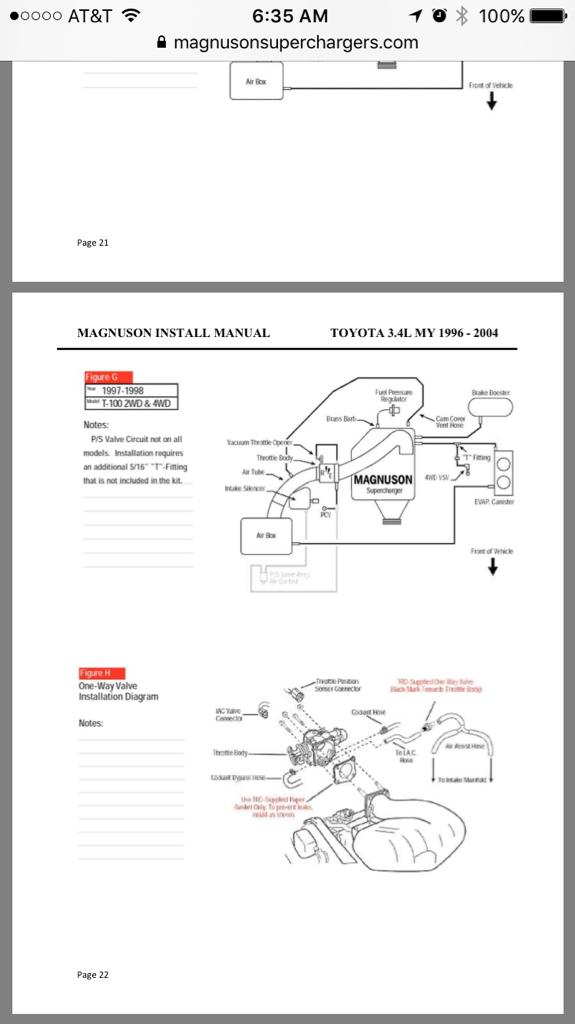
Last page of vacuum diagrams shows it. It's grey'd out and includes a special note on the left regarding it.

684a6b497a0bf023bd59a0b3c2d45db4.jpg


It says for T100, but the early model 3.4's did use a vacuum valve. I think 96, 97 and maybe 98. I would not recommend capping it. It's designed for a reason and its only 2 connections. One goes to one of the capped ports on his now AIRRAID tube, other tee's into PCV. (One line before throttle blade, one line after throttle blade).
 
Last edited:
Thanks to everyone for their responses.

The new bypass valve will allow you to start the engine. Under vacuum the valve should completely open, it's not in your videos. It's most definitely making boost at startup and killing the engine. I would suggest not trying to start it again until you get that new bypass valve installed as I have no idea what up to 7 lbs of boost will do on your engine at startup. Nothing good.

I've yet to see an engine with the power steering vacuum hoses, that's a new one. None of the supercharger vacuum hose routings show it connected so capping them is the way to go. Might experience low RPM's at full steering lock but not a big deal.

I will wait until I get the replacement bypass valve actuator before trying to start it again and report back with my results.

So the older style engines used a valve in the power steering system connected to vacuum in order to increase engine RPM when steering effort increases, predominately meant for idle. If you follow those lines, one goes before the throttle blade, one goes after. When the power steering system increases its pressure, the valve opens and creates a tiny controlled "vacuum leak" around the throttle blade which slightly increased RPM. This helps to prevent stalling in slow speed steering situations. This is done on newer computers with an electrical switch instead of a mechanical one and the engine computer increases rpm accordingly.

As far as the main problem, yes fix the bypass valve. Also check the little ground connection on the driver side of the supercharger. That is a main computer ground and it can do funky stuff if left loose or off. It's on a 10mm headed bolt near the little box marked "diagnostics".

I would also make sure you connected all the spark plug wires and such. Gotta make sure all connections are fully seated including MAF and igniter. Also the little plug just behind the top of the passenger side timing cover which is for the coolant temp sensor for the computer. That off could make it think it's up to temp and therefore overloading fuel when cold. Probably not but gotta look at everything.

I'm willing to bet it's a very simple thing left unplugged.

Edit:
So I just watched the videos. It's unlikely to be the ground I suggested as it wouldn't run at all if that were off. I can clearly hear the supercharger whining at a low load which would be the cause of the fuel smell. Stupid question, but did you put a gasket on the base of the supercharger? It runs like there's a massive vacuum leak. You need to make sure all hoses are connected. Take pictures and post up if uncertain.

https://www.magnusonsuperchargers.co...4_Magnuson.pdf

Last page of vacuum diagrams shows it. It's grey'd out and includes a special note on the left regarding it.

It says for T100, but the early model 3.4's did use a vacuum valve. I think 96, 97 and maybe 98. I would not recommend capping it. It's designed for a reason and its only 2 connections. One goes to one of the capped ports on his now AIRRAID tube, other tee's into PCV. (One line before throttle blade, one line after throttle blade).

I completely overlooked that vacuum hose diagram because it was for the T-100 but that's exactly how the PS vacuum lines were routed before; one before the TB and one after. I'm glad you were aware of this odd variation because I was starting to doubt myself. It will be easy to re-connect the pre-TB hose and I will have to figure out what tee I need to plug into the PCV hose.

We did install a brand new gasket between at the base of the SC.

I will also check that the coolant temp sensor is connected.

Last night my buddy triple checked all the vacuum hoses and electrical connections, which I had already triple checked. We also cleaned the MAF and all the electrical connections that were disturbed when installing the SC. We even re-installed the "old" plugs and it made no difference. Not surprisingly, the plugs we just installed were black and smelled of fuel.
 
Last edited:
https://www.magnusonsuperchargers.c...uals/89-89-34-003_RevB_Toyota_34_Magnuson.pdf

Last page of vacuum diagrams shows it. It's grey'd out and includes a special note on the left regarding it.

684a6b497a0bf023bd59a0b3c2d45db4.jpg


It says for T100, but the early model 3.4's did use a vacuum valve. I think 96, 97 and maybe 98. I would not recommend capping it. It's designed for a reason and its only 2 connections. One goes to one of the capped ports on his now AIRRAID tube, other tee's into PCV. (One line before throttle blade, one line after throttle blade).

Whoa, I totally missed that. I think my screen doesn't show that grey very well (or my eyes are going bad!). 4Runners with the power steering vacuum hoses must really be a unicorn if even TRD doesn't show them with it.

A 5/16 T fitting can be had at a hardware store (look under the plumbing section for a barbed fitting) or plastic ones at auto parts stores.
 
The bypass valve actuator should be delivered Monday.

I checked the coolant sensor, which was connected. I also re-plumbed the power steering vacuum lines per the Magnuson directs for the T100.

On a sorta unrelated note, I bought two catch cans to install, one for the PCV and the other for the CCV. When installing the SC in noticed some brown gunk in the CCV line coming into the intake tube. The engine end of the line was split pretty bad as well.
 
The bypass valve actuator should be delivered Monday.

I checked the coolant sensor, which was connected. I also re-plumbed the power steering vacuum lines per the Magnuson directs for the T100.

On a sorta unrelated note, I bought two catch cans to install, one for the PCV and the other for the CCV. When installing the SC in noticed some brown gunk in the CCV line coming into the intake tube. The engine end of the line was split pretty bad as well.

I highly recommend replacing the PCV valve if it's starting to spew oil into your intake. It might be stuck open slightly. Use only an OEM PCV valve, I've gone through 2 parts store ones in 4 years. They don't seal well and caused a bad idle condition.

It's interesting about the catch cans and how it varies. Some people have it catch oil and clean up the intake. On mine, it was full of water and only caught condensation which is harmless.
 
The bypass valve actuator should be delivered Monday.

I checked the coolant sensor, which was connected. I also re-plumbed the power steering vacuum lines per the Magnuson directs for the T100.

On a sorta unrelated note, I bought two catch cans to install, one for the PCV and the other for the CCV. When installing the SC in noticed some brown gunk in the CCV line coming into the intake tube. The engine end of the line was split pretty bad as well.

Update

The bypass valve actuator was delivered today and is installed and connected via vacuum hose. I also installed a brand new throttle body gasket.

The engine still won't idle and will not run consistently.

Is it something with the fuel regulating valve? Trims way too far off? I'm running outta ideas here.
 
You could put the old intake back on and see what happens to for sure rule out the supercharger or not. I'm willing to bet something is sticking with the IAC even tho I think you said you cleaned it.
 
You could put the old intake back on and see what happens to for sure rule out the supercharger or not. I'm willing to bet something is sticking with the IAC even tho I think you said you cleaned it.

Is there anyway to check the IAC? In my check, re-check, re-re-check procedure I confirmed it would only allow air from the TB to flow INTO the engine. Isn't that counter intuitive though? That's the only "vacuum" line that flows OUT of the intake.
 
Is there anyway to check the IAC? In my check, re-check, re-re-check procedure I confirmed it would only allow air from the TB to flow INTO the engine. Isn't that counter intuitive though? That's the only "vacuum" line that flows OUT of the intake.


There's tons of 3rd Gen IAC cleaning write up. I'm not talking about the tiny check valve you're supposed to install in the air assist line. That wouldn't cause your symptom. It just seems like your engine isn't holding an idle, which is what the IAC controls. It's common to have this issue after a battery disconnect on a tired/dirty IAC since the computer has learned to compensate. And with battery disconnected it resets but is unable to baseline since the passage remains closed.

Any way, basically you remove the AIRAID intake tube. Then you remove the MOTOR portion of the IAC with 2 screws. I always used to leave the actual valve installed since this keeps you from having to drain the little coolant hoses that feed the valve. Removing the motor portion on its own allows access to be able to turn the shaft from the motor end and then clean the actual valve portion just inside the throttle body. For a test, after the screws are removed and the electric part is taken off, you can very gently turn that shaft by finger tips. (It only rotates like 90 degrees or less total so don't force it.) but you will feel a sticky part from carbon build up. That will prohibit the valve from opening enough to allow the engine to idle. That sticky part needs to be cleaned. It needs to be smoooooth as butter.

Do a forum search for IAC cleaning for a more detailed write up. It's a free easy idea to cross something off the list. Post pictures if you have questions. These 3.4's are about as simple an engine as they come.

Edit: I just watched Tim's video and it was good but unnecessary to do that much work. Like I said above, remove intake boot, remove 3 pin electrics plug that juts out from directly under throttle inlet. Behind that is the electric motor portion of the IAC valve with 2 screws. You want to be careful and apply a lot of force so you don't strip out the screw heads. Once those screws are out, the white (or black) motor piece pulls straigh off. It's somewhat magnetic so it sort of sticks. Behind that is the tiny shaft I reference. That shaft spins to actuate a small air bypass in the throttle body. You will see the passage just inside the throttle inlet, before the throttle blade. Squirt a little brake cleaner in that hole and manually spin the valve shaft back and forth a ton until it rotates smoothly. Reassemble, fire it up and let it relearn a bit. Then go do some donuts.
 
Last edited:

Members online

Forum statistics

Threads
278,315
Messages
3,554,102
Members
248,016
Latest member
Advally Service

Trending content

Back
Top