5-speed clutch pedal sticks on floor in morning (three days in a row)

Status
Not open for further replies.
I put a linear spring in mine. My theory is that the torsion spring is designed to have greater push back at the top and bottom of the pedal , but to be more neutral in the middle where it engages. A linear spring will have more tension on it the further you press it. Since I like things simple and I have enough strength in my leg to push a clutch with a linear spring I went with that. The pressure plate by itself should be enough to return the clutch If everything is in proper working order. The spring is more of a safety factor
 
This is great info!! Great Job. For me I removed the whole pedal assemble and replaced all the bushing and the pedal and the spring. While I think a redesign may be in order I chose to restore to factory new with factory parts. My set up lasted 200K+ before I had to do anything and I figured that it should last well. 2 years later I am still going strong and no squeaks yet. Fingers crossed. I invested under a $100 to rebuild the whole thing.
 
My theory is that the torsion spring is designed to have greater push back at the top and bottom of the pedal , but to be more neutral in the middle where it engages.
I had not thought of the difference in tension at the ends versus the middle, but that makes a lot of sense!

A linear spring will have more tension on it the further you press it.
Even though I gave the toyota back to the owner, she is balking at driving it, still thinking it's not safe.

So a linear spring, while maybe a temporary exigency, I don't think is going to work since she seems to like it put back the way it was.

Since I like things simple and I have enough strength in my leg to push a clutch with a linear spring I went with that.
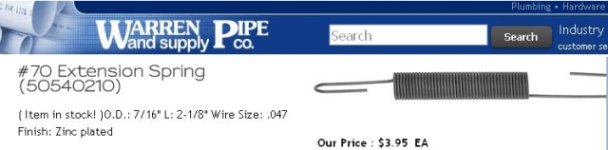
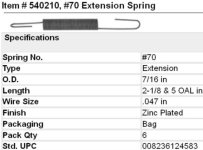
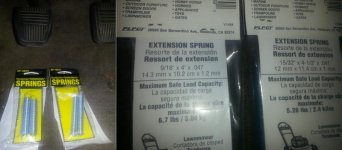
Today I'll see if I can get a spring at the hardware store. I think a "#70 extension spring" (whatever that means) is what I get (I didn't know they even had numbers).

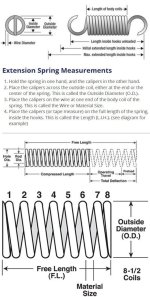
Googling for what a "#70 extension spring" even means, I found this
spring-measurement-guide.

It seems if I'm gonna buy the temporary spring at a hardware store until I can find the right nylon bushings, I should probably know the relaxed length and diameter, or, if the hardware stores sells them by #70, that will work also.

Once I get it, I'll try to measure the spring properly, so that others have a better handle on how to modify alternative choices.

The pressure plate by itself should be enough to return the clutch.
Thank you for answering that question as I wasn't sure if the hydraulics works backward as much as it works forward.

So if the clutch returns most of the way, I guess that's a diagnostic hint that the pressure plate springs are good?
 

Attachments

  • how_to_measure_extension_spring.jpg
    how_to_measure_extension_spring.jpg
    108 KB · Views: 1,970
  • toyota_clutch_pedal_return_spring_qpq_bushing.jpg
    toyota_clutch_pedal_return_spring_qpq_bushing.jpg
    83.1 KB · Views: 2,426
Last edited:
This is great info!! Great Job.

I very much appreciate that, especially coming from you, who was the first to suggest this problem, based on matching the symptoms with your experience.

I often take a lot of heat for being detailed (as I did with teaming up with mtbtim to solve the prothane sway bar bushings size problem once and for all).

Lots of people just replace the parts without thinking all that much about making it better, or, what they do is far worse, which is they blindly throw various parts at the problem until one or more of them fixes it, never even wondering if they could IMPROVE the diagnostics and repair procedures for everyone, just by spending a lot of time to make up a definitive thread that has all the options, all the sizes, all the suppliers, and all the procedures.

Just so you know, a quirk of mine, since I know nothing myself, is to combine ALL the known relevant knowledge into a one-stop-shopping thread, so that the person who comes AFTER me, has a very easy time of it. I can't possibly do that for an entire transmission repair, but, for this problem, it should be possible to create a one-stop-shopping thread - don't you think?

Everyone who comes after us will appreciate the effort we put into the project now.

In fact, after they read this thread, they should ask "what was the fuss all about?", but that's after they've together already properly sized the right-sized nylon replacement bushings and/or extension return spring that is, and after we together write up a step-by-step guide based on dozens of people's experiences.

:)

For me I removed the whole pedal assemble and replaced all the bushing and the pedal and the spring.

What's great to know is what each of us has done, and, when it comes time to remove stuff, I'm gonna look back at your thread to see what remove-and-replace procedures I can find.

I admit I do not fit well under that dashboard, so, the least time I can spend removing the wrong things in the wrong order, the better it will be for my back!

So I'll be looking critically for your step-by-step how to, when it's time to remove stuff! :)

While I think a redesign may be in order I chose to restore to factory new with factory parts.

So far I've seen various types of redesign attempts:
  1. At least one person just removed the torsion spring & Q-P-Q bushings!
  2. Most replaced the spring Q-P-Q bushings with a "brake-spring" sized extension spring
  3. Some tried brass fittings (but there are cases where the brass broke)
  4. One tried nylon fittings (he seemed to have the most experience)

Fewer attempted to modify the clutch pedal itself:
  • Most bought a new or used clutch pedal (about $100 new)
  • Can we safely assume some just re-used the old worn pedal?
  • One welded a new P-anchor plate onto the original clutch pedal
  • The most experienced guy epoxied cover plates around the enlarged gouge

Did any of you guys re-use the old clutch pedal?
Did you have problems fitting the new P bushing into the enlarged gouge?

My set up lasted 200K+ before I had to do anything and I figured that it should last well. 2 years later I am still going strong and no squeaks yet.

I was going to say this owner's setup lasted for $150K miles, but in reality, the clutch pedal squeaked early on and, in reality, who knows when the P bushing was destroyed? It could have been 50K miles ago for all I know.

I know of one guy I saw while looking this up who said he has to replace his P bushing yearly, so, I think people may be thinking these things last longer than they really do, simply because you have to know exactly where to look, and you have to look, to know for sure.

I invested under a $100 to rebuild the whole thing.

In a previous post I listed my current dealer prices, which come to about 50% higher than you paid, with the clutch pedal alone being the total price that you paid for the entire repair.

So you got a good deal.
If I go to the local stealer, I don't see how this can cost less than $150 to bring it back to OEM.

But I'm leaning toward a different tack at the moment, which is:
A. Pacify the owner (a relative of mine) by installing a temp linear spring
B. Figure out a suitable nylon replacement for the Q-P-Q bushings
C. Write up DETAILS so that the next person doesn't have all the size information that I don't yet have on the bushings themselves

To that end, does anyone out there have any measurement for the size of the OEM Q-P-Q torsion-spring bushings that we need to find nylon replacements for?

(The #70 extension spring is apparently 7/16" outside diameter, 2-1/8" long or 5" long, 0.047 inch wire size; but I don't know the size of the OEM Q-P-Q bushings yet.)

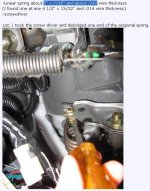
EDIT: This thread on a Tacoma forum suggests looking for a linear spring of 5" x 7/16" and about .047 wire thickness but the closest he found was at Ace at 4-1/2" x 15/32" and .014 wire thickness.

 

Attachments

  • warren.jpg
    warren.jpg
    59.3 KB · Views: 1,810
  • ace_spring.jpg
    ace_spring.jpg
    71.6 KB · Views: 2,031
  • 70.jpg
    70.jpg
    97.2 KB · Views: 1,939
Last edited:
I'm always of the opinion that all the answers are there, they are just scattered all over the Internet, so, to that end, I think we have some tentative answers to the many questions left unanswered in this thread.

NOTE: The answers below may very well be WRONG. Please supply information so that we can IMPROVE the answers!

Q: What causes the squeaks?
A1: Some say it's the normal metal-to-metal contact of the torsion-spring coils.
A2: Others say it's the abnormal metal-to-metal contact of the torsion-spring to P-holding plate after the plastic P bushing has been destroyed.
There is a horseshoe shaped plastic insert that goes between the heavy clutch return spring and the pedal. The plastic eventually breaks and then you have metal-metal contact between the spring and the pedal. The spring is harder than the pedal so it begins to remove material from the pedal and squeak in the process.

Q: Can you fix the squeak without replacing anything?
A: Some say you can, but that would only work if the squeak is due to the torsion spring coils rubbing.

Mine will squeak every once in a while. I just shoot everything under the dash (on the clutch pedal linkage) with some spray lithium grease.

Q: How long do OEM P & Q bushings last?
A: Nobody seems to know; most say they last for 100K to 200K miles; but others intimate they break early and nobody looks to check until the resulting metal-on-metal wear causes a problems.


Q: Can you just replace the missing P bushing (and not the clutch pedal)?
A: Dunno, but perhaps not, since the uneven gouge may quickly destroy the new P bushing???
Anyone considering replacing the $3 plastic horseshoe is wasting their time IMO. Once the original is gone and the spring starts to eat into the pedal (causing the squeak), the plastic horseshoe insulator no longer fits in the pedal groove as intended. It's made of hard plastic and will break and fall out again before it distorts to fit (like my custom nylon special does).

After taking mine apart for the squeak, replacing all plastic bushings & the horseshoe unit, welding up the pedal where the spring ate it, the new plastic horseshoe lasted only a couple days. I ended up taking it all back apart and making a horseshoe replacement on the lathe out of some nylon stock I had. This fix has lasted about 8 months now.

Q: How well do brass replacement fittings work?
A: Some say well, others say they broke in days.

Q: How well do nylon replacement fittings work?
A: One seemingly reliable experienced person said nylon works best (especially if you opt to not replace the worn clutch pedal).

Q: How well does the extension spring mod work?
A: Most say the torsion-to-tension brake-pedal return spring mod works well; but it changes the feel from non-linear to increasing linear.

Q: What size replacement nylon QPQ bushings should we buy?
A: Nobody has given a reliable size yet - so we're all guessing.
(It would be great if someone can measure an OEM Q & P bushing!)

if you can get tubular (cored) nylon, it should be sized so the ID fits around the spring and the OD drops into the pedal groove - roughly 1/8" wall or less going by memory, except I made mine from larger stock on the lathe spur-o-the-moment-style. With a razor blade or sharp knife, cut it lengthwise so you can fit it over the spring. I also greased the spring/nylon so the spring slides inside the nylon and the OD of the nylon just crushes into the pedal slot. Be sure to thoroughly debur the spring or it will eat up the new part.

Q: What size mod torsion-to-tension spring should we buy?
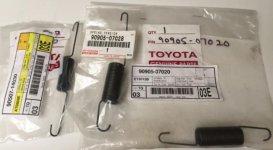
A: Some say a #70 hardware-store tension spring (2-1/8" by 7/16" by .047 thick) will work, while others use a Toyota brake-lever return spring (PN 90905-07028? 90905-07020?, 90507-14030?), both of which work without further modification since the mounting points already exist.

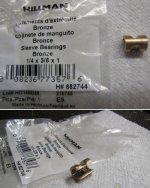
Q: What size bronze sleeve bearings should we buy to replace the u-shaped P bushing?
A: Some say a Bronze Sleeve Bearing of 1/4" x 3/8" x 1" will work.
 

Attachments

  • brass_bushing_replacement.jpg
    brass_bushing_replacement.jpg
    91.4 KB · Views: 1,951
Last edited:
Q: What size mod torsion-to-tension spring should we buy?
A: Some say a #70 hardware-store tension spring (2-1/8" by 7/16" by .047 thick) will work, while others use a Toyota brake-lever return spring (PN 90905-07028? 90905-07020?, 90507-14030?), both of which work without further modification since the mounting points already exist.

Based on the wide array of tension springs people seem to be using, I'm gonna guess that the torsion-to-tension spring mod probably works no matter what spring you put in place.

Still, it would be nice to narrow down the choices so that we have a definitive answer as to what spring closest matches the desired pedal feel.

For those who have done the torsion-to-tension clutch pedal-return spring mod, can you suggest which spring worked best for you?

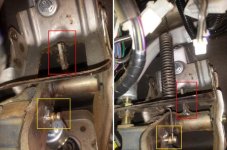
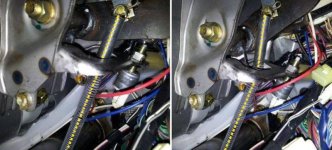
Caption: The first photo below is a shot of the hard-to-get rear view of the tension-to-torsion spring mod in a Tacoma; the rest are Toyota brake-pedal return springs other people used.
 

Attachments

  • rear_view_torsion-to-tension_spring_mod.jpg
    rear_view_torsion-to-tension_spring_mod.jpg
    62.8 KB · Views: 7,859
  • 909_springs.jpg
    909_springs.jpg
    37.6 KB · Views: 4,672
I used a Toyota brake pedal spring. i had an extra one when I did my transmission swap and it is working fine after a couple years.
 
A clutch spring from an 80s 2wd toyota pickup. Pretty much the same set up. Have had it in place for about 3 years. I found it in a junk yard.
 
I removed the torsion spring & bushings and was going to replace with a #70 extension spring but did find one and left it without the spring. It's been running ok without the spring for over a year.

Only issue is last winter it got to around 40 degrees a couple of nights and the pedal would return all the way up in morning. pulled it up with my foot and after a couple of pumps it was ok
 
The owner won't even drive the 4Runner, thinking it's not safe, so, I think I have to go OEM or retrofit with nylon bushings.

We have traded vehicles until I fix this, which is no big deal since I see no problem with driving it, while she's absolutely paranoid about the pedal not coming all the way up (and once in a while, sticking in the down position).

It did that on me just now as I drove to the hardware store to get the linear springs, so, sometimes the geometry of the torsion spring minus the three PQP bushings does cause enough friction for the pedal to remain down, about two inches off the floor, in the clutch-engaged position (it seems).

Anyway, a quick flip with my toe solved that, so it's not a worry for me, but it is for her, so, my plan is simple.
1. Remove the clutch pedal assembly (gotta look at the DIYs)
2. Put a linear spring (any linear) spring in place for now
3. If she can live with the "feel" of the linear spring, I'm done.

If not ...
4. Redesign the torsion spring setup
a. Bring the clutch assembly to the box stores
b. Find a suitable nylon set of bushings & machine them to size
c. Repair (somehow) the worn pedal P-bushing plate

Or ...
5. Buy a new $150 OEM pedal assembly + torsion spring + PQP bushings
 

Attachments

  • linear_spring.jpg
    linear_spring.jpg
    39.4 KB · Views: 4,202
1. Remove the clutch pedal assembly (gotta look at the DIYs)

I can easily see the bottom catch for the spring, but I can't find (yet) by eyeballing it, the top catch, so, I'm gonna go through the DIYs to list the best one(s) for this repair, so that the next person following me can just go right to the best one for the 4Runner.

Despite what some threads said, the 4-cylinder seems to be the same clutch assembly as the 6-cylinder, and the same as what I've seen on the Tacomas, so, I think almost any DIY that is sufficiently detailed should do.

As I read the first mentioned DIY, I find instantly a problem to resolve:
Clutch squeak Linear Spring swap (TW how to)

While this guy just pried the torsion spring out with a screwdriver, he says the top of the linear spring attaches to a 'welded tab' (somewhere).

But he heard a click each time, which he presumed to be due to the width of the spring hitting something during travel.
I began to hear a very faint "tick" every time I engaged and released the pedal. Of course only I am the one who can hear it but it's still pissing me off beyond belief.

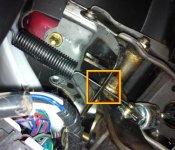
Turns out that notch, in which the middle part of the torsion spring nestled into (just northeast of the spring in the pic above), rotates down when the pedal is pressed and back up again (on that axle with orange goop on it) when the pedal is released. When it does that, it ends up hitting the spring and making that ticking noise.

More concerning is when I was manually pushing and releasing the pedal with my hand, watching this crapfest unfold before my eyes, I can see the spring ever so slightly get hung up on that notch. My fear is that it gets fully hung up on it while driving.

Someone else felt the same notching:
well I just went out to check mine. (first time in probably a year) and noticed that mine hits it too. and also something strange. the spring looks stretched up until that point where it looks like it hasn't been used even when the spring is depressed. (like there is a small gap between the coils of the spring but when it gets to that part the coils are all touching. [this is when the clutch is depressed and released as well])

I just wrapped it in gaffer's tape.

Still making a little "click/tick" noise. I don't think that hitting the spring was it. It's something in the mechanism that goes through the firewall.

Apparently the OP switched out the spring to the Toyota brake return spring, which is of a different geometry.
 

Attachments

  • hardware_store_spring.jpg
    hardware_store_spring.jpg
    59.1 KB · Views: 15,843
Last edited:
Apparently the OP switched out the spring to the Toyota brake return spring, which is of a different geometry.

After reading that entire thread for the first time, I found out that the springs I bought will have the "clicking and bending" problem on the Tacoma, which, if it happens on the 4Runner, the driver is certainly going to notice.

I wish I had known this before I went and bought the wrong springs.

In the thread listed above, the guy finally removed the linear spring that was clicking and replaced it with the Toyota brake-pedal return spring.

The part number that Tacoma guy ended up using was Toyota 90905-07020
 

Attachments

  • toyota_brake_pedal_return_spring_fix.jpg
    toyota_brake_pedal_return_spring_fix.jpg
    53.8 KB · Views: 16,501
Now that I re-read all the threads, for detail, I see things that nobody mentioned here yet, which is that whatever spring is used, absolutely MUST clear that opening up high, near the upper connection tab!

For example, this picture, again on a Tacoma, shows the problem area well:
* Tacoma clutch pedal retrofit

Notice also that this picture is the best yet, for showing the upper mounting tab.
 

Attachments

  • tacoma_pedal_spring.jpg
    tacoma_pedal_spring.jpg
    46.7 KB · Views: 7,060
Now that I know it matters that you get a bona-fide "pedal" spring, I notice details I hadn't noticed before in the other threads.

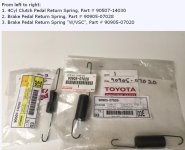
For example, notice that the Toyota "clutch" pedal return spring seems to be of a thinner outside diameter than the two Toyota "brake" pedal return springs in this thread.

From left to right:
1. 4Cyl Clutch Pedal Return Spring, Part # 90507-14030
2. Brake Pedal Return Spring, Part # 90905-07028
3. Brake Pedal Return Spring "W/VSC", Part # 90905-07020
 

Attachments

  • three_sperings.jpg
    three_sperings.jpg
    52.7 KB · Views: 4,398
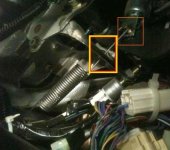
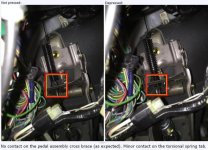
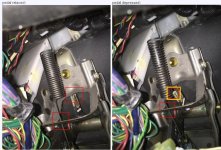
Looking more closely at the contact points, there seem to be two problem areas that the spring dimensions need to avoid:
1. Contact at the clutch pedal assembly cross brace
2. Contact at the clutch pedal torsion spring P-bushing tab

In the photo below, from the thread mentioned above, one of the two contact points was alleviated by the geometry of the large brake-pedal return spring; so I will try to get the smaller clutch-pedal return spring instead at the Toyota dealership.
 

Attachments

  • best_to_get_clutch_pedal_return_spring.jpg
    best_to_get_clutch_pedal_return_spring.jpg
    66.9 KB · Views: 16,559
Unfortunately, it turns out, at least on the Tacoma, that even the long-hook brake-pedal return spring 90905-07028 makes contact with the clutch pedal P bushing tab when the clutch pedal is pressed.
 

Attachments

  • smaller_brake_spring.jpg
    smaller_brake_spring.jpg
    70.7 KB · Views: 10,279
Based on these experiments on the Tacoma, if the 4Runner uses the same setup, and given that all three brake and clutch pedal return springs seem to make contact at either both places, or just at the P-tab, the best recommendation seems to be to go with the smaller clutch return spring, Toyota P/N 90507-14030

Out of the three, I recommend the 4Cyl Clutch Pedal Return Spring, Part # 90507-14030

The others have more spring contact and get a bit noisy.

Interestingly, the guy who ran those experiments said he felt no difference in pedal feel between the two different-sized springs:
1. Smaller 4-cylinder Tacoma clutch pedal return spring 90507-14030
2. Larger 6-cylinder Tacoma long-arm brake pedal return spring 90905-07028

As far as the difference between the 4cyl spring and the brake return spring, no real difference that I could tell with the little bit of test driving I did. The deciding factor was the amount of spring contact which can totally be solved by grinding down the torsional spring perch

Now that I have the two springs in stock, I'll run some measurements before hooking up the smaller clutch pedal return spring & checking for the two contact points in the Toyota 4Runner:
a. Toyota Tacoma 4-cylinder clutch-pedal return spring 90507-14030
b. Toyota Tacoma brake-pedal return spring 90505-07020
 

Attachments

  • toyota_spring_measurement.jpg
    toyota_spring_measurement.jpg
    61.4 KB · Views: 4,297
I don't remember anyone mentioning that the two Toyota springs come with less-than-full-size rubber inserts, so, I'll mention that now.

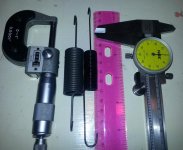
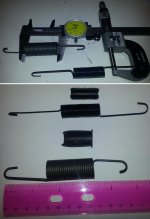
So that nobody else has to go to this trouble to help out, after pulling out the rubber inserts from each spring, I measure the following with the micrometer and caliper:

Brake Pedal Return Spring Toyota PN 90905-07020:
  • Length inside hooks unloaded = 4.585"
  • Length of body coils = 1.780"
  • Coil inside diameter = 0.610"
  • Coil outside diameter = 0.748"
  • Wire diameter = 0.0735"
  • Distance from the last coil to the inside curve of the hook (long end) = 1.540"
  • Distance from the last coil to the inside curve of the hook (short end) = 1.212"

Clutch Pedal Return Spring Toyota PN 90507-14030:
  • Length inside hooks unloaded = 5.610"
  • Length of body coils = 1.545"
  • Coil inside diameter = 0.413"
  • Coil outside diameter = 0.637
  • Wire diameter = 0.0555
  • Distance from the last coil to the inside curve of the hook (long end) = 2.075"
  • Distance from the last coil to the inside curve of the hook (short end) = 1.960"

Since both springs have a long end and a short end, I'm not yet sure which way goes up, so, if you already know, please let me know ASAP.
(The less-than-coil-length rubber inserts seemed to me, as I recall, to have been in the short end.)
  • Difference between long and short end on the brake-pedal-return spring = 1.540" - 1.212" = 0.328"
  • Difference between long and short end on the clutch-pedal-return spring = 2.075" - 1.960" = 0.115"

If it matters, if I close my eyes and hook my finger in each end of both springs, and pull, they seem "about the same" in feel initially, but after trying it a few times, there seems to be a slight more "bounciness" and "stretchiness" in the brake-pedal return spring than in the clutch-pedal return spring.
 

Attachments

  • measure_each_spring.jpg
    measure_each_spring.jpg
    75.9 KB · Views: 9,049
Last edited:
The deed is done, but what happened was entirely unexpected.

First off, getting the old clutch pedal return torsion spring off took only a couple of minutes, whereas I had expected that task to be somewhat difficult.

I removed absolutely nothing prior. All I did was lower the seat back on the front drivers seat and slide it back as far as it would go, and I raised the steering wheel and I put a shop light and a few pliers and screwdrivers on the carpet. That was it for prep.

The reason it took two minutes was that I was prying with only one large screwdriver for the first minute. When I added the second pry bar to the mix, pop, off came the torsion spring, which stayed in place and didn't bounce around.

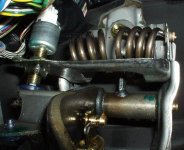
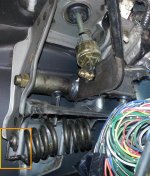
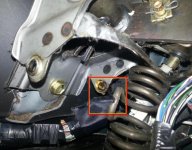
Of the three plastic Q-P-Q bushings, only one Q bushing was still in place and the torsion spring had about 1/3rd of its diameter eaten away (so this problem was a long way in the making!).

Predictably, the P tab welded onto the clutch pedal was also well eaten away.

But, super surprisingly (to me, anyway), the clutch pedal feel when I tested it without any spring, was actually pretty good! Also, the cruise control switch seemed to be depressed (although I didn't test it on the road), even without any spring.

So, for sure, 95% or more of the clutch pedal return is simply due to the back hydraulic pressure from the pressure plate back onto the slave and master cylinders.

I then hooked the short end of the clutch pedal return spring to a tab with a hole in it up above, and then pulled with a pair of needlenose pliers, and in just a couple of tries, the linear spring was attached.

It was super easy! Five minutes, maybe ten, but no more than 10 minutes from start to finish! Wow. I had expected far worse from what some people had written (although others did mention the job was super simple).

The next surprise was when I tested the clutch pedal feel, in the garage (not yet on the road), where I couldn't tell the difference between the pedal feel with the spring and the pedal feel without any springs!

The only difference I could see is that the cruise control switch was definitely depressed fully with the linear spring in place. That was about it for what seemed different with and without the linear spring.

Up until now I thought people were crazy who said they removed the torsion spring and operated the clutch without any spring whatsoever, but now, I think that almost 98% or 99% of the pedal return is due to the back pressure from the pressure plate.

Very little pedal-return force seems to be due to the spring, which is surprising, considering how thick the torsion spring was.
 

Attachments

  • clutch_pedal_torsion-to-tension_spring001.jpg
    clutch_pedal_torsion-to-tension_spring001.jpg
    133.4 KB · Views: 16,286
I removed the torsion spring & bushings and was going to replace with a #70 extension spring but did find one and left it without the spring. It's been running ok without the spring for over a year.

At first, I thought that was crazy to operate without a spring, given how thick the torsion spring is; but now I have to agree with you.

The pedal feel without any spring is almost the same, if not the same, as the pedal feel with the linear spring in place.

The only difference I felt was maybe slightly less slop in the last quarter inch.

Here, by the way, is a picture of how badly the spring was eaten into.

I'd say it's about 1/3 the way through, so, this problem happened long ago.

So I'd say the P bushing goes first, then both the spring metal and P-tab go simultaneously (presumably causing the squeak), and finally the Q bushings fail when the spring geometry changes over time (where below there is only one Q bushing left).
 

Attachments

  • clutch_pedal_torsion-to-tension_spring002.jpg
    clutch_pedal_torsion-to-tension_spring002.jpg
    81.6 KB · Views: 4,937
Last edited:
Status
Not open for further replies.

Members online

Forum statistics

Threads
278,315
Messages
3,554,130
Members
248,016
Latest member
Advally Service

Trending content

Back
Top