Is a Hi Lift Jack Absolutely Needed?

The rear factory hitch receiver is widely considered the safest, strongest, and best place to attach for recoveries.

It is more than strong enough to lift a vehicle.

Feel free to keep spreading your mis-information. :pound:
 
No lifting with trailer hitch

The rear factory hitch receiver is widely considered the safest, strongest, and best place to attach for recoveries.

It is more than strong enough to lift a vehicle.

Feel free to keep spreading your mis-information. :pound:

So far you're the only person saying this. Several people here have disagreed with you and given simple explanations.

I hope no one else is convinced that you're right and try using the trailer hitch as a lifting point.

Suite yourself though. You're free to do anything you like to your truck.
:ballchain:
 
The rear factory hitch receiver is widely considered the safest, strongest, and best place to attach for recoveries.

It is more than strong enough to lift a vehicle.

Feel free to keep spreading your mis-information. :pound:
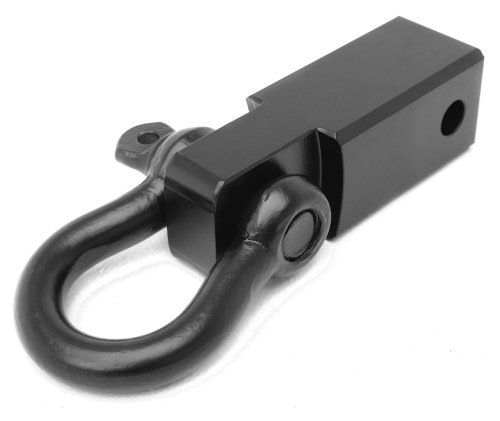
it would certainly be my GO TO extraction point. especially using one of these.


4105SPxSOQL.jpg


you could lock the hi-lift right into that shackle, it would lift it just fine.

I have used mine a lot over the years on various occasions. from winching, to spreading, and lifting a truck to repair a tire.

the real advantage the hi-lift gives, is in its name. it gives you a lot of lifting height, to compensate for lifted vehicles, or uneven, or soft ground.
 
tongue weight

There should be no trouble at all lifting from the hitch. It's actually a very good spot due to the nature of the shape that captures the jack's lift hook. 500lbs of dynamic tongue weight is much more force than lifting would apply. And the design is basically identical in strength down or up. There's nothing like cable stays or other unique specialty directional design that would make it stronger in either direction. It's just a piece of steel tube that's bent and welded to the frame. Anyone who's towed much with a 4runner has almost certainly lifted the rear from the hitch at least once in a while when decoupling the trailer.

The 4Runner weighs 4700 pounds empty. 40% of that is on the back axle. Lifting by the trailer hitch applies almost 0.40x4700= 1880 #. That's 3.75 times the 500 pound tongue weight limit.

If there's cargo it just adds to the weight on the hitch at nearly 100%.

Not sure I get your last point. You can't lift 500# with your back, when removing a trailer from the hitch. And if it weighs nearly that much at the tongue you should have it on a wheeled hitch stand. On a cranking lift you only lift the trailer tongue until it's loose, then pull the truck away.

I'd much rather use the tire lift method shown above or a sturdy rock slider and the right hook accessory before lifting by the trailer hitch.
 
So far you're the only person saying this.

That's because lots of us are ignoring your blather, but if you're going to appeal to ignorance, I'll be your huckleberry.

You can safely lift the rear of a truck using a factory 2" receiver if you properly chock the front wheels. It is done literally all the time. The hitch and frame rails are quite strong enough to support the weight of the rear of the truck. In fact, I've never even heard of a structural failure in the frame rails or the hitch itself due to being lifted by the receiver. I have heard of hitches being bent or torn when used in seriously heavy recovery pulls, but never failing when used as a lift point. Feel free to find us some examples.
 
No offense intended here, I just don't want you to damage your vehicle. Don't use the receiver hitch for a lifting point and it's not the best point to use for a recovery point. The best recovery points are attached to the frame directly, or in line with the frame such as the loops or shackles on a steel bumper.

As others have said above, You can't lift 5000 pounds with the 2" trailer receiver. As someone said above, the tongue weight limit is 500 pounds.

The 5000# trailer rating applies to trailered loads on their own axles with their own brakes. It does not mean you can apply 5000# in any direction on the receiver hitch. It will not stop a 5000# trailer at a reliable, safe speed. For that you need trailer brakes. I would not expect it to be the strongest recovery point to pull on. For that I would use a hook or loop tied directly to the frame.

I've seen the receiver hitch recovery shackles listed on line but I wouldn't use one. I'd rather have a couple of recover shackles through plates welded onto both sides of the frame

Just look at the receiver hitch tube itself. It's connected on the sides laterally to the frame. That's a weak means of support. The forward-direction, 2" square strut is interrupted by the spare tire. Any pull or lift on the receiver tube will apply a much larger force to the lateral supports, due mainly to the sideways direction of the supports.

As an example, consider the sag force on a line. On a clothes line type of support, for every pound of force in the vertical direction you must have many times more capacity in the direction of the line. That's why pulling a vehicle out of the mud by running a cable from a fixed point to one side, through the recovery hook and out sideways to the recovering vehicle, with both ends at steep angles, applies much more force to the stuck vehicle at a shorter pull distance. There's some difference between a line with pinned (free to rotate) ends and the fixed (welded) ends of a receiver mount, but the comparison should make it easy to comprehend the forces at play.

^^This is nonsense ^^

I've seen one example ever of a vehicle hitch not being up to the task. It was a Ford f250 on 44" boggers being pulled out by a logging skidder. The hitch bolts failed and it came loose.

A 10 second stop from 60mph is roughly 1G of force on a hitch laterally. So stopping a 5k lb trailer in 10 seconds from 60mph would put 5k lbs of lateral force on the hitch. That's well within the strength of the hitch.

I don't know the wall thickness or specific material. But the beam deflection calculation should be pretty simple if anyone happens to know these things. I'm guessing it's in the ball park of .1 inches at 2500lbs and less than half of the ultimate strength of the hitch's cross tube.
 
The 4Runner weighs 4700 pounds empty. 40% of that is on the back axle. Lifting by the trailer hitch applies almost 0.40x4700= 1880 #. That's 3.75 times the 500 pound tongue weight limit.

I'm not sure you understand the whole "tongue weight" rating. You want 10% of the trailer weight on the tongue for towing. That's what the guidelines are for towing stability. You don't want too much weight on the rear, which causes the front to feel "light", affecting vehicle handling.

It is in no way a reference to the strength of the hitch.

The hitch can handle pulling, stopping, and other various road forces of a 5,000 lb trailer attached to it.
 
I believe the tongue weight for towing is based on towing. It is calculated to be safe to tow. Using it as a recovery point is different.
 
I'm not sure you understand the whole "tongue weight" rating. You want 10% of the trailer weight on the tongue for towing. That's what the guidelines are for towing stability. You don't want too much weight on the rear, which causes the front to feel "light", affecting vehicle handling.

It is in no way a reference to the strength of the hitch.

The hitch can handle pulling, stopping, and other various road forces of a 5,000 lb trailer attached to it.
^^^ This. The hitch and connections can handle well in excess of 2,000-lb vertical.

Think about it this way... the recommended vertical load is 500-lb for driving stability. But what happens if you are emergency braking and your 3,000-lb load (on a 2,000-lb trailer) breaks a strap and slides toward the hitch? Now your tongue load has jumped from 499-lb to a dynamic 2,500-lb. Certainly not stable for driving around curves, but the Toyota engineers definitely designed enough strength so the receiver wouldn't break off.

I wouldn't lift from a Class I receiver.
A 1.25" Class II is maybe questionable, depending on the weight of the vehicle, especially if it's aftermarket.
But you should be good to go with a 2" OEM Class III hitch or higher.
 
Last edited:
Okay, fine...you can use the trailer hitch as hi-lift jack point, but you definitely can't use it to store hot pockets. I mean, I've read the owner's manual and even read some owners' reviews, and nowhere have I read that it is okay to use the tow hitch as a hot pocket storage area.

And if KidVermicious wants to challenge me on that and start throwing Tombstone quotes my way, I'm totally going rogue and hijacking this thread....
 
Everyone quoting the 4Runner weight of 5,000 lbs or whatever figure was being thrown around is forgetting you're not suspending the entire weight of the vehicle from the hitch. You're lifting the back (light) end a foot or so off the ground. Probably not even half of the weight of the vehicle and should be no problem...Unless you're one of those guys with 900 lbs of shit in the cargo area when you go wheeling. :hiding:
 
[MENTION=112177]4RnR Grl[/MENTION] I believe your truck got lifted by a high lift jack on the receiver hitch when you got high centered at the cove, I have the pic to prove it! As pointed out it was only the rear weight, not the whole truck. Ideal? Maybe not, but it was effective and no puppies were harmed in the recovery operation.

To the OP's question, I have one, I have yet to need to use it but for the low cost it's nice to have it on the roof just in case... I generally don't leave it up there unless heading off-road.
 
Last edited:
The rear hitch is bolted directly to the rear cross member... Of course you can lift the truck from there. Been doing it in my land cruiser for years and wouldn't hesitate to lift my 4runnee there. Obviously everyone has their own opinions but I would feel safe hanging the truck from the rear hitch
 
500lb tongue weight is only in place due to limitations of the springs and maintaining safe handling dynamics. The hitch is perfectly fine to use as a lifting/recovery point.
 
The 4Runner weighs 4700 pounds empty. 40% of that is on the back axle. Lifting by the trailer hitch applies almost 0.40x4700= 1880 #. That's 3.75 times the 500 pound tongue weight limit.

If there's cargo it just adds to the weight on the hitch at nearly 100%.

Not sure I get your last point. You can't lift 500# with your back, when removing a trailer from the hitch. And if it weighs nearly that much at the tongue you should have it on a wheeled hitch stand. On a cranking lift you only lift the trailer tongue until it's loose, then pull the truck away.

I'd much rather use the tire lift method shown above or a sturdy rock slider and the right hook accessory before lifting by the trailer hitch.

Common sense tells me it is more than adequate to lift from and I have done it a few times.
 
I buried a 2WD Chevy S-10 pre runner in Vegas about 15 years ago. We used one to get it unstuck. I've carried a Hi-lift ever since. However, the only time I've used it since the previously mentioned was for training and pulling cement sauna tubes out of the ground.

Bottom line. I'd rather have it and not need it than to need it and not have it.
 
X-Jack, Maxtrax, shovel, axe, 6,000 lb come a long, bubba rope and a few chains and nylon slings. I used to have a High Lift in the 80's as a kid but there is way better technology out there for the same price. I'm finally going to spoil myself with a nice 10k Warn winch soon but I have drug out 2 Suburbans, 1 1st gen 4Runner, 1 K-5 Blazer and a Chevy Luv out of a ton of snow sand and mud and never had a High Lift. Come to think of it it was only when I had my Jeep as a kid I needed one.......hmmmmm.
 

Members online

No members online now.

Forum statistics

Threads
278,316
Messages
3,554,111
Members
248,016
Latest member
Advally Service

Trending content

Back
Top