The 3.4L TRD Supercharger Thread

I am WAY late to this party. I installed my 1st gen supercharger, URD six 305cc and PCU injector setup 13 years ago. Apparently my truck is a 49 state without EGR. The URD current website say's they recommend the 7th injector for non-EGR. Don't have any software or A/F sensing equipment.

Just found a plastic tube coming from the PCU. I assume that needs to be put in the pressurized side which hasn't been connected for years (if ever). Used this wiring diagram https://www.yotatech.com/forums/f2/...cc-hose-routing-question-271783/#&gid=1&pid=3.

Why am I just paying attention now? I tore the motor apart and found four or five pistons with pinched top rings. Petrified of detonation, I installed 9.0:1 CP pistons from LC Engineering. Truck has a 2.2" pulley.

Can I just T off from the pressurized nipple that connects to the FPR and call it good? I don't know crap about the tuning software, open loop or closed loop with this PCU. This truck did not have the expensive A/F sensor before the cat and I just replaced it with another O2 sensor.
 
Yeah dude so there is tons of confusion on this system. I'll try and explain how I understand it. First of all, there are a few different variations of the 7th injector kit. If your vehicle has basic 02 sensors, then there is a URD kit that taps into cam and crank sensor signals (which allow to adjust timing) and the front 02 sensor signal (which lies to the main ECU to allow for fuel enrichment). If your vehicle has Air Fuel Ratio sensors which is like 99 or 2000 and above then the URD Kit alone will not adjust fuel appropriately. You need a different kit since AFR sensors work on principles of amperage not voltage.

I was told personally by gadget via email that my system (which is the 02 version) CAN and DOES change closed loop enrichment. In the same email he went on to say the "overpressure" setting is to tell the URD Kit when to start tricking the ECU to allow for that.

Here's a hypothetical scenario of my system's operation: it's at 2500 RPMs and I start to punch it so my boost pressure is at 2 psi. My URD Kit is set to 1 psi, so it activates and begins turning on the 7th injector. It simultaneously takes the now overly rich 02 signal voltage and skews it to a more acceptable voltage and sends that acceptable voltage to the main ECU. Meanwhile, it also takes the Cam and Crank sensor signals and delays/modifies accordingly to slow timing down, yet again relays an acceptable value to the main ECU. Result: the main ECU thinks the 02 is running fine, see a perfect Cam/Crank correlation, and doesn't know we just added a massive amount of extra fuel via the 7th, and also tricked the main ECU into sending its spark later (retarded timing) by delaying the cam signal.

That's my understanding. I could be wrong but from a software, mechanical, and electronic stand point that makes the most sense to me and that's how I would build this system.

Again, if you look under your hood at the emissions label it will show you what your vehicle has. It will have a list that says "SFI, EVAP" etc and it will then either have "HO2S (2)" (standard oxygen sensor, and closed loop tuneable) or it will say "AFR" for Air Fuel Ratio sensor which is tuneable with a seperate URD controller.

Hope that helps.

I’m aware how the timing works it really isn’t the issu. Furthermore from what Gadget and SS says spark knock is due to timing. Making it richer won’t retard timing like higher octane or manually retarding the spark will do. Higher octane is needed to retard timing via fuel delivery. This is obviously why Meth does a good job but can also supposedly cause issues with overadvanced timing in vacuum. I’d also like to add that the issue is spark knock not detonation. It isn’t a heat issue. It’s all in the timing so extra fuel to cool things off supposedly won’t help with that.

As far as I’m aware there are two systems. One with “fixed” closed loop enrichment and one without. This is according to Speedy on his website. He said he got this information directly from Gadget. Either way you can add one of two CLOSED LOOP modules. But it depends on the o2/AFR sensor. For me and anyone who has the AFR sensor you can only skew the signal so far in closed loop until it causes issues. According to the URD AFR description it seems to imply 12.9:1 is the lowest you can go in closed loop.. I also email Gadget about this. He said 13.5 AFT is pretty close to as rich you can run in closed loop until it causes issues. I still might get it and try to get it at least to 13AFR. Better than 13.5.

Speedy mentions this on his website. The dude has been boosting closed loop with 2.2 and 2.1 pulleys with 13.5AFR for years without issue. He also has not don’t any valve body mods and so far no problems running it pretty hard. I don’t know how many people don’t run a valve body mod like that and are just fine. I’d like to know as the ITP mod seems like overpriced fear mongering. The Transgo should be the exact same thing. These aren’t motors with very high HP and Torque. And they’re the same transmissions in the Supra with much higher numbers from the factory. A $800 and week long wait seems overly excessive.

As for the o2 sensor style I guess it’s easier to manipulate. Maybe the ECU isn’t as picky since it’s not as accurate. IDK.
 
Last edited:
And this is why I did not install the URD system, lol.

I’m not trying to argue your point. But as far as the two system go they’re pretty similar. Do you have a o2 or AFR sensor?

I’ve often thought about goin to the AEM but it could could be a bunch of work for nothing. If the AEM can’t skew AFR signals lower than the URD/SS systems then I’d be in the same boat. Split Seconds AFR box can only skew a AFR sensor by so much. I’m not so sure AEMs technology, ability to skew AFRs, is much different. It may be that the AFR style ECUs won’t let anything skew below 13.0:1 AFR.
 
I am WAY late to this party. I installed my 1st gen supercharger, URD six 305cc and PCU injector setup 13 years ago. Apparently my truck is a 49 state without EGR. The URD current website say's they recommend the 7th injector for non-EGR. Don't have any software or A/F sensing equipment.

Just found a plastic tube coming from the PCU. I assume that needs to be put in the pressurized side which hasn't been connected for years (if ever). Used this wiring diagram https://www.yotatech.com/forums/f2/...cc-hose-routing-question-271783/#&gid=1&pid=3.

Why am I just paying attention now? I tore the motor apart and found four or five pistons with pinched top rings. Petrified of detonation, I installed 9.0:1 CP pistons from LC Engineering. Truck has a 2.2" pulley.

Can I just T off from the pressurized nipple that connects to the FPR and call it good? I don't know crap about the tuning software, open loop or closed loop with this PCU. This truck did not have the expensive A/F sensor before the cat and I just replaced it with another O2 sensor.

If it was detonation you would have heard it. And these truck don’t really suffer from detonation. It’s spark knock from timing. Basically the spark is going off before the piston reaches TDC. And if it was detonation you would probably have melted Pistons as well. Sounds like you were washing the rings out. I’m assuming the oversized injectors were way too rich without the help of the PCU to regulate how much fuel and a AFR sensor to check AFR.

You need to T into the line going from the fuel pressure gauge to the back of the S/C and you need a special T to go to the PCU to eliminate extra noise and get a accurate reading. You can get them form URD. Then you need to download the R4 software from Splitsec.com and have a laptop to set it up. The 7TH injector tuning guide should help even though you have the larger injector version. URD U-Tune guild should have everything you need.
 
I’m not trying to argue your point. But as far as the two system go they’re pretty similar. Do you have a o2 or AFR sensor?

I’ve often thought about goin to the AEM but it could could be a bunch of work for nothing. If the AEM can’t skew AFR signals lower than the URD/SS systems then I’d be in the same boat. Split Seconds AFR box can only skew a AFR sensor by so much. I’m not so sure AEMs technology, ability to skew AFRs, is much different. It may be that the AFR style ECUs won’t let anything skew below 13.0:1 AFR.

Narrowband O2 sensor. I can skew it as much as I want, since it intercepts and either adds or removes voltage from the signal. I can skew it to lower than 10.0 AFR (gauge doesn't read lower than that) but only did that once when initially testing the system. Can also make it run lean if I want to... heard of some people increasing their AFR's on highway driving to save gas but kinda risky if you ask me. Plus wouldn't matter on this engine anyway since there's no gas to be saved!

If you have a 4Runner with the newer wideband AFR sensor, you can set the mapping to "AFR" mode, where you just do some simple testing to figure out what voltage gets what reading, then you literally just fill the cells with the desired AFR at what boost level. 11.8 at WOT, 14.7 at cruise and it automatically calculates the rest. Done.
 
Last edited:
Narrowband O2 sensor. I can skew it as much as I want, since it intercepts and either adds or removes voltage from the signal. I can skew it to lower than 10.0 AFR (gauge doesn't read lower than that) but only did that once when initially testing the system. Can also make it run lean if I want to... heard of some people increasing their AFR's on highway driving to save gas but kinda risky if you ask me. Plus wouldn't matter on this engine anyway since there's no gas to be saved!

If you have a 4Runner with the newer wideband AFR sensor, you can set the mapping to "AFR" mode, where you just do some simple testing to figure out what voltage gets what reading, then you literally just fill the cells with the desired AFR at what boost level. 11.8 at WOT, 14.7 at cruise and it automatically calculates the rest. Done.

I mean with the system I have now WOT isn’t a issue. I can add more fuel if desired. But what I want to know if if I can get 12.0 AFR in closed loop high boost with the AEM system. Then there’s the possibility of not being able to add enough fuel at high RPM at high boost with stock injectors. Then I’d have to install bigger injectors.

As I’ve said before from what I’ve been told with the stock AFR ECU supposedly only lets you get so rich by skewing closed loop with a piggyback. It looks like 12.9 is about as rich as it will get before you throw a light.

I want to know if anyone with the AEM and AFR system can get any richer than that. From what URD says the AFR calibrator only lets you get so rich in closed loop. I think 12.9 is about as good as it gets.
 
I mean with the system I have now WOT isn’t a issue. I can add more fuel if desired. But what I want to know if if I can get 12.0 AFR in closed loop high boost with the AEM system. Then there’s the possibility of not being able to add enough fuel at high RPM at high boost with stock injectors. Then I’d have to install bigger injectors.

As I’ve said before from what I’ve been told with the stock AFR ECU supposedly only lets you get so rich by skewing closed loop with a piggyback. It looks like 12.9 is about as rich as it will get before you throw a light.

I want to know if anyone with the AEM and AFR system can get any richer than that. From what URD says the AFR calibrator only lets you get so rich in closed loop. I think 12.9 is about as good as it gets.

The AEM FIC 6 can go as rich as you want without throwing a code in closed loop. I run in the mid 12's in closed loop. Only problem is the AEM unit cannot drive the 7th injector all that well by itself. It's much better with a 6 injector upgrade like what I have, I put in the injectors URD uses.
 
The AEM FIC 6 can go as rich as you want without throwing a code in closed loop. I run in the mid 12's in closed loop. Only problem is the AEM unit cannot drive the 7th injector all that well by itself. It's much better with a 6 injector upgrade like what I have, I put in the injectors URD uses.

Right. YOU can but you also have a o2. I have a AFR. There’s a difference....this is stated many times over and the AFR sensor is known to more difficult to tune in closed loop.

I’m trying to figure out what I’m going to do. Yank the 7th out and but a AEM at $400 and a new injectors at $300 and hope that I can skew close loop on a AFR sensor to 12.5 or buy the AFR calibrator and take it to 13.0 or MAYBE a little lower for $250.
 
Right. YOU can but you also have a o2. I have a AFR. There’s a difference....this is stated many times over and the AFR sensor is known to more difficult to tune in closed loop.

I’m trying to figure out what I’m going to do. Yank the 7th out and but a AEM at $400 and a new injectors at $300 and hope that I can skew close loop on a AFR sensor to 12.5 or buy the AFR calibrator and take it to 13.0 or MAYBE a little lower for $250.

13.0 AFR isn't terrible for closed loop though. Remember, this isn't a 500 RWHP monster than will blow a $20,000 engine if it goes a tad lean. It's a 20 year old 4Runner. It's rich enough to eliminate most detonation. Only the Split Second unit has issues with the AFR-type sensor that I know of. Most other piggybacks and standalones work better with an AFR sensor.
 
My supercharger doesn’t whine

I just bought a supercharged 1999 4runner with a first gen supercharger on it and the supercharger doesn’t whine when the engine is warm does anyone know why it would do this ?
 
I have a 2000 auto with a 2.1" pulley and larger injectors running the AEM F/IC-6. When I apply very slight throttle from a stop, the engine goes lean for a split second before catching itself and bringing the AFRs back down. Ex, I'll give slight throttle and see the AFR spike to ~18 for a split second then return to 14.7 or so under light acceleration.

I'm thinking it has plenty of fuel at low load/low RPM where I see this happen because it runs quite rich during an open loop cold start. I'm working on tuning the fuel map and have gotten it to an OK spot but am having trouble working out the final kinks. Any thoughts on what might be going on?

I also read [MENTION=115347]gamefreakgc[/MENTION] mention controlling the F/IC-6 using AFR mode. I'm pretty sure my '00 auto has the AFR sensor according to MTD's F/IC-6 install thread. Do you have further info on how to use AFR mode?
 
I just bought a supercharged 1999 4runner with a first gen supercharger on it and the supercharger doesn’t whine when the engine is warm does anyone know why it would do this ?

As in you floor it and it doesn't create any boost? Either the bypass valve is stuck open or you have a massive boost leak/vacuum leak just below the charger.

I have a 2000 auto with a 2.1" pulley and larger injectors running the AEM F/IC-6. When I apply very slight throttle from a stop, the engine goes lean for a split second before catching itself and bringing the AFRs back down. Ex, I'll give slight throttle and see the AFR spike to ~18 for a split second then return to 14.7 or so under light acceleration.

I'm thinking it has plenty of fuel at low load/low RPM where I see this happen because it runs quite rich during an open loop cold start. I'm working on tuning the fuel map and have gotten it to an OK spot but am having trouble working out the final kinks. Any thoughts on what might be going on?

I also read [MENTION=115347]gamefreakgc[/MENTION] mention controlling the F/IC-6 using AFR mode. I'm pretty sure my '00 auto has the AFR sensor according to MTD's F/IC-6 install thread. Do you have further info on how to use AFR mode?

Don't sweat the 18's. Until the stock ECU learns the new injectors and how they perform the AFR's will wiggle around a bit. Mine drop to the 16's once I get on it it for the first 5-7 days. The stock ECU has to learn the fuel trims right again if I have to either disconnect the battery or pull the EFI fuse. Makes it more complicated when you have headers.

However, you should be NOT be taking out any fuel at idle or low RPM's, or even low boost at that matter. If you need help tuning it, post up a photo of your fuel table and O2 table.
 
Don't sweat the 18's. Until the stock ECU learns the new injectors and how they perform the AFR's will wiggle around a bit. Mine drop to the 16's once I get on it it for the first 5-7 days. The stock ECU has to learn the fuel trims right again if I have to either disconnect the battery or pull the EFI fuse. Makes it more complicated when you have headers.

However, you should be NOT be taking out any fuel at idle or low RPM's, or even low boost at that matter. If you need help tuning it, post up a photo of your fuel table and O2 table.

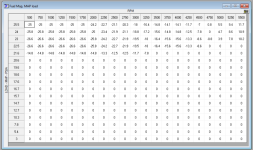
Here's my fuel map so far. I haven't changed anything on the O2 table yet.

GD8R6zl.png
 
Here's my fuel map so far. I haven't changed anything on the O2 table yet.

GD8R6zl.png

Is that in % mode? You have too much fuel under almost all settings. I bet your Long-term fuel trims are in the -10% or -20% range.

If you click on my build thread in my signature, I have notes on how I tuned my 4Runner. I realize I don't have a photo of my fuel trims, I'll add that soon.

First off, your table needs to be re-scaled. The max PSIA you will see with the 2.1" at sea level in 11.5 PSI, so that's 26.2 PSIA. However, in 1st gear the 2.1" makes about 9.5 PSI, in 2nd it makes 10.5 and in 3rd it makes around 11-11.5 PSI so take that into consideration. Second, unless you have a manual, you should never see above 5500 RPM. Manuals should never see above 6500... but you really shouldn't rev it over 6000 ever. Double click on the cell row and columns to change the end, then select all and "Calculate" to smooth it out. Here's my O2 sensor table for reference, note the row and column headers:

296310d1525668088-jerods-supercharged-t%5Bu%5Drd-build-o2-sensor-skewing-aem-fic.jpg


This is a great starting point for the O2 sensor. This is in voltage offset mode, so if you use this be sure to set it as such in the Setup screen. The -.479 you see in the corner was just a reference (cannot ever use that cell) since that value is an exact 12.0 AFR on my rig. -0.484 gave me 11.8, which is what URD says is the optimum AFR ratio for these engines at WOT.

The stock ECU will de-tune any fuel you add on the fuel table. It'll be fine for a week or so then you'll notice it going back to 14.7 AFR on everything except closed loop (closed loop kicks in around 75% throttle or 4000 RPMs). I'll post up my fuel table to show you what I mean.

EDIT: Here's my fuel table attached at the bottom. I have methanol injection so I pull full up top until high RPM's. You'll have to do the opposite, but see how I don't touch a single fuel trim until 7ish PSI. The O2 sensor skewing does all that, you can't do both at the same time very well.
 

Attachments

  • Untitled.png
    Untitled.png
    55 KB · Views: 3,158
Last edited:
Is that in % mode? You have too much fuel under almost all settings. I bet your Long-term fuel trims are in the -10% or -20% range.

If you click on my build thread in my signature, I have notes on how I tuned my 4Runner. I realize I don't have a photo of my fuel trims, I'll add that soon.

First off, your table needs to be re-scaled. The max PSIA you will see with the 2.1" at sea level in 11.5 PSI, so that's 26.2 PSIA. However, in 1st gear the 2.1" makes about 9.5 PSI, in 2nd it makes 10.5 and in 3rd it makes around 11-11.5 PSI so take that into consideration. Second, unless you have a manual, you should never see above 5500 RPM. Manuals should never see above 6500... but you really shouldn't rev it over 6000 ever. Double click on the cell row and columns to change the end, then select all and "Calculate" to smooth it out. Here's my O2 sensor table for reference, note the row and column headers:


This is a great starting point for the O2 sensor. This is in voltage offset mode, so if you use this be sure to set it as such in the Setup screen. The -.479 you see in the corner was just a reference (cannot ever use that cell) since that value is an exact 12.0 AFR on my rig. -0.484 gave me 11.8, which is what URD says is the optimum AFR ratio for these engines at WOT.

The stock ECU will de-tune any fuel you add on the fuel table. It'll be fine for a week or so then you'll notice it going back to 14.7 AFR on everything except closed loop (closed loop kicks in around 75% throttle or 4000 RPMs). I'll post up my fuel table to show you what I mean.

EDIT: Here's my fuel table attached at the bottom. I have methanol injection so I pull full up top until high RPM's. You'll have to do the opposite, but see how I don't touch a single fuel trim until 7ish PSI. The O2 sensor skewing does all that, you can't do both at the same time very well.

Thanks for the info! I'm sure the O2 skewing is my missing link. I could get it to behave well for a short period of time, but it would always tune out my fuel adjustments. I'll give it a go starting from your base O2 map.
 
What min/max voltage should I have entered in the O2 sensor settings?

'00 automatic.

Depends if you have the older narrowband sensor or the newer AFR sensor. For the narrowband, minimum is 0 and maximum is 1.11 volts. For the newer, you'll just have to figure it out. The narrowband is constantly switching from low to high, in about +/- 0.5 AFR. The newer sensor stays still. Put it in idle and hold the RPM at 2000 rpm after coolant is warmed up, then whatever cell is active, slowly take away voltage until you start seeing it drop. Record on paper what voltage = what AFR's. If you have the newer AFR-type sensor, I suggest not using offset mode and instead use AFR mode once you've figured it out. Sounds complicated, but it's actually quite easy.

Then in your table for O2 skewing, with AFR mode enabled you literally just type in the target AFR for that boost level and you are done.
 
Depends if you have the older narrowband sensor or the newer AFR sensor. For the narrowband, minimum is 0 and maximum is 1.11 volts. For the newer, you'll just have to figure it out. The narrowband is constantly switching from low to high, in about +/- 0.5 AFR. The newer sensor stays still. Put it in idle and hold the RPM at 2000 rpm after coolant is warmed up, then whatever cell is active, slowly take away voltage until you start seeing it drop. Record on paper what voltage = what AFR's. If you have the newer AFR-type sensor, I suggest not using offset mode and instead use AFR mode once you've figured it out. Sounds complicated, but it's actually quite easy.

Then in your table for O2 skewing, with AFR mode enabled you literally just type in the target AFR for that boost level and you are done.

After testing today I'm pretty sure I have the narrowband sensor. I saw it jumping from ~0V to ~0.7V when the AFR was around 14.7. I tried two of the same sensor to make sure and had the same result with both. There are still two things I can't seem to figure out.

1. In setup, I have my low voltage set to 0V and high set to 1.11V. I can't get the AFR below 12.2 even when subtracting the maximum allowable voltage. I'm testing in neutral with the engine at 2k RPM. I made the changes in the cell being used as well as the surrounding cells to avoid any interpolation issues.

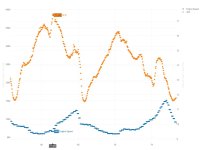
2. I still see a spike in AFR upon initial throttle application. The graph below shows what I'm talking about. I start to apply throttle, and before the engine speed increases, the AFR spies. The spike can get up in to the 20s at times. It feels like the engine stutters before taking off and causes the whole vehicle to lurch. I'ts been so bad that I've actually stalled twice trying to make low speed maneuvers in a parking lot.
 

Attachments

  • Capture.JPG
    Capture.JPG
    79.3 KB · Views: 2,829
After testing today I'm pretty sure I have the narrowband sensor. I saw it jumping from ~0V to ~0.7V when the AFR was around 14.7. I tried two of the same sensor to make sure and had the same result with both. There are still two things I can't seem to figure out.

1. In setup, I have my low voltage set to 0V and high set to 1.11V. I can't get the AFR below 12.2 even when subtracting the maximum allowable voltage. I'm testing in neutral with the engine at 2k RPM. I made the changes in the cell being used as well as the surrounding cells to avoid any interpolation issues.

2. I still see a spike in AFR upon initial throttle application. The graph below shows what I'm talking about. I start to apply throttle, and before the engine speed increases, the AFR spies. The spike can get up in to the 20s at times. It feels like the engine stutters before taking off and causes the whole vehicle to lurch. I'ts been so bad that I've actually stalled twice trying to make low speed maneuvers in a parking lot.

1. Turn on the "High Level Drive" option in the Setup screen. This will amplify the AFR changes you can get with the voltage offset.

2. Ok, that's not normal. Sounds like you could have a vacuum leak though, allowing unburnt air into the system. Or possibly an exhaust leak upstream of the front O2 sensor (or at the sensor itself). Actually, a vacuum leak could also be messing with your first issue of only a 12.2 AFR.
 
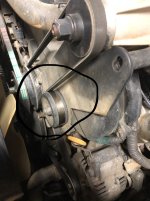
Does anyone have the part number for the idler pulley underneath the supercharger snout pulley? Mines roasted and making a TON of bearing noise.
 

Attachments

  • trdpulley.jpg
    trdpulley.jpg
    127.8 KB · Views: 2,907

Members online

Forum statistics

Threads
278,312
Messages
3,554,087
Members
248,016
Latest member
Advally Service

Trending content

Back
Top