Well this is a pisser b/c no one seems to know what to do now, including me.

flygirl0344

New member
So my 4runner was overheating (well, the gauge was climbing above normal and I just turned it off. Thank gawd I had just gotten home and wasn't stranded). I popped the hood and I saw green fluid on the left side of the engine only (also under battery tray so it ob was slung up there but not a drop on the fan). After 2 hours off and on of cleaning it all and searching, I couldn't find a leak or anything loose so I dumped some K-seal in, replaced the old TS with an OEM TS, gasket, new fluids and burped/bleed the system with a funnel in the rad opening , while it was running at a slight incline. It bubbled a bit then stopped but I had to turn off the ignition b/c the fluid was slowly creeping up the funnel and about to spill over. The reservoir was about 1/4 full.

I also replaced the rad cap after both hoses were sucked flat after it cooled down. The new cap fixed the suck. But it's still trying to overheat and the top radiator hose gets blazing hot and the bottom stays cool to touch. I turned off the ignition before it got too hot, per the temp gauge, as it was creeping past normal op temp. I've done this procedure several times just to make sure I got all the air out but it still continues to overheat and the heat inside doesn't work/blows cold, yet the heater hoses under the hood are both warm.

The heater control valve works/moves fine when I turn the temp knob. I refilled w/ 2.5 gallons of fluid at proper water/fluid ratio as that is what the manual indicates. To get all the fluid in the block I had to let it cool, pull off the top hose and dump the additional gallon in that way as the rad wouldn't accept the entire 2.5 gallons, even while running it.

I do not see any signs of pink fluid leaks indicating a water pump failure, nor underneath are there any corroded lines, cables or obvious leaks or smells inside. Exhaust is fine, no smoke ,etc. The heater not working tells me there IS a cooling problem.

1999 Toyota 4 Runner Limited, 190k miles.

1) shouldn't the rad hoses both be warm/hot?
2) Since TS, gasket cap are all brand new OEM, what else can be the problem?
3) what the heck do i do now? Flush heater core even tho both heater hoses going into firewall are warm?
4) I still have no heat and it engine is still overheating. Not that it matters b/c I live in Florida but I suspect no heat is telling me there's a problem somewhere.
5) All of this was done w/heat turned to hot setting

Anyone? Thanks in advance!
 
Register to hide this ad
How old is your water pump and radiator?
Water pump impeller though it's steel could be corroded away.
Drain Radiator remove hoses use water hose to check for flow thru radiator.
This can happen to the best of us, T-stat in correctly flow wise. With jiggle @ 6

Yes both hoses should be warm/hot to touch, 180*
 
Last edited:
1. It was not a good idea to put any kind of leak stop in the cooling system. It will never fix anything.

2.sounds like the coolant is not being circulated. My guess is the impellers on the water pump are gone.
 
superex-too late now. my dad always used bars leak and it worked every time. Just following what he did.

hugo-what would the ect sensor have to do w/it overheating and rad hoses hot/cold?

96red-everything is original as in NEVER done anything to it except gas, oil, brakes and go.

The TS is in exactly like the old one. the little silver jiggle thing is about a 1 o'clock. i took a pic of the old one and put the new one in exactly in the same position.

What should be the FIRST things I do?

1) drain rad and then check flow w/water hose or
2) just put on a new water pump since it's never had one? I will let a mechanic do this as I dont have the patience or tools to do that.
3) what would ballpark (range) cost for a mechanic to do this? NOT at the dealership but a local shop?
4) is the rad flow the best way to determine if it's the rad or water pump?

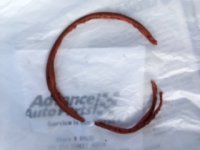
forgot to mention that when I took out the TS, I found red gasket looking material inside the housing. I cleaned it out, put in new OEM TS, gasket and then added the fluid and tested several time since then. Yesterday doing the very last bleed/burp with the rad cap off I saw another piece of that red gasket material right in the top of the rad opening. See pic. Thoughts on all of the above? Thanks again everyone.
 

Attachments

  • IMG_2734.JPG
    IMG_2734.JPG
    24.1 KB · Views: 726
Radiators and water pumps don’t last forever. Plastics age and degrade with heat and time. Radiators clog with mineral deposits. They have plastic housings which develop hairline cracks. I babied my 2000 and it still needed radiator, water pump, thermostat, all hoses, belts, plug wires, etc before 180,000 miles. I replaced everything over time as part of my preventative maintenance before they failed. If you want to keep this 4Runner for the long haul and have confidence in it before embarking on a long trip, replace those components. Find a good independent mechanic to assess everything, make recommendations, and get an estimate. You don’t need everything done at once, but sometimes if makes sense to replace several items since the disassembly/assembly labor can cost more than parts. Good luck!
 
+1 on replacing the water pump and radiator (and might as well replace the timing belt stuff, seals, and any worn pulleys since you'll have it all apart, no significant extra labor)

While you're at it flush out the heater cores. Both of mine were full of crap and the line going to the rear heater core had to be blown out with an air compressor, it was too clogged for a water hose to get it.

I also had the radiator hoses sucked flat. My issue was actually both the radiator cap was bad and the hoses and connections going from the radiator to the reservoir were completely clogged with crap. I had to bore them out with some wire i had laying around. After all that though my heat is working great and I don't have to worry about overheating or pink milkshake.
 
Ok Nov, thanks! I'll do all of that stuff for sure. What do you think is a reasonable price for all of that work and parts? I'll prolly buy parts myself but let's say I have the shop buy and install what would total ballpark cost be?
 
superex-too late now. my dad always used bars leak and it worked every time. Just following what he did.

hugo-what would the ect sensor have to do w/it overheating and rad hoses hot/cold?

96red-everything is original as in NEVER done anything to it except gas, oil, brakes and go.

The TS is in exactly like the old one. the little silver jiggle thing is about a 1 o'clock. i took a pic of the old one and put the new one in exactly in the same position.

What should be the FIRST things I do?

1) drain rad and then check flow w/water hose or
2) just put on a new water pump since it's never had one? I will let a mechanic do this as I dont have the patience or tools to do that.
3) what would ballpark (range) cost for a mechanic to do this? NOT at the dealership but a local shop?
4) is the rad flow the best way to determine if it's the rad or water pump?

forgot to mention that when I took out the TS, I found red gasket looking material inside the housing. I cleaned it out, put in new OEM TS, gasket and then added the fluid and tested several time since then. Yesterday doing the very last bleed/burp with the rad cap off I saw another piece of that red gasket material right in the top of the rad opening. See pic. Thoughts on all of the above? Thanks again everyone.

Wow, you got a lot going on here. Let's see if we can dissect some of this.

First of all, in your 1st post you said you found green fluid but later you said you have red. Which is it?

Bars leak was probably not a smart thing to do. A thorough flush is definitely in order as you say you have no heat and seemingly no radiator flow combined with finding large debris in your coolant.

Speaking of debris, it looks like a piece of red RTV. A first I thought it was mistakenly put around the thermostat housing and "pinched" off because someone got happy with the RTV. I'm going to give that someone isn't that stupid though because that area is sealed by an special oring around the edge of the TS. Now, another place that might have come from is someone got happy with the RTV when they installed a new WP and the excess pinched off inside. I read you said it never had one but this the most likely place that RTV would enter the cooling system as the other 3 places I mention would be much more unlikely. You could verify this by taking your upper TB cover off and looking for red RTV on the edges of the WP. One thing here though is that Toyota, from the factory, used a metal gasket with bonded sealant on it. BUT, many have confirmed that Toyota, FROM THE FACTORY, used red sealant on the WP. Mine wasn't like that, but just wanted you to know that, maybe there was some excess hanging on the inside seam, FROM THE FACTORY, and it finally let go. The only other places would be if some idiot tried to "seal" a leaking oring on the oil cooler instead of replacing the $5 oring and $2 bonded washer, or the water outlet on top of the TB cover. The common theme here is someone (maybe even a Toyota line assemblyman) got happy with some RTV somewhere and it "might" be clogging the passage ways in your radiator and heater core.

What I would do first is simply verify the fan clutch is good. With the motor hot (and obviously off) the fan should be difficult to turn by hand, although not impossible) If it spins somewhat easily then you've found your problem (although that still doesn't explain the mystery green liquid you found). If all is good with the fan clutch, try to flush is out with a water hose. Disconnect both radiator hoses at the radiator. Take out the TS. Make a fixture and reverse flush through the TOP hose (which is opposite normal flow) See what comes out. Then switch the fixture to the bottom hose and flush that way. Do this back and forth several times.
Now to flush the heater core. Reverse flush it first. Should be the hose on the right, looking at the it from the front of the motor. That hose is NOT the one going to the heater valve. Normal flow is intake manifold -> heater valve-> heater core-> suction side of WP via pipe running along passenger side of motor. Do the same procedure with this as with the motor block we flushed out earlier.

At this point you could put the TS back in (which, by the way, the Jiggle valve should be at 6 oclock not 12) reconnect the hoses and fill with water. Regular water is fine for now as we are still testing. Start and run truck an fill it up as much as possible. Turn off truck, when it gets hot (or you can leave the TS out to test the WP right away without the warmup). Next, disconnect the upper hose from the radiator and BRIEFLY run the truck and see if you have good flow. It should pump out pretty good. A friend here is helpful. Obviously, if it trickles out., make sure you have enough water in the system. If the flow is still weak then you probably have bad WP. If this is the case you'll want to replace it and also do the TB and associated other parts at the same time. If flow is good then you've really narrowed it down to the only one component, the radiator. Not a bad idea to replace it now anyways just as a preventative maintenance, especially if you truck is an automatic. Just have to make sure there's no more debris in the system, which means you have to flush it again like we did before.

One more thing, make sure the cooling fins on your AC condenser are clear. Air flow won't get to the radiator if those fins are all bent over or if the cooling fins on the radiator in front of your fan are mangled up. This is not likely your problem but it's worth cleaning and straightening while you're in there.

Not going to go into what kind of coolant (and water) or how to fill the system etc. Plenty of threads on that.

Please let us know how you made out. Nothing worse than people working through a problem on a forum but not posting the final solution(s). Defeats the main purpose of this forum.
 
Last edited:
What should be the FIRST things I do?

1) drain rad and then check flow w/water hose or
2) just put on a new water pump since it's never had one? I will let a mechanic do this as I dont have the patience or tools to do that.
3) what would ballpark (range) cost for a mechanic to do this? NOT at the dealership but a local shop?
4) is the rad flow the best way to determine if it's the rad or water pump?

forgot to mention that when I took out the TS, I found red gasket looking material inside the housing. I cleaned it out, put in new OEM TS, gasket and then added the fluid and tested several time since then. Yesterday doing the very last bleed/burp with the rad cap off I saw another piece of that red gasket material right in the top of the rad opening. See pic. Thoughts on all of the above? Thanks again everyone.

1 & 2, draining Rad checking flow won't cost you anything but time.
If you have kept your antifreeze relatively fresh I doubt the pump is bad,
but could be.. most get changed due to leaking.

3, Shops depending how small/big they are $60-$100/hr approx.
Rad change about hrs worth + parts

4, It's a start of troublingshooting your issue.

The red gasket maker RTV should not be there, someone has been into it.
The jiggle valve needs to be at 6 oclock for best cooling and burping.
If I were you I'd buy this:https://www.ebay.com/itm/Toyota-TIM...Runner&hash=item2a144a37e8&vxp=mtr&rmvSB=true I do
And a aisin radiator (OEM) rockauto, for sure if original Rad (strawberry milkshake can happen). If auto.
With your milage your due for it all anyway.
If you supply parts I do this job for $500, if I know you, $300 you just watch hand me tools n beers. Long ago I paid $600 for labor alone drop it off, pick it up.
[MENTION=107674]JRZEE2000TR4LTD[/MENTION], is spot on very good way to go about it.
 
Last edited:
JRZ-I do recall when the TS housing was off, seeing a bit of the same red material squishing thru a bit from whatever the housing bolts to. But there was only the black gasket on the TS, as it should be.

It was def green fluid not red. I think I may have been referring to the red gasket. Sorry ab that.

What do you mean by this: Make a fixture and reverse flush through the TOP hose...And to confirm take out the TS again right? Can you explain this procedure a bit more please? I'm unclear on what exactly I'm flushing..between the 2 hoses or into the block?

Fan turns exactly as you described it should.
Fins are all straight and clean..
When I do above procedure, I will be sure to put jiggle valve at 6. It is at 1 now. Could this be the SOLE problem..that it's at 1 and not 6?

Glad I can do this test with just water, coolant is a sticky mess. BTW, do I need to worry about turning heat on during this testing?

I REALLY do appreciate the guidance here. 96RED and JRZEE great and helpful info! As soon as I hear back from you, I'll start with your recommendations.
 
What do you mean by this: Make a fixture and reverse flush through the TOP hose...And to confirm take out the TS again right? Can you explain this procedure a bit more please? I'm unclear on what exactly I'm flushing..between the 2 hoses or into the block.

Yes remove T-Stat for flushing the block, which is what your doing as he describe.

By saying "fixture" he means a way to attach water hose to Rad hose that doesn't leak water so you have a power flush effect. You want to create a double male adapter that fits garden hose female one end to rad hose female other end, use hose clamps to secure it. There are many small water passages in block that will require some pressure to flush trash out.
You'll need to be creative to come up with double male adapter, say PVC plug cap that fits inside rad hose that has hole in center for a male fitting to attach water hose too.
Secure plug in rad hose with rad hose clamp. You'll have to cut threaded water hose fitting off end of garden hose to attach it using a hose clamp to the male fixture/adapter you just created.
Doing as he described you'll be flushing engine block, then attach rad hoses to rad, remove rad hoses from engine, install double male adapter, flush radiator.
 
Last edited:
96Red, great “picture” description oh how to do this. Thanks for that! I’ll head this am to home depot and get pvc and other items, also to grab Heater core flush kit from auto parts store. Are you by any chance close to Tampa and can do this, it’s hot and I have coooold beer! Lol

Years ago I was told that for an AT vehicle, if youve passed the manufacturer recommended time for doing the FIRST tranny fluid change , don’t ever do it. I never questioned that bc at the time I had a 5 speed. Now I have an automatic and a tranny w original fluid, should I have it changed and just NOT flushed or both or neither?

Also w 190k miles, and I plan on keeping my 4Runner, would you kindly confirm/list everything that needs to be replaced or done (ie-heater core flushed, tranny fluid change etc) : new radiator, water pump, hoses, lines, cables..

Oh I forgot I did change plugs and wires twice. Thanks again.
 
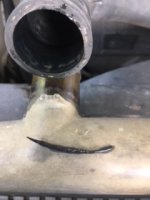
UPDATE: In preparation to do the flush, I pulled off the top rad hose and just inside the hose found this black gasket piece. Does this change any of my testing or just proceed as planned?
 

Attachments

  • black gasket.JPG
    black gasket.JPG
    31.6 KB · Views: 442
UPDATE: In preparation to do the flush, I pulled off the top rad hose and just inside the hose found this black gasket piece. Does this change any of my testing or just proceed as planned?

No, doesn't change anything. Is that a shaved of piece of a large oring or does it seem like more RTV of the black variety? Helps to be able to possibly identify what it is then maybe where it might be coming from so we can narrow down what maybe be going on in your cooling system. Lot of maybes and possiblys there. Sorry about that but you have a bit of a mystery right now.
 
96Red, great “picture” description oh how to do this. Thanks for that! Are you by any chance close to Tampa and can do this, it’s hot and I have coooold beer! Lol

The "picture" double male is a Industry standard term for such an adapter, though in the PC world of today some might call me a dl;;sjjddk pig. Depends on what your definition of close is, My parents lived in Sand Key/Largo for 25 yrs, many trips made 725 mi, drive fast 10 hr, normal 11 1/2 hr.
What beer we talking, Lol.
[/QUOTE]

Now I have an automatic and a tranny w original fluid, should I have it changed and just NOT flushed or both or neither?[/QUOTE]

Depends what your fluid looks like now, as the risks/plan of attack change based on color, remaining viscosity, grit/particles in fluid.
Me, since you want to keep it, I would drain, drop pan, inspect pan magnets for metal, clean pan and magnets, close it up, do a series of drains and fills 3-4 in 10-15k miles. A forum search will show you the can of worms you can open,
I've had good luck over the years different make vehicles doing this.
[/QUOTE]

Also w 190k miles, and I plan on keeping my 4Runner.[/QUOTE]
#1 Change Lower Ball Joints with Toyota OEM only, search LBJ failures here, not pretty, dangerous!! Upper ball joints since your in there also.
#2 Radiator search (Strawberry Milkshake),
1&2 to me can cause you the most grief in a hurry.
#3 The timing belt kit I linked is a good one, if you've never changed TB and associated parts it's time.
As needed or preventative maint.
Rear axle seals are going to go at some time, known issue.
Change rear diff fluid, if 4x4 transfer case and front diff.
Upper & lower control arm bushings front & rear, front more so, steering rack bushings.
Tie rod ends inner & outer, more so if needed, OEM can last a long time.
If original, shocks and springs are probably done, good time for lift kit, ha.
The list goes on, Lol.
I purchased a 01 3-17 198k mi, did all this and more as described including trans. Good for another 200k mi.


Their good rides
.[/QUOTE]
 
JZ, it looks shaved and not sure if its RTV or Oring. How can I determine the diff?

96Red, I will def have all of that done once I get her back on the road. And any beer you want!

I certainly do appreciate the detailed replies and instructions. SO very helpful! Just got back from Lowes, headed outside now to resume testing. Will let you know the results in a bit.
 
96Red, great “picture” description oh how to do this. Thanks for that! I’ll head this am to home depot and get pvc and other items, also to grab Heater core flush kit from auto parts store. Are you by any chance close to Tampa and can do this, it’s hot and I have coooold beer! Lol

Years ago I was told that for an AT vehicle, if youve passed the manufacturer recommended time for doing the FIRST tranny fluid change , don’t ever do it. I never questioned that bc at the time I had a 5 speed. Now I have an automatic and a tranny w original fluid, should I have it changed and just NOT flushed or both or neither?

Also w 190k miles, and I plan on keeping my 4Runner, would you kindly confirm/list everything that needs to be replaced or done (ie-heater core flushed, tranny fluid change etc) : new radiator, water pump, hoses, lines, cables..

Oh I forgot I did change plugs and wires twice. Thanks again.


Oh boy the "flush" vs "drain the pan" debate. A lot of "info" on this in this forum. More than a couple from me. You really should get some fresh fluid in there somehow.

Basically there's 2 schools of thought here. Some believe that "flushing" out the old fluid also can remove clutch materials in the fluid that are all keeping the AT shifting correctly or by flushing you "move" said material to a location in the tranny you don't want it. So what people do is drain the pan (About 3-4 qts, tranny total capacity is 11 qts) and do this say every oil change then, in theory, you fluid is "somewhat" refreshed after, say, the 3rd or 4th change. This is ok if you understand that you are ALWAYS mixing old fluid with new fluid. I believe this is better than doing nothing at all.

The 2nd way is getting all of the fluid out the 1st time. Some have claimed, that after doing a "flush" their tranny shit the bed. I don't doubt this, for the reasons I mentioned earlier although I will say that if just removing dirty, broken down fluid with clutch material in it made your tranny fail then it probably was on it's last leg anyway. Anyways, there are machines out there that do "flushes" several ways. I used to work on these machines so I have an understanding of how they work. Furthermore, if used improperly they most certainly can mess your tranny up. Of course, you'll never know that a tech did something wrong while performing this procedure. What you want to do though is not a "flush". What you want to do is a 1- to - 1 EXCHANGE of your fluid. This should not move anything around in your tranny as it is only using the transmission's pump to move the fluid. There are machines that use external pump(s) to move the fluid and that is where I believe you can have issues. Kinda like what we're doing with your cooling system. We are putting more pressure through it because we WANT to move things through (and out of) it. Reversing flow helps move thing too. You DON'T want to do this in your tranny. (another mistake that a tech can make with a machine although many machines have directional flow indicators or sensors for direction, I can't tell you how many times I've seen those fail.
So, in essence, what you want to do, (and what I've done) is remove the correct hose of the tranny cooler (bottom of the rad) and let that go into a bucket. I like to use a male to hook a piece of clear tubing to the fitting on 90 degree fitting on the driver's side of the radiator. Secure it somehow so it doesn't "whip" around when flow starts. Get yourself at least 3 gallons of ATF. Start off by draining the pan, measure the amount taken out and put fresh in. This is about the amount that you want to try to get out of the truck each time you start it as I will describe. This will also give you a head start. Start you truck and in about 10-15 (about 5 sec a qt) seconds and you will have pumped out about 2-3 qts. Try not to let the pan go dry. You can measure how much you took out if you want, or put graduations on your bucket. I didn't do that, I just eyeballed it and corrected the amount at the end. Do this start stop procedure 5 or 6 times until you've ran at least 11 qts through it. The clear hose will allow you to see the progression of dirty fluid to clean fluid. Try to leave a least a qt at the end to correct the level. Try not to overfill here as the truck probably isn't hot yet and you want to do your final level correction on a fully warmed up truck. Hook things back up take it for a spin. Manually shift through all the gears including reverse. Park it on a level surface and do your final level check. If somehow you went over, the best thing is to let it cool a bit and drain the appropriate amount from the pan drain. That's all I got to say about that. (Forrest Gump)

Maintenance items:

Front and rear dif fluid cahnge
Transfer case fluid change
Drive shaft greasing
VC gaskets leaking? Very common.
Brake fluid flush
Power steering fluid exchange
Throttle body cleaning (the right way so crap doesn't go into the IAC)
PCV and grommet (with the VC gaskets is the easiest)
Front brake pads wearing evenly? (inboard and Outboard) if not, caliper pistons sticking
Rear brake adjustment
Original LBJs at 190K? if so, change them.
If you're into the cooling system I would replace the upper and lower rad hoses. I really like OEM here (along with the clamps) but to each their own.
Loose , vac hoses on top of the intake manifold and all the EVAP hoses
 
Last edited:

Members online

No members online now.

Forum statistics

Threads
278,315
Messages
3,554,130
Members
248,016
Latest member
Advally Service

Trending content

Back
Top