5-speed clutch pedal sticks on floor in morning (three days in a row)

Status
Not open for further replies.
Hey foo, Christmas came early!

Q%20Bushing_zps93gnfong.jpg~original


P%20Bushing_zpsjjvnno2u.jpg~original


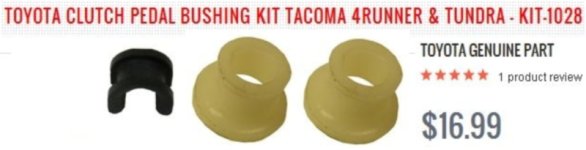
I wanted to thank you for compiling all this info into one thread. My 4Runner pedal was sticking and the idea of adding an extra spring rather than understanding the root cause was unsettling. It turns out I had two issues: The clutch pedal bracket/bushings were worn through and what I think is a throw-out bearing problem. I replaced the bracket and bushings with OEM parts, which removed the squeak and the pedal no longer sticks to the floor. The pedal doesn't come up the last inch or two, yet the master/slave cylinders are good. So that pretty much leaves it to the throw-out bearing, or something else near the clutch. I'll tackle that job next summer; for now I can live with my pedal not returning fully.

Anyways, I wanted to better understand the problem with the bracket and bushings so I don't have to shell out more money on those in 5 years or so.
Your thread really helped me better understand the situation (and the assortment of solutions that people came up with), so I thought I'd repay the favor.

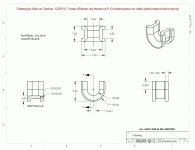
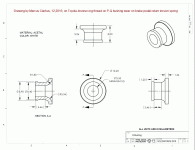
I ordered some extra bushings and made these drawings of the parts. The simple outer dimensions were measured with digital calipers, inner diameters where measured with pin gauges, and for some of the tricky measurements I used a CMM/Vision system.

Now how do I know the materials, you ask? Simple: a burn test. Boedeker Plastics : How to Identify Plastic Materials Using The Burn Test

The smooth, shiny, slippery, hard, somewhat brittle, white Q-bushing I immediately recognized as acetal (aka Delrin, POM). I did a burn test just to be sure, side by side with a sample of plastic that I was 100% certain was acetal. Both samples continued to burn after I removed the flame from the lighter. Same slow, blue glowing flame; same nasty smell. Easy.

I suspected the P-bushing was some type of nylon based on the application, appearance, and how tough it is (well, not that tough when the clutch pedal spring is rubbing against it for thousands of repetitions, but tough when I'd pick at it with a fingernail or knife). I did the burn test and it smelled like burning hair, had a small yellow flame with a blue base, and continued to burn after I removed the lighter. I did the same test with a piece of plastic that I was 100% certain was Nylon 6/6 and it had the same smell, same flame appearance, but extinguished immediately when I removed the lighter. From the chart I linked to, I think it's pretty clear the P Bushing is made of Nylon 6.

So why did people say the P-bushings they made out of nylon work better? I don't know. Luck? Bias? Thicker walls so there was more material to wear through before it failed?

These are the reasons I believe the bushings fail over time:

1. Wear (duh). But seriously, the bushings have a lot of pressure applied to them by your foot and that spring. There's no way Toyota believed these things would outlast the vehicle, but the alternatives (bronze bushings, ball bearings) are very expensive compared to a 2 cent injection molded plastic part. I still can't figure out exactly why they felt it was necessary to go with a torsion spring, but since they did I understand why they chose plastic bushings, even though I don't like it.

2. Wearing of the metal components, especially the bracket for the P-bushing. As soon as you wear through that bushing and start rubbing against the metal, you're changing the geometry (and therefore stress concentrations). If you gouged the metal and throw new bushings in there they aren't going to last long at all, no matter how much grease you dump on them. Same goes with bronze bushings - and good luck getting those aligned with the spring properly (which isn't exactly a precision component itself).

3. Dirt and lack of lubrication. Dirt or metal particles getting on the bushings and sticking in the lubricant can definitely accelerate the wear. Keep everything clean and covered with a thin coat of grease.

4. Humidity. This one is only going to affect the nylon P-bushing, not the acetal Q-bushings. Nylon absorbs a lot of moisture and becomes soft, making it wear faster. Having the bushing exposed to a constant high humidity will shorten its life. Not much you can do about this one though.

All that and still no solution?:redbrick::redbrick:
Yep, sorry. I've been thinking on it, but there's really no obvious fix-it-for-good solution, at least in my mind. As far as plastics go, nylon and acetal are actually very good materials for bushings because of their low friction and high wear resistance. Unfortunately, the forces here are just too high for plastics to withstand for decades. I'd like to figure out a way to use bearings or bronze bushings or maybe just a beefier plastic bushing (www.igus.com has a lot of sizes, something must fit!). It's going to be a challenge to get them installed properly (misalignment = fast failure). My plan (for now) to save me from replacing my bracket again is to replace the bushings every 30,000 miles or so and keep them coated in silicone grease.
 
Last edited:
Hey foo, Christmas came early!
Wow. Just wow. That is more than any of us could possibly have hoped for!

Your thread really helped me better understand the situation (and the assortment of solutions that people came up with), so I thought I'd repay the favor.
You got it! That's exactly what this thread is all about.
All of us, working together, as a team, to move each one of us forward, where each of us stands on the others' shoulders!

Your extremely detailed information will help everyone with a stick now, and in the future!

Thank you, for me, and on behalf of everyone who fabricates stronger bushings or who seeks a third-party supplier of similar sized but better material replacement P & Q bushings!

Since this thread is intended to be a reference thread, and therefore to ensure that your photobucket pictures are preserved as long as this forum is preserved, I took the liberty of appending them to the forum itself.

Thank you also for testing the materials (which almost certainly destroyed the bushing being tested) and thank you for taking the effort of explaining your tests, in true scientific manner (so that others can follow suit and improve as needed).

Like you, I too am super surprised that the P bushing (which is the more problematic of the two) is nylon, as I read what you read, which is that folks felt nylon would hold up better than the OEM P-groove bushing, which seems to be the one that always fails first.

I think it's great that you tried to do a failure analysis, concluding that sheer wear is what killed them, which basically means that at least the P bushing must be replaced every (x) miles. I don't think a pure inspection is worth it since the bushing itself is inexpensive compared to the amount of work it is to dismount the assembly to inspect the bushings.

Would you agree with the recommendation of every two (or three?) years putting a new P bushing in?
Owners could then stock a set of three or four and that would last about a decade?

As for why they went with that torsion spring contraption, the only thing that I've read that makes sense is that it somehow moderates the feel nicer than does the tension spring (however I was unable to feel the difference although I was testing bad bushings with the torsion spring against the tension spring).

Certainly the torsion spring contraption is complexly engineered, so, some manager somewhere decided it was important to have over the existing tension spring setup.
 

Attachments

  • PBushing.gif
    PBushing.gif
    47.2 KB · Views: 1,126
  • QBushing.gif
    QBushing.gif
    49.2 KB · Views: 1,087
Last edited:
Thank you again Marcus Clarcus for your wonderfully detailed diagrams.

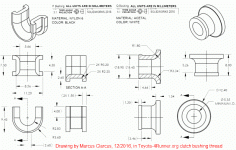
To further help others source suitable replacements in hardware stores, here's a single-page graphic of your diagrams, compressed so that they print into a page that can be brought to the hardware store to select suitable replacements.

One question for Marcus Clarcus is about your clutch pedal tab.

Was your P-bushing clutch-pedal groove worn out of round?

I think a lot of the repairs that broke are because it's problematic to put a new bushing into a worn groove. I can certainly understand why people would do that, as the clutch pedal is expensive, as is the bracket (whereas the P and Q bushings and the torsion spring are inexpensive by way of comparison).

So I have two questions for you:
Q1: Was your clutch pedal p-bracket groove worn such that you had to replace the clutch pedal?
Q2: I'm curious how you found this thread, as it was intended to be a first reference for someone who had similar problems - so I'm hoping it served that purpose for you.
 

Attachments

  • toyota_clutch_pedal_return_bushings.gif
    toyota_clutch_pedal_return_bushings.gif
    48.1 KB · Views: 1,064
  • bushing_holes.jpg
    bushing_holes.jpg
    79.4 KB · Views: 1,072
Last edited:
So why did people say the P-bushings they made out of nylon work better? I don't know. Luck? Bias? Thicker walls so there was more material to wear through before it failed?

Great post! Thank you for for taking the time to diagram the bushings, identify the materials, and document your results.

My DIY nylon bushing is still holding up well, most likely because I was able to use a thicker bushing due to the wear on my clutch pedal fork. Once the groove in the fork is worn then the stock bushings are not properly supported and fail quickly. I had to reinforce my fork to provide support for the bushing, and then made a custom sized bushing to fit the wear pattern specific to my fork.

- Matt
 
Great post! Thank you for for taking the time to diagram the bushings, identify the materials, and document your results.
The great part about this thread is everyone is pitching in together, to help the NEXT person start off where we all left, which moves the ball forward.

Eventually, if everyone adds value like yours and Marcus', we will have this problem licked, for good!
My DIY nylon bushing is still holding up well, most likely because I was able to use a thicker bushing due to the wear on my clutch pedal fork.
Thank you for reporting back since it's critical to know how long any replacement method works.

To this day, I don't know myself how long the original OEM bushings last.
Does anyone have a clue when they last?
The 4Runner I'm working on has over 150K miles and the squeak, I'm told, happened during the warranty period - so that's too great of a span for me to determine based on the one 4Runner.

But together, we can assess how long the bushings last because that forms our recommendation for when to inspect and replace them.

How long (time or miles) has your nylon replacement lasted?
That question will begin the basis for our future recommendations on inspection.

BTW, it seems to me that inspection of the Q bushings may be relatively easy but inspection of the P bushing seemed impossible to me, but maybe that was because it wasn't there (and because, at the time I inspected them, I didn't know what I know now).

  • Is it worth the trouble just inspecting the Q and P bushings?
  • Or should people plan on replacing at the time of inspection?

Once the groove in the fork is worn then the stock bushings are not properly supported and fail quickly. I had to reinforce my fork to provide support for the bushing, and then made a custom sized bushing to fit the wear pattern specific to my fork.
I have to agree with you that the groove, once worn, is problematic.
Almost certainly it will destroy a new OEM bushing within a year (or so) based on what I've read.
It even destroyed a brass bushing, based on what I read.

I like the way you shored up the u-shaped groove though, so in your case, you restored to some degree the original characteristics of the groove.
223924d1477080214-5-speed-clutch-pedal-sticks-floor-morning-three-days-row-grumble.jpg
 
You're welcome foo, and thank you for reposting the pics! I hate it when I see a great thread with a bunch of “photo does not exist” images.

FYI I bought my 4Runner with 206k miles on it and the pedal was already squeaky and would stick to the floor sometimes. From 206k-208k miles it quickly got worse… which might be related to the fact that this is the first manual transmission vehicle I’ve ever driven/owned :tongue1:

Would you agree with the recommendation of every two (or three?) years putting a new P bushing in? Owners could then stock a set of three or four and that would last about a decade?
Yep that’s what I’m gonna do to save my clutch pedal bracket from ever wearing down again (unless of course I, or someone else, comes up with a better solution).

Certainly the torsion spring contraption is complexly engineered, so, some manager somewhere decided it was important to have over the existing tension spring setup.
I had the exact same thought. I’m curious if it has ever been implemented in cars that weren’t built by Toyota.

Q1: Was your clutch pedal p-bracket groove worn such that you had to replace the clutch pedal?
Q2: I'm curious how you found this thread, as it was intended to be a first reference for someone who had similar problems - so I'm hoping it served that purpose for you.
Q1: Yes the P-bracket was worn – definitely not as badly as some of the pictures I’ve seen, but enough that I decided to replace it. It was bad enough that it would NOT constrain/align the P-bushing center axis with the center axis of the straight-section of the torsion spring.
…please let me know if that was unclear, it’s a little hard to explain.
Q2: I was browsing some other threads on the subject, and I believe you posted a link to this thread. You saved me a lot of time!

Great post! Thank you for for taking the time to diagram the bushings, identify the materials, and document your results.
My DIY nylon bushing is still holding up well, most likely because I was able to use a thicker bushing due to the wear on my clutch pedal fork. Once the groove in the fork is worn then the stock bushings are not properly supported and fail quickly. I had to reinforce my fork to provide support for the bushing, and then made a custom sized bushing to fit the wear pattern specific to my fork.
- Matt

You’re welcome and thanks for the update. It sounds like you did a pretty good repair job.
 
I have to agree with you that the groove, once worn, is problematic.
Almost certainly it will destroy a new OEM bushing within a year (or so) based on what I've read.
It even destroyed a brass bushing, based on what I read.

On my fork with a worn groove a new OEM bushing lasted about a month, my first brass bushing about 3 months, and my second brass bushing about 2 days. This was all before I reinforced the fork to add more support and switched to the nylon bushing.

- Matt
 
You're welcome foo, and thank you for reposting the pics! I hate it when I see a great thread with a bunch of “photo does not exist” images.
You have the right attitude in that the whole point is that the thread serves as a reference for other people with the same problem.
If a key photo is missing over the years (because a photobucket account goes down), it often frustrates the user.

So these photos will now last as long as the forum lasts, helping others long after we're gone.
FYI I bought my 4Runner with 206k miles on it and the pedal was already squeaky and would stick to the floor sometimes. From 206k-208k miles it quickly got worse… which might be related to the fact that this is the first manual transmission vehicle I’ve ever driven/owned :tongue1:
The 4Runner I'm working on was bought new, where the owner is a relative, who said she told the warranty department at the dealer that it squeaked but they didn't know what the problem was.

That means either they lied, or they were incompetent since this seems to be prevalent in all the torsion-spring Toyota Tacomas, Tundras, and 4Runners.

Yep that’s what I’m gonna do to save my clutch pedal bracket from ever wearing down again (unless of course I, or someone else, comes up with a better solution).
While some do without any spring, the only known "better" solution is either to replace the P bushing periodically (every three years?) or to eliminate the torsion spring altogether or to beef up the P bushing.

Your materials and dimensions effort will help others in that last endeavor.

I’m curious if it has ever been implemented in cars that weren’t built by Toyota.
I too would be interested in whether other manufacturers resorted to the complex torsion spring apparatus. I had asked if the 4th and 5th generation 4Runners had the same problem, but all I received was ridicule, because, apparently, there is no manual transmission option in the later models (which hadn't occurred to me when I had asked).

Q1: Yes the P-bracket was worn – definitely not as badly as some of the pictures I’ve seen, but enough that I decided to replace it. It was bad enough that it would NOT constrain/align the P-bushing center axis with the center axis of the straight-section of the torsion spring.
Thank you for letting us know that you had to also replace the clutch pedal because the P-bushing tab groove was worn.

I'm sorry you had to go through that expense,which is all in the metal bracket assembly and clutch pedal, and not in the P or Q bushing or in the torsion spring.

Had owners only known this sooner, the expense of a new metal bracket and clutch pedal could have been averted, with timely replacement of that nylon P bushing.

I don't think the Q bushings need to be replaced as often, but, I would think most of us would replace them with the P bushing simply because the effort involved is the same to replace all three bushings as it is to replace just the middle one.

Q2: I was browsing some other threads on the subject, and I believe you posted a link to this thread. You saved me a lot of time!
Perfect! That's how I designed it to work!

Thanks for letting me know because that makes me feel good that my approach worked, which was to search for all the related threads and then to read them thoroughly, and to take what was good (and remove what was bad) from each one, and put it in one comprehensive one-stop-shopping thread.

Then I slowly linked each of those threads to this thread (and vice versa), doing them one at a time over a period of a few weeks because people get mad when they don't understand this approach (they don't see the big picture).

My only regret is that the title of this thread is wrong, which I can't change (I tried, but it only changes the title within the thread, but not outside the thread).

People won't find this thread by the title but certainly a keyword or photo search should find it, so, all is not lost.

You’re welcome and thanks for the update. It sounds like you did a pretty good repair job.

Actually, I'm not perfectly happy with the results because the Toyota clutch pedal return spring I used does tap the clutch pedal P-tab ever so slightly when fully depressed.
The owner doesn't notice though, and I made the mistake of telling her it was a "mod" and she got upset so I had to quickly lie and tell her I was just joking and that I had replaced it with the OEM parts.

Then she was happy.

The fact is, she can't tell the difference in pedal feel, and neither can I (although I only had it when it wasn't working right). I'd be all ears if/when someone confirms what the heck Toyota was thinking when they designed this thing, as the feel isn't all that different with either spring (AFAICT).

Thank you again, on behalf of everyone solving this problem in the future, and Merry Christmas!
 
Last edited:
On my fork with a worn groove a new OEM bushing lasted about a month, my first brass bushing about 3 months, and my second brass bushing about 2 days. This was all before I reinforced the fork to add more support and switched to the nylon bushing.

Thank you Matt for that helpful information, as your experience was perhaps the most extensive of all for the retrofit solutions.

The fact your OEM P bushing lasted a month should rightfully discourage others who read this thread to just pop in a new P bushing into the worn groove, and it should prove the point that replacing the P-bushing periodically (every three years?) makes the most sense.

The fact even your beautiful brass retrofit failed indicates that nothing, really, will work unless/until the P-tab groove on the clutch pedal is either fixed (by replacing with a new clutch pedal or by welding on a new tab or by epoxying supporting plates as you did in your wonderfully comprehensive DIY).

It's fantastic to know that, after supporting the groove and replacing with a larger chunk of machined nylon, yours is still working. This will encourage others by showing them what doesn't work and what does work.

Thank you very much for being instrumental in solving this problem for everyone!
I hope your information helps others long after we're all gone and that others take the spirit of giving back like you did and like Marcus Clarkus did!

That's the right attitude!

Merry Christmas!
 
Last edited:
The fact even your beautiful brass retrofit failed indicates that nothing, really, will work unless/until the P-tab groove on the clutch pedal is either fixed (by replacing with a new clutch pedal or by welding on a new tab or by epoxying supporting plates as you did in your wonderfully comprehensive DIY).

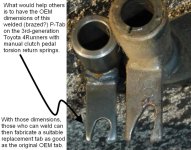
I hate to ask for too much, but, I just realized when I wrote that above, that it would probably be useful to others if we had the dimensions of the original groove of the metal P tab.

Since that groove shape and dimensions can only be obtained from a brand new pedal in our hands, I only ask the NEXT person who buys a new clutch pedal, to draw the outline of the P tab and then mark on that outline what the dimensions are.

That way, anyone who wants to weld (or braze) a new tab can grind it out properly to fit the ORIGINAL dimensions, and save money on not needing to buy a new clutch pedal.

What else others could use is a photo, just like that below, but with the new P bushing in place on both the old and new, so we can see why Matt's OEM and brass bushings failed when re-used in the worn P-tab groove.
 

Attachments

  • p-tab-dimensions.jpg
    p-tab-dimensions.jpg
    78.4 KB · Views: 1,236
Last edited:
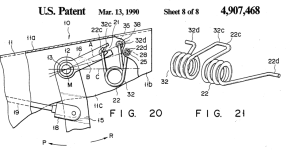
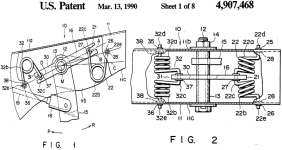
The spring in this patent (filed by a Japanese company, and referenced later by Toyota) looks familiar...
https://www.google.com/patents/US4907468

You can even see the P-bushings in the figures. I'm tired so I just skimmed the figures -- I'll examine the graphs and text another day.

Note: if you scroll to the bottom of the patent there are lots of related patents in the "Patent Citations" and "Referenced By" sections. You can also just search phrases on Google Patent Search
example- https://www.google.com/?tbm=pts#safe=off&tbm=pts&q=spring+pedal

Here are some interesting reads on the return springs in various cars:
https://www.google.com/patents/US3009554
https://www.google.com/patents/US3302763


I hate to ask for too much, but, I just realized when I wrote that above, that it would probably be useful to others if we had the dimensions of the original groove of the metal P tab.

That way, anyone who wants to weld (or braze) a new tab can grind it out properly to fit the ORIGINAL dimensions, and save money on not needing to buy a new clutch pedal.

That's a great idea. I'll measure it when I replace my bushings in 3 years if no one else gets to it first :P

Merry Christmas!
 
That's a great idea. I'll measure it when I replace my bushings in 3 years if no one else gets to it first.

I knew you would have done the measurements had any of us thought of it at the time, and I wistfully realized too late that yours is already in place so it's definitely not worth the effort to take it apart just for the measurements.

This all really should have been done many years ago, but we had to have a critical mass of guys working together to help the next person such as you and Matt and RockDawg, and TheDurk, ST Runner, David CH, and others.

So let's just keep an open invitation for the NEXT person who replaces their clutch pedal to do two things:
  1. Draw and measure the groove and tab dimensions, and,
  2. Snap a photo of the P bushing in both the new and worn grooves

The spring in this patent (filed by a Japanese company, and referenced later by Toyota) looks familiar...
https://www.google.com/patents/US4907468

Thanks Marcus (can I call you that?) for seeking to further our collective understanding of "what was toyota thinking" when they designed that double-coil pedal-return torsion spring.
Pedal effort-reduction apparatus, US 4907468 A
Abstract
A pedal effort-reduction apparatus according to the present invention comprises a pedal arm and a lever which is movable as one therewith. First and second torsion coil springs are provided between the lever and a support bracket. The first coil spring urges the pedal arm to return to its initial position before the arm, starting from the initial position, reaches a position at a predetermined rotational angle to the initial position. When the pedal passes the predetermined-angle position, the first spring begins to urge the pedal arm in the direction in which it is being pushed. The second spring is attached to the lever so as to urge the pedal arm only in the direction in which it is being pushed. Therefore, when the pedal arm is pushed past the predetermined-angle position, the repulsive force generated by both the first spring and the second spring then acts as a pedal effort-reduction force.

Here is their stated objective:
OBJECT OF THE INVENTION

Accordingly, the object of the present invention is to provide a means by which the initial effort necessary to operate a pedal can be reduced and which also enables a further reduction in pedal effort after a so-called cross-over point has been passed.

In the prior art description, they use terms such as "treading force" and "urging the pedal", which I presume mean the initial feel at the top of the travel (but I'm guessing).
The present invention relates to an apparatus for reducing the treading force required to operate a pedal, such as the clutch pedal of an automobile. More specifically, the present invention relates to an improvement of the means for urging the pedal.

One consequence of the recent development of higher-output engines is that the repulsive force generated by the clutch springs has become much greater, so that the effort required to operate the clutch pedal has increased correspondingly. Not surprisingly, there is now considerable demand for an apparatus able to provide the maximum reduction possible in the pedal effort.

The patent talks about the "first torsion spring" and the "second torsion spring", and some of the diagrams show two springs, so, I wonder if our single-spring apparatus is intended to only work in one direction?
 

Attachments

  • US4907468-8.png
    US4907468-8.png
    49.8 KB · Views: 656
  • US4907468-1.png
    US4907468-1.png
    65.8 KB · Views: 635
Last edited:
Status
Not open for further replies.

Members online

Forum statistics

Threads
278,315
Messages
3,554,125
Members
248,016
Latest member
Advally Service

Trending content

Back
Top