Advice requested from those of you who have mounted tires & balanced wheels at home

Status
Not open for further replies.
Thanks for that advice on the wheel weight pliers that the pros use.
230685d1481720655-advice-requested-those-you-who-have-mounted-tires-balanced-wheels-home-wheel_weight_pliers.jpg


But a hammer and a small/sharpish punch will work fine, just tap it under the edge of the clip and pry the weight off.
Thanks also for that advice that a hammer and pick of some sort will work fine since you have the experience I lack.

Since I'm not going to be doing this often, that makes sense not to have to store yet another single-purpose tool in my already very crowded toolbox, as I already now have two useless tools that were never needed (the crossbar 4-way tool and the swan-neck breaker bar).

In the case of the swan-neck breaker bar, it's apparently misadvertised because it's NOT for passenger tires, whereas in the case of the crossbar 4-way tube, it does nothing that is needed since any screw-on air chuck would do as well (or better). Live and learn.
 
Last edited:
Moving to the next step, I will likely have the vehicle to work on the other four wheels on the weekend so I want to order the right type of wheel weights, in the right sizes.

This is the front of the rim on the balancer
230741d1481749378-advice-requested-those-you-who-have-mounted-tires-balanced-wheels-home-1_balance_wheel.jpg

This is the rear of the steel rim
230742d1481749392-advice-requested-those-you-who-have-mounted-tires-balanced-wheels-home-2_balance_tires.jpg

Here is a closeup of the old existing weight
230743d1481749401-advice-requested-those-you-who-have-mounted-tires-balanced-wheels-home-3_old_weight.jpg

From that little bit of information (which is all I have), do you know enough about balancing to know which TYPE (and variety) of weights to purchase?

For the actual process, I have been researching the steps by watching all the youtube videos on how to use the HF bubble balancer, where it seems the process of determining where and how much weight seems to be as easy as using a traditional (offset) balance scale.

1. Use the head of the HF wheel balancer to find a flat spot
2. Put the head on the post and zero the inner bubble with 3 screws
3. Remove all weights and debris from the tire/wheel assembly
4. Place the tire/wheel assembly on the HF bubble balancer
5. Determine balance weight by placing weights to level the bubble
6. Mark the weight and position of the weight on the tire or wheel
7. Divide the weight amount in half for each position on the wheel
8. Clip half the weight on both sides of the rim at the desired position
9. Put the best balanced wheels on front, and the worst as the spare
10. Test drive up to 80mph (if possible) & dynamic balance if it vibrates

My main question at the moment is which kinds of weights to buy?
Googling, it seems "Perfect Equipment" sells a lot of the weight out there.

For example, here is a $17 50-piece set on Amazon: 3/4OZ P TYP WHLWT BX/50
230744d1481749408-advice-requested-those-you-who-have-mounted-tires-balanced-wheels-home-4_perfect_equipment_weight_set.jpg

But they're all 3/4 ounce, and I probably need fewer weight with better variety.

O'Reilly seems to sell Perfect Equipment weights:

But you have to know what you need as there are multiple types, some of which say "Not Legal For Sale In California, Illinois, Maine, New York, Washington and Vermont" where I am.

Since lead is not an option, there are only "steel" or "zinc".
Which would you use? Why?

The choices in "types" seem to be:
1. AW Series, Steel or Zinc, Coated
2. FN Series, 5g Steel or Zinc, Coated
3. IAW Series, 5g Steel or Zinc, Coated
4. MCS Series, Steel or Zinc, Coated
5. TZ Series, 0.25 Oz. Steel or Zinc, Coated

From that little bit of information (which is all I have), do you know enough about balancing to know which TYPE of weights to purchase (and what variety)?
 
Last edited:
If it helps you to tell me the type of weights to buy (and sizes), here is a side view closeup of the one (old) weight on the front of the rim.
230745d1481750383-advice-requested-those-you-who-have-mounted-tires-balanced-wheels-home-5_weight_on_front.jpg

And here is a side view closeup of the one (old) weight on the rear of the rim.
230746d1481750390-advice-requested-those-you-who-have-mounted-tires-balanced-wheels-home-6_weight_on_rear.jpg


What type of weight would you get for these rims, and what sizes?
  1. AW Series, Steel or Zinc, Coated
  2. FN Series, 5g Steel or Zinc, Coated
  3. IAW Series, 5g Steel or Zinc, Coated
  4. MCS Series, Steel or Zinc, Coated
  5. TZ Series, 0.25 Oz. Steel or Zinc, Coated
 
I do recommend getting that $8 valve stem tool. you have all the other, more expensive tire changing gear, its very likely this wont be the last set you do. skimping on that very handy tool seems silly.

I agree that, sometimes, just being able to do the job slightly easier and better is worth it, if you do it more than once.

And I plan on using these tools until I die; so there will be a new set of tires for each car every two years, which means I'll be using them about once a year.

Valve stem puller, about $8 and worth its weight in gold.
MILS449.JPG

I took your advice (and everyone's advice) but the tool was backordered, but I picked it up today:

O'Reilly 15-3606 UPC: 639601536061

230780d1481759064-advice-requested-those-you-who-have-mounted-tires-balanced-wheels-home-7_tire_valve_installation_tool.jpg


No need for the puller, a pair of pliers and a small bit of lube on the stem and it'll pop in with no effort.
You seem to know the most since I agree with you that there really is no need for any special tools to remove the valve or put it back in.

  • To remove the valve is as easy as cutting it off with a utility knife
  • To put it back in only requires screwing something on the threads and using that to pull the lubricated valve through

Anyone with a compressor likely already has something that screws on the end because any beach-ball football soccer ball pin inflator has the right female threads.

But I bought the valve installation tool anyway, just to learn how well it works in both directions because the goal here is to learn myself and to teach others at the same time with your combined experience and mine (working together to create a reference thread that many can use for years in the future).
 
I'm glad I have a real tire machine.

WalMart here takes used tires for $2.50 per tire. Of course, each state has different disposal fees (if any), so that number is just for reference. It's one of the services they offer cheap just like taking used oil for free to get you in the store.
 
I'm glad I have a real tire machine.
I'm sure a "real" tire machine would make things easier, but it too has to be stored and maintained, so nothing is free in the end.

For practice, I changed a sedan tire today for a friend who had a flat so I offered to fix it for him with one of those t-shaped patches that both seal the inside and the hole itself. It was so easy compared to the SUV tires, that I looked like a pro in front of my friend, especially since I had prepared him for potential issues.

So more and more, think that UnderFire is completely correct that the Optimo P225/75R16 108T sidewalls are simply on the upper end of what this HF tire changer can do.

The only hard part on the Otimos was:
a. Breaking the bottom bead (i.e., the first bead), and,
b. Setting the top bead (i.e., the last bead).

Other than the first and the last bead, the rest of the beads were easy.

My recommendation for the next person doing the job is to modify the tool as follows:
  1. You'll want the tool securely mounted (mostly needed when forcing the last top bead back on the wheel)
  2. You'll want to shore up the bead breaker (so that it doesn't bend like mine did)

WalMart here takes used tires for $2.50 per tire. Of course, each state has different disposal fees (if any), so that number is just for reference. It's one of the services they offer cheap just like taking used oil for free to get you in the store.

Out here they tax us to death, so I'm curious if they add tax to that $2.50 like they do here?

Out here, they even tax the 10 cents CRV per bottle you pay for returning soda bottles, and when you return the bottle, you never get your tax back (you pay, effectively 11 cents for the recycling fee but you never get back that last cent which is a tax already on top of the price for the soda which is already taxed at about 10 percent).

For tires, they're taxed so many times it's not funny.

BTW, all those "fees" (aka taxes) are NOT used for recycling; they just go into the general fund!
 
Last edited:
Who said anything about a real tire machine being free? Far from free. ;)

I wasn't clear, but you understood.

What I meant was nothing is a perfect package - in that there are costs involved with the tire-changing machine, not the least of which are maintenance and storage and opportunity costs.

BTW, it looks like I'm on my own for choosing the style of weights, where I found this just now researching what weights to use:
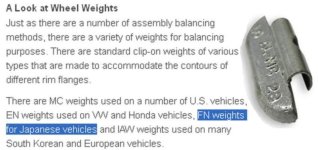
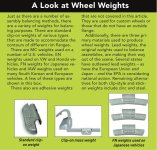
There are MC weights used on a number of U.S. vehicles, EN weights used on VW and Honda vehicles, FN weights for Japanese vehicles and IAW weights used on many South Korean and European vehicles.

That doesn't prove that I need FN weights, but it implies that I do.
I wish someone knew this basic stuff better than I do.
 

Attachments

  • types_of_weight.jpg
    types_of_weight.jpg
    41 KB · Views: 1,278
  • balancing_tires.pdf
    balancing_tires.pdf
    1,002.3 KB · Views: 232
  • types_of_weight2.jpg
    types_of_weight2.jpg
    110.4 KB · Views: 2,507
  • wheel_weights.pdf
    wheel_weights.pdf
    3.3 MB · Views: 441
Last edited:
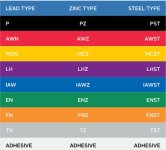
It seems from that same PDF that FN, which is the type that most japanese cars use, can't be used in California, so, I'll need FNZ (zinc) or FNST (steel) if FN is indeed the style of weight to use for the Toyota 4Runner.
 

Attachments

  • chart.jpg
    chart.jpg
    35.5 KB · Views: 3,492
It gets more complicated the deeper I read about matching weights correctly!

Bearing in mind that the trailing "Z" is for zinc and a trailing "ST" is for steel, and the U stands for uncoated, and that the sizes are generally 0.25 oz. to 3 oz each.

The PZU-Series zinc uncoated (PZ is coated) (PST-Series steel) clip-on wheel weight is used on standard passenger car 13”–17” steel wheels.
The AWZ-Series zinc (AWST-Series steel) clip-on wheel weight is used on most domestic vehicles equipped with alloy rims that were manufactured prior to 1995.
The MCZ-Series zinc (MCST-Series steel) clip-on wheel weight is used on most domestic vehicles equipped with alloy rims.
The LHZ-Series zinc ( LHST-Series steel) clip-on wheel weight is used primarily on late-model Chrysler cars and is designed to fit their unique wheel flange profile.
The IAWZ-Series zinc ( IAWST-Series steel) clip-on wheel weight is used primarily on most European and certain Asian vehicles equipped with alloy wheels.
The ENZ-Series zinc ( ENST-Series steel) clip-on wheel weight is used primarily on Audi, Mercedes Benz and early-model Japanese vehicles equipped with alloy wheels.
The FNZ-Series zinc (FNST-Series steel) clip-on wheel weight is used primarily on most Japanese vehicles equipped with alloy wheels that were manufactured prior to 1990.
The TZ-Series zinc ( TST-Series steel) clip-on wheel weight is used primarily on most domestic light trucks equipped with decorative and larger-thickness steel wheels and most late-model light-trucks equipped with alloy wheels.

Note that the FNZ/FNST says "prior to 1990" but I think they mean *after* 1990.

Based on this somewhat confusing information (due to typos), I think most of you with alloy wheels would use the FNZ or FNST style; but I think, with the steel wheels I'm working on, that I probably need the PZ, PZU, PST, and PSTU styles for zinc, steel, coated and uncoated respectively.

But I'm not sure yet, so if anyone knows that I take the PZ or PST, please let me know.
 
Damn, I didn't know wheel weights went that deep. We use ones that look like the one on the front of your wheel for all steel wheels. Not sure what type the are. You'll want weights varying from .5-2.0 OZ based on my experience.
 
You seem to know the most since I agree with you that there really is no need for any special tools to remove the valve or put it back in.

  • To remove the valve is as easy as cutting it off with a utility knife
  • To put it back in only requires screwing something on the threads and using that to pull the lubricated valve through
until you get a stubborn stem, and struggle to get it in place without ruining the threads.

FYI, that tool is a remover also. no need to mess with a knife.


for the weights, the FN's will be for alloy wheels. steels wheels should just use a basic steel wheel weight, for pretty much all of them.

honesty, because of how convoluted the wheel weights are, you are probably better off sending the tires out for balance, after you have mounted them. if you intend to balance all the tires/wheels you come across, you will need hundreds of dollars worth of weight laying around. expensive, and they take up a lot of space.


OR, you could just go with stick on weights. you don't get as good of a balance, and I believe they are a bit more expensive. but, they are universal. don't forget to keep some break cleaner handy, for cleaning the wheels, otherwise the weights wont stick well.


I don't know what they charge there, but around here its $15 a tire to balance. thats not so bad, once you consider all that it takes...


Damn, I didn't know wheel weights went that deep. We use ones that look like the one on the front of your wheel for all steel wheels. Not sure what type the are. You'll want weights varying from .5-2.0 OZ based on my experience.
yes, they are ridiculous anymore. basically a weight design for each manufacturer.
 
I've got to say, I admire your tenacity in following a project through. I would have gone to the tire shop ages ago....

I hope this turns out successfully in the end!
 
I don't know what they charge there, but around here its $15 a tire to balance. thats not so bad, once you consider all that it takes...

That's exactly my take on it. I mount my own, throw them in the bed of my pickup to Les Schwab and let them balance for me. I worked in a tire shop 30 years ago for a summer job and know there's no way to get it as close on a bubble machine as you can get on a spin balancer, let alone modern balancing equipment.

They usually only charge me for two tires also since they don't have to remove them from the vehicle and then put them back on.

The 37" and 40" tires on my Jeeps get Dynabeads.
 
Damn, I didn't know wheel weights went that deep.
I didn't either. I thought they were just lead weights.
Who knew they aren't even lead, at least in the states that banned lead already.
  1. California,
  2. Illinois,
  3. New York,
  4. Maine,
  5. Vermont,
  6. Washington, and
  7. Minnesota

We use ones that look like the one on the front of your wheel for all steel wheels.
Thanks for that advice.

My Autozone, Pep Boys & O'Reilly stores don't stock *any* lead weights (but they can all order them). So I went to Harbor Freight today and bought all the lead weights they had but all they had on the shelf were two weights of stickon weights and no clip ons.

Had I just done this once before I would know what I'm beginning to suspect, which is that nobody stocks the clipons at the consumer shops, probably for a bunch of reasons (not a lot of markup, lots of storage shelf space for the various types, and low demand by consumers).

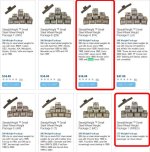
So in 20/20 (experience) hindsight, I should have realized that I have to get the lead weights ahead of time by ordering boxes of 50 of each size.

They even sell "kits", based on car brands.

Not sure what type the are.
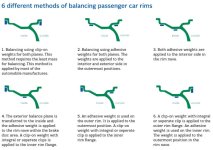
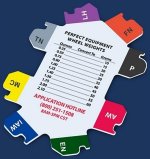
This PDF shows that there happens to be a "rim gauge" template which will tell me what type of weight I need for the rim I'm working on:

That PDF mentions the following wheel weight brands:
1. Perfect
2. Halko
3. Hodge
4. Plombco
5. Bada

I have read from cover to cover the complete catalogs of those half-dozen lead-weight suppliers, so, at this point, I know enough to hazard a guess that mine are "P" type but I plan on taking the rim to a local tire shop who will have a rim gauge (which is what they use to figure this stuff out).

You'll want weights varying from .5-2.0 OZ based on my experience.

I agree with you that I'll want a variety of weights, probably only obtainable in boxes of 50. So, now that I know what I didn't know before, I think the solution, in hindsight, is simply to order four or five boxes (of 50) of the most needed sizes.

I'm assuming those sizes I'll need are the smallest, and the largest, and a few somethings in between.
 

Attachments

  • a_rim_gauge.jpg
    a_rim_gauge.jpg
    57.3 KB · Views: 3,174
Last edited:
I've got to say, I admire your tenacity in following a project through. I would have gone to the tire shop ages ago....

I hope this turns out successfully in the end!

I'm with you - can't help but admire the tenacity and bookkeeping.
 
until you get a stubborn stem, and struggle to get it in place without ruining the threads.
I appreciate the advice. The advice is helpful, because, this is one situation where the right tool for the job is very cheap (about 8 bucks, just like you said it would be).

Plus, this tool that you kindly suggested is a Goldilocks size and shape in that it's big enough not to get lost in a toolbox (like the four-way tool likely will) and yet it's a perfect size and shape to fit in the drawers with the other related tools.
FYI, that tool is a remover also. no need to mess with a knife.
I know. In fact, I can't wait to try it out when I get the other four wheels for the removal task, since it seems that it can remove old valve without destroying it - just in case we need a spare in a pinch. I don't plan on re-using valves, but, having spares around won't hurt.

Another thing this tool allows is to remove a valve on a tire that is still on the rim, only with the bead broken. I don't envision replacing valves without removing the tires, but this tool makes that task easier also.

for the weights, the FN's will be for alloy wheels. steels wheels should just use a basic steel wheel weight, for pretty much all of them.
I see now, after reading the half-dozen manufacturers' entire catalogs, that the weight I need is probably the "most" standard of the dozen or so different types for passenger tires.

My first pass at guessing the sizes that are needed for a homeowner is the following:
  • 1/4 ounce (probably about 10)
  • 1/2 ounce(probably about 10)
  • 3/4 ounce(probably about 10)
  • 1 ounce(probably about 10)
  • 1.25 ounce (probably about 10)

honesty, because of how convoluted the wheel weights are, you are probably better off sending the tires out for balance, after you have mounted them. if you intend to balance all the tires/wheels you come across, you will need hundreds of dollars worth of weight laying around. expensive, and they take up a lot of space.

I know so much more now than when I started, so, what I know is akin to what you said, which is that if you plan on doing all your neighbor's wheels, you'll need the same assortment of weights that a tire shop carries.

However, if all you do are the couple of vehicles you own, it's a lot easier to stock parts. More so, I see now that weights are sort of like nuts, bolts, screws, and washers, in that you can stock them as you see them (e.g., as you find them walking on the road), so that when you need them, you have a "stash" collected over the years.

OR, you could just go with stick on weights. you don't get as good of a balance, and I believe they are a bit more expensive. but, they are universal. don't forget to keep some break cleaner handy, for cleaning the wheels, otherwise the weights wont stick well.
The brake cleaner is a good idea. So are the stickon weights, as they are essentially universal. And HF sells them, so today I picked up the two sizes that HF sells of the stickon weights, which will have to do for this job (for now).


I don't know what they charge there, but around here its $15 a tire to balance. thats not so bad, once you consider all that it takes...
We covered that earlier in this thread.

The math for return on investment is pretty simple, which is that it costs around $200 to $250 for the tools (give or take) and it costs around $20 to $25 per tire (give or take) at the cheapest shops so that's around 10 or so tires at the low-end price.

If you have two vehicles, you will make your money back in about two years, assuming tires last for two years and you get one flat per two years for each car.

But you don't do this purely for cost reasons just like you don't mod your car purely for cost reasons or just like you don't do your own maintenance on your SUV for cost reasons.

You do it because you enjoy being able to do it knowing that the task is well beyond the capabilities of many people.

yes, they are ridiculous anymore. basically a weight design for each manufacturer.

After reading a half-dozen catalogs, I have to agree with you that the variety sure seems more than it needs to be.

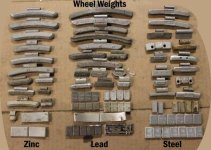
Given that, and noticing that the wheel I'm working on has two different shaped weights, I suspect that the tire shops often put the wrong wheel weights on, simply out of expediency.

 

Attachments

  • wheel_weight_sample.jpg
    wheel_weight_sample.jpg
    69.6 KB · Views: 1,459
I've got to say, I admire your tenacity in following a project through. I would have gone to the tire shop ages ago....
You have to realize I'm different than most people, which is both good and bad.

I don't have many threads (in fact, I have very few) and I don't post to a lot of threads (although I am very responsive in the threads I author).

That's because my goal is to SOLVE the problem for everyone, by teaming up with all of you, so that the thread becomes a reference thread, which helps the next person do the job so easily that others in the future will wonder what all the fuss was.

However, I don't know as much as you do, so I delve deeply into a small area, instead of delving widely into many areas. In doing so, together, we (the team) come up with solutions that have never before been proposed in that we hone the solutions to as much as we can.

To that end, here are some of those types of threads:

I hope this turns out successfully in the end!

Thanks for the kind words of encouragement.

The good news is that it can't help but turn out well, because the worst thing that happens is that I simply drop off the wheels and tires at a tire shop to mount and balance them if I screw stuff up. :)
 

Attachments

  • packages_of_wheel_weights.jpg
    packages_of_wheel_weights.jpg
    118 KB · Views: 1,243
Status
Not open for further replies.

Members online

No members online now.

Forum statistics

Threads
278,315
Messages
3,554,130
Members
248,016
Latest member
Advally Service

Trending content

Back
Top