until you get a stubborn stem, and struggle to get it in place without ruining the threads.
I appreciate the advice. The advice is helpful, because, this is one situation where the right tool for the job is very cheap (about 8 bucks, just like you said it would be).
Plus, this tool that you kindly suggested is a Goldilocks size and shape in that it's big enough not to get lost in a toolbox (like the four-way tool likely will) and yet it's a perfect size and shape to fit in the drawers with the other related tools.
FYI, that tool is a remover also. no need to mess with a knife.
I know. In fact, I can't wait to try it out when I get the other four wheels for the removal task, since it seems that it can remove old valve without destroying it - just in case we need a spare in a pinch. I don't plan on re-using valves, but, having spares around won't hurt.
Another thing this tool allows is to remove a valve on a tire that is still on the rim, only with the bead broken. I don't envision replacing valves without removing the tires, but this tool makes that task easier also.
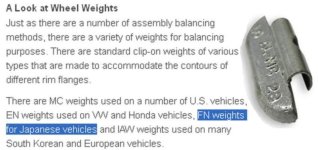
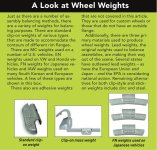
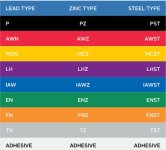
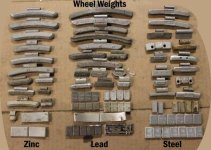
for the weights, the FN's will be for alloy wheels. steels wheels should just use a basic steel wheel weight, for pretty much all of them.
I see now, after reading the half-dozen manufacturers' entire catalogs, that the weight I need is probably the "most" standard of the dozen or so different types for passenger tires.
My first pass at guessing the sizes that are needed for a homeowner is the following:
- 1/4 ounce (probably about 10)
- 1/2 ounce(probably about 10)
- 3/4 ounce(probably about 10)
- 1 ounce(probably about 10)
- 1.25 ounce (probably about 10)
honesty, because of how convoluted the wheel weights are, you are probably better off sending the tires out for balance, after you have mounted them. if you intend to balance all the tires/wheels you come across, you will need hundreds of dollars worth of weight laying around. expensive, and they take up a lot of space.
I know so much more now than when I started, so, what I know is akin to what you said, which is that if you plan on doing all your neighbor's wheels, you'll need the same assortment of weights that a tire shop carries.
However, if all you do are the couple of vehicles you own, it's a lot easier to stock parts. More so, I see now that weights are sort of like nuts, bolts, screws, and washers, in that you can stock them as you see them (e.g., as you find them walking on the road), so that when you need them, you have a "stash" collected over the years.
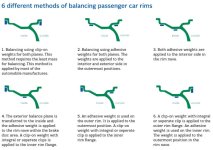
OR, you could just go with stick on weights. you don't get as good of a balance, and I believe they are a bit more expensive. but, they are universal. don't forget to keep some break cleaner handy, for cleaning the wheels, otherwise the weights wont stick well.
The brake cleaner is a good idea. So are the stickon weights, as they are essentially universal. And HF sells them, so today I picked up the two sizes that HF sells of the stickon weights, which will have to do for this job (for now).
I don't know what they charge there, but around here its $15 a tire to balance. thats not so bad, once you consider all that it takes...
We covered that earlier in this thread.
The math for return on investment is pretty simple, which is that it costs around $200 to $250 for the tools (give or take) and it costs around $20 to $25 per tire (give or take) at the cheapest shops so that's around 10 or so tires at the low-end price.
If you have two vehicles, you will make your money back in about two years, assuming tires last for two years and you get one flat per two years for each car.
But you don't do this purely for cost reasons just like you don't mod your car purely for cost reasons or just like you don't do your own maintenance on your SUV for cost reasons.
You do it because you enjoy being able to do it knowing that the task is well beyond the capabilities of many people.
yes, they are ridiculous anymore. basically a weight design for each manufacturer.
After reading a half-dozen catalogs, I have to agree with you that the variety sure seems more than it needs to be.
Given that, and noticing that the wheel I'm working on has two different shaped weights, I suspect that the tire shops often put the wrong wheel weights on, simply out of expediency.